
What if the furniture you buy today was actually designed to fail? It is a common frustration to watch a table you have owned for only a few months start to wobble or see the paper-thin edges of a veneer top begin to peel away. You likely remember the heavy, immovable pieces from your childhood home that seemed to defy the passage of time and the rigours of daily life. It’s natural to wonder why your parents’ furniture has lasted so long while modern high-street alternatives often feel like temporary placeholders in your living space.
In this guide, we will uncover the material science and traditional joinery techniques that create true heirloom quality. You’ll learn how to distinguish solid timber from fragile composites and discover how The Mensa Table Company blends artisanal integrity with modern design to create pieces that endure. We’ll walk you through the markers of quality, from the “Under-Table Test” to understanding how timber movement affects longevity. By the end, you’ll have the knowledge to find furniture that isn’t just a transactional purchase, but a multi-generational investment built with old-school integrity.
Key Takeaways
- Understand the fundamental differences between solid timber and composite boards to ensure your next piece is capable of being repaired rather than replaced.
- Uncover the structural secrets of why your parents’ furniture has lasted so long, focusing on the shift from mechanical joinery to the temporary shortcuts of modern mass production.
- Learn how to use the “Under-Table Test” to spot signs of true craftsmanship, such as finished undersides and thoughtful grain selection, that reveal a maker’s commitment to quality.
- Discover how specific frame designs, including the U-Frame and X-Frame, provide the stability needed to turn a functional object into a multi-generational heirloom.
- Gain the knowledge to invest in pieces like the Mensa Dining Table that combine contemporary aesthetics with the same artisanal integrity found in antique heritage furniture.
The Mystery of the ‘Forever’ Table: Why Heritage Furniture Outlasts Modern Retail
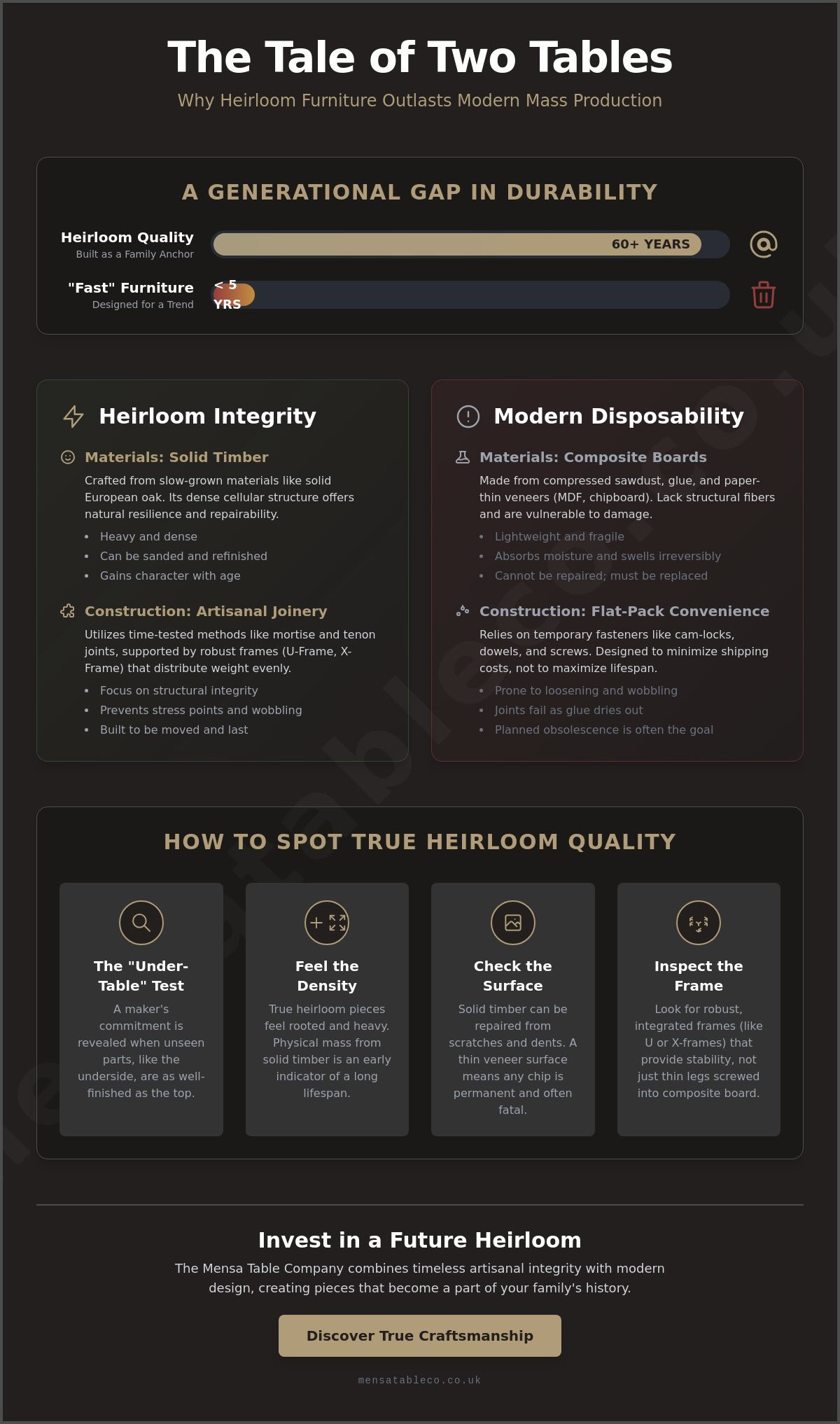
Most modern dining tables aren’t designed to survive a house move, let alone a generation. We’ve entered an era of “fast furniture” where the average lifespan of a high street piece is often less than five years. This is a stark contrast to the heavy, oak centrepieces that anchored our childhood homes for decades. The secret to why your parents’ furniture has lasted so long isn’t just luck or better care. It’s found in the deliberate choice of materials and construction methods that prioritised longevity over shipping convenience. Heirloom quality is the marriage of material integrity and repairability; it’s the fundamental difference between a table that can be sanded and refinished and one that must be thrown away the moment the surface chips.
Mass production today focuses on the transactional. Manufacturers prioritise reducing shipping weight and ensuring boxes fit neatly into a flat-pack delivery van. This often means sacrificing the structural lifespan of the piece. When we look at a table in our workshop, we don’t see a box to be shipped; we see a site for human connection that needs to stand firm through every holiday dinner and late-night conversation. A table that lasts sixty years does so because it was built with the understanding that it would become a part of a family’s history.
The Rise of Planned Obsolescence in Furniture
The shift toward mass-produced retail changed how furniture is held together. Instead of deep-seated joints, modern pieces often rely on cam-locks, dowels, and industrial glue that eventually dries out and fails. High street retailers favour a disposable mindset, using hollow cores and thin veneers that cannot withstand the rigours of daily life. In the context of dining room furniture, planned obsolescence is the intentional design of pieces using non-repairable materials and weak fasteners that ensure a product will eventually fail and require replacement. Our team rejects this approach, focusing instead on manual production for our dining tables to ensure they remain immovable.
Why Your Parents’ Furniture Was an Investment, Not a Purchase
For previous generations, buying a table was a significant life event. Throughout the history of furniture design, makers understood that the dinner table serves as the emotional anchor of the home. This emotional weight was matched by physical mass. Density is one of the earliest indicators of a piece’s lifespan. A table crafted from solid European oak feels rooted in the room because the timber itself is packed with tight, slow-grown fibres. When you understand why your parents’ furniture has lasted so long, you realise they were investing in a foundation. Unlike the thin, screw-on legs of mass-market goods, structural frames like our X-Frame or U-Frame designs distribute weight across the entire timber surface, preventing the stress points that lead to the inevitable wobbling of cheaper alternatives.
Beyond the Surface: The Superiority of Solid Timber over Composite Materials
The physical weight of a vintage sideboard or a heavy dining table often provides the first clue as to why your parents’ furniture has lasted so long. When you lift a piece made from composite materials like MDF or chipboard, you’re mostly lifting glue and compressed sawdust. These materials are fundamentally flawed because they lack a cellular structure. If a composite table gets wet or the surface chips, the core absorbs moisture like a sponge, causing irreversible swelling. In contrast, solid European oak possesses a natural resilience born from decades of slow growth, offering a tactile warmth and a density that resists the dents and dings of a busy household.
Timber is a living, breathing material that continues to respond to its environment long after it leaves our workshop. A common mistake in mass-market design is treating wood as a static plastic. Solid wood needs room to breathe; it expands and contracts with the changing seasons and humidity levels. If a maker doesn’t account for this natural movement through traditional construction, the wood will eventually crack or warp. Species like solid black walnut are prized not just for their chocolate hues and aesthetic depth, but for a structural hardness that ensures the surface remains a reliable foundation for generations.
Solid Wood vs. Veneer: A Practical Breakdown
Modern retail often hides cheap cores under a paper-thin layer of veneer. These surfaces are fragile; once the edge peels or a deep scratch occurs, the piece is effectively ruined. Solid wood offers a different promise. It allows for repeated sanding and refinishing, which essentially resets the clock on the furniture’s age whenever you choose. While a table made from solid European ash can be sanded back and refinished multiple times to erase decades of wear, a veneered particle board alternative will suffer irreversible structural swelling and surface delamination if the paper-thin top layer is compromised. If you’re unsure which timber suits your home’s unique environment, you can speak with our makers for a personal recommendation.
The Resilience of Different Wood Species
The choice of species dictates how a table will age. Solid European ash is celebrated for its incredible shock resistance and straight grain, making it an ideal candidate for heavy-use family dining tables. On the other end of the spectrum, solid Swedish pine offers a softer, more rustic character that develops a beautiful patina over time. Choosing long-lived timber over short-lived composites is also an act of environmental responsibility. By investing in a single piece of furniture that lasts fifty years, you prevent ten disposable alternatives from entering the waste stream, honouring the natural resource by giving it a permanent place in your home.
The Art of Joinery: How Traditional Construction Defeats Screws and Glue
While the quality of the timber provides the raw potential for longevity, the joinery is what truly determines a piece’s lifespan. A primary reason why your parents’ furniture has lasted so long is that it was likely built using mechanical joints rather than relying solely on metal fasteners. In traditional craftsmanship, a mortise and tenon joint creates a physical interlock where the wood itself provides the strength. Metal screws and nails are often temporary solutions; they create friction but eventually work loose as the timber naturally expands and contracts with the seasons. Once a screw hole is stripped or the surrounding wood fibres are crushed, the structural integrity is compromised. A handcrafted joint, however, grows more secure under the weight of the piece, ensuring the table remains as steady as the day it was finished.
Wobble is the first sign of a table’s eventual failure. It indicates that the connection points have lost their grip and the frame is no longer distributing weight evenly. To prevent this, we focus on engineering bases that provide absolute lateral stability. Modern heirloom design doesn’t have to reject metal entirely. Instead, it integrates metal frames in a way that respects the timber’s need to move. By using oversized mounting holes and specific bracing, we ensure that the wood can breathe without putting stress on the joints, combining industrial strength with artisanal wisdom.
From X-Frame to Trapezium: Engineering a Stable Base
The architecture of the base is just as vital as the surface it supports. Our X-Frame dining tables are a perfect example of this, providing exceptional lateral stability that naturally resists the side-to-side swaying that often plagues four-legged designs. For those seeking a more industrial aesthetic, the Trapezium dining table offers incredible structural rigidity through its geometric form. Even more complex designs, like our Spider Leg Dining Table, serve a practical purpose beyond their striking silhouette. This central support system allows for maximum legroom while centralising the weight, ensuring the table remains immovable regardless of where pressure is applied.
Handcrafted vs. Machine-Assembled
There is a quiet confidence in a table that doesn’t rely on hidden plastic brackets or cam-locks. Machine-assembled furniture is designed for the convenience of the factory and the ease of a consumer with an Allen key. Flat-pack furniture is inherently weaker because it must be simple enough for anyone to build, which often means sacrificing deep, permanent connections. In our workshop, the human eye is involved at every stage. We spot grain alignment issues and structural weaknesses that a machine would miss. This manual approach ensures that every piece in our collection is a deliberate investment in stability rather than a temporary purchase.
Identifying Heirloom Quality: A Checklist for Your Next Investment
Spotting true craftsmanship requires looking beyond the initial aesthetic appeal of a showroom floor. While many modern pieces use clever lighting and styling to mask structural shortcuts, understanding why your parents’ furniture has lasted so long gives you a blueprint for what to seek out today. Quality isn’t just about the surface you see; it’s about the integrity of the parts you don’t. A dedicated maker treats every square inch of the timber with the same reverence, ensuring that the piece remains stable and beautiful for decades rather than just a few seasons. Before you commit to a new centrepiece, use these practical tests to verify its heritage potential.
The most revealing check is what we call the ‘Under-Table’ Test. Reach beneath the tabletop and feel the surface. In mass-produced furniture, the underside is often left raw, poorly sanded, or finished with a cheaper, thinner coating to save time and cost. A true heirloom piece, however, will be finished on both sides. This isn’t just for tactile pleasure; an even finish on the bottom is crucial for timber stability, as it ensures the wood absorbs and releases moisture at the same rate on both faces, preventing the warping and bowing that ruins lesser tables.
Physical mass remains a primary indicator of lifespan. Perform a gentle ‘shakedown’ test by applying lateral pressure to the corner of the frame. A table built with traditional integrity will feel immovable and rooted to the ground. If you detect even a millimetre of sway or hear the faint creak of metal fasteners straining against wood, the piece lacks the structural joinery needed to survive the rigours of a busy household. Finally, examine the finish. High-street furniture often uses thick, plastic-like lacquers that sit on top of the wood. These coatings are prone to cracking and cannot be easily repaired. We prefer natural oil and wax finishes that penetrate the grain, allowing the timber to age gracefully and making it possible to buff out minor scratches at home.
Sensory Markers of a Quality Build
Your senses are your best tools when evaluating furniture. Handcrafted pieces possess a distinct ‘Hand-Feel’ where every edge has been softened by a human touch, lacking the sharp, artificial corners typical of machine-cut mass production. The smell should be of natural timber and oils, not the harsh chemical scent of industrial adhesives. To check for grain continuity across a tabletop, trace the cathedral patterns and growth rings across the joins to ensure the boards were selected from the same timber batch to create a unified visual flow. This attention to detail ensures the wood moves together as a single, cohesive unit.
Choosing the Right Proportions for Longevity
Substance is often more important than sheer thickness. While a thick tabletop looks impressive, the real quality lies in how that weight is supported. Ensure the frame is scaled correctly for the timber’s density; for example, a heavy oak top requires a substantial base like our U-Frame or Trapezium designs to prevent sagging over time. It’s also vital to consider matching benches or seating that share the same structural capacity, creating a balanced environment that won’t put undue stress on your flooring. If you have questions about which proportions will best suit your specific space, get in touch with our specialist team for a detailed consultation on your project.
The Mensa Table Company: Crafting Tomorrow’s Heirlooms with Artisanal Integrity
At The Mensa Table Company, we don’t believe that quality should be a relic of the past. While the wider industry has shifted toward mass production and disposable materials, we have chosen to remain rooted in the techniques that explain why your parents’ furniture has lasted so long. Our work is a deliberate rejection of the flat-pack culture. We blend traditional craftsmanship with modern silhouettes, ensuring that a piece like our Mensa Dining Table possesses both the structural integrity of a century-old heirloom and the clean lines required for contemporary living. Every item we create is a commitment to solid timber; we use no veneers, no shortcuts, and no hidden composites that compromise the lifespan of your investment.
We understand that a dining table is more than just a surface for meals. It’s an emotional anchor that grows alongside your family. It’s the site where toddlers learn to draw, where teenagers tackle homework, and where friends gather for late-night celebrations. This generational standard extends across our entire collection. Whether you are choosing matching benches to complete your dining set or selecting a coffee table for your living room, the same manual production and artisanal care are applied. We build furniture that is prepared to endure the beautiful, messy reality of family life for the next fifty years and beyond.
A Dedicated Specialist Approach
Our workshop is home to a tight-knit team of local craftsmen who view their trade as a calling rather than a transaction. The Mensa Table Company values the connection between the creator and the end user, knowing that the hands that sanded the timber are the same ones that ensured the frame was perfectly aligned. This personal approach allows us to maintain a deep respect for the natural elements we work with. We focus on ethical sourcing, selecting timbers with a rich natural history that we are proud to bring into your home. By prioritising substance over flashy marketing, we provide a thoughtful, intentional alternative for those who seek furniture with a soul.
Your Table as a Backdrop for Shared Rituals
Investing in a piece from The Mensa Table Company is an act of moving beyond the transactional nature of modern retail. It’s an invitation to bring a focal point into your home that serves as a backdrop for your most meaningful social rituals. We don’t just sell furniture; we provide the setting for your family’s future history. Every knot in the oak and every grain pattern in the walnut is a unique marker of a living resource that has been given a permanent purpose. We invite you to explore our full shop to find the piece that will become your home’s future heirloom, crafted with the same quiet confidence that defined the furniture of generations past.
Build a Legacy for Your Own Home
Choosing furniture that endures isn’t about looking backward; it’s about reclaiming a standard of quality that respects both the material and the people who use it. We’ve explored the structural secrets and the tactile differences that explain why your parents’ furniture has lasted so long, from the density of slow-grown timber to the permanence of traditional joinery. By moving away from disposable veneers and fragile flat-packs, you can invest in a focal point that remains immovable through every season of your life. Our tight-knit team is dedicated to this artisanal spirit, handcrafting each piece in our UK workshop using solid European Oak, Ash, and Walnut. We never use veneers or shortcuts because we believe your home deserves a foundation built with absolute integrity. If you’re ready to find a piece that will anchor your family’s history for the next fifty years, we’re here to help you begin that journey.
Discover our range of handcrafted dining tables built to last generations
Common Questions About Heirloom Quality
Is solid wood furniture really worth the higher price?
Solid wood furniture is worth the investment because it offers a lifespan measured in decades rather than years. Unlike composite materials that swell or peel when exposed to moisture or heat, solid timber can be repeatedly sanded and refinished. This repairability prevents the expensive cycle of replacing “fast furniture” every few seasons, making it a more sustainable and cost-effective choice over the long term.
Can modern furniture ever be as durable as ‘antique’ furniture?
Modern furniture can absolutely match the durability of antiques if it is built with the same material integrity and traditional joinery. While mass-market retail has largely abandoned these standards, artisanal workshops still use the techniques that explain why your parents’ furniture has lasted so long. Pieces like our Mensa Dining Table combine this heritage-level strength with contemporary silhouettes that fit today’s homes.
What is the most durable wood for a family dining table?
Hardwoods such as Solid European Oak and Solid Black Walnut are the most durable options for a high-traffic family environment. These species possess a high grain density and natural hardness that resists impact and daily wear. Solid European Ash is another exceptional choice; its natural shock resistance ensures the table remains a steady foundation for generations of shared meals and social rituals.
How do I know if a table is solid wood or just veneered?
Look closely at the edges and the grain pattern to distinguish solid wood from veneer. A veneered table often shows a visible seam where the thin top layer meets the edge banding. On a solid timber table, the grain flows naturally from the top surface over the side edges without interruption. You can also check the underside; solid pieces are consistently finished on both faces to ensure stability.
Why do modern tables start wobbling after a few years?
Most modern tables start wobbling because they rely on metal fasteners like cam-locks and screws that lack a physical interlock. As timber naturally expands and contracts with the seasons, these metal components work loose and crush the surrounding wood fibres. Once this connection is compromised, the table loses its lateral stability, leading to a structural failure that traditional joinery was designed to prevent.
How can I make my new furniture last as long as my parents’ did?
The best way to ensure longevity is to prioritise solid materials and structural engineering over flat-pack convenience. To help your furniture endure, choose pieces crafted from slow-grown hardwoods and maintain the surface with natural oil or wax finishes. These treatments penetrate the grain and allow you to buff out minor scratches, keeping the timber healthy and resilient against the passage of time.
Does ‘handcrafted’ always mean better quality?
Handcrafted furniture is generally superior because it involves a human specialist who can identify unique grain characteristics and potential structural weaknesses. While a machine treats every board the same, a craftsman selects specific pieces of timber to work in harmony. This manual approach ensures that every joint is perfectly seated and every edge is softened by hand, resulting in a piece with a soul and a much longer lifespan.
What should I look for in the joinery of a dining table?
Look for deep, mechanical joints like the mortise and tenon rather than simple butt joints held together by industrial glue or screws. These interlocking connections are a primary reason why your parents’ furniture has lasted so long. The joinery should feel immovable even under lateral pressure, indicating that the frame is designed to distribute weight evenly and resist the stresses of daily use.

Leave a Reply