
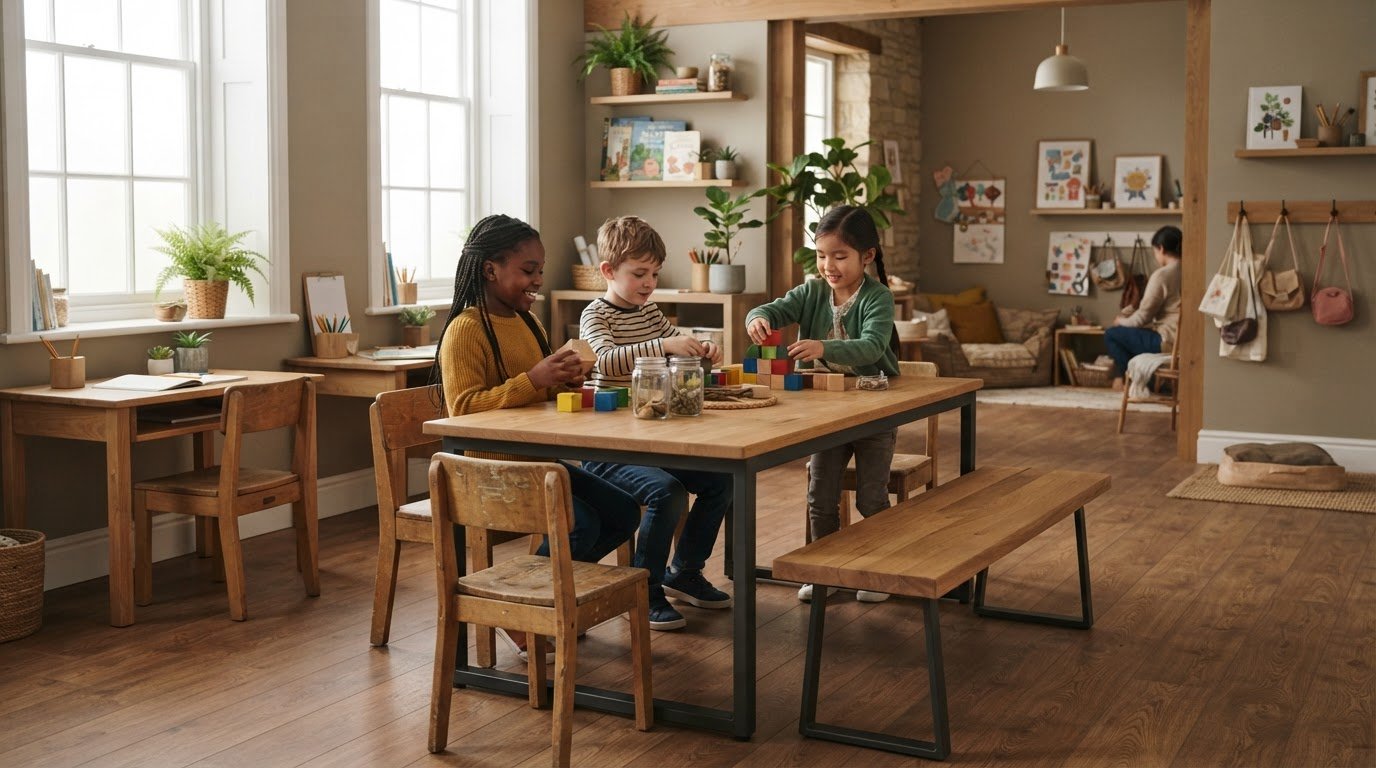
A bench can work well when students benefit from sitting side by side for shared activities, conversation or a change from individual desks. Knowing when to use a bench for flexible seating means balancing that collaborative feel with each pupil’s need for personal space, focused work and a suitable seat. A bench is one option, not a replacement for every desk and chair.
It’s natural to want a welcoming classroom that still supports concentration. Flexible seating offers choice, but the right arrangement depends on the activity, the students and how comfortably they can use the space together.
This article explains when a bench may suit students, how it fits alongside stools, cushions and other flexible seating, and how it compares with traditional desks and chairs. It also covers when individual seating may be more suitable, helping you balance connection with room to focus.
Key Takeaways
- Use a bench when pupils can benefit from sitting together for shared activities, while keeping individual seating available for focused work.
- Match seating to the task and each student’s needs; a bench is one flexible option, not a universal replacement for desks and chairs.
- Introduce a small range of seating choices and explain how each should be used so pupils can choose a place that helps them learn.
- Keep comfort, space, movement and safe use in mind when deciding whether a bench suits your classroom.
- Compare benches with other flexible seats and traditional furniture to create a classroom arrangement that supports both collaboration and concentration.
Flexible seating choices and student needs
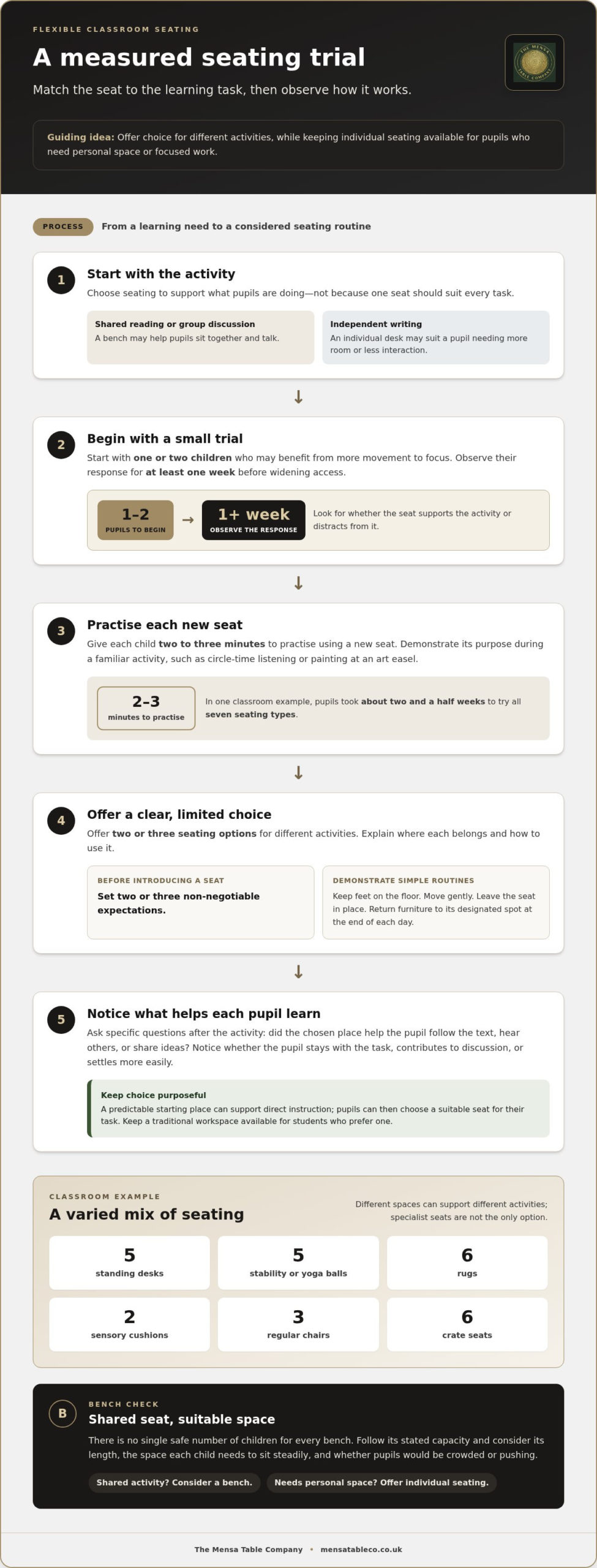
Flexible seating gives children different places to work instead of assigning every task to the same chair and desk. One classroom example included five standing desks, five stability or yoga balls, six rugs, two sensory cushions, three regular chairs and six crate seats. This shows that teachers can create varied spaces without relying on specialist seats such as wobble chairs or exercise balls. The key is to consider how each option supports a particular activity and student.
How many children can safely sit on a classroom bench? There is no single safe number for every bench. Follow its stated capacity, and consider its length and how much space each child needs to sit steadily without crowding or pushing.
Deciding when to use a bench for flexible seating starts with the activity. A bench may suit shared reading or group discussion, where children benefit from sitting together. For independent writing, a pupil who needs more room or less interaction may do better at an individual desk. Demonstrate each seat during a familiar activity, such as listening to a story at circle time or painting at an art easel, so children understand its purpose.
Introduce choices gradually. Educators can start by identifying one or two children who seem to need more movement to focus, then observe their response for at least one week before widening access. Give each child two to three minutes to practise using a new seat. In one classroom example, pupils took about two and a half weeks to try all seven seating types. A measured trial helps teachers see whether an option supports the task or distracts from it.
Choice works best with a clear routine. Offer two or three seating options for different activities, and explain where each belongs and how to use it. Before introducing a seat, set two or three non-negotiable expectations. Demonstrate simple behaviours, such as keeping feet on the floor, moving gently and leaving the seat in place. Ask pupils to return the furniture to its designated spot at the end of each day.
Some children need a predictable starting point before choosing. A designated home-base spot can be used for direct instruction, after which pupils select a suitable place for their task. Teachers can invite children to try the options at the start of the year, then encourage choices that help them work successfully. If a pupil’s sensory needs affect seating, recommendations from an occupational therapist or another support provider can help inform which options to offer.
Thoughtful observation and structured trials can help guide seating choices. A rotation of two to three options suits different activities; educators can start with one to two children, observe for at least one week, and give each child two to three minutes to practise. Students took about two and a half weeks to try all seven types.
Allowing students to choose their seats
Choice gives students some control over where they learn, but it works best when it supports the task. A standing desk may suit a pupil who concentrates better while upright, while a quiet corner may help during individual reading. For partner work, two pupils might choose adjacent chairs to share materials without moving across the classroom. The teacher’s role is to make each option purposeful, not to treat every seat as suitable for every activity.
Flexible seating can also support participation. In one study of college students, 64% said flexible seating helped them participate more in class. That result concerns college students, so it shouldn’t be treated as proof of the same effect for every child. In a school classroom, the teacher can look for practical signs: does a pupil contribute to discussion, stay with the learning task, or settle more easily in a chosen space? These observations help connect seating choices with engagement.
Student preferences become clearer when feedback is specific. After a reading task, ask whether the chosen place helped the student follow the text. After group work, ask whether the seat made it easier to hear and share ideas. A short conversation about a particular activity gives more useful information than simply asking whether a pupil liked a chair. Teachers can also notice whether a child repeatedly chooses to stand or prefers a defined, familiar spot.
A predictable routine keeps choice from interrupting learning. For example, pupils might begin a lesson in an assigned place, then choose from available seats once the teacher has finished giving instructions. This gives everyone a clear starting point while leaving room to move for independent work. When a student chooses a seat, they should also know what comes next: where to collect materials, how to move safely and where to return the furniture.
Choice should include pupils who prefer a traditional workspace. One classroom recommendation is to retain four to six regular desks for children who want a designated seat. This matters because flexible seating is not automatically comfortable or useful for every student. Teachers can review the options by noting which spaces pupils choose, asking what helped them work and adjusting access if a seat causes distraction or disrupts others.
For a bench, the key question is whether shared seating suits the activity and the children using it. It may work for paired reading or collaborative tasks when pupils can sit comfortably and focus together. It’s less suitable when a student needs personal space or finds nearby conversation distracting. Ask pupils about their preferences, then match the seating to the learning purpose rather than letting popularity alone determine the choice.
Flexible furniture compared with traditional desks and chairs
Traditional desks and chairs give each pupil a defined place, while flexible furniture can change how a classroom supports movement and group work. Comparing the two helps teachers decide what to keep and where alternative seating can serve a particular task.
Making Room for Alternative Seating
Making room means removing or rearranging desks so alternative seating can fit without blocking classroom activities. One teacher’s example began with 30 desks and added different options; by mid to late September, six desks remained. Another classroom approach suggests removing three to four desks for every table option added. These examples aren’t a fixed formula. They show why teachers should consider class numbers, circulation space and whether pupils still need individual work areas.
Start by identifying the activity a new space should support. A table may suit group tasks, while standing desks create a place to work upright. In one classroom, a teacher replaced a table with five standing desks. This made movement part of the room’s layout rather than an interruption. Keep enough conventional desks for pupils who need a personal work surface or a familiar setting.
Transitioning from Traditional Desks
Transitioning means introducing flexible furniture alongside familiar desks, then adjusting the balance as pupils and teachers learn what works. One classroom example removed six desks after adding two tall tables, while another kept desks for individual testing. Retaining some traditional chairs gives pupils a clear alternative if a new arrangement distracts them or doesn’t suit the lesson.
A gradual change also lets teachers observe how furniture affects behaviour and movement. For example, start with one alternative space for a specific activity, then assess whether it helps pupils work without disrupting others. A floor cushion may suit circle time or a PSHE discussion; paired with a lap desk, it can also create a low-level study space. These arrangements serve different purposes, so they need not replace desks.
Traditional chairs are usually static and individual, while flexible options can include varied chair arrangements, standing desks and floor seating. Stackable chairs can be moved aside to open the room for an activity, then put back afterwards. The practical difference is that fixed desks organise pupils around personal workspaces, while movable furniture lets teachers reshape areas for groups, quiet tasks or discussion.
Floor cushions and lap desks show how two simple items can create a work area without a standard desk. A cushion offers a lower place to sit, while the lap desk holds books or writing materials. Teachers should still consider whether pupils can focus comfortably in that position. A chair and desk may provide a steadier surface for a long written task, while cushions can bring a group together for a short discussion.
Comfort, collaboration, adaptability and inclusion
Flexible learning spaces work best when each type of seating has a clear purpose. A bench, stools and traditional chairs can support different ways of sitting, working and sharing ideas.
Comfort in Flexible Seating
Comfort means choosing a seat that lets a pupil settle into an activity without discomfort becoming a distraction. A chair with a back may suit a longer writing task, while a floor cushion can work for a short story discussion. The practical test is whether the student can focus and take part in that task. A seat that feels comfortable for one child may not suit another.
A college-student study found that 78% agreed or strongly agreed they could concentrate while using flexible seating. That finding does not establish what every school pupil will prefer, but it highlights why comfort and concentration belong in the same conversation. Teachers can notice whether a pupil changes position often or leaves a seat during independent work. That observation can prompt a different type of seating, rather than assuming one chair suits everyone.
Collaboration Through Flexible Seating
Collaboration means arranging seats so pupils can share conversation, materials and attention during a joint task. A bench can bring a small group together for paired reading, while separate chairs may give each child more room for a collaborative art activity. The layout should let pupils see and hear one another without crowding the work surface. A bench is most useful when sitting close together supports the task.
For a discussion, a teacher might place stools or chairs in a circle, giving each pupil a clear place to speak. For shared reading, a bench can create a common space where children follow the same book. These arrangements can make participation more visible, but the teacher should also notice who stays quiet or struggles to join in. Adjusting the seating can help a pupil enter the conversation.
Adaptability in Flexible Seating
Adaptability means changing a learning space as the activity or pupils’ needs change. A row of chairs can serve individual work, then move aside for a circle discussion; a standing space can offer movement during a task. This matters when one room must support different kinds of learning throughout the day. Flexible furniture makes those changes possible without committing every pupil to a single arrangement.
Inclusion means ensuring every student has a suitable place, even if it isn’t a standard chair or desk. A pupil may need a quieter corner, a stable seat or more space from classmates. Teachers can offer choices while keeping traditional seating available, then explain the purpose and routines for each area. Where a child has sensory needs, recommendations from an occupational therapist can help guide suitable seating choices. The aim is a room where benches, stools and chairs serve pupils rather than define them.
What are the disadvantages or risks of using benches for flexible seating?
A bench can support shared work, but it won’t suit every pupil or lesson. Its shared seating offers less personal space than separate chairs, which may make close collaboration difficult for a pupil who prefers room to themselves. During quiet reading, nearby movement or conversation can distract someone trying to concentrate. A bench is less suitable when individual focus matters more than sitting together.
Seating choice can also create practical challenges. If several pupils want the same spot, a bench may become a source of disagreement rather than a useful learning space. A teacher can set a clear routine for choosing seats, such as assigning the bench to a defined activity or group. The aim is predictable access, not letting popularity decide who gets to sit there.
Safe, considerate use takes teaching and follow-up. Explain how pupils should sit, move and share the space, then demonstrate the expected behaviour. For example, show children how to sit without leaning or jostling a classmate. Review the expectations when the bench is used for a new activity. A single demonstration may not be enough for every pupil to remember the routine.
Some pupils may use a flexible seat in a way that disrupts learning or creates difficulties for themselves or others. If a child struggles to use a seating option safely, educators are advised to switch them back to a regular chair. This keeps the boundary clear without treating the bench as unsuitable for the whole class. A standard chair remains a useful alternative for that lesson.
Consider the room layout, too. A bench beside a busy route may interrupt movement between desks, resources and activity areas. During group work, it may bring children together; during independent tasks, the same arrangement could increase distractions. Before using a bench, consider the task, the pupils sharing it and whether its position leaves the rest of the classroom usable.
These trade-offs help clarify when to use a bench for flexible seating. It suits an activity when pupils can share the space comfortably, follow its routines and stay engaged. It may not suit a child who needs more separation, struggles with the arrangement or is distracted by nearby pupils. Keep another seating option available so the teacher can respond to those needs.
For a classroom trial, observe how pupils use the bench during a specific task, such as paired reading or group discussion. Notice whether they can take turns, stay settled and return to learning after interruptions. If the arrangement repeatedly causes difficulties, change the activity or seating plan rather than insisting on the bench. Flexible seating works through thoughtful adjustments, not one fixed choice.
The Mensa Table Company: The Mensa Dining Table
The Mensa Table Company makes dining tables for shared spaces where people gather to talk and eat. If your flexible seating plan includes a bench, a dining table can provide a practical centre for group activities and gatherings. The Mensa Dining Table is one option; The Spider Leg Dining Table, The X-Frame Dining Table and The U-Frame Dining Table offer other designs to consider for your space.
Choose a table based on how you’ll use the room: consider who will gather there, what activities happen around it and how the seating needs to fit. Knowing the space’s purpose helps you weigh a table alongside flexible seating, rather than choosing furniture in isolation.
Contact The Mensa Table Company to discuss a dining table for your shared space.
Shape a classroom that grows with its pupils
A seating plan can evolve as pupils become familiar with the classroom and its routines. Treat each furniture choice as part of the learning environment: notice which spaces encourage participation, then refine the room around how lessons actually unfold. Deciding when to use a bench for flexible seating is one part of the process, not a decision that has to define the whole classroom.
The Mensa Table Company offers The Mensa Dining Table, The Spider Leg Dining Table and The X-Frame Dining Table. Each can provide a shared surface for pupils to gather around for discussion or collaborative activities. Consider how a table might support the room’s wider purpose alongside the seating pupils use around it.
When you’re ready to explore a dining table for a shared classroom space, contact The Mensa Table Company. A thoughtful next step can help bring the room’s practical needs and welcoming atmosphere together.
Frequently Asked Questions
When is a bench suitable for flexible seating in UK classrooms?
Use a bench for flexible seating when pupils need a shared place for a specific classroom activity and can sit together comfortably. It may suit a short paired discussion near a project display, where children can refer to the same work. Keep the bench clear of busy walkways, and consider whether pupils can see the teacher and learning materials from their seats.
What are the benefits of benches compared with chairs for flexible seating?
A bench gives pupils a shared seating surface, while separate chairs provide individual places. This can make a bench useful when classmates need to sit side by side and share a book, model or display. Chairs give pupils more separation and let the teacher arrange seats individually. The right choice depends on the activity: shared work may favour a bench, while independent tasks may suit separate chairs.

Leave a Reply