

Imagine clearing your dining room for a handcrafted centerpiece, only to find the delivery date has passed with an empty space still where your family should be gathering. It’s a frustrating moment that sparks a flicker of worry about your investment. Knowing what to do if your custom furniture is delayed is the first step toward regaining your peace of mind. While it feels like a setback, a delay in bespoke work is often the final stage of quality assurance; it ensures the timber is perfectly seasoned and the finish is flawless. We understand that waiting for a piece like a Mensa Dining Table requires a unique kind of patience.
You likely feel a mix of inconvenience and a nagging fear that communication has broken down. We agree that clear updates from the workshop are essential when you’re navigating the 10 to 20 week lead times typical for heirloom quality pieces. This guide will teach you how to protect your investment while understanding the artisanal process. You’ll learn the practical steps for communicating with your maker, your rights under the Federal Trade Commission’s rules regarding delayed shipments, and how to ensure your project remains a priority in the workshop while the craftspeople focus on the finer details.
Key Takeaways
- Understand why bespoke lead times are flexible and why timber seasoning is a non-negotiable step for a stable, high-quality finish.
- Learn how to initiate a warm check-in to get honest updates on your build phase, from the initial joinery to the final coat of oil.
- Discover what to do if your custom furniture is delayed to protect your investment and maintain a positive connection with your maker.
- Find practical ways to manage your home space so the wait for your new handcrafted centerpiece doesn’t feel like a sacrifice.
- Explore why an extra month of waiting is a logical trade-off for a piece designed to host your family’s stories for a hundred years.
The Nature of Bespoke: Why Custom Furniture Timelines Differ from Mass-Market
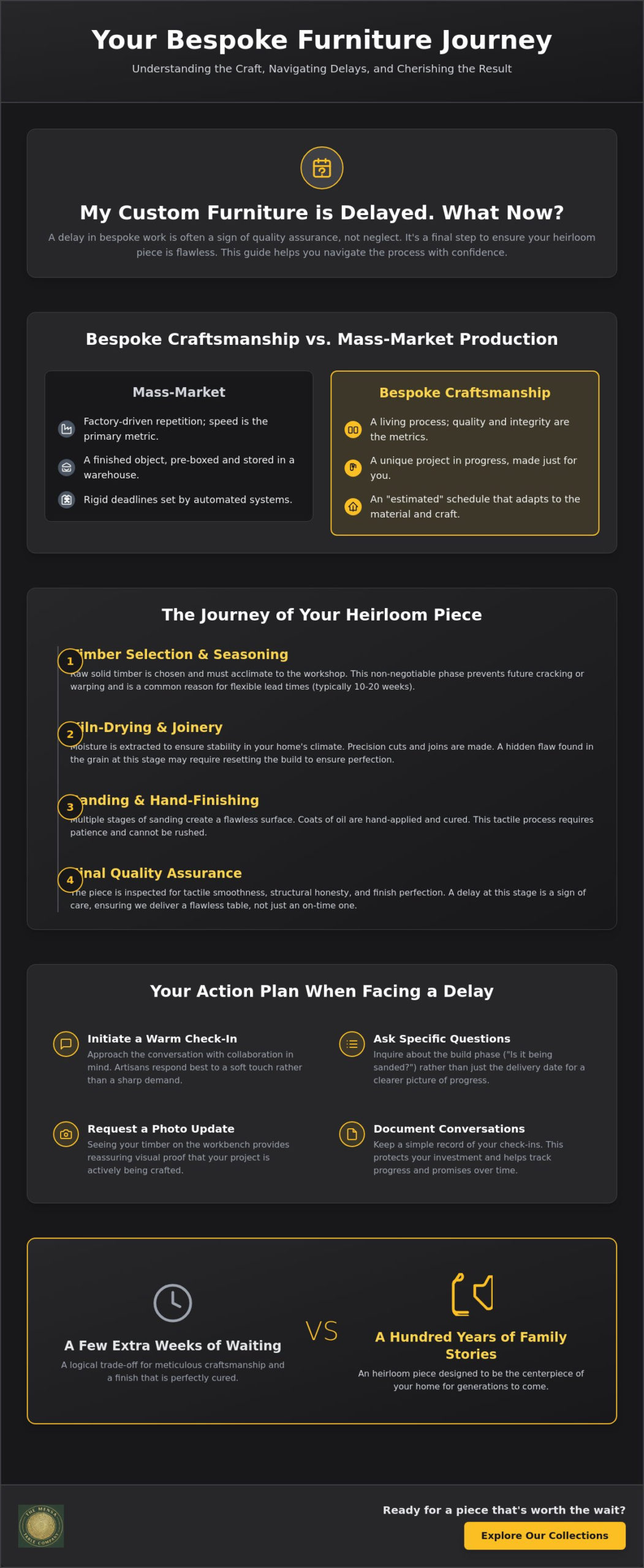
A factory floor is a place of repetition, but a woodworking workshop is a place of response. When you order a piece from a large retailer, you are buying a finished object that has already been boxed and shelved. In contrast, The Nature of Bespoke furniture is a living process. If you are currently wondering what to do if your custom furniture is delayed, the answer often begins with a shift in perspective. A bespoke lead time is not a rigid deadline set by a machine; it is a carefully managed schedule that breathes with the materials and the hands that shape them.
The most vital part of this journey is the seasoning and stability phase. Unlike flat-pack items that use composite materials, our work relies on the natural integrity of solid timber. When raw wood enters the workshop, it must acclimate to the local environment. This quiet period of waiting ensures the wood finds its balance before the first cut is even made. Rushing this stage is impossible. If the timber is forced into a shape before it’s ready, the finished piece may move or crack years down the line. We choose to wait now so your furniture lasts for generations.
Understanding the Artisanal Build Cycle
Every project follows a deliberate path: meticulous timber selection, kiln-drying verification, precision joinery, and hand-applied finishing. We pay close attention to the unique character of solid European oak to ensure every plank complements the next. Kiln-drying is a critical, non-negotiable process that extracts deep-seated moisture from the timber to prevent warping, splitting, or shrinking once the table enters the controlled climate of your home. Sometimes, a craftsman might discover a hidden flaw deep within a grain pattern during the sanding phase. In these moments, we don’t hide the defect; we reset the build stage to find a more perfect piece of wood.
Why “Estimated” Is the Most Important Word in Your Order
Understanding what to do if your custom furniture is delayed starts with recognizing that your piece is not a SKU on a shelf, but a project in progress. Small teams prioritize the soul of the work over the speed of the shipping department. In an industrial setting, speed is the metric of success. In our workshop, the metric is the tactile smoothness of a finished edge and the structural honesty of the joinery. A delay usually indicates that a maker is taking extra time to resolve a technical challenge or perfect a finish. It’s a sign of care, not a sign of neglect. We would rather deliver a flawless table a few weeks late than a compromised one exactly on time.
Proactive Communication: Steps to Take When Your Order Passes Its Lead Time
The silence from a workshop can feel heavy when a promised date has slipped past. It is natural to feel a sense of unease or worry about the status of your investment. However, knowing what to do if your custom furniture is delayed often involves a soft touch rather than a sharp demand. Artisans work with their hands; their focus is often on the grain and the glue rather than the inbox. Initiating a warm check-in creates a bridge of communication that encourages honesty. This collaborative approach is far more effective than a confrontation because it respects the human element of the craft and the dedicated hands behind the tools.
When you reach out, ask specific questions that relate to the physical state of the piece. Is the timber currently in the sanding phase, or has the first coat of hand-applied oil been finished? These details provide a much clearer picture than a simple inquiry about the delivery date. Requesting a photo update is another practical and reassuring step. Seeing the raw, tactile reality of your specific timber sitting on a workbench provides visual proof that the work is progressing. It transforms a purely transactional interaction back into a shared journey between the creator and the home.
The global furniture industry has faced an Ongoing Supply Chain Strain over recent years, impacting everything from specialized hardware to the availability of premium finishing oils. Documenting your conversations is a wise way to track progress, but keeping the tone supportive ensures you remain a partner in the process. A maker who feels respected is more likely to provide transparent updates and go the extra mile to ensure the final result exceeds your expectations.
The “Artisan Update” Request
Creating a clear dialogue is easier with a structured approach. If you are waiting on one of our bespoke dining tables, you might use a template like this: “Hi [Name], I am getting excited to see our table in our home. Could you let me know which stage the build is currently in? If you have a moment to snap a quick photo of the timber on the bench, we would love to see the progress.” This verifies the work is active and keeps the relationship warm while acknowledging the complexity of the build.
Setting New Milestones
Once you have re-established contact, pivot from the missed date to a new, structured plan. There is a vital difference between “Production Completion” and the “Delivery Window.” The first is when the last coat of oil is dry; the second is when the piece is actually in the van. Ask for a firm window based on the current stage of the build. Staying top of mind through polite, regular interest is the most effective way to ensure your project moves steadily through a busy workshop. If you have questions about a current order or want to discuss a future project, feel free to reach out to our team for a personal update.
Material Realities: Understanding Timber Sourcing and Workshop Logistics
The path from a standing tree to a centerpiece in your home is rarely a straight line. While open communication provides peace of mind, the physical constraints of the workshop and the forest often dictate the tempo of production. Understanding these material hurdles is vital when deciding what to do if your custom furniture is delayed. As of July 2026, the price of lumber has seen a steady rise, increasing by 5.10% over the previous month. This market volatility means that sourcing the highest grade of solid European oak requires more than just a simple order; it requires a diligent hunt for stock that meets our rigorous standards for moisture and grain quality.
We often spend days on what we call “The Perfect Grain Search.” This involves sifting through individual slabs of timber to find those that possess the visual character your home deserves. If a delivery of kiln-dried timber arrives and fails our moisture content verification, we must wait for a replacement from our ethical suppliers. Kiln-dried availability fluctuates based on environmental factors at the source, and we refuse to compromise the future stability of your table for a faster turnaround today. A table that hasn’t reached the correct internal balance will eventually succumb to the dry heat of a modern home, leading to cracks that no amount of oil can fix.
Our workshop is a space of focused, manual labor. While industrial plants use automation to mask labor shortages, a small, dedicated team relies on the health and precision of every individual. A single bout of illness or a day spent on essential equipment maintenance can ripple through a tightly packed schedule. We believe this trade-off is worth it. It ensures every joint is cut with human eyes and every surface is checked by a craftsman who cares about the legacy of the piece. When you choose a manual approach, you’re choosing a pace dictated by quality rather than a quota.
The Journey of Solid Black Walnut and Oak
Solid black walnut is a high-demand, low-yield material that demands immense respect during the sourcing phase. Because these trees grow more slowly than other species, sustainable sourcing is a slower, more ethical process that respects the natural cycle of the forest. We prioritize timber from managed woodlands where heritage and longevity are valued over quick profits. Wood is a natural element that moves and breathes, requiring patience throughout its transformation from a raw, rugged plank into a refined functional investment.
Finishing and Curing: The Hidden Delay
The final stage of production is often the most sensitive to the British weather. Our natural oil and wax finishes need specific humidity levels to cure into a durable, protective layer that highlights the wood’s tactile qualities. If the air is too damp, we risk “clouding” or a tacky surface that will never properly harden against the spills of daily life. A sudden shift in UK weather can add 48-72 hours to a finishing schedule unexpectedly. We would never ship a piece before the finish has fully set and bonded with the grain, as a rushed finish is a finish that fails.
Preparing Your Home and Mindset for a Delayed Arrival
The empty space in your dining room where a handcrafted centerpiece should stand can feel like a quiet void in the heart of your home. It is easy to view this gap as a source of stress, especially when you have planned gatherings or social rituals around a new arrival. However, knowing what to do if your custom furniture is delayed involves more than just checking emails; it requires a practical strategy for living in the gap. By shifting your focus from the missing object to the preparation of its environment, you can transform a period of frustration into one of intentional anticipation. This time allows you to ensure that every detail of the room is worthy of the heritage piece currently being perfected in the workshop.
Reframing the wait as a period of preparation helps maintain the emotional value of your investment. You aren’t just waiting for a commodity; you are waiting for a natural element that has been seasoned, cut, and finished by hand. This deliberate pace is what ensures the wood won’t warp or move in your home’s climate. When the table finally arrives, the preparation you’ve put into the room will make that first shared meal feel even more significant. The wait is simply the final ingredient in a piece built to last for a hundred years.
The “Don’t Sell Yet” Rule
One of the most common mistakes is clearing out existing furniture the moment an estimated lead time approaches. We always advise keeping your current dining surface until the delivery van is confirmed to be less than 24 hours away. If you have already cleared the room and find yourself without a place to gather, consider bringing in coffee tables or smaller desks to serve as temporary focal points. This prevents the room from feeling abandoned and maintains the social rhythm of your household. If space is at a premium, use this time to organize the surrounding area, ensuring that once the delivery arrives, the transition is seamless and calm.
Styling Around the Void
A delay offers a rare opportunity to refine the smaller details that elevate a room from a simple space to a curated home. Use these extra weeks to finalize your selection of matching benches or to measure for a rug that will frame the table’s unique silhouette. Whether you are awaiting the architectural lines of a Mensa design or the industrial spirit of a Spider Leg frame, visualizing the final layout helps in selecting the perfect overhead pendant light. Preparing your home also means checking the practicalities of the delivery route. Solid wood is heavy and requires a clear, safe path through your home. You might also use this time to source high-quality floor protectors or to treat your existing flooring, ensuring it is ready for the weight of a lifetime investment. If you need specific dimensions to help with your room planning, get in touch with our workshop for the exact specifications of your build.
Why a Handcrafted Table is Worth the Extra Time
The weight of a solid wood table is a promise of permanence. While the temptation of an instant delivery is strong, the reality of fast furniture is a cycle of replacement that drains both your wallet and the planet’s resources. A mass-market piece often reaches the end of its life within a decade, succumbing to loose joints or peeling veneers. In contrast, a Mensa table is built to host a century of life. Understanding what to do if your custom furniture is delayed means looking past the immediate inconvenience to the decades of service the piece will provide. When you view the investment through the lens of a “cost per year,” waiting an extra month for a lifetime piece is a logical, rewarding trade-off.
There is a profound emotional connection in knowing the hands that shaped your family’s centerpiece. Every mark of the chisel and every pass of the sander was performed by a person dedicated to their trade. This isn’t an anonymous object from a shipping container; it is a collaborative creation between the workshop and your home. A table isn’t just a piece of furniture. It is the silent witness to every birthday, the steady anchor for every late-night conversation, and the backdrop for decades of shared stories. This heritage of human connection is what makes the artisanal process so vital.
The Anti-Flat-Pack Philosophy
You chose bespoke because you value substance over flashy marketing. Instant furniture often relies on industrial chemicals and synthetic glues that can off-gas into your living space for years. Our handcrafted pieces are finished with natural oils and waxes that respect the wood’s organic origins. This manual approach ensures your table remains a healthy, tactile part of your environment. There is a quiet satisfaction in owning a piece that cannot be found in any catalogue. Your table’s grain pattern is as unique as a fingerprint, a one-of-a-kind natural sculpture that no assembly line could ever replicate.
Investing in Your Home’s Future
Solid wood is one of the few materials that grows more beautiful as it ages. Over the years, the timber will develop a rich patina, a soft glow that reflects the history of your home. Scratches and marks from daily use don’t ruin the piece; they become part of its narrative, easily refreshed with a light application of oil. By choosing to buy once and for life, you are making an environmentally responsible choice that rejects the “throwaway” culture of modern retail. This is an investment in your home’s future and a gift to the next generation. Explore our full range of handcrafted dining tables and see the quality worth waiting for.
Welcoming a Heritage Piece into Your Home
Choosing bespoke furniture is a commitment to quality that transcends the fleeting convenience of mass-produced goods. By understanding the artisanal build cycle and the material realities of timber sourcing, you can transform the waiting period into a time of meaningful anticipation. You now know exactly what to do if your custom furniture is delayed, from initiating a warm check-in with the workshop to preparing your space for a heavy, solid wood arrival. This patience ensures that every joint is perfect and every finish is durable enough for decades of shared meals and stories.
Our tight-knit team remains dedicated to creating focal points that are built for generations, not just for now. Every item is handcrafted in our UK workshop using premium Solid European Oak, Ash, or Walnut to ensure a legacy of strength and beauty. If you’re ready to bring an authentic, manual touch into your living space, we are here to guide you through every step of the process. View our signature Mensa Dining Table and start your bespoke journey today. Your home deserves a centerpiece that values substance over flashy marketing and stands the test of time.
Frequently Asked Questions
Is it normal for custom furniture to be late?
Minor delays are common in bespoke woodworking because the process relies on natural materials and manual labor rather than automated assembly lines. Lead times of 10 to 20 weeks are standard for heirloom quality pieces. Unlike mass production, an artisanal schedule must adapt to the seasoning of the timber and the meticulous precision required for hand finishing to ensure the piece lasts for generations.
Can I ask for a discount if my bespoke table is delayed?
You can certainly ask, but most makers prioritize the integrity of the work over price reductions. A delay often signifies that more time is being spent on your specific piece to resolve a technical challenge or perfect a finish. Instead of a discount, many workshops offer value through extra care or specific finishing adjustments that further protect your long term investment.
What are my consumer rights for delayed furniture delivery in the UK?
Under the Consumer Rights Act 2015, goods should be delivered within 30 days unless a different period was agreed upon at the time of purchase. For bespoke items, the agreed lead time serves as the baseline. If a maker misses this window, you have the right to agree on a new, reasonable deadline. If they fail to meet that second date, you may be entitled to cancel for a full refund.
How can I tell if a delay is due to quality control or poor management?
Transparency is the most reliable indicator of a quality driven delay. A maker who provides specific details about build stages, such as timber seasoning or oil curing, is likely managing the natural requirements of the craft. Poor management is usually marked by vague excuses or a total lack of communication. Knowing what to do if your custom furniture is delayed involves looking for these specific artisanal details in their updates.
Should I cancel my order if the delay exceeds four weeks?
Cancellation should be a last resort for a piece intended to host your family stories for a century. A four week delay is a small fraction of a table’s 100 year lifespan. If the maker remains communicative and the work is actively in progress, staying the course ensures you receive the unique, handcrafted centerpiece you envisioned rather than settling for a compromised, mass produced alternative.
Does the type of wood affect how long a table takes to build?
The species of timber significantly influences the production timeline. Dense hardwoods like solid European oak and black walnut require unique drying and working sessions to ensure stability. Walnut, in particular, is a low yield material that demands a more careful sourcing and selection process. These natural factors mean that some woods simply cannot be rushed without risking the structural honesty of the finished piece.
How often should I expect updates from a bespoke furniture maker?
You should expect updates at major milestones rather than daily reports. A warm check in every few weeks is a reasonable expectation during a standard 10 to 20 week build. This rhythm allows the craftsmen to stay focused on the manual work while still keeping you connected to the transition of the raw materials into a functional focal point for your home.
What happens if my custom furniture arrives and it is not what I expected?
Contact the workshop immediately to discuss any discrepancies between the finished piece and your original specifications. Because bespoke items are tailored to your needs, clear communication during the design phase is essential. If the furniture has a structural flaw or fails to match the agreed details, a reputable maker will work closely with you to rectify the issue and ensure the investment meets your high expectations.

Leave a Reply