

A thick tabletop can still make a poor table. What makes a table structurally sound is how its top, apron, legs and frame connections work together: the frame must support the top, the joints must resist movement, and the feet must sit evenly on the floor. A balanced design can feel steady in everyday use without relying on bulk alone.
It’s natural to judge a table first by its surface, especially when you’re picturing meals, work or long conversations around it. But strength is built beneath the grain, where overhangs, aprons and carefully joined parts help distribute weight and limit wobble.
This article explains how these features contribute to a dependable table, what stability looks and feels like, and why frame connections matter as much as materials. You’ll get a clearer sense of how thoughtful construction supports everyday use.
Key Takeaways
- Assess how far the tabletop extends beyond its supports, since overhang affects balance and how weight is carried.
- Look at the apron’s role: it can stiffen the frame while also affecting legroom and the table’s visual profile.
- Notice whether the table sits evenly and resists rocking; stable footing is part of everyday usability.
- Consider how the tabletop connects to the frame, because secure, well-judged joints help limit movement over time.
- Compare the legs, rails and frame as a working structure, not just as separate design details.
Overhanging and flush tabletops
For ordinary freestanding tables in UK homes, there is no single building-regulation measurement for tabletop overhang. A sound design depends on the table’s intended use, the top’s weight and how the frame supports the surface.
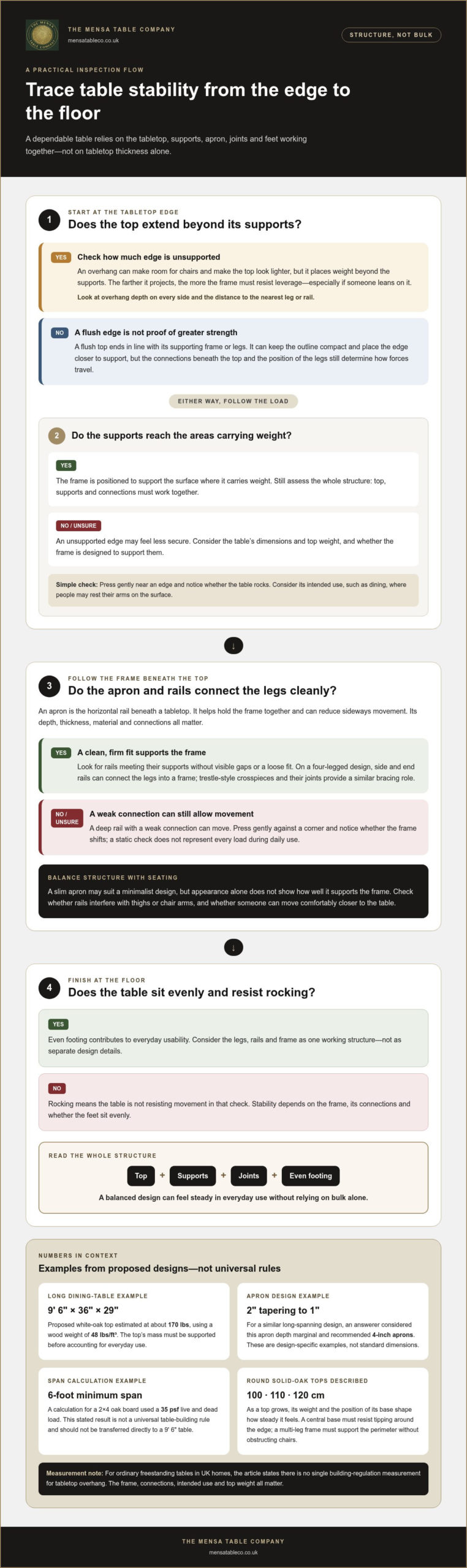
An overhang is the part of the tabletop that extends beyond the legs or frame. It creates room for chairs and can make the top look lighter, but it also puts weight beyond the supports. The farther the edge projects, the more the frame must resist leverage, especially if someone leans on it.
A flush tabletop ends in line with its supporting frame or legs. This can keep the outline compact and place the edge closer to the support, but flush edges don’t automatically make a table stronger. The connections beneath the top and the position of the legs still determine how forces travel through the frame.
Consider a proposed dining table measuring 9′ 6″ long, 36″ wide and 29 inches tall. Its white-oak top was estimated at about 170 lbs, using a wood weight of 48 lbs/ft3. Those figures illustrate why the top’s mass matters: support must carry the surface itself before accounting for everyday use. A visible overhang adds leverage, so long tops need a frame designed to support their dimensions and weight.
A span calculation for a 2×4 oak board used a 35psf live and dead load and returned a minimum span of 6 foot. That result describes the stated calculation, not a universal rule for table construction. It shouldn’t be transferred directly to a 9′ 6″ table: board orientation, timber, connections, frame layout and load all affect performance.
Round tops show the same relationship between surface and support. Solid-oak round tabletops are described in diameters of 100, 110 and 120 cm. As the top grows, its weight and the position of its supporting base shape how steady the table feels. A central base must resist tipping around the edge; a multi-leg frame must support the perimeter without obstructing chairs.
When assessing an overhang, look at its depth on every side, the distance to the nearest leg or rail, and whether the table rocks when you press gently near an edge. Consider the table’s intended use, such as dining, where people pull chairs close and rest their arms on the surface. A modest projection can make seating easier; an unsupported edge may feel less secure.
Flush and overhanging designs can both work. What matters is whether the supports reach the areas carrying weight and the frame stays firm in ordinary use. Assess the whole structure: the tabletop, supports and connections must work together.
For ordinary freestanding tables in UK homes, there is no single building-regulation measurement for tabletop overhang. Safety depends on whether the frame and connections support the top and resist leverage during everyday use.
Table aprons and minimalist table design
An apron is the horizontal rail beneath a tabletop, commonly joining the legs along its edges. It helps hold the frame together and can reduce sideways movement when the table is pushed or used. Its depth, thickness and connections all matter. A slim apron may suit a minimalist design, but its appearance alone doesn’t show how effectively it supports the frame.
One proposed design used side aprons 2 inches thick, tapering to 1 inch at the end. An answerer considered that apron depth marginal for a similar long-spanning table and recommended 4-inch aprons. These are design-specific examples, not universal dimensions. The key lesson is to judge an apron against the table’s span, material, frame layout and intended use, rather than treating a particular measurement as a rule.
A deeper apron has more vertical dimension, which can help it resist bending. Thickness and timber also affect stiffness, while the way each rail joins the legs influences whether the frame stays square under sideways pressure. A deep rail with a weak connection can still move. A carefully designed frame, on the other hand, may have a cleaner profile without relying on bulky rails.
Minimalist tables often reduce visible structure, so examine the space beneath the top as closely as the silhouette. A shallow apron can preserve an open view and leave more room for knees. But rails positioned too low may interfere with thighs or chair arms. For a dining setup, compare the apron’s position with the chair’s seat and arms, and consider how easily someone can move closer to the table.
Use the table’s outline to assess where the aprons sit. On a four-legged design, rails along the sides and ends can connect the legs into a frame. On a trestle-style design, crosspieces and their joints provide a similar bracing role. Pressing gently against a corner can reveal whether the frame shifts, though a static check won’t represent every load during daily use.
When comparing designs, look for a consistent relationship between the apron, legs and top. A rail should meet its supports cleanly, without visible gaps or a loose fit. Check whether the apron obstructs chairs, whether the legs are connected across the frame, and whether the table stands evenly. A spare profile can still be structurally considered: minimalism works best when it simplifies the appearance without leaving the frame poorly braced.
For a table intended for a particular room or seating arrangement, sketch the chair positions and apron line together. This simple comparison can make legroom and frame choices easier to judge before you settle on a design.
Table stability and structural strength
Understanding what makes a table structurally sound starts with how its parts share everyday loads. Timber choice, frame geometry and secure joints all contribute to stability.
Materials and Timber Dimensions
Materials and timber dimensions describe the wood and the size of the structural parts supporting the tabletop. Both influence stiffness, weight and how forces travel through a table. A proposed frame used legs 1 ½ inches thick, with each leg 4 inches wide at the top, tapering to 2 inches at the bottom. These dimensions illustrate how a leg can retain a broader connection near the frame while narrowing towards the floor.
Oak is one timber used in table construction, but species alone doesn’t determine strength. Section size, grain direction, span and connections all affect how a component behaves. A substantial top needs supports suited to its weight, while slender legs need effective bracing against sideways movement. Compare the frame’s dimensions with the table’s proportions rather than judging durability by thickness alone.
Failure Causes and Prevention
Common causes of table failure include loose joints, inadequate bracing, uneven feet and loads concentrated beyond the supports. These can cause rocking, frame movement or stress around a connection. Prevention starts with examining the complete structure: check that legs meet rails securely, the table stands level and the support layout suits its use. Don’t use a table edge as a seat or step.
One proposed table’s calculated total load was 900lb. That figure belongs to that calculation, not a general capacity for dining tables. Weight placement also matters. A heavy object near the centre loads the frame differently from someone leaning at an outer edge, where leverage can increase stress.
A standard 7′ (2.13m) dining table can often take the full weight of an adult. That example doesn’t make every tabletop suitable for standing or climbing. A person’s weight creates a concentrated load, and the frame, joints and support positions determine how it responds. Everyday strength depends on intended use, not a single demonstration.
During an inspection, press gently at each corner and watch for rocking or movement between the legs and rails. Check whether the feet meet the floor evenly and whether the frame remains square. A wobble can come from uneven flooring, loose connections or a frame that twists under pressure. Notice where the movement starts before judging the tabletop alone.
Look closely at joints for gaps, shifting or separation, especially where legs meet rails. Repeated sideways force can loosen a weak connection over time. A well-matched frame distributes loads through its legs and crosspieces, while appropriately sized timber helps keep those parts aligned. What makes a table structurally sound is the complete system: stable footing, secure connections and support where the weight is carried.
Tabletop and frame connections
Legs and aprons need close-fitting joints that resist twisting and sideways movement. Mortise-and-tenon joints, dowelled joints and properly secured mechanical fixings can all connect these parts. The right choice depends on the timber, frame design and quality of the fit.
A connection transfers force from one piece of timber to another. If a leg shifts where it meets an apron, the frame can rack, or distort out of square. For example, pushing a dining table across the floor puts sideways pressure through its legs and rails. Sound joints help these parts act together rather than move independently.
A mortise-and-tenon joint fits a projecting tenon into a matching opening in the leg. Its broad contact surfaces can help resist movement if the joint is accurately made and secured. Dowel joints use aligned wooden pins between adjoining parts. With either method, gaps or poor alignment can weaken the connection, so workmanship matters as much as the joint’s name.
Bolts and other mechanical fixings can also draw frame components together. Their strength depends on secure placement and suitable support in the timber. A fixing close to an edge may leave less material around it, while a loose fitting can allow movement under repeated pressure. Look for joints that sit firmly and evenly, without visible separation or shifting.
The tabletop needs a different connection from the legs and aprons. Wood changes dimension as moisture conditions change, particularly across the grain. A top fixed too rigidly across its width can develop stress as it moves. Slotted fixing points or tabletop fasteners can hold the surface while allowing limited movement across the grain.
Check how the top is attached by looking beneath its edges. Fixings should connect it securely to the frame while allowing for timber movement. For example, screws through slots can move slightly as a solid-wood top expands or contracts. The fixings must still prevent the top from sliding or lifting in ordinary use.
Inspect each connection as part of the whole structure. Follow the route from tabletop to apron, then apron to leg, and look for gaps, uneven joints or loose hardware. A table can have a substantial surface yet feel unstable if a rail moves at its joint. Likewise, a secure frame cannot support the top properly if its attachments let the surface shift.
For a practical check, place the table on an even floor and apply gentle pressure near a corner. Watch whether movement starts at the tabletop fixing, an apron joint or a foot. This helps distinguish a loose connection from uneven contact with the floor. A well-joined table keeps its parts aligned while allowing its wooden top to respond naturally to changing conditions.
What are the key components of a structurally sound table?
A dependable table works as a complete structure, from tabletop to feet. The top, supporting frame, legs, rails, joints and floor contact each have a distinct role. A sturdy surface cannot compensate for a loose leg connection, and a rigid frame cannot prevent rocking if one foot misses the floor.
The tabletop should suit its supports in size, weight and intended use. A solid-wood dining surface, for example, needs attachments that hold it steady while allowing natural movement across the grain. Its span matters too: a long surface needs support positioned to control bending, while an overhanging edge puts extra leverage on nearby frame parts.
Legs carry the table’s load to the floor, so their position affects balance and usable space. Four corner legs create clear support points, while a central pedestal leaves the corners open but must resist tipping. Compare the leg layout with where people sit or lean. A foot placed too far inboard can make an edge feel less secure under pressure.
Rails and aprons connect the legs and help keep the frame aligned. Their position can reduce sideways movement, but it also affects legroom. Picture a dining chair pushed beneath the table: a low rail may meet the sitter’s knees, while a rail firmly joined to each leg helps brace the frame. A useful design balances support with comfortable seating.
Joints transfer force between components. A close-fitting connection between a leg and rail helps prevent them from shifting independently; a gap or loose fixing can let the frame rack under repeated movement. Inspect where each rail meets a leg, then check how the tabletop attaches to the frame. Secure connections hold parts in position without restricting solid wood’s movement across the grain.
- Surface: Match the top’s span and weight to its supporting structure.
- Frame: Check that rails connect the legs and resist sideways movement.
- Joints: Look for close fits, aligned parts and secure fixings.
- Feet: Confirm each foot meets the floor, with no rocking on a level surface.
These checks work together. If a table rocks, identify whether movement starts at a foot, joint or frame before blaming the top. If the table feels firm but chairs catch on the apron, the frame may support the surface while compromising everyday comfort. A useful assessment considers stability, seating and construction as one system.
Choosing a dining table means weighing these structural details alongside the room and how it’s used. Discuss a dining table for your space and the features that matter to your everyday use.
The Mensa Table Company: The Mensa Dining Table
The Mensa Table Company makes dining tables for people considering tabletop support, frame style and everyday seating needs. The Mensa Dining Table, Spider Leg Dining Table, X-Frame Dining Table and U-Frame Dining Table offer different frame designs to compare with your room and how you use the table.
Start by comparing the frame’s position with the chairs, legroom and tabletop edge. Then consider which design best suits how your household gathers, from shared meals to work at the table. A table’s structure should suit its setting as well as its appearance.
Explore the dining table designs from The Mensa Table Company at mensatableco.co.uk.
Choose a Table That Belongs in Your Everyday Life
A table becomes part of the rhythm of a home: a place for supper, shared plans, creative work and conversations that linger. Understanding what makes a table structurally sound gives you a clearer starting point, but choosing one is personal. Consider how you’ll use it, how people gather around it and which frame suits the character of your room.
The Mensa Table Company makes The Mensa Dining Table, The Spider Leg Dining Table and The X-Frame Dining Table. Each offers a different design to consider as you picture the table in your home and the moments it will hold. Let practical needs and the feel of the space guide your decision, not appearance alone.
If you’re ready to explore which table could suit your home, contact The Mensa Table Company. A thoughtful choice can bring lasting purpose and a welcoming centre to everyday life.
Frequently Asked Questions
How does table design affect stability and load capacity?
Design determines where a table carries weight and how it resists movement. A narrow base beneath a broad top, for example, may feel less steady when someone leans on an outer corner. A frame that extends towards the edges can support the top closer to that pressure point. Chair placement matters too: legs positioned where people need to sit can affect everyday comfort.
What fasteners and adhesives are best for table construction?
The best connection depends on the joint, timber and whether it needs to come apart. Wood adhesive can bond close-fitting timber joints, while screws or bolts can clamp parts together and allow disassembly. A removable leg, for example, may suit a bolted connection, while a fixed frame may use glued joinery. Adhesive cannot compensate for a poorly fitting joint, and fasteners must suit the materials they connect.
How can a table be prevented from wobbling or racking?
Start by placing the table on a firm, level part of the floor, then identify which leg moves. An uneven floor can cause rocking even when the frame is sound. If movement comes from a joint, tighten accessible fixings according to the maker’s instructions. Avoid dragging the table by one corner, which twists the frame; get help to lift it when moving it across a room.
How much weight can a typical dining table safely support?
There is no single safe load that applies to every dining table. Capacity depends on the top, frame, joints, support positions and how weight is distributed. A pile of books near the centre loads a table differently from someone leaning hard on one edge. Use the maker’s stated capacity for that specific table, and avoid standing or climbing on it unless it is designed for that use.
How do you test a table for stability and structural strength?
Test the table empty on a firm floor before adding dishes or equipment. Press gently near each corner, then along the centre of each edge, watching for rocking, twisting or separation at a joint. Next, place ordinary items gradually across the surface and observe whether it stays level. Stop if you hear cracking or see movement; don’t test strength by standing or jumping on the tabletop.

Leave a Reply