
Imagine a dinner party where the most memorable part isn’t the wine, but the fact that no one had to play musical chairs to avoid a table leg. We have all been there, squeezed into a corner and knocking knees against a bulky wooden post while trying to enjoy a Sunday roast. It’s frustrating when a piece of furniture feels like it’s working against the flow of your home rather than enhancing it. You deserve a gathering space that feels intentional, sturdy, and welcoming.
A v-frame dining table changes that narrative by using clever architectural geometry to reclaim your floor space and provide unparalleled legroom. By choosing a design that prioritises human ergonomics, you can transform your dining area into a light, airy sanctuary. In this guide, we will explore how these handcrafted pieces blend the sensory warmth of solid European hardwoods, like Oak and Ash, with a contemporary silhouette. You’ll discover how a permanent, no flat-pack construction ensures your table remains a stable backdrop for generations of shared stories and social rituals. We’ll show you why this specific frame style is the ultimate investment for a modern British home that values both form and function.
Key Takeaways
- Understand how the unique architectural geometry of a v-frame dining table eliminates awkward corner legs to maximise your seating capacity and legroom.
- Discover why choosing solid European hardwoods and permanent joinery ensures your investment remains a stable, wobble-free centrepiece for generations.
- Learn the practical steps for measuring your dining space to maintain an airy feel and easy movement around your new focal point.
- Explore how pairing your table with a matching bench creates a clean, contemporary silhouette that enhances the visual flow of modern British homes.
- Gain insight into the artisanal process of hand-finishing timber, which highlights the natural textures and sensory appeal of your bespoke furniture.
Defining the V-Frame: Where Architectural Geometry Meets Home Comfort
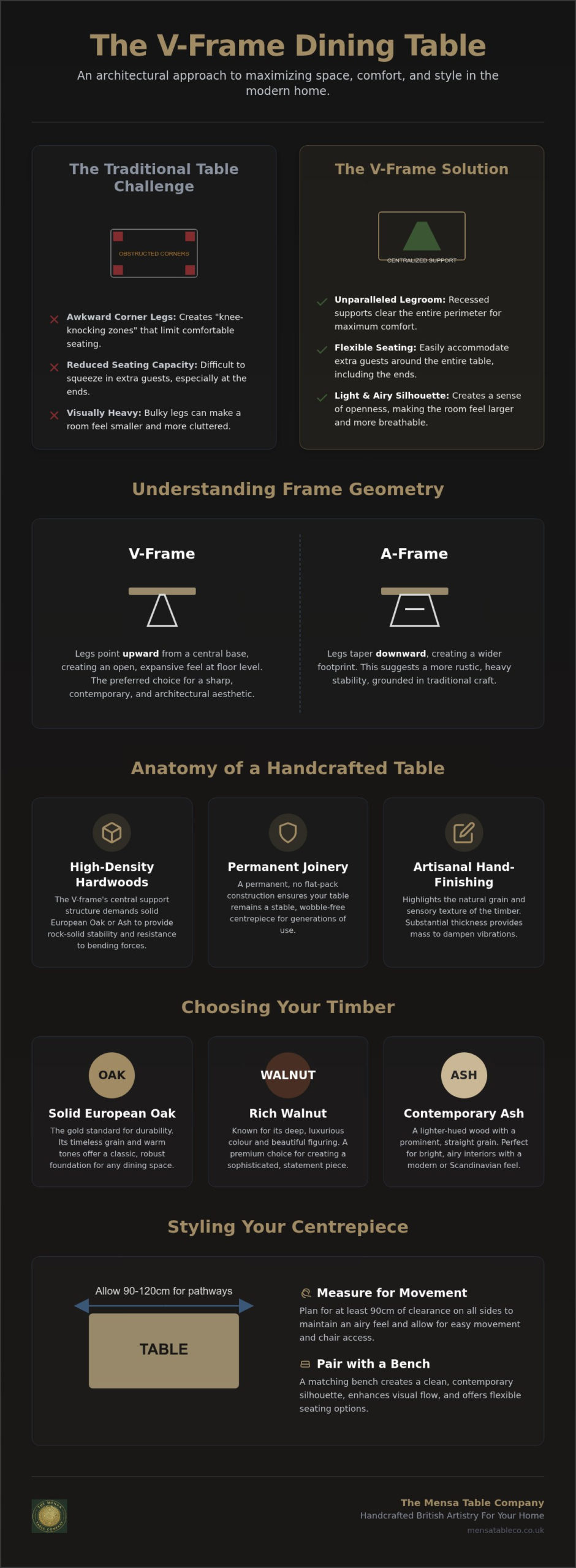
The v-frame dining table represents a thoughtful departure from the heavy, corner-heavy designs that often dominate traditional dining rooms. Drawing inspiration from the classic Trestle table, this modern iteration uses a central-pedestal concept featuring twin angled supports. These legs reach upward from a stable base to meet the underside of the timber, creating a silhouette that feels both grounded and incredibly light. It’s a design that values the raw beauty of the wood while embracing a sophisticated, structural logic.
Because the supports are recessed away from the table’s edge, the top appears to float. This isn’t just a visual trick. It has a profound psychological impact on how we perceive our living space. In a standard British home where every square inch matters, seeing more of the floor beneath the table reduces visual clutter. It makes the room feel larger and more breathable, turning a heavy functional object into a sculptural centrepiece. By removing the bulky obstacles at the corners, we create a sense of weightlessness that invites movement and light into the heart of the home.
The Ergonomic Advantage: Solving the Legroom Puzzle
Traditional tables often force us into a battle with corner legs. We’ve all experienced that awkward moment of straddling a thick piece of wood while trying to enjoy a meal. The v-frame dining table solves this legroom puzzle by clearing the perimeter. Because the supports are tucked toward the centre, you have unrestricted seating around the entire edge. It’s the perfect solution for those festive occasions when you need to squeeze in an extra guest or two. Everyone can sit comfortably, and those at the ends can finally stretch their legs without obstruction. You can find these adaptable designs in our collection of dining tables, where we prioritise your comfort as much as the aesthetic.
V-Frame vs. A-Frame: Understanding the Silhouette
While both designs use angled geometry, the V-frame and A-frame offer very different atmospheres. An A-frame tapers downward, creating a wider footprint at the floor which suggests a more rustic, heavy stability. In contrast, the V-frame points upward. This creates an open, expansive feel at floor level, which is why it’s often the preferred choice for contemporary interiors. You get the same structural integrity but with a sharper, more architectural line. It’s a choice between the sturdy presence of traditional craft and the airy, sophisticated rhythm of modern design. Our team takes pride in ensuring the sharp lines of the V-frame are balanced by the natural, tactile warmth of hand-finished timber.
The Anatomy of a Handcrafted Table: Timber, Grain, and Joinery
The structural integrity of a v-frame dining table relies on a delicate balance of physics and material strength. Unlike traditional designs that use a perimeter of four legs and a connecting apron to distribute weight, the V-frame concentrates its support toward the centre. This architectural choice demands the use of high-density hardwoods. Without the natural rigidity found in species like Oak or Ash, a table of this silhouette would lack the necessary resistance to bending forces. We select each piece of timber not just for its visual character, but for its ability to provide a rock-solid foundation that remains perfectly level under the weight of a heavy Sunday roast or a stack of books.
There is a profound sensory joy in running your hand across a tabletop that has been finished by a person rather than a machine. Hand-finishing allows us to respect the unique topography of the grain. You can feel the subtle ridges and the history of the tree beneath your fingertips. To complement the geometric weight of the V-legs, we often use a substantial timber thickness. This creates a visual harmony where the top feels as substantial as the base, ensuring the piece looks grounded in your dining room. This thickness isn’t just for show; it provides the mass required to dampen vibrations and prevent the “hollow” sound often associated with mass-produced alternatives.
Choosing Your Species: Oak, Walnut, and Ash
Selecting the right timber is the first step in defining the soul of your furniture. Each species brings a different energy to the v-frame dining table design:
- Solid European Oak: This is the gold standard for durability. Its timeless golden hues and prominent grain patterns make it a versatile choice for both rustic and modern spaces. Explore our solid European Oak collection to see how this material ages beautifully over decades.
- Black Walnut: For those seeking a sophisticated, dark-grained look, Walnut defines modern luxury. It offers a chocolatey depth that contrasts sharply with the architectural lines of the V-frame.
- European Ash: Ash is a lighter, contemporary alternative. It’s incredibly strong and features striking grain movement that adds a sense of organic energy to a minimalist room.
The “No Flat-Pack” Rule: Why Construction Matters
We believe that a dining table should be a permanent fixture in your life. Mass-produced V-frames often arrive in boxes, held together by simple bolts that inevitably loosen. This leads to “lateral sway,” where the table begins to wobble with even the slightest nudge. Handcrafted construction avoids this by using permanent joinery. Whether we are employing traditional mortise and tenon joints or heavy-duty steel fixings designed for a lifetime of use, our focus is on structural permanence. If you have questions about how we can tailor these techniques for your home, please feel free to speak with our craftsmen about your bespoke requirements. By choosing a table built as a single, integrated unit, you are investing in a piece that will remain as stable for your grandchildren as it is for you today.
V-Frame vs. Traditional Trestle: A Performance Comparison
When we compare a v-frame dining table to a traditional four-legged design, the first thing you notice is the liberation of space. A standard table creates a rigid boundary at each corner, effectively “caging” your seating area. In contrast, the V-frame pulls its footprint inward. This centralisation means you aren’t just buying a piece of furniture; you’re reclaiming the perimeter of your dining room. It allows for a much more fluid movement throughout the home, which is essential in modern open-plan living where the dining area often doubles as a walkway.
Seating flexibility is where this architectural design truly shines. Without corner obstacles, you can slide chairs or matching benches anywhere along the length of the timber. It accommodates the natural ebb and flow of daily life, from quiet morning coffees to boisterous family celebrations where an extra guest always seems to appear. There is also a quiet, practical joy in the “cleaning factor.” Navigating a vacuum or mop around a single central structure is far simpler than dancing between four separate legs. Whether your home features sleek hardwood or plush carpet, the concentrated weight of the V-base provides a grounded, deliberate presence that feels stable and secure.
Stability Under Pressure: The Physics of the V-Shape
A common misconception is that central supports are inherently less stable than the traditional four-post approach. However, the physics of the V-shape tells a different story. The angled supports act as structural braces, distributing the load from the tabletop down through a wide, heavy base. We’ve engineered our V-frames to handle significant weight, even with heavy end-loading. You can lean on the edge with confidence, knowing the table won’t tip or flex. This reliable stability comes from the sheer density of our solid European hardwoods and the precision of our permanent joinery, which eliminates the mechanical play found in lesser, bolted alternatives.
Visual Weight and Room Dynamics
In modern Scandi or Industrial interiors, visual “noise” is often the enemy of a peaceful home. Traditional trestles, while beautiful in a farmhouse setting, can often feel heavy and overbearing in a light-filled kitchen. The v-frame dining table offers a more refined architectural statement. Its clean, sharp lines provide a focal point that feels intentional rather than accidental. It bridges the gap between the raw, organic world of the timber and the structured, minimalist world of modern British design. By choosing a V-structure, you’re opting for a silhouette that makes a statement without shouting, allowing the natural grain of the wood to remain the true hero of the room.
Styling Your Centrepiece: Sizing, Seating, and Benches
Styling a room around a v-frame dining table is an exercise in balancing bold architectural lines with the lived-in warmth of a family home. To truly appreciate the floating effect of the recessed legs, you must give the piece room to breathe. We recommend leaving a minimum of 90cm of “walk-around” space between the table edge and the nearest wall or sideboard. This ensures that the dining area remains a site for fluid movement and easy conversation, rather than a cramped obstacle course. When the table has space, its geometric silhouette becomes a deliberate design choice rather than just a functional necessity.
One of the most effective ways to maintain this airy, contemporary aesthetic is through what we call the “Bench Solution.” Traditional chairs, while functional, can often create a “forest of legs” that distracts from the clean geometry of the V-frame. When you browse our matching handcrafted benches, you will see how they create a long, horizontal silhouette that mirrors the tabletop. Benches also offer the practical benefit of tucking completely under the table when not in use, which further opens up your floor space and highlights the structural supports.
The Perfect Fit: Sizing Guide for 6, 8, and 10 Seaters
Finding the right scale for your v-frame dining table depends on your typical social rituals. For a standard 6-seater, we typically suggest dimensions of approximately 180cm x 90cm. This provides ample room for place settings without feeling overwhelming in a medium-sized kitchen. However, this design is particularly effective for “Grand” 10-seater tables reaching 240cm or more. Because the supports are centralised, these larger pieces don’t feel as heavy or imposing as a four-legged equivalent. If you prefer “feasting” style dining with large shared platters, consider opting for a custom width of 100cm or 110cm to accommodate the extra centrepiece space.
Pairing with Seating and Decor
When selecting chairs to mix with a bench, look for designs with slim profiles or open backs that don’t hide the structural beauty of the legs. You can soften the sharp lines of the frame by introducing natural textures, such as heavy linen runners or hand-thrown ceramics. Lighting also plays a crucial role in the overall atmosphere. A linear pendant light hanging low over the table will mirror its length and draw the eye to the rich, hand-finished grain of the wood. To maintain this sensory appeal, we recommend the use of hard wax oils for daily protection, as they preserve the wood’s breathability and tactile quality. If you are unsure which dimensions would best fit your floor plan, please contact our workshop for expert guidance on your bespoke project.
The Mensa Commitment: Handcrafted British Artistry for Your Home
When you choose a v-frame dining table from our workshop, you aren’t just purchasing a piece of furniture; you’re entering into a relationship with the people who actually build it. We are a tight-knit team of specialists who take immense pride in every joint we cut and every surface we sand. Unlike the transactional nature of high-street retailers, we value the connection between the creator and the end user. We see our work as the creation of a home’s focal point, a site where social rituals and family history will eventually unfold. This personal, manual approach ensures that every table leaving our UK workshop meets a standard of quality that mass production simply cannot replicate.
Our commitment to excellence begins long before the first saw blade touches the wood. We feel a deep sense of environmental responsibility, which is why we exclusively source sustainable European hardwoods. Whether it is the golden warmth of Oak, the pale elegance of Ash, or the dark sophistication of Walnut, these materials are selected for their unique physical characteristics and their ability to last for generations. By choosing a handcrafted piece over “disposable” flat-pack alternatives, you are making an intentional investment in a more sustainable future. We believe in building things once and building them well, creating furniture that respects its natural origins and the passage of time.
Bespoke Customisation: Your Vision, Our Craft
Every home has its own unique rhythm and spatial requirements. This is why we don’t believe in a one-size-fits-all approach. We invite you to be part of a collaborative process where you can adjust dimensions and timber species to perfectly fit your specific vision. From the initial enquiry to the moment we deliver the finished piece to your home, we are here to guide you through the details of the work. You can visit our shop to start your bespoke journey and explore the various configurations we offer. This manual interaction ensures that the final output is not just a commodity, but a meaningful reflection of your lifestyle.
A Legacy in Wood: Furniture Built to Last Generations
Solid wood is a living material that develops a unique patina and character over decades of use. The small marks and changes in tone that occur over time are not flaws; they are the record of a lifetime of shared memories. Because we adhere to a strict “No Flat-Pack” rule, our tables possess a structural integrity that remains rock-solid for years. Our permanent joinery ensures that your v-frame dining table will serve as a stable backdrop for your children and grandchildren. There is a quiet confidence that comes from owning a piece of furniture built with traditional techniques, knowing it has been designed to stand as a lasting legacy in the heart of your home.
Bring Architectural Elegance to Your Dining Room
Choosing this specific design is a deliberate investment in your home’s aesthetic and your family’s daily comfort. By embracing unique geometry, you reclaim valuable floor space and eliminate the frustration of bulky corner legs. We’ve seen how the use of solid European hardwoods and permanent joinery ensures your furniture remains a stable, wobble-free centrepiece for generations. Our tight-knit team handcrafts every piece in the UK. We adhere to a strict no flat-pack rule to guarantee superior structural integrity.
This artisanal approach transforms a simple piece of furniture into a site for human connection and shared social rituals. With national delivery available, we’re ready to help you create a bespoke focal point that reflects your personal style. It’s time to move away from disposable furniture and choose a piece built with heart and heritage. We invite you to appreciate the details of our work and the longevity of the materials we use.
Explore our full range of handcrafted V-frame dining tables
Common Questions About V-Frame Dining Tables
Is a v-frame dining table stable enough for a busy family home?
Yes, a v-frame dining table is exceptionally stable because we use permanent joinery rather than loose bolts. By handcrafting each piece from high-density European hardwoods, we ensure the structure can withstand the energetic pace of a family kitchen. Our no flat-pack rule means the table arrives with superior structural integrity; it won’t develop the lateral sway often found in mass-produced furniture. It’s a rock-solid investment built to support decades of shared meals and social rituals.
How much legroom does a v-frame table actually provide compared to corner legs?
This design provides significantly more legroom because the supports are tucked away from the corners. Unlike traditional tables where guests must dodge bulky legs, the V-frame allows people to sit anywhere along the perimeter without obstruction. This architectural choice is perfect for squeezing in extra guests during the holidays. It creates a sense of openness at floor level, making the seating area feel spacious even when the table is fully occupied by a large group.
Can I use a bench with a v-frame dining table?
Absolutely, pairing a v-frame dining table with a matching bench is one of our favourite styling solutions. Benches create a clean, horizontal line that mirrors the tabletop and can be tucked completely underneath when not in use. This combination maximises your floor space while maintaining a sophisticated, architectural silhouette. We offer handcrafted benches in the same solid timbers to ensure a perfect match in grain and character for your dining area.
What is the best wood species for a modern v-frame table?
Solid European Oak is often considered the best choice for its incredible durability and timeless golden grain. If you prefer a darker, more luxurious feel, Black Walnut offers a deep chocolatey tone that highlights the sharp lines of the frame. For a lighter, more contemporary look, European Ash provides a striking grain movement that feels modern and energetic. Each species we source is sustainably harvested and selected for its long-term structural performance and sensory appeal.
How do I clean and maintain a solid oak v-frame table?
You can maintain the beauty of a solid oak table by simply wiping it with a soft, damp cloth and avoiding harsh chemical cleaners. We finish our timber with high-quality hard wax oils that protect the wood while allowing its natural texture to shine through. To keep the surface looking its best over the years, we recommend a light re-application of oil every 12 to 18 months. This simple ritual preserves the wood’s breathability and tactile charm.
Do you offer custom sizes for v-frame tables?
Yes, we are a dedicated bespoke workshop and can adjust the dimensions of your table to fit your specific room layout. Whether you need a compact 4-seater for a breakfast nook or a grand 10-seater for a formal dining room, we can tailor the length, width, and timber species to your requirements. This collaborative process ensures your furniture is a perfect fit for your home’s unique rhythm and your family’s social needs.
What is the standard height of your v-frame dining tables?
Our tables are typically handcrafted to a standard height of approximately 75cm. This measurement is carefully chosen to ensure a comfortable dining experience when paired with most standard dining chairs or our own matching benches. It provides the ideal amount of clearance for your legs while keeping the tabletop at an ergonomic level for eating, working, or socialising. If you have specific height requirements for a bespoke project, our team can certainly accommodate those during production.
Does the table arrive fully assembled or as flat-pack?
We never sell flat-pack furniture because we believe in the permanence of high-quality joinery. Your table will arrive either fully assembled or as a solid top with legs that our team will securely fix in place during delivery. By avoiding the flimsy bolts used in mass-produced goods, we ensure that your v-frame dining table remains a sturdy, wobble-free centrepiece from the moment it enters your home. This approach guarantees a level of durability that lasts for generations.

Leave a Reply