
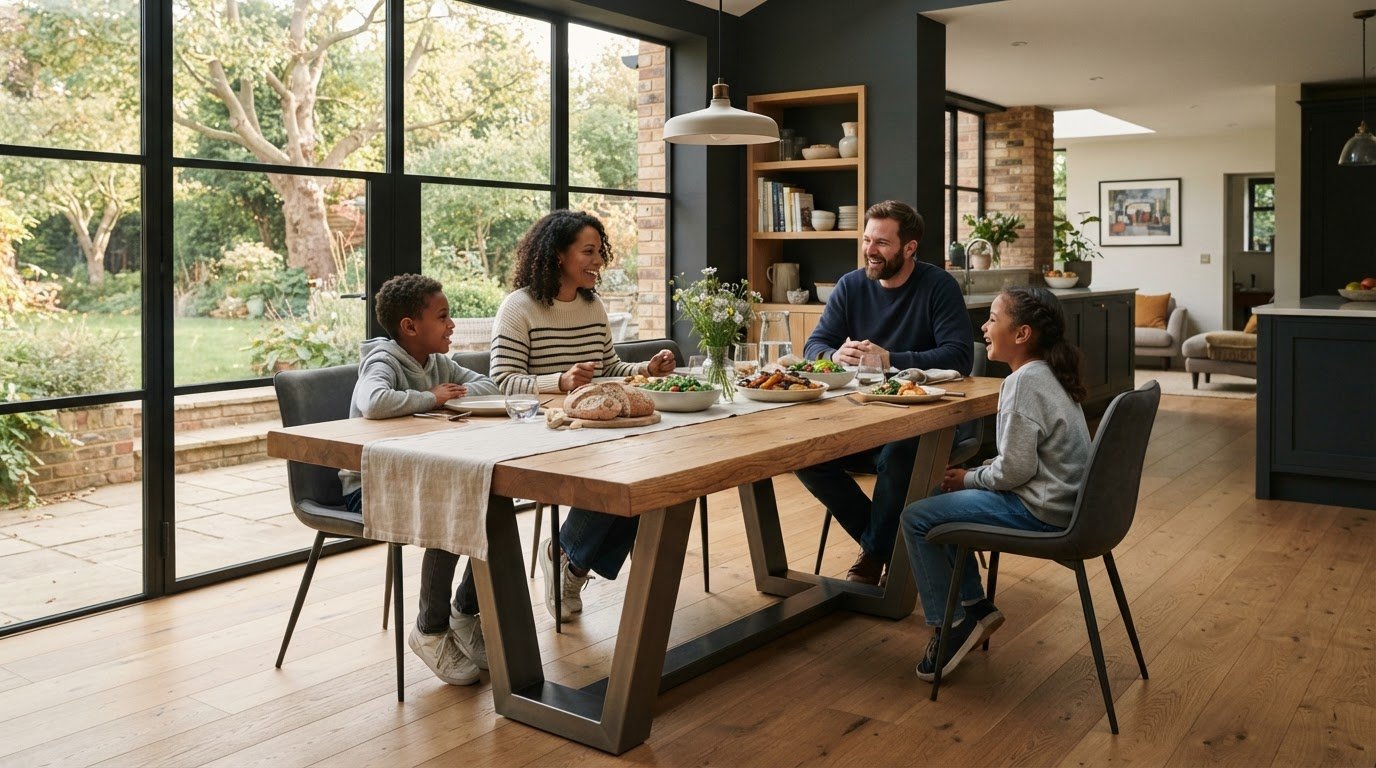
What if the base that makes a table stand out also affects how comfortably everyone can sit around it? A v-frame dining table brings a strong, angled shape into a room, but it is worth checking whether that shape will work with your chairs, available space and usual routines. Its appeal is not only visual. The frame’s position and proportions can also affect seating and legroom.
If you like the design but are unsure how it will fit your home, start with practical details as well as appearance. This guide explains what defines a V-frame, how to assess its scale alongside your room and chairs, and what to ask the maker about dimensions, materials, finishes, tabletop options and seating compatibility. It also compares V-shaped bases with other common table supports, so you can weigh the differences against your needs. The Mensa Table Company offers a V-Frame as part of its handcrafted dining-table range, giving you a specific design to consider for everyday meals and conversations.
Key Takeaways
- Recognise how a v-frame dining table’s angled supports shape its appearance, and check the specific frame layout rather than assuming all designs are alike.
- Assess where the supports sit in relation to your usual chair positions to help judge seating comfort and legroom.
- Compare V-frame, A-frame, X-frame and pedestal bases by their silhouettes and the practical points that matter in your room.
- Measure the table area with chairs pulled out, then consider how people will move around the dining space.
- Before choosing, ask the maker to confirm dimensions, materials, finishes, tabletop options and any seating or bench compatibility.
What Is a V-Frame Dining Table, and What Makes Its Design Distinctive?
A V-frame dining table has visible supports arranged to form a V-shaped outline beneath the tabletop. The construction can vary, so the name describes the frame’s appearance rather than specifying how its parts are joined, where they sit or how the table is supported. These details matter: the base creates the silhouette, while seating clearance and stability depend on the individual design.
A dining table’s top and supports work together as a useful surface and as furniture that shapes a room. For broader context on how tables have served practical and social roles over time, see this overview of the history of tables. With a V-frame, the angled lines beneath the top draw the eye downwards and can give the table a more graphic presence than a base that recedes visually.
How does a V-frame table base create its distinctive look?
Look at the outline made by the supports. The angled elements meet or lean towards one another to create a recognisable V. Their spacing, angle and position beneath the tabletop affect the table’s overall balance. A prominent frame may make the base a focal point, while a less conspicuous one can leave more attention on the tabletop. If the maker provides product photographs, check the side and end views to understand the actual arrangement rather than assuming every V-frame is built in the same way.
The shape alone does not show how the frame is fixed or how stable the finished table is. Ask the maker to confirm these product details, particularly if you are considering a large tabletop or expect to use the table every day.
Which interiors can a V-frame dining table complement?
Consider the lines already in your room. A V-shaped base can echo angular details in chairs, lighting or shelving, or provide a deliberate contrast in a space with softer shapes. In a simple setting, its outline may become a feature. In a room with patterned furniture or strong architectural details, it may compete for attention. Neither effect is automatically right. Think about how the table will sit alongside the pieces you already own.
Before settling on a look, review photographs of the particular model and confirm its materials, finish and proportions. The Mensa Table Company offers a V-Frame dining table within its handcrafted dining-table range, but those details cannot be inferred from the style name. Consider appearance and practical fit separately: a striking base still needs to suit the room and the way people sit around it.
How the V-Frame Base Affects Seating, Legroom and Everyday Use
A V-shaped base may look open beneath the tabletop, but appearance alone will not tell you whether your chairs fit comfortably. Usable seating depends on the frame’s exact position, the table’s dimensions and the width and shape of your chairs. A support behind a chair may not affect where someone sits, while one aligned with a seat could limit chair placement or foot space.
Table design balances the needs of a useful surface with the form of its supports. The development of table design offers broader context, but for a particular v-frame dining table, the practical answer lies in its measurements and layout. Ask the maker for a dimensioned drawing or measurements showing where the supports sit, then compare them with your planned chair positions. Do not assume that every V-frame offers the same clearance.
Will a V-frame dining table leave enough room for chairs?
Sketch the tabletop from above and mark where each chair will go, including chairs at the ends if you plan to use them. Compare those positions with the supports, and measure your chairs at their widest point. This can reveal possible clashes before you order. The number of people who can sit comfortably depends on the actual tabletop dimensions, chair widths and support layout, so avoid relying on a general seating estimate without checking the product measurements.
Also allow for chairs to be pulled out. A table may fit within the room, but the chairs could leave too little space to sit down, stand up or move around it.
What should you consider for daily dining?
Think about your usual routine. Do you add a chair for visitors, use the ends of the table or sit down for longer meals? Check where feet will rest at each regular seat, and whether the frame could interrupt a comfortable position. If possible, assess the table in person. Otherwise, use a floor plan and measurements to compare the base with your chairs and available space.
Consider access beneath and around the supports when cleaning. Before deciding, ask the maker questions such as:
- What are the tabletop dimensions and the exact positions of the supports?
- How much clear space is available for chairs along the sides and at the ends?
- Are there measurements or diagrams showing legroom and the underside of the table?
- Which chairs or matching benches, if any, are compatible with this model?
- How should the table be cleaned around and beneath its frame?
These details can help you judge whether the design suits your household. For model-specific guidance, you can ask The Mensa Table Company about the V-Frame table.
V-Frame vs Other Dining Table Bases: Which Shape Fits Your Priorities?
A table base shapes more than the space beneath the top. Its lines affect the table’s visual weight, while the supports’ actual position can influence where chairs fit. Compare the silhouette you like with the clearances you need, rather than choosing by style name alone. These creative dining table base ideas offer visual inspiration, but product measurements are what show how a particular table may work in your home.
How does a V-frame compare with an A-frame or X-frame?
A V-frame is defined by supports that form a V-shaped outline. An A-frame suggests an A-like profile, while an X-frame brings two crossing directions into view. Each creates a different pattern beneath the tabletop: a V draws attention to its angled lines, an A has a more triangular outline, and an X creates an intersecting effect. None is automatically the better choice. The visual weight of each depends on the proportions and placement of the frame in the particular design.
| Base type | Silhouette | Points to check | Potential room considerations |
|---|---|---|---|
| V-frame | Angled supports forming a V | Support positions in relation to chairs and feet | A pronounced geometric feature beneath the top |
| A-frame | Supports arranged in an A-like outline | Whether the frame narrows or occupies space near seating | A triangular shape that can complement other angular details |
| X-frame | Supports crossing to create an X-like form | Where the crossing point and frame sit beneath the top | A strong intersecting pattern that may become a focal point |
| Pedestal | Central support or supports beneath the top | Base footprint, stability and chair positions | A visually simpler outline around the table edges |
When might a pedestal or simpler base suit your needs?
If flexible chair placement is a priority, a pedestal may be worth comparing because it can leave the table edges less interrupted by corner legs. That does not guarantee better clearance: the pedestal’s footprint, tabletop size and chair design still matter. A simpler-looking base may also suit a room where you want the tabletop or surrounding furniture to take visual precedence. Check the actual frame layout and dimensions before deciding.
The V-Frame is one of several options in The Mensa Table Company’s dining-table range. Browse the dining table range to compare available base styles, then use each product’s details to assess its proportions and seating positions. The right choice is the one whose shape suits your room and whose measured layout works for the way you gather.
How to Choose the Right V-Frame Dining Table for Your Room
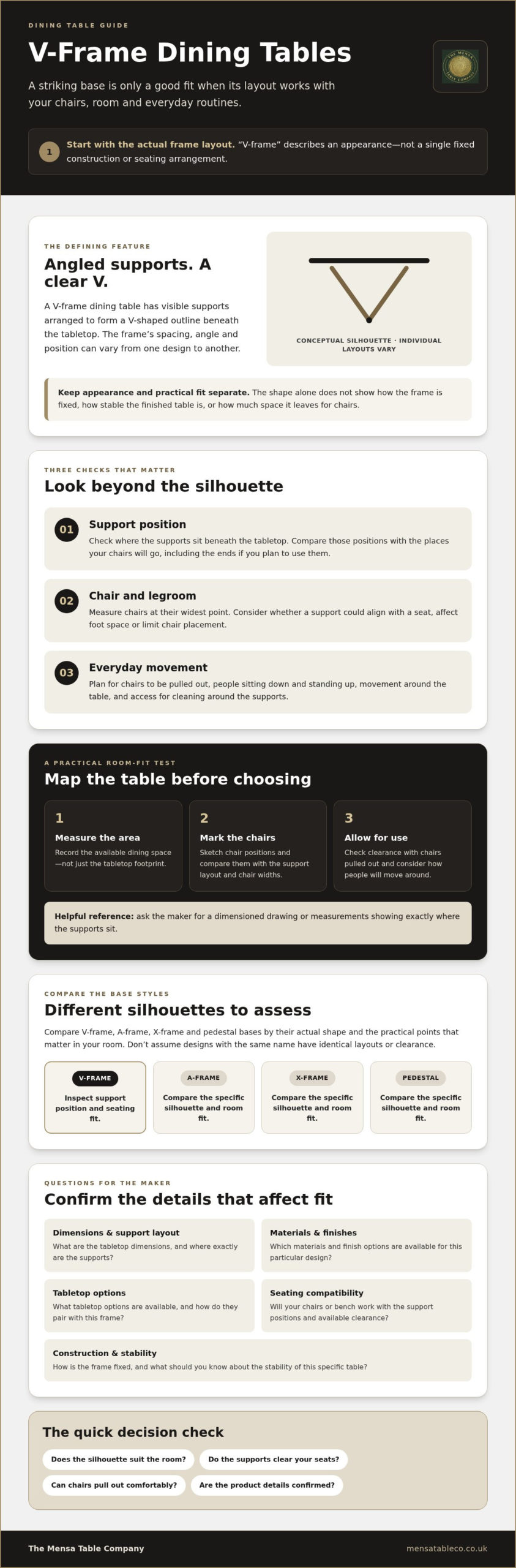
A table can look perfectly proportioned on its own, then feel awkward once chairs are in place and people are moving around it. Choose a v-frame dining table by testing the whole arrangement, not just measuring the tabletop. This four-step process connects your room dimensions with the frame, chairs and everyday routes through your home.
- Measure the room and proposed table area. Note the available floor space, doorways and nearby furniture. Measure the tabletop you are considering, then mark its outline on the floor with masking tape or paper to judge its scale.
- Plan circulation. Map the paths people use to enter, leave and move through the room. Check these routes with chairs pulled out, since the table’s footprint alone will not show how much space the occupied dining area needs.
- Assess your seating. Mark each intended chair position and compare chair widths with the tabletop and supports beneath it. Consider how often you will add a chair or use the table ends, and whether a matching bench might suit your layout.
- Confirm the product details. Compare your room plan with the maker’s measurements and ask about the frame’s placement, materials, finishes and available tabletop options.
How do you measure the room around a V-frame table?
Measure the proposed tabletop area and the routes people need to use around it. Then mark the chair positions, including the space each chair occupies when pulled back for someone to sit down or stand up. Walk the planned route as you would during a meal. This simple floor plan can reveal a tight corner or blocked walkway before you choose a table, without relying on a one-size-fits-all clearance figure.
What product details should you confirm before ordering?
Ask the maker to confirm the tabletop’s exact dimensions and the positions of the supports beneath it. Check which materials and finishes are available for the specific model, and whether your chosen chairs or a bench suit its layout. If a product description or photograph leaves a question unanswered, ask for clarification rather than assuming all V-frame designs are alike.
- What are the tabletop dimensions and frame placement?
- How might the supports relate to my planned chair positions?
- Which materials, finishes and tabletop options are confirmed?
- Is a matching bench compatible with this table?
With your room measurements and seating plan to hand, contact the table makers with your V-Frame questions and discuss the details that matter for your home.
Explore the V-Frame Dining Table with The Mensa Table Company
The V-Frame dining table is one option in The Mensa Table Company’s range of handcrafted dining furniture. Its angled base can bring a clear geometric presence to a dining room, but the right choice also depends on how the table fits your space and the people who will gather around it. Start an enquiry with practical details so you can compare the design with your room rather than relying on the style name alone.
What can you ask the makers about the V-frame table?
Ask for the confirmed dimensions of the tabletop and the position of the frame beneath it. These details help you compare the supports with your planned chair positions and assess legroom. You can also ask which materials, finishes and tabletop options are available for this model, and whether a matching bench or other seating arrangement is compatible. Confirm the answers for the specific table rather than assuming options apply across the range.
- What are the table’s exact dimensions and support positions?
- Which materials, finishes and tabletop options are confirmed?
- How might the frame affect the chair positions in my seating plan?
- Are matching benches compatible with this V-Frame table?
It can help to share a simple room plan, measurements of your dining area and details of the chairs you expect to use. If you have a particular visual preference, describe the proportions or overall feel you are looking for. Explaining how the table will be used can make your product questions more specific. Ask the maker to clarify anything not covered in the product information.
How to take the next step with confidence
Before deciding, bring together four checks: whether the table fits the room, whether chairs have space to move, whether its proportions suit your surroundings and whether the product specifications are confirmed. Photographs help you judge appearance, while measurements and a seating plan help you think through everyday use. Neither needs to be guessed from the V-frame label.
With those details in hand, send an enquiry about the V-Frame dining table to The Mensa Table Company. A considered conversation about the frame, dimensions and seating can help you decide whether it suits your home. A dining table is more than a shape beneath a top. It can become the familiar setting for shared meals, passing conversation and everyday routines.
Choose a Table That Feels Right at Home
A V-frame’s angled supports can make a dining table a distinctive focal point, but the best choice balances that visual character with the way your household uses the room. Measure the space with chairs pulled out, check where the frame sits in relation to your seating, and confirm the table’s dimensions and available specifications with the maker. These practical checks help you choose with confidence rather than guesswork.
The Mensa Table Company offers a V-Frame dining table as part of its handcrafted furniture range. Before deciding, consider how its proportions will sit alongside your existing furniture and which details you still need clarified. A dining table becomes part of everyday life, from quick meals to long conversations around the table.
Ready to explore whether the design suits your home? Talk to us about a V-Frame dining table and share your room measurements, seating plan and questions. This gives you a practical starting point for deciding whether the table fits the moments you’ll share around it.
Frequently Asked Questions
What is a V-frame dining table?
A V-frame dining table has visible supports arranged to create a V-shaped outline beneath the tabletop. The name describes the base’s appearance, not a single construction method, so the exact position and joining of its supports can differ between models. The Mensa Table Company includes a V-Frame dining table in its range. Check the specific product details to understand its proportions and frame layout.
Are V-frame dining tables practical for everyday use?
They can be practical for everyday dining if the particular table suits your room, chairs and routines. Before choosing, consider where the supports sit in relation to your usual seats, whether chairs can be pulled out comfortably and how accessible the area beneath the table is for cleaning. Measurements or a product drawing can help you assess these details. Do not judge daily comfort from the V-shaped silhouette alone.
Does a V-frame dining table affect legroom?
It can, depending on where the supports sit beneath the tabletop and where people are seated. A v-frame dining table will not necessarily offer the same legroom as another V-frame model. Compare the frame’s position with your intended chair places, and check whether diners have room for their feet. Ask the maker for dimensions or a drawing that shows the base layout before deciding.
How do I choose the right size V-frame dining table?
Measure the space for the tabletop, then allow for chairs pulled out and the routes people use around the room. Compare the table’s confirmed dimensions with your available floor area, and consider the width of the chairs you plan to use. If you are unsure whether the arrangement will fit, mark the proposed footprint on the floor and ask the maker to confirm the model’s measurements.
Can you use a bench with a V-frame dining table?
A bench may work, but compatibility depends on the table’s dimensions and frame position. The Mensa Table Company sells matching benches, though you should confirm whether a particular bench suits the V-Frame table. Ask about clearance along the side, how the bench would sit in relation to the supports and whether there is enough room to move it in and out comfortably.
How does a V-frame compare with an A-frame dining table?
A V-frame has supports that create a V-shaped outline, while an A-frame suggests an A-like shape beneath the top. The difference changes the visible pattern and perceived visual weight of the base, but neither design is automatically more suitable. Compare photographs and measurements of the specific models, paying attention to support placement, chair positions and how the table’s outline fits your room.
What should I ask before ordering a V-frame dining table?
Ask the maker to confirm the tabletop dimensions, frame positions, available materials and finishes, and any tabletop options for the specific model. Check how the base is fixed, how it may relate to your planned seating, and whether a matching bench is compatible. Sharing your room measurements, chair dimensions and seating plan can make your questions more useful and help you assess the table before ordering.

Leave a Reply