
What if the wait for a handmade table says less about a national standard and more about the work behind your particular piece? If you’re looking for the typical waiting time for a handmade table UK buyers can expect, current estimates commonly fall between 4 and 14 weeks, with more complex projects sometimes taking longer.
It’s understandable to want a firm date, especially when you’re coordinating a table with a move, renovation or special occasion. But a maker’s lead time can cover different stages, from agreeing the design and materials to making the table and arranging delivery. The table’s size, specification and the workshop’s existing schedule can all affect the timeline, so one estimate won’t necessarily match another.
This guide explains why there’s no single UK-wide waiting time, which parts of the process can shape yours, and how to plan with less last-minute pressure. Whether you’re choosing a Mensa, Spider Leg or X-Frame dining table, or planning matching benches, understanding the steps can help you make room for the piece that will gather people around it.
Key Takeaways
- Understand why the typical waiting time for a handmade table UK customers encounter is an estimate, not a universal promise.
- See how dimensions, design details, materials and finish choices can shape the work involved in an order.
- Learn when a ready-made table may arrive sooner: when the exact piece you want is already available.
- Plan backwards from your move, renovation or occasion, agree the table details early and leave some extra time in your plans.
- Explore how choosing a Mensa, Spider Leg, X-Frame or another dining table style, with matching benches if desired, fits into your plans.
What Is the Typical Waiting Time for a Handmade Table in the UK?
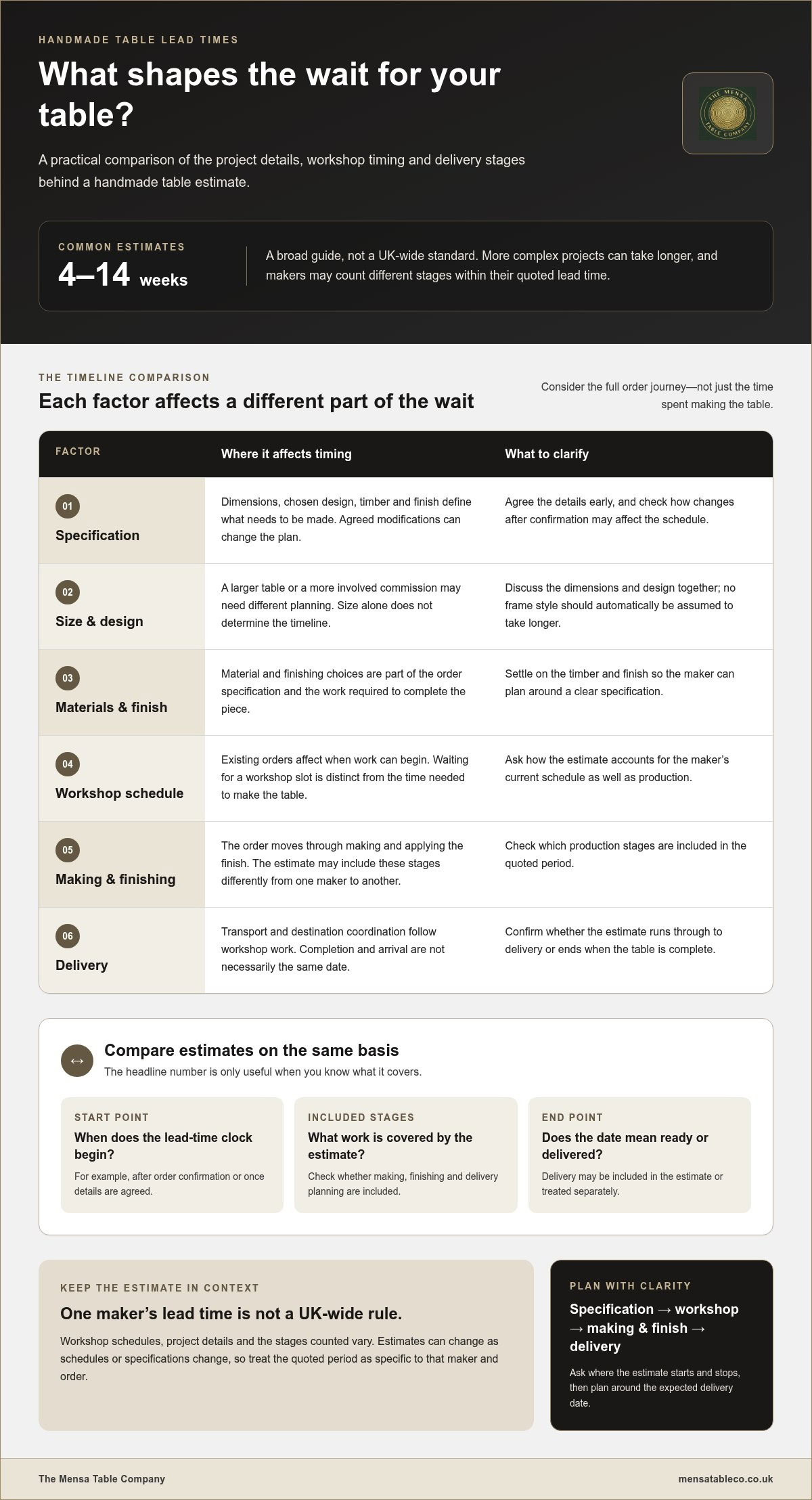
There isn’t one timetable that applies to every handmade table. Estimates commonly fall between 4 and 14 weeks, but this is a broad guide based on individual makers’ stated lead times, not a UK-wide standard. The typical waiting time for a handmade table UK buyers encounter depends on the piece, the workshop schedule and what the quoted period includes.
In this context, lead time means the period from agreeing the order details to the expected delivery of the completed table. The term is also used more broadly for the wait between placing an order and receiving a product; see this explanation of typical waiting time. For a handmade piece, look beyond the headline number and establish where the clock starts and stops.
What does a handmade table lead-time estimate include?
The process may involve discussing the project, agreeing the table’s specification, making it, applying the finish and coordinating delivery. Estimates don’t always cover each stage in the same way. One maker might start counting once the order is confirmed, while another may refer to the period after the design and details are agreed. Delivery may be included in the estimate or treated as a separate stage.
Compare what the timeframe covers, not just the number of weeks. A useful estimate identifies its starting point and whether it runs through to delivery.
Why is there no single UK-wide waiting time?
Each workshop has its own order schedule, and each table has its own requirements. A straightforward design and a more involved commission won’t necessarily move through the process at the same pace. Even estimates from one maker can change as the schedule or project details change.
Published lead times offer examples of how long a particular maker’s orders may take; they don’t establish a timeframe for every UK workshop. Makers may start counting from different points or allow different periods for making, finishing and delivery planning.
Lead times are maker- and project-specific, so one workshop’s estimate shouldn’t be treated as a UK-wide rule. When comparing waiting times, check the start date, which stages are included and whether the expected date means the table will be ready or delivered. Those details make estimates easier to assess and help you plan around when you want your table in place.
Which Parts of Making a Handmade Table Can Affect the Wait?
A table’s lead time reflects more than the hours spent shaping and assembling it. The process begins with a clear specification, moves through making and finishing, then requires delivery to be coordinated. Some factors affect the time needed to create the piece; others affect when work can begin or when the finished table can reach your home.
Dimensions, design complexity, material and finish choices, agreed modifications, workshop capacity and delivery arrangements all influence a handmade table’s lead time. Their effect depends on the individual project, so none can be converted into a reliable, universal number of extra weeks.
How size, design, and finish shape production planning
Settling the dimensions and finish helps define what needs to be made. A straightforward specification may involve fewer decisions than a commission with several agreed changes or detailed finishing requirements. A larger table can also call for different planning from a smaller one, although size alone doesn’t determine the timeline.
Frame styles such as the Mensa, Spider Leg, X-Frame or Trapezium offer different design directions, but no style should be assumed to always take longer. The practical question is what your chosen design, dimensions, material and finish require together. Changes after those details have been agreed may also mean the plan needs to be reviewed.
How workshop schedules and delivery coordination matter
The time required to make a table and the time spent waiting for a workshop slot aren’t the same thing. Existing orders shape a maker’s schedule, so a project may be ready to start later even if the making process is well defined. When reviewing an estimate, consider how it accounts for the workshop schedule as well as the work itself.
Delivery planning follows the making and finishing stages, but arrangements vary. The expected delivery date may depend on coordinating transport and the destination, so don’t treat the completion of workshop work as the same date the table will arrive.
Material choices are another part of planning: settling on timber and finish gives the order a clearer specification. For background on the UK Government’s approach to timber sourcing, read its policy paper on deforestation due diligence. The paper provides context on sourcing policy; it shouldn’t be read as a prediction of the timing for any individual table.
For the typical waiting time for a handmade table UK buyers might experience, consider how these factors interact rather than focusing on one detail in isolation. If you have a particular table style, size or date in mind, share those priorities as you plan the order. This helps make the specification and timing clearer from the outset.
Handmade vs Ready-Made: Comparing Waiting Times
A ready-made table may arrive sooner than a handmade one, but only if the piece you want is already available. If it needs to be made after you order, there may still be a production wait. The useful comparison isn’t simply handmade versus ready-made: consider whether the table is already made, how closely it fits your needs, and what happens between ordering and delivery.
As you consider the typical waiting time for a handmade table UK makers publish, compare the route as well as the headline estimate:
| Route | How it’s made and specified | What shapes the wait |
|---|---|---|
| Ready-made and available | The table is already made, with choices usually limited to the items offered. | Dispatch and delivery arrangements still affect when it reaches you. |
| Made to order | An established design or specification is produced after the order is placed. | The workshop schedule and making process contribute to the wait. |
| Bespoke or individually specified | The design and details may involve more decisions tailored to the project. | Agreeing the details and carrying out the work shape the schedule. |
These are broad distinctions, not fixed definitions. Furniture sellers don’t always use “made to order” and “bespoke” in exactly the same way, so focus on what the terms mean for the particular table and when its lead time begins.
When might a ready-made table suit a tight deadline?
If the exact table you want has already been made and is available, choosing it may reduce the wait before dispatch. That can suit a firm move-in date or occasion. Ready-made choices may offer less flexibility over dimensions, finish and design, however. Factor in delivery too: an available item isn’t necessarily delivered immediately.
What changes between made-to-order and bespoke furniture?
Made-to-order may mean choosing within an established design or specification; bespoke may involve more individual decisions about the piece. The labels vary, so clarify what’s being agreed and what work follows. More customisation can add planning steps as details are developed, but it doesn’t translate into a universal extra number of weeks.
Choosing a table is also about how it will sit in your home and serve everyday meals. If a ready-made option fits your space and priorities, its availability may suit your schedule. If the design, dimensions or specification of a handmade table matter more, weigh that fit against the time needed to make and deliver it. Compare the starting point, production and delivery in each estimate before deciding which route works for you.
How to Plan a Handmade Table Order Around Your Date
A move, renovation or family gathering can give your table order a real deadline. Share that date before finalising the details, so the expected making and delivery schedule can be considered alongside your plans. The typical waiting time for a handmade table UK makers quote is a guide, not a date to build your whole schedule around.
A practical timeline checklist before placing an order
Work backwards from when you need the table in place, allowing for the order process as well as the making itself. Leave some breathing room in your own plans in case they shift, rather than assuming every maker needs the same buffer.
- Set the needed-by date. Note when the table must be ready for use, whether that’s before a move, once renovation work is complete or ahead of a gathering. Share the date early.
- Choose your priorities. Decide what matters most: the date, a particular design, specific dimensions or a finish that suits your home. Knowing what’s essential can make decisions easier.
- Agree the specification. Settle the details before the order is finalised. Changes later may require the plan to be reviewed.
- Plan delivery and leave room. Account for delivery coordination as well as production. Don’t rely on the earliest estimate as your only planning date.
Keep the agreed details and any date-related correspondence together. This gives you a clear reference point for the specification and timing discussed.
What details should you have ready?
Before discussing handmade dining tables, make a note of the dimensions that suit your room and how many people you’d like to seat. Think about the style, material and finish you prefer, as well as practical needs such as leaving enough room to move around the table.
If benches or other furniture need to coordinate, include them in the conversation from the beginning. A matching bench, for example, may affect how you plan the table’s dimensions and the space around it. Having those details together helps define the order as a whole, rather than treating each piece as an afterthought.
Bring your preferred date and priorities into your planning with The Mensa Table Company. Discuss your table plans and timing, including the details that matter to you.
Discuss Your Handmade Table Plans with The Mensa Table Company
A table becomes part of the rhythm of a home: weekday suppers, long conversations and gatherings with family and friends. Choosing one is about more than finding a style you like. Room dimensions, how you use the table, material preferences and the date you need it all help shape your plans. Discussing these details together gives the timing conversation useful context, without relying on a general estimate as a promise for your order.
Match your table choice to the room and the way you gather
The Mensa Table Company makes handmade dining tables in Mensa, Spider Leg, X-Frame, U-Frame, Trapezium, A-Frame and V-Frame styles. Consider the character you want the table to bring to the room, how many people you’d like to seat and how much space you have around it. These practical details help guide a choice that suits both shared meals and daily life.
Material is part of the decision, too. If you’re considering solid European oak tables, bring that preference into the discussion alongside your chosen style and dimensions. If matching furniture is part of the plan, mention it at the same time so the pieces can be considered together.
Make the next step clear without promising a set turnaround
Share your preferred table style, approximate dimensions, material and finish ideas, along with any important dates, such as a move, renovation or gathering. If your plans have flexibility, say so; if a particular date matters, make that clear before the order details are settled. The typical waiting time for a handmade table UK buyers encounter is only a broad reference. Your project’s timing needs to be considered in light of its agreed details.
Once the table and its requirements are clearly described, you can discuss how your chosen piece fits your plans. There’s no need to assume every design follows the same schedule. A Mensa, Spider Leg or other frame-style table has its own specification, and timing should be considered alongside the details of the project.
Have a style, a room in mind or a date you’re planning around? Discuss your handmade table plans with us. Share what matters to you, and we can talk through your table and timing together.
Plan Ahead for a Table Made for Your Home
The typical waiting time for a handmade table UK buyers encounter isn’t a fixed national standard. Lead times depend on the maker, the agreed design and materials, workshop scheduling, and what’s included in delivery. Compare estimates by checking when the clock starts and what stage the expected date refers to.
If you have a date in mind, share it early, settle your priorities and table details, and leave some room in your plans rather than relying on the earliest estimate. Dimensions, finish and delivery arrangements all contribute to a realistic timeline.
The Mensa Table Company makes handmade dining tables in styles including Mensa, Spider Leg and X-Frame, alongside other frame designs and matching benches. Together, they can create a welcoming setting for everyday meals and the occasions you look forward to.
Have a style or date in mind? Discuss your handmade table plans with us, including the dimensions, materials and details that matter to you. Start planning a table that feels at home in your space.
Frequently Asked Questions
How long does a handmade table usually take to make in the UK?
A commonly cited estimate for a handmade table in the UK is around 4 to 14 weeks, but this is a broad guide, not a national standard or a guaranteed delivery window. The typical waiting time for a handmade table UK buyers experience depends on the maker’s schedule, the table specification and what the estimate includes. Check whether the timeframe runs from agreeing the order details to completion, dispatch or delivery.
Why can handmade table waiting times vary so much?
Waiting times vary because each workshop has its own order schedule and each project involves different decisions and work. Table dimensions, design, material, finish and agreed changes can shape production planning. The maker’s existing workload also affects when a project can begin, while delivery arrangements influence when the finished table arrives. Compare estimates by checking their starting point and the stages they cover, rather than relying on the headline number alone.
Does a bespoke dining table take longer than a standard design?
It can involve more planning, but “bespoke” and “standard” aren’t used consistently by every furniture seller, so the label alone won’t tell you the timeline. A project with individual design decisions or modifications may require more details to be discussed and agreed before work begins. A standard design can still be made to order. Focus on the actual specification and what the estimate covers from agreement through to delivery.
When does the waiting time for a handmade table start?
It depends on how the maker defines its lead time. Some estimates start once the order is confirmed; others may begin after the design, dimensions, material and finish have been agreed. The discussion and specification stage may therefore sit outside the quoted period. Before planning around an estimate, establish its starting point and whether it includes making, finishing and delivery coordination, so you understand what the expected date means.
Can I order a handmade table in time for a specific event?
Possibly, but timing depends on the project and the maker’s schedule, so share your event date before finalising the order details. Work backwards from when the table needs to be in place, allowing for decisions, production and delivery planning. Leave some personal contingency rather than relying on the earliest estimate. A clear date gives the maker important context, but it shouldn’t be treated as a guaranteed delivery promise.
Is a ready-made table quicker to receive than a handmade table?
It may be quicker if the exact table you want has already been made and is available. Even then, dispatch and delivery coordination affect arrival. If a ready-made item doesn’t suit your preferred size, finish or design, it may not meet your needs; an item made after ordering may also involve a wait. Compare availability and delivery timing with the fit and specification you want, not just the furniture category.
Does choosing a matching bench affect a handmade table order?
Including a matching bench means planning the table and seating together. Consider how both pieces will fit your room, and share your preferred dimensions and requirements as part of the order discussion. The extra coordination may affect planning, but it doesn’t automatically add a set amount of time. The Mensa Table Company offers matching benches alongside its handmade dining tables, so you can discuss how the pieces and your required date fit together.

Leave a Reply