The most sustainable piece of furniture you will ever own isn’t the one made from recycled plastic; it’s the one you only have to buy once. Choosing a solid wood dining table is an act of intentionality in a world increasingly filled with disposable, flat-pack alternatives. We understand the hesitation that often accompanies such a significant investment. You want the warmth of natural grain without the fear of wood warping or cracking as the seasons change. It’s common to feel caught between the allure of genuine timber and the confusion of high-quality veneers that simply cannot offer the same soul or longevity.
We believe the focal point of your home should be as structurally sound as it is beautiful. This guide will help you discover how to select a handcrafted table that balances timeless aesthetics with generational durability. You’ll gain the confidence to choose the right timber species, whether you’re drawn to the deep, chocolate tones of Black Walnut or the reliable character of European Oak. We will also explore the ergonomic benefits of bespoke leg designs, including our signature Mensa and Spider Leg frames, so you can perfectly visualize how your family will gather around your new centerpiece for decades to come.
Key Takeaways
- Learn why choosing a solid wood dining table is a long-term investment in your home’s legacy, offering a tactile durability that veneers simply can’t replicate.
- Gain confidence in selecting the right timber by understanding the distinct grain patterns and aging qualities of European Oak, Ash, and Black Walnut.
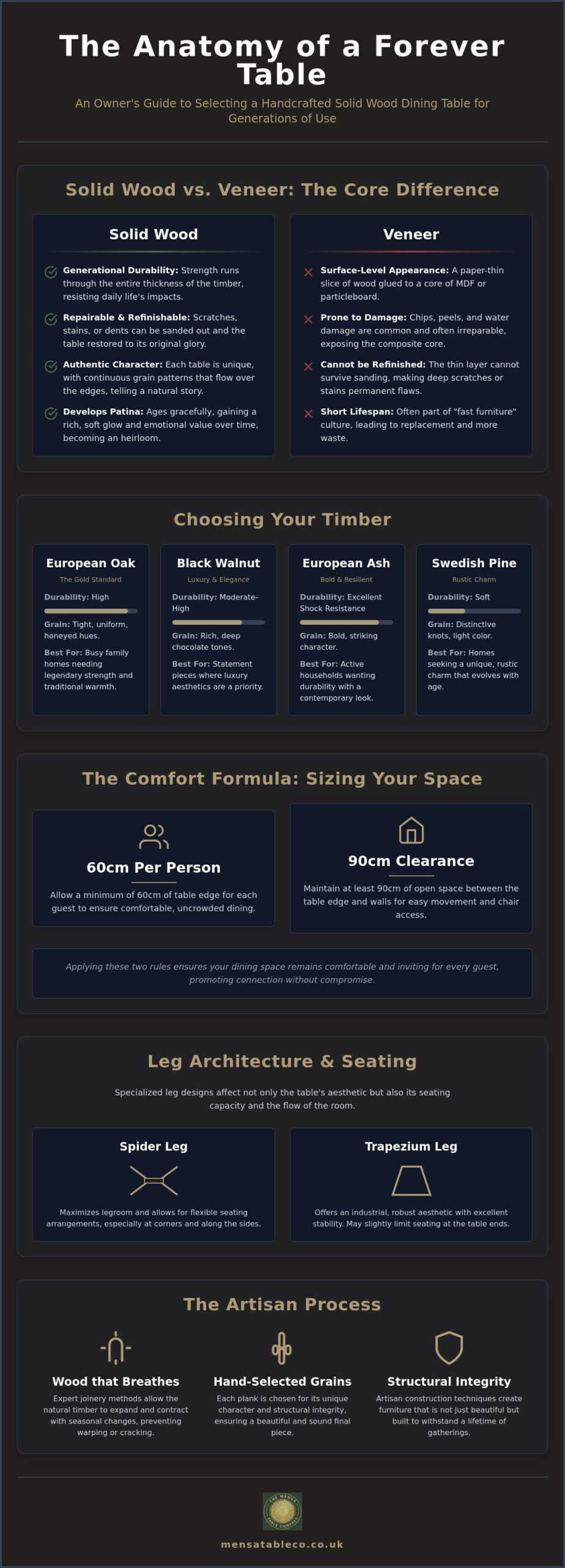
- Apply the 90cm clearance and 60cm per-person rules to ensure your dining space remains comfortable and inviting for every guest.
- See how specialized leg architectures, from the industrial Trapezium to the signature Spider Leg, affect your table’s seating capacity and room flow.
- Discover the artisan joinery methods that allow natural timber to breathe without compromising the structural integrity of your furniture.
Why Solid Wood is the Superior Choice for Your Dining Room
A solid wood dining table begins its journey long before it reaches your home. It starts in the quiet strength of a forest, where European Oak or Black Walnut grows for decades, developing a unique story within its rings. Choosing 100% natural timber over engineered alternatives is a decision to bring that living history into your daily life. Unlike mass-produced furniture that relies on chemical glues and thin coatings, real wood offers a tactile warmth that invites touch. Every knot and swirl in the grain is a singular mark of authenticity. No two pieces are ever identical.
Environmental responsibility is woven into the very fiber of these materials. In an era of “fast furniture,” the most sustainable choice is the one that never needs to be replaced. Real wood breathes. It possesses an inherent resilience that allows it to withstand the rhythmic chaos of family life, from spilled morning coffees to late-night conversations. This longevity reduces waste and honors the natural origin of the raw timber.
Solid Wood vs. Veneer: Spotting the Difference
Understanding the difference between solid timber and a veneer is essential for any intentional homeowner. A veneer is merely a paper-thin slice of wood glued over a core of particleboard or MDF. While it might look convincing at first glance, it lacks the structural heart of a true solid European Oak piece. Solid wood survives moves, house changes, and accidental knocks because its strength runs all the way through, unlike flat-pack alternatives that rely on flimsy cam-locks and screws.
You can identify quality by looking at the end-grain. If the grain patterns on the top of the table continue over the edge and down the side, you’re looking at natural timber. This depth allows for the artisan process of wood finishing to be repeated over time. If a solid wood dining table becomes scratched or stained after years of use, it can be sanded back and refinished to its original glory. Veneers simply don’t have the depth to survive a sander.
The Longevity Factor: Generational Furniture
We often speak about “forever furniture,” but with solid wood, this isn’t just a marketing phrase. It’s a physical reality. As years pass, timber develops a rich patina, a soft glow that only comes from age and use. It records the history of your home. While a budget table might seem cost-effective initially, its short lifespan often leads to a higher cost-per-year when you inevitably have to replace it. A handcrafted table, such as those made from solid Black Walnut, is a site for human connection that appreciates in emotional value, becoming a cherished heirloom for the next generation.
Comparing Timber Species: Oak, Walnut, Ash, and Pine
Selecting the right timber for your solid wood dining table is a deeply personal choice that dictates the atmosphere of your room. It’s about finding a balance between the visual story of the grain and the physical demands of your household. Every species we work with carries its own weight, texture, and resilience. To help you understand these differences, we look to the Janka hardness scale. This industry standard measures a wood’s resistance to denting and wear, ensuring your investment stands up to the rhythmic pace of daily life. Sourcing is equally vital. We prioritize European hardwoods because they offer superior density and a lower environmental footprint compared to many global alternatives. For a deeper look at the technical properties of different timbers, you might find this Guide to Furniture Woods helpful in your decision-making process.
Durability varies significantly between species, which is why your lifestyle should guide your choice:
- Solid European Oak: High durability, perfect for busy family homes.
- Solid Black Walnut: Moderate to high durability with a focus on luxury aesthetics.
- Solid European Ash: Excellent shock resistance and bold grain character.
- Solid Swedish Pine: A softer timber that ages with a unique, rustic charm.
The Classics: Solid European Oak and Ash
Solid European Oak remains the definitive gold standard for those seeking a blend of traditional warmth and legendary strength. Its tight, uniform grain and honeyed hues provide a sense of permanence that few other materials can match. If you prefer something more contemporary, Solid European Ash offers a lighter, creamier palette with striking, sweeping grain patterns that act as a piece of natural art. Both species respond beautifully to natural oils and waxes. These finishes penetrate deep into the fibers to protect while highlighting the wood’s inherent character. You can explore our Solid European Oak collection to see these textures for yourself.
The Premium Choice: Solid Black Walnut
For a truly sophisticated statement, Solid Black Walnut is unparalleled. It’s the ultimate luxury timber, known for its rich, chocolate tones and elegant, flowing grain. Walnut brings an immediate sense of maturity and calm to modern dining spaces. While it sits slightly lower on the hardness scale than Oak, its natural oils make it incredibly stable and resistant to shrinking or swelling. It’s a wood that demands attention without being loud. View our handcrafted Solid Black Walnut tables to discover how this species can transform your home.
Character and Charm: Solid Swedish Pine
If your home leans toward a rustic or farmhouse aesthetic, Solid Swedish Pine offers a soft, inviting charm. It’s a more affordable entry into the world of handcrafted furniture, yet it doesn’t sacrifice warmth or personality. Pine is a living record of its environment, often featuring more knots and color variations that add to its “lived-in” feel. It’s perfect for creating a cozy, informal backdrop for family meals. You can browse Solid Swedish Pine furniture to find the right fit for your space.
Choosing the perfect timber is the first step in a very personal journey. If you’re still unsure which species best fits your lifestyle, our team is always happy to discuss your specific requirements and help you find the right match.
Leg Architecture: Balancing Design and Ergonomics
The foundation of a solid wood dining table lies beneath its surface. While the timber top captures the eye with its natural grain, the leg architecture dictates the daily rhythm of your home. We’ve seen many dining rooms where the table top is beautiful, but the legs make seating a struggle. Choosing the right frame is about balancing visual weight with ergonomics. You must ensure there’s enough knee room and that chairs can tuck in fully when not in use. For those looking for deeper technical insights into high-quality construction, a guide to selecting wood furniture provides a wonderful foundation for understanding how different components work together to ensure longevity.
Industrial-inspired steel frames have seen a rise in popularity because they offer incredible strength without the bulk of traditional timber legs. This allows us to create designs that feel light and airy, even when supporting a heavy slab of European Oak. The choice of frame doesn’t just affect style; it determines how many guests you can comfortably host without someone knocking their knees against a support beam.
The Signature Mensa and Spider Leg Models
The Spider Leg Dining Table is a masterclass in seating flexibility. By centralising the support, this design removes the obstacles usually found at the corners of a table. It’s an ideal choice for round tables or smaller rooms where you might need to squeeze in an extra guest during a celebration. The Mensa Dining Table offers a more architectural statement. Its balanced, geometric frame provides a sturdy base that feels grounded and modern. Both models are designed to maximize chair clearance, ensuring that the “flow” of your dining area remains uninterrupted.
X-Frame, U-Frame, and Trapezium Styles
If you’re drawn to a rustic-industrial hybrid, the X-Frame Dining Table is the quintessential choice. Its bold, crossing lines provide exceptional stability and a sense of heritage. For those who prefer a minimalist or Scandi aesthetic, the U-Frame and Trapezium Dining Table designs offer clean, uncluttered lines. These frames are particularly effective because they allow for plenty of end-of-table seating. Unlike traditional four-legged tables, these styles give you more freedom to position chairs along the entire length of the timber.
A-Frame and V-Frame Designs
The A-Frame Dining Table provides a nod to traditional trestle tables but with a contemporary, manual finish. It offers immense structural stability, making it perfect for larger, heavier tops. In contrast, the V-Frame Dining Table offers a lighter visual footprint. Its tapered design creates a sense of movement and sophistication. To create a cohesive look throughout your home, you can often match these frame styles across your matching benches and coffee tables, ensuring every piece of furniture speaks the same design language.
Sizing Your Table for Comfort and Connection
A solid wood dining table is more than a surface; it’s the stage for your family’s most meaningful rituals. However, even the most beautiful piece of European Oak can lose its charm if the room feels cramped or guests feel crowded. To ensure your dining space remains a place of comfort, you must consider the physical flow of the room. The golden rule is to allow at least 90cm of clearance between the table edge and any walls or other furniture. This space ensures that people can move freely behind seated guests without causing a disruption. It transforms a tight corner into a functional walkway.
When calculating seating, we recommend the 60cm standard for elbow room per person. This measurement allows everyone to dine comfortably without feeling restricted or bumping into their neighbour. Standard off-the-shelf sizes often ignore these nuances, which is why we value the ability to customise your dining table size in our shop. Many UK homes feature unique architectural quirks, from chimney breasts to bay windows, that require a more intentional approach to dimensions than mass-produced furniture can provide. We believe your furniture should fit your home, not the other way around.
Seating Capacity: From 4 to 10 People
Choosing between a 4-6 seater and a grander 8-10 seater depends on both your daily life and your hosting aspirations. A 4-6 seater is often the perfect fit for compact kitchens, offering a sense of intimacy for morning coffees and family dinners. For those who love to host, an 8-10 seater becomes a grand centrepiece for the home. Don’t forget to consider table width. A wider top provides essential centre-of-table space for shared platters and decorative elements. This prevents the surface from feeling cluttered during a festive feast.
The Benefits of Matching Benches
Many of our clients find that discovering our range of matching dining benches is the key to balancing capacity and floor space. Benches are incredibly practical. They can be tucked completely under the table when not in use, opening up the walkway in smaller rooms during the day. Beyond the practical, they foster a communal, social atmosphere. There is something inherently warm about sliding onto a bench together; it creates a shared experience that individual chairs sometimes struggle to replicate.
If you have a specific space that requires a non-standard dimension to perfectly frame your room, reach out to our team to discuss a bespoke build tailored to your home.
The Artisan Process: Why Handcrafted Matters
Timber is a living material, even after it’s been shaped into a solid wood dining table. It continues to breathe, expanding and contracting in response to the moisture levels in your home. We’ve found that many mass-market retailers ignore the science of timber movement, resulting in pieces that eventually split or warp. We manage this natural rhythm through intentional, traditional joinery. By using techniques that allow the wood to slide and shift within its frame, we ensure the structural integrity of the piece remains perfect through the damp of winter and the heat of summer. This is the quiet expertise that distinguishes a handcrafted heirloom from a factory-line product.
Our work is a deliberate rejection of the flat-pack culture. Mass-produced furniture often relies on cam-locks, glue, and screws that lose their grip as the years pass. In contrast, our workshop focuses on solid joinery that outlasts these disposable alternatives. Every cut is precise, and every joint is designed to bear weight for generations. This manual approach extends to our finishing, where we use high-quality oils that bond with the wood fibers. These oils don’t just sit on the surface like a plastic lacquer; they enhance the tactile quality of the grain while providing deep, durable protection.
Caring for Your Solid Wood Investment
A solid wood dining table is remarkably resilient, but it does appreciate a little care. Daily maintenance is simple: a soft, damp cloth is usually all that’s required to keep the surface looking vibrant. It’s also helpful to manage the humidity in your dining room, as extreme fluctuations can put unnecessary stress on the timber. One of the greatest benefits of real wood is its repairability. Unlike veneers that must be discarded when damaged, solid timber can be lightly sanded and re-oiled. Scratches become part of the story, or they can be vanished with a bit of artisan attention, ensuring the piece stays in your family rather than heading to a landfill.
The Mensa Table Company Philosophy
Our dedication to the trade is rooted in a personal connection between the maker and the home. From the initial selection of raw European hardwoods to the final oiling of a solid Black Walnut top, every step is dictated by the time required for high-quality output. We don’t offer furniture restoration; instead, we focus our energy on creating new, durable pieces that won’t ever need it. When you choose one of our tables, you’re bringing a piece of our UK workshop into your life. It’s a story of ethical sourcing, manual production, and a belief that the things we gather around should be built to last a lifetime.
Investing in the Heart of Your Home
Choosing a solid wood dining table is a commitment to a slower, more intentional way of living. It’s an investment in a piece that doesn’t just fill a space but anchors the rituals of your daily life. By understanding the unique characteristics of European hardwoods and the ergonomic benefits of specialized leg architecture, you can move forward with confidence. You aren’t just buying furniture; you’re selecting a backdrop for a lifetime of shared meals and stories. The artisan process ensures that your table breathes and ages with grace, becoming more beautiful with every passing year.
Since 2018, we’ve been handcrafted in the UK, focusing our expertise on the tactile beauty of European Oak, Ash, and Black Walnut. Our team is dedicated to the manual production of every piece, ensuring that the natural history of the wood is honored in your home. With national UK delivery available, we’re ready to help you bring your vision to life. Explore our collection of handcrafted solid wood dining tables and find the piece that resonates with your family’s story. We look forward to crafting a generational centerpiece for your home.
Frequently Asked Questions
Is a solid wood dining table worth the extra cost?
A solid wood dining table is worth the investment because it offers a lifespan that mass-produced alternatives simply cannot match. While the initial cost is higher, the ability to sand and refinish the surface means the table can last for generations. It doesn’t end up in a landfill after five years. Instead, it becomes a cherished family heirloom that appreciates in sentimental value as it records the history of your home.
How do I prevent my solid wood table from cracking or warping?
Maintaining a stable environment is the most effective way to prevent your timber from warping or cracking. Wood is a living material that reacts to changes in humidity and temperature. Keep your table away from direct heat sources like radiators or wood burners, and try to maintain a consistent indoor humidity level. Our artisan joinery methods specifically allow for natural timber movement, which helps the wood breathe without compromising its structural integrity.
What is the best timber for a family dining table with children?
European Oak is generally the best choice for busy family homes with children due to its exceptional density and hardness. It sits high on the Janka scale, meaning it’s highly resistant to the daily knocks and scratches that come with family life. European Ash is another excellent alternative, offering similar durability with a striking grain that hides minor wear well. Both species provide a sturdy, reliable foundation for everything from homework to messy mealtimes.
Can I use a solid wood table in a room with underfloor heating?
Yes, you can use a solid wood table with underfloor heating, provided the timber has been properly seasoned and the room’s temperature is managed carefully. We recommend species like Oak or Walnut for their natural stability. It’s important to introduce the heat gradually and avoid placing the table directly over high-temperature zones. This careful approach prevents the wood from drying out too quickly, which is the primary cause of shrinkage or splitting in heated environments.
How often should I re-oil or wax my handmade wooden table?
We recommend re-oiling your table every six to twelve months, depending on how frequently the surface is used. You’ll know it’s time when the wood starts to look slightly dull or if water no longer beads on the surface. Applying a fresh coat of high-quality oil is a simple, rewarding process that restores the grain’s vibrancy. This regular maintenance ensures the timber remains protected and continues to feel soft and tactile to the touch.
What is the standard height for a solid wood dining table in the UK?
The standard height for a solid wood dining table in the UK usually sits between 75cm and 77cm. This dimension is carefully chosen to provide an ergonomic experience when paired with standard dining chairs. It allows for ample legroom while ensuring your arms rest at a comfortable level during meals. This balance of height and clearance is essential for creating a space where guests feel relaxed and connected throughout the evening.
Do I need to use a tablecloth on a handcrafted solid wood surface?
You don’t need to hide your table under a tablecloth; we encourage you to celebrate the natural grain and texture. While the wood is protected by high-quality oils, using coasters for hot drinks and placemats for heated plates is a sensible precaution. These small habits protect the finish from heat marks while allowing you to enjoy the tactile experience of the timber every time you sit down for a meal.
How do I choose between an X-frame and a Spider leg design?
Choosing between these designs depends on whether you value a rustic aesthetic or maximum seating flexibility. The X-Frame Dining Table offers a bold, industrial look that provides immense stability, though the legs can sometimes limit where chairs are placed. In contrast, the Spider Leg Dining Table features a centralised support system. This architecture removes obstacles from the corners, making it the perfect choice if you often need to squeeze extra guests around the table.

Leave a Reply