
Your dining table is the silent witness to your life’s most meaningful rituals, from quiet morning coffees to the boisterous laughter of a Sunday roast. Choosing a solid oak dining table in 2026 means looking beyond the glossy veneer of mass-produced furniture to find something that carries the weight of history and the promise of the future. You want a piece that feels grounded and honest, yet you’re likely worried about the common pitfalls of timber, like warping or the soul-crushing uniformity of high-street brands.
We believe a table is a site for human connection, not just a transaction. In this guide, you’ll discover how to distinguish true artisanal joinery from temporary fixtures and how to select a design that reflects your personal style. We’ll walk through the structural elegance of X-frame and Spider leg styles, explore the sensory richness of European oak grain, and provide the confidence you need to invest in a handcrafted piece that will serve your family for generations. From the initial inspiration of the raw timber to the functional role the item plays in your home, we invite you to appreciate the details that make a table truly unique.
Key Takeaways
- Learn why the slow, careful process of kiln-drying is essential for protecting the natural character of European Oak against the dry heat of modern living.
- Discover how to select a leg style, from the industrial X-frame to the sculptural Spider design, that balances your room’s aesthetic with the practical needs of your solid oak dining table.
- Master the essential measurements for seating and room clearance to ensure your dining space feels both spacious and inviting for every guest.
- Gain the confidence to choose artisanal joinery over mass-produced alternatives, investing in a piece that matures alongside your family’s story.
The Enduring Appeal of a Solid Oak Dining Table
The dining table acts as the quiet heartbeat of a home. It is the site for the ritual of the meal, where stories are shared and the day’s burdens are finally set aside. For centuries, British homes have looked to oak as the gold standard for furniture because of its incredible resilience and timeless character. When you run your hand across a solid oak dining table, you aren’t just touching a piece of furniture. You are connecting with a living history, feeling the unique ridges of a grain that grew over decades in the open air. This tactile experience is something mass-produced, synthetic alternatives simply cannot replicate. We believe in moving away from a culture of disposable goods, choosing instead to create pieces that become part of your family’s heritage. A table should be an investment in connection, a sturdy backdrop for a lifetime of Sunday roasts and late-night conversations.
Why Real Wood Beats Veneer and Flat-Pack
Choosing solid timber over particle board is a decision rooted in long-term thinking. While veneer tables might look convincing in a showroom, they lack the structural integrity required to survive the rigours of daily life. Understanding the Material: Solid European Oak Quality reveals that real wood is dense and durable, capable of being sanded and refinished if life leaves its mark. Unlike flat-pack alternatives that rely on glue and sawdust, our tables are built with the strength of the original tree. Over the years, your solid oak dining table will develop a unique patina, a soft glow that only comes from decades of use and light exposure. This longevity is a core environmental benefit. By investing in a single, high-quality piece, you reduce the demand for the cheap, short-lived furniture that frequently ends up in landfills. It is a commitment to quality over convenience.
Oak as a Design Chameleon
Oak possesses a rare ability to adapt to almost any interior aesthetic. In a traditional farmhouse setting, its weight and presence provide a sense of rustic comfort. Yet, when paired with clean lines or steel frames, that same wood becomes a sleek centerpiece for an industrial loft. The way natural light interacts with the grain is particularly striking. Morning sun highlights the intricate medullary rays and swirls that are the hallmark of European oak. These patterns are unique to every tree, ensuring no two tables are ever identical. We often watch as the golden tones of the wood shift throughout the day, creating a dynamic energy in the room. Solid oak is a living material that breathes and reacts to its environment.
Understanding the Material: Solid European Oak Quality
Every tree tells a story through its rings, and European Oak is perhaps the most eloquent narrator of all. When we select timber for a solid oak dining table, we’re looking for more than just a piece of wood. We search for a balance of density and durability that can withstand the weight of daily life while retaining its natural elegance. European Oak is renowned for its tight grain and warm, honeyed tones, which distinguish it from its faster-growing cousins. It’s a material that demands respect. Because wood is naturally hygroscopic, it continues to breathe long after it’s been crafted into a table. This is why we place such high importance on the kiln-drying process. By reducing the moisture content to a level that matches a modern, centrally heated home, we ensure the timber remains stable, preventing the warping or cracking that often plagues lower-quality alternatives.
Timber movement is a reality of working with organic materials. A craftsman’s skill lies in anticipating this movement rather than fighting it. We use joinery techniques that allow the wood to expand and contract slightly with the seasons. When choosing your table, you’ll also need to decide on the “grade” of the oak. Rustic oak celebrates the tree’s history, featuring natural knots, burrs, and colour variations that give the piece an immediate sense of soul. In contrast, prime oak offers clean, architectural lines and a more uniform surface. Neither is objectively better; it’s about the atmosphere you want to create in your dining room. If you’re struggling to decide which character fits your space, you can reach out to our craftsmen for a chat about the different textures we have in the workshop.
European Oak vs. Other Species
While American White Oak is a popular choice globally, it often carries a colder, greyer undertone that can feel clinical in a domestic setting. European Oak, by comparison, offers a richer warmth and a more intricate grain pattern that feels inherently at home in British interiors. Ash is another beautiful alternative, known for its pale, olive-streaked appearance, but it lacks the iconic stature of oak. For those who value heritage and a deep connection to the landscape, our Solid European Oak species page details exactly why this timber remains our primary obsession.
The Science of the Grain
The visual soul of a solid oak dining table is found in its grain. The way a log is sawn determines whether you see straight, cathedral-like arches or the sought-after medullary rays. These rays, often called “silver grain,” appear as shimmering, ribbon-like flakes across the surface. They aren’t flaws; they’re a hallmark of genuine, high-quality oak and a sign that the wood was cut to maximise both beauty and strength. The slow growth of European oak results in its legendary strength, creating a cellular structure that is incredibly difficult to mar or dent.
Matching Form to Function: Choosing Your Frame and Leg Style
The base of your solid oak dining table is more than just support; it is the structural soul of the piece. While the oak top provides the warmth and tactile history, the frame dictates the architectural language of your home. We often find that the contrast between heavy, organic timber and industrial powder-coated steel creates a striking balance. This juxtaposition allows a piece to feel both grounded in tradition and sharply modern. The Enduring Appeal of a Solid Oak Dining Table is often rooted in this versatility, where the strength of the wood meets the precision of the metalwork. Choosing the right frame is about more than just a “vibe.” It’s a decision that affects how you and your family inhabit the room.
Functionality is just as vital as aesthetics. You don’t want your guests to feel like they’re in a game of Tetris with their knees. A central frame allows for unrestricted movement along the sides, while end-positioned legs provide a more traditional, enclosed feel. The visual weight of the frame also matters. A thick, chunky X-frame might dominate a small kitchen, whereas a slender V-frame can make a 10-seater table feel surprisingly light and airy.
The Spider Leg and X-Frame: Statement Designs
The Spider Leg Dining Table is a masterpiece of central support. Because the legs converge at the midpoint, you can comfortably seat guests at any point around the perimeter without anyone hitting a table leg. It’s the ultimate choice for social dining and large gatherings. The X-Frame Dining Table, by contrast, offers a more robust, rustic profile. It balances structural boldness with a welcoming charm that suits larger, open-plan rooms. You can explore these and more in The Mensa Dining Table collection, where each frame is hand-welded to ensure a lifetime of stability.
U-Frame, Trapezium, and Modern Geometrics
For those seeking a cleaner, more architectural look, the U-Frame and Trapezium designs offer sharp, geometric silhouettes. These frames work beautifully in contemporary homes where natural light can pass through the open structure, preventing the table from feeling too heavy. If space is at a premium, the A-Frame and V-Frame designs create a sense of height. A key benefit of these modern frames is their compatibility with matching benches. By selecting a frame that is slightly narrower than the tabletop, you allow the benches to tuck in fully when not in use. This keeps your walkways clear and maintains the tidy, deliberate flow of your living space.
Sizing Your Space: From Intimate Dinners to 10-Seater Gatherings
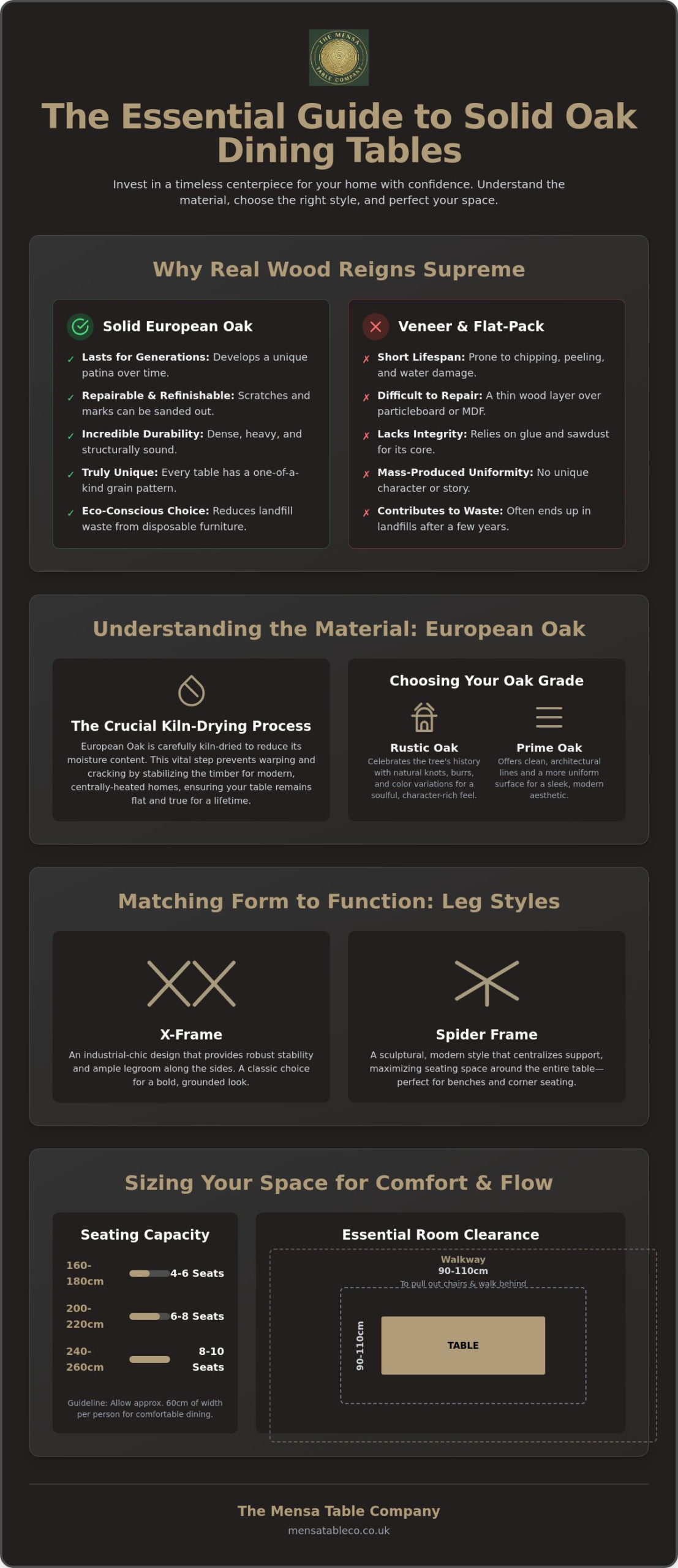
Selecting the right dimensions for your solid oak dining table is a delicate balance of ergonomics and aesthetics. A table that is too large can stifle the flow of a room, while one that is too small may look adrift in a spacious kitchen-diner. We always recommend the golden rule of dining room clearance: leave at least 90cm of space between the edge of the table and the nearest wall or piece of furniture. This allows guests to pull out their chairs and move behind one another without the awkward shuffle that ruins the atmosphere of a meal. When you calculate seating, consider the personal space each guest needs. While 60cm is the standard minimum width per person, providing 70cm offers a more luxurious experience, allowing for extra elbow room and a more relaxed dining ritual.
In our workshop, we often advocate for fixed-length tables over extending models. While extensions offer occasional convenience, a fixed-length solid oak dining table possesses a superior structural integrity and a seamless grain pattern that isn’t interrupted by mechanical joints. It’s a piece built for the long term, designed to sit at a comfortable height of 75cm to 78cm. This standard range ensures that most dining chairs fit perfectly, maintaining a healthy posture through long evenings of conversation. If you are unsure how a specific size will translate into your home, you can discuss your room dimensions with us to ensure a perfect fit.
Seating Capacity Guide
To help you visualise your future gatherings, we use these general benchmarks for rectangular tables:
- 1.8 metres: Comfortably seats 6 people.
- 2.4 metres: Ideal for 8 people.
- 3.0 metres: A grand centerpiece for 10 people.
In square rooms, a round table can often provide a better flow, softening the sharp corners of the space. We also suggest pairing your table with matching benches. Benches offer incredible flexibility, allowing you to squeeze in extra children or guests during festive celebrations while tucking away neatly when the meal is over.
Measuring Your Room Like a Pro
Before making your final choice, use masking tape on your floor to outline the table’s footprint. This simple trick helps you visualise the physical presence of the timber and ensures you’ve accounted for the “walk-flow” in open-plan areas. It’s vital to remember that the visual weight of the wood matters just as much as the physical inches. A chunky oak top requires a more substantial frame for visual balance, ensuring the piece feels proportional and intentional within your interior design.
Investing in Heritage: The Mensa Table Company Craftsmanship
At the Mensa Table Company, we don’t believe in rushing the creative process. Every solid oak dining table that leaves our UK workshop is the result of a singular, steady focus, where our team dedicates itself to one piece at a time. This deliberate pace is our antidote to the frantic world of mass production. It allows us to listen to the wood, respecting the natural variations in the European Oak, Ash, and Black Walnut that we source so carefully. We’ve been handcrafting in the UK since 2018, and our “anti-flat-pack” philosophy remains at the core of everything we do. When you invest in our work, you’re receiving a permanent fixture for your home, not a box of parts that will eventually rattle and fail. It is a commitment to substance over flashy marketing, valuing the manual approach in every interaction.
Our craftsmanship extends beyond the dining room to every corner where people gather. We bring the same artisanal rigour to our breakfast bars and bespoke desks, ensuring that even your morning coffee or your workday is grounded in the tactile warmth of real timber. By choosing a solid, handcrafted piece, you’re making an intentional choice for sustainability and longevity. These aren’t just commodities; they’re meaningful life investments that elevate the goods from mere furniture to the backdrop of your family’s story. We take immense pride in the fact that our tables don’t just occupy space, they create a site for human connection that lasts for generations.
The Maker’s Mark: Quality You Can Feel
Our hand-finishing techniques are designed to preserve the sensory experience of the grain, ensuring the wood feels alive and textured beneath your fingertips. We pair these organic tops with hand-welded steel frames. These frames are built to support the immense weight of a solid oak dining table, providing a level of stability that mass-produced alternatives can’t match. The Mensa design itself has become a signature of modern British joinery, representing a quiet confidence in the quality of the work and a deep respect for the natural elements we use.
How to Start Your Commission
Starting your own commission is a guided journey through materials and forms. You can navigate our shop to find the specific species and frame combination, like the Spider or X-frame, that speaks to your home’s character. Because these are heavy, solid pieces, the delivery process is handled with the same care we give to the construction. We don’t just drop off a package; we ensure your new heirloom arrives safely, ready to become the focal point of your social rituals. We invite you to explore our full range of handcrafted dining tables and begin the process of bringing a piece of artisanal heritage into your home.
Bringing Your Home’s Heart to Life
Investing in a solid oak dining table is about more than just filling a room; it’s about creating a permanent site for your family’s most cherished social rituals. We’ve explored how the rich grain of European oak and the architectural strength of frames like the Spider or X-frame come together to form a piece that matures alongside you. By respecting the natural movement of the wood and planning your space with careful measurements, you ensure that your table remains a comfortable and inviting focal point for decades. It is a transition from a mere piece of furniture to a true family heirloom.
As Solid European Oak Specialists, we take immense pride in our 5-star craftsmanship. Every piece is handcrafted in the UK with a level of care that mass-produced alternatives simply cannot match. We invite you to move away from disposable culture and embrace a legacy of quality that your guests will notice and your family will treasure. We are dedicated to creating furniture that reflects the warmth and authenticity of your home.
Browse Our Signature Solid Oak Dining Tables
We look forward to helping you create a space where memories are made for generations to come.
Common Questions About Choosing a Solid Oak Dining Table
How do I maintain a solid oak dining table to prevent staining?
You can prevent staining on your solid oak dining table by using coasters and mats for hot or wet items and wiping spills immediately with a soft, damp cloth. We finish our pieces with high-quality oils that penetrate the wood, creating a protective barrier while celebrating the natural grain. Don’t use harsh chemicals or abrasive cleaners, as these can strip the protective finish and leave the timber vulnerable to moisture.
Will a solid oak table warp or crack over time?
A well-crafted table shouldn’t warp or crack if the timber has been correctly kiln-dried and the joinery allows for natural seasonal movement. Because oak is an organic material, it reacts to humidity and temperature changes in your home. Our craftsmen use specific techniques to ensure the wood can breathe without compromising the structural integrity of the piece, protecting your investment for generations.
What is the best leg style for a small dining room?
The V-frame or A-frame leg styles are often the best choice for smaller dining rooms because their slender profiles create a sense of visual lightness. Central designs like the Spider leg are also excellent, as they eliminate corner legs that might obstruct movement in a tight space. These designs allow you to maximise the footprint of your room without making the area feel cluttered or heavy.
Can I use a solid oak table in a room with underfloor heating?
You can use a solid oak dining table in a room with underfloor heating, provided the wood has been seasoned to a low moisture content. It’s important to introduce heat gradually at the start of the season to allow the timber to acclimatise. Rapid temperature spikes can cause the wood to dry too quickly, so a steady, consistent heat is always best for maintaining the stability of the tabletop.
Is European oak better than American oak for furniture?
European oak is often preferred for high-end British joinery because it offers warmer, honey-toned hues and a more intricate grain pattern than American varieties. American white oak tends to have a colder, greyer undertone and a more uniform appearance. For homeowners seeking a piece with deep character and a traditional aesthetic, the richness of European timber is almost always the superior choice.
How many people can comfortably sit at a 2-metre dining table?
A 2-metre table typically seats six people comfortably, with three chairs positioned along each long side. If you pair the table with matching benches, you can often accommodate eight guests, as benches allow for more flexible seating arrangements during festive gatherings. This length provides enough personal space for each diner to enjoy their meal without feeling cramped or restricted by the table legs.
Do I need to oil my oak table regularly?
Most solid oak tables benefit from a fresh coat of oil every six to twelve months to maintain their lustre and water resistance. You’ll know it’s time for a top-up when the wood begins to look slightly dull or when water no longer beads on the surface. This simple ritual nourishes the timber and deepens the natural character of the grain, ensuring the piece ages beautifully over time.
Why is solid oak furniture so much heavier than other types?
Solid oak is significantly heavier than other furniture types because of the sheer density of the timber’s cellular structure. Unlike flat-pack items made from hollow boards or softwoods like pine, oak is a slow-growing hardwood that packs an immense amount of mass into every inch. This weight is a hallmark of quality, providing the rock-solid stability and durability that allows the table to survive decades of daily family use.

Leave a Reply