
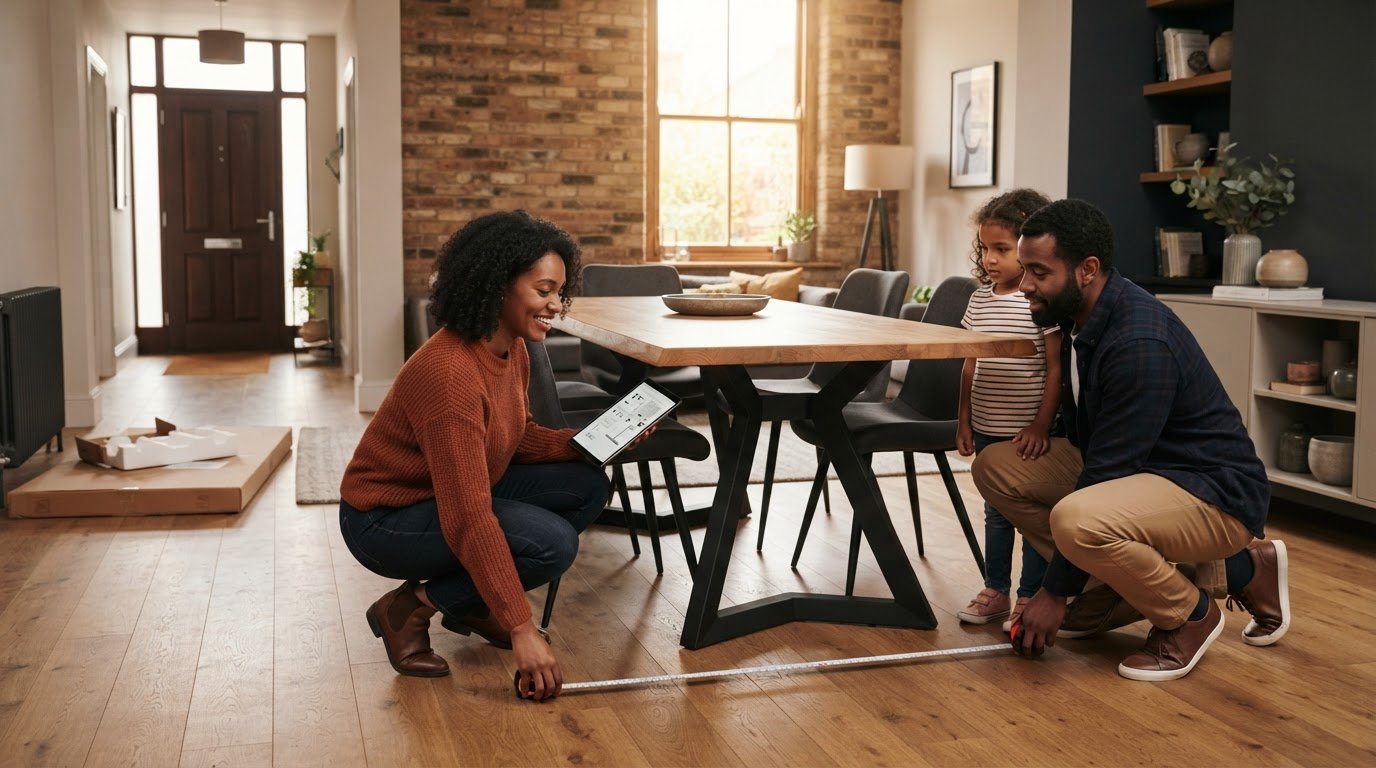
What if the dining table that looks just right on screen leaves barely enough room to pull out a chair? Photos can help you picture a piece, but they can’t tell the whole story. That’s why the ultimate checklist for buying furniture online starts with evidence, fit and delivery details, not appearance alone.
It’s sensible to pause before ordering. Whether you are shopping for dining spaces or looking for bedroom furniture from specialists like The Mattress Boutique, product listings can leave questions about materials, finishes or construction, while delivery, assembly and returns arrangements affect how well a piece works in your home. A few careful checks can help you make a confident choice.
Use this practical checklist to compare specifications, assess dimensions and finishes, and plan for delivery and assembly before you buy. We’ll also look at how to choose a dining table that suits your room and everyday routines, from checking solid-wood details to leaving space for chairs and people to gather. With the right information in hand, you can choose for the life you’ll share around the table, not just the image on the page.
Key Takeaways
- Use the ultimate checklist for buying furniture online to assess purpose, product details, room fit, delivery terms and your final decision.
- Separate stated specifications from product photos and styling language so you can compare furniture using useful evidence.
- Record key details side by side, noting anything unclear or irrelevant to your needs before choosing between options.
- Measure the placement area, clearance and route into the room to catch practical fit issues before ordering.
- Apply these checks to made-to-order Mensa dining tables, handcrafted from 100% solid wood.
Buying Furniture Online: What to Check Before You Commit
Photographs can help you picture a piece in your home, but they can’t answer every question about its materials, construction or practical fit. A styled image shows one setting under particular lighting, not every detail you need to make a considered choice. The ultimate checklist for buying furniture online gives you a repeatable way to assess the listing instead of relying on the impression it creates.
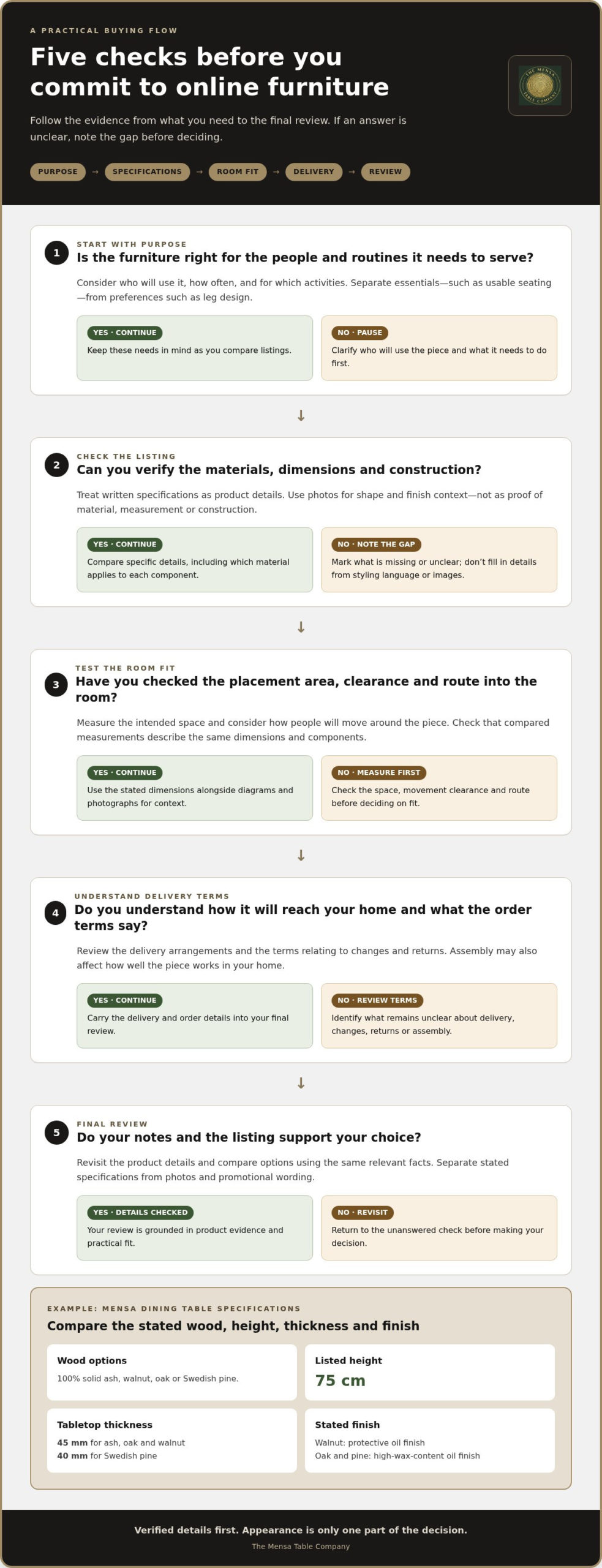
Work through each stage in order. This helps you avoid letting an attractive finish distract you from a piece that doesn’t meet your needs, and makes it easier to spot unanswered questions before you decide.
- Purpose: Decide who will use the furniture and what it needs to do.
- Specifications: Read the stated materials, dimensions and construction details.
- Room fit: Measure the intended space and consider how people will move around the piece.
- Delivery terms: Understand how the item will reach your home and what the order terms say about changes and returns.
- Final review: Revisit the listing and your notes before committing.
A sound online purchase depends on verified details, not appearance alone. Treat each part of a listing as evidence: written specifications describe the product, while photos help you interpret its shape and finish. A systematic check also makes it easier to compare options fairly. For a broader introduction to furniture types and construction, consider how a piece’s form and materials relate to the way you’ll use it.
Start with the job the furniture needs to do
Before comparing finishes, think about the people and routines the piece needs to serve. Who will use it, how often and for which activities? Separate essentials, such as enough usable seating or a surface suited to everyday meals, from preferences such as a particular leg design. Whether furnishing an indoor dining room or selecting outdoor dining arrangements from specialists like Rengard, consider whether meals are usually shared by the household alone or whether guests often join. This gives you a practical basis for judging dimensions and design, rather than letting a pleasing style set your priorities.
Treat product photos as one source of evidence
Look through the full set of images. A styled room view can show the overall impression; close-ups may reveal surface details, and a specification diagram can help explain proportions. Lighting can shift apparent colour, camera angles can distort scale, and nearby objects can make a piece seem larger or smaller. Don’t treat a photograph as proof of a material, measurement or construction method. Note what the listing states, what the images suggest and what you still need to consider.
This approach keeps your decision grounded without dismissing the appeal of a well-made focal point. A table may bring people together for quick breakfasts, long conversations and celebrations, but it also needs to work in your room and fit the routines you actually have. Begin with purpose, then let clear product information and practical checks shape your choice.
Check Furniture Materials, Construction and Listing Details
A useful product specification tells you what the furniture is made from, how large it is and how it’s constructed. These details give you something concrete to compare across listings, unlike broad descriptions such as “premium” or “high quality”, which don’t explain what you’ll receive. As you work through the ultimate checklist for buying furniture online, distinguish specific statements from visual impressions and promotional wording.
Material names and construction details tell you more about a piece than styling language alone. A photograph may show a warm wood tone, for example, but it can’t establish the wood species or how the piece is built. Look for details specific enough to understand the item, and don’t fill gaps with assumptions.
Read the material and construction description closely
Start with the named material, then check whether it describes the whole item or only one component. A listing might identify the tabletop material without saying what the legs are made from, so read the wording precisely. Construction details should help you understand the finished piece and its components, not simply repeat a style label.
For wood furniture, look for the species and any stated finish. Mensa dining tables are made from 100% solid ash, walnut, oak or Swedish pine. Their listed height is 75 cm, and tabletop thickness is 45 mm for ash, oak and walnut, or 40 mm for Swedish pine. These are useful, comparable facts; a phrase like “premium timber” alone isn’t. You can compare options such as solid European oak by checking the named wood and relevant specifications, rather than relying on colour alone.
Check the finish description too. Walnut tables have a protective oil finish, while oak and pine tables have a high-wax-content oil finish. Don’t assume the finish is the same across different wood types or products.
Use dimensions and images together
Find the full set of measurements and identify what each one applies to. Check whether dimensions describe the complete item, the tabletop or another component. Then use diagrams and photographs for context. Images can help you picture shape and proportion, but they shouldn’t replace a stated measurement or fill in one that’s missing.
Keep comparisons like for like. If you’re weighing up two tables, compare the same dimensions and components, rather than setting one tabletop measurement against another product’s overall size. Don’t assume that a measurement, material or finish carries across every item in a range. Variations matter, especially when they could affect your room plan or how the furniture works day to day.
A practical way to review a listing is to sort each detail into three groups:
- Stated: The listing names the material, measurement or construction detail clearly.
- Unclear: The wording or images leave room for more than one interpretation.
- Not relevant: The detail won’t affect your choice or intended use.
Use the “unclear” group carefully. “Premium”, “crafted” or “natural” may sound appealing, but without a specific material or construction detail, they aren’t a like-for-like specification. When comparing solid-wood tables, note the stated wood, dimensions and finish separately from the way the room is styled in photographs. That distinction helps you decide based on what the listing actually says.
Compare Online Furniture Options Without Guessing
Online shopping can still support a confident decision. The key is to compare clear product evidence rather than trying to judge an item from photographs alone. A simple side-by-side record helps reveal which differences matter to your home and which listings leave important details unanswered.
Create a like-for-like comparison
Choose products in the same category, then record each listing’s information in a consistent format. Keep practical non-negotiables, such as fitting the available space, separate from preferences such as a particular leg design. This stops a strong visual impression from outweighing a detail that affects everyday use.
Use a table like this in your notes. Add product names across the top, then mark each detail as stated, unclear or not relevant to your needs. Where a specification is stated, record the actual value too, so you can compare evidence rather than just its status.
| Detail to compare | Option A | Option B |
|---|---|---|
| Material | Stated / unclear / not relevant | Stated / unclear / not relevant |
| Dimensions | Stated / unclear / not relevant | Stated / unclear / not relevant |
| Construction | Stated / unclear / not relevant | Stated / unclear / not relevant |
| Customisation | Stated / unclear / not relevant | Stated / unclear / not relevant |
| Delivery information | Stated / unclear / not relevant | Stated / unclear / not relevant |
Be precise in your notes. If a table’s material is named but its dimensions are incomplete, record those separately rather than giving the listing one overall rating. A missing detail isn’t automatically a reason to reject an option; consider whether that information matters to your decision.
Judge craftsmanship through stated details
Broad adjectives such as “premium” or “beautifully made” may describe a seller’s view, but they don’t explain materials or construction. Give more weight to specific information that helps you understand the piece: named materials, stated dimensions, descriptions of components and available custom options. These details make comparisons more useful and keep promotional language in perspective.
Customisation can be valuable when it addresses a real need, such as a size that better suits your room or a finish that works with your existing furniture. Record which options are available and whether they meet a non-negotiable need or simply reflect a preference. Don’t assume every product can be altered in the same way.
With real-wood furniture, natural grain differences mean individual pieces won’t look identical. Each Mensa table is one of a kind because of its natural grain. Treat this as a characteristic of the material, not a promise of a particular grain pattern. The ultimate checklist for buying furniture online is most useful when it helps you weigh what’s stated, what matters to you and what remains unclear, without letting decorative language make the decision for you.
Measure Your Space and Check Delivery Before Ordering
A piece can suit a room perfectly on paper and still be difficult to get through the front door. Measure both the place it will live and the route it must take to get there. Then review delivery, assembly and returns information before checkout. The ultimate checklist for buying furniture online isn’t complete until the furniture can reach its intended spot and the fulfilment terms suit your home.
Measure the room and the route in
Follow this sequence and record each measurement. Compare access points with the product dimensions, allowing for turns and the way the item may need to be manoeuvred. A clear route matters just as much as a clear space in the room.
- Measure the placement area. Mark the intended footprint, including the full length and width of the furniture. For a dining table, consider how it will sit in relation to walls and other furnishings.
- Allow surrounding clearance. Think about everyday movement around the item. For a table, account for chairs being pulled out and people moving around them, not just the tabletop’s footprint.
- Check doorways and hallways. Measure the clear width and height of entrances and corridors along the route. Include narrow passages before reaching the room.
- Trace the full route. Check stairs, landings and turns, noting where the route narrows or changes direction. Compare those access measurements with the listed dimensions before ordering.
Don’t rely on a room measurement alone. If a table fits the dining area but can’t pass through a doorway or around a tight turn, the room dimensions won’t solve the problem. Keep your measurements together so you can compare them directly with the listing and spot access issues early.
Understand fulfilment and after-order policies
Delivery arrangements can differ by order, so read the product details and delivery terms for the item you’re buying. Check what delivery covers, where the furniture will be placed, the stated timing and any conditions attached. Also review the assembly details: Mensa dining tables require minimal leg attachment, and instructions are provided.
Before checkout, review the cancellation, order-change and returns information. For Mensa orders, changes or cancellations must be requested within 24 hours of purchase, and additional charges may apply. Read the returns policy before ordering, and keep your order details accessible. Clear terms help you plan for the item’s arrival and understand what to do if your circumstances change.
Mensa tables are delivered by a two-person team. Free UK mainland delivery to the ground floor applies to orders over £250; orders under £250 have delivery charges calculated at checkout. Optional delivery upgrades include Room of Choice for £15.00, Room of Choice plus Unpacking & Packaging Removal for £25.00, and Full Assembly in Room of Choice plus Packaging Removal for £67.50, subject to safe access.
Once your measurements and delivery notes are ready, you can make a more informed decision about a table made for your home and the people who gather around it. The team’s contact page is available for general enquiries.
Apply the Online Furniture Checklist to a Mensa Dining Table
A dining table is more than a set of measurements. It’s where everyday meals, celebrations and long conversations take place, so its materials, proportions and practical details all deserve a careful look. The Mensa range offers a useful example of applying the ultimate checklist for buying furniture online to a real, made-to-order piece. Its stated specifications show how clear details can support a considered decision.
Start with your needs: how many people usually sit down together, how often guests join, and how the table will fit into your room. Then compare those needs with the product details, your measurements and the delivery information for the table you’re considering.
Check the table’s confirmed materials and dimensions
Mensa dining tables are made to order from 100% solid wood, in ash, walnut, oak or Swedish pine. Compare the named wood with your preference, then check the tabletop thickness: it’s 45 mm for ash, oak and walnut, and 40 mm for Swedish pine. Every dining table has a height of 75 cm. These specific details help you compare the listing with your room plan and requirements.
The tables support up to 200 kg. Consider that stated capacity alongside your intended everyday use, while keeping other practical checks in view: the table’s full dimensions, surrounding clearance and route into the room. Natural grain varies, so each table is one of a kind. That’s a characteristic of solid wood, not a promise that a photograph will show the exact grain of the table you receive.
Construction details can also help you compare options. The tables have heavy-duty steel legs, with a black matte powder-coat finish as standard and custom RAL powder-coat available on request. Use the product details to compare the leg style and any customisation relevant to your space.
Review customisation, delivery and the next step
Custom sizes, finishes and leg styles are available on request. Think about whether an adjustment would solve a practical need, such as fitting a particular space, or whether it’s simply a visual preference. Make a note of what matters before choosing, then use the product information to understand the table you’re considering.
Minimal leg assembly is required, with instructions provided. Full assembly in the room of choice, including packaging removal, is available for £67.50, subject to safe access. Delivery is by a two-person team. Review the delivery terms for the table and your order before checkout, including the applicable scope and timing.
Bring your notes together before deciding: the table’s stated wood and dimensions, how it suits your routines, any custom options relevant to your space, and the delivery arrangements. This turns browsing into a practical comparison and helps you choose a table with the details that matter to your household in clear view. You can talk through your requirements with the team.
Make Your Next Furniture Choice With Confidence
The right piece should feel at home in your room and in the rhythms of daily life. Picture the meals, conversations and small rituals it will hold, then use your notes to decide which details matter most. The ultimate checklist for buying furniture online helps you move from browsing to a choice grounded in your space and needs.
If a dining table is on your mind, Mensa tables are handcrafted to order from 100% solid wood, with custom sizes, finishes and leg styles available on request. Use the stated specifications, measurements and delivery details to work out how a table could suit your home.
Talk with us about choosing a dining table for your home, and take the next step towards a piece made to become part of the moments you share around it.
Frequently Asked Questions
Is it safe to buy furniture online without seeing it in person?
You can make a considered purchase online by relying on clear specifications, measurements and written terms rather than photos alone. The ultimate checklist for buying furniture online helps you assess those details systematically. Save the product description and order confirmation, and compare the item’s stated dimensions with your room plan. If a detail could change your decision, treat it as unresolved rather than assuming the listing or image answers it.
What should I do if the furniture I receive looks different from its online photos?
First, compare the delivered item with the product description and stated specifications, remembering that lighting and screen settings can affect how colours appear. Photograph any damage or differences from what was described, and keep your order details and packaging while you review the returns information. Natural grain variation in solid wood can create an appearance different from a listing photo. If the item seems faulty or not as described, raise the issue with the seller promptly.
Can I change or cancel an online furniture order after placing it?
It depends on the seller’s terms and whether the furniture is being made to your specifications. The Mensa Table Company requires changes or cancellations to be requested within 24 hours of purchase, and additional charges may apply. For most online goods, UK cancellation rights generally provide a 14-day period after receipt, but exceptions can apply, including to goods made to a customer’s specifications. Read the applicable policy before ordering and act quickly if you need a change.
How can I check whether furniture will fit through my doorway?
Measure the doorway’s clear opening, then check the hallway, stairs, landings and turns between the entrance and the intended room. Compare these measurements with the item’s dimensions, considering whether it can be angled safely through the narrowest point. Don’t rely only on doorway width: a turn or low ceiling can be the limiting factor. If the listing gives packaged dimensions, compare those too, as they may differ from the assembled item.
What payment methods can I use to order from The Mensa Table Company?
The Mensa Table Company accepts major credit cards, Apple Pay, Google Pay and bank transfer for online orders. Choose the method you’re comfortable using, and check that the payment details shown at checkout match the option you selected. Keep your confirmation email or other order record after payment; it gives you a useful reference if you need to review your purchase details or follow up on an order.
Does online furniture need assembly when it arrives?
Assembly depends on the particular furniture, so check its product details before ordering. Mensa dining tables require minimal leg attachment, and instructions are provided. Set aside a clear space to work and read the instructions before beginning. Don’t assume every online table arrives fully assembled or that every seller uses the same arrangement. Mensa also offers an optional full-assembly service at checkout.
Why can two solid-wood tables look slightly different?
Solid wood has natural grain patterns, so two tables made from the same species can show different markings and variations in appearance. Each Mensa dining table is one of a kind because of its natural grain. Wood can also change colour slightly over time. These differences are part of the material’s character, so use the listed species and finish to guide your choice rather than expecting the exact grain shown in a photograph.

Leave a Reply