
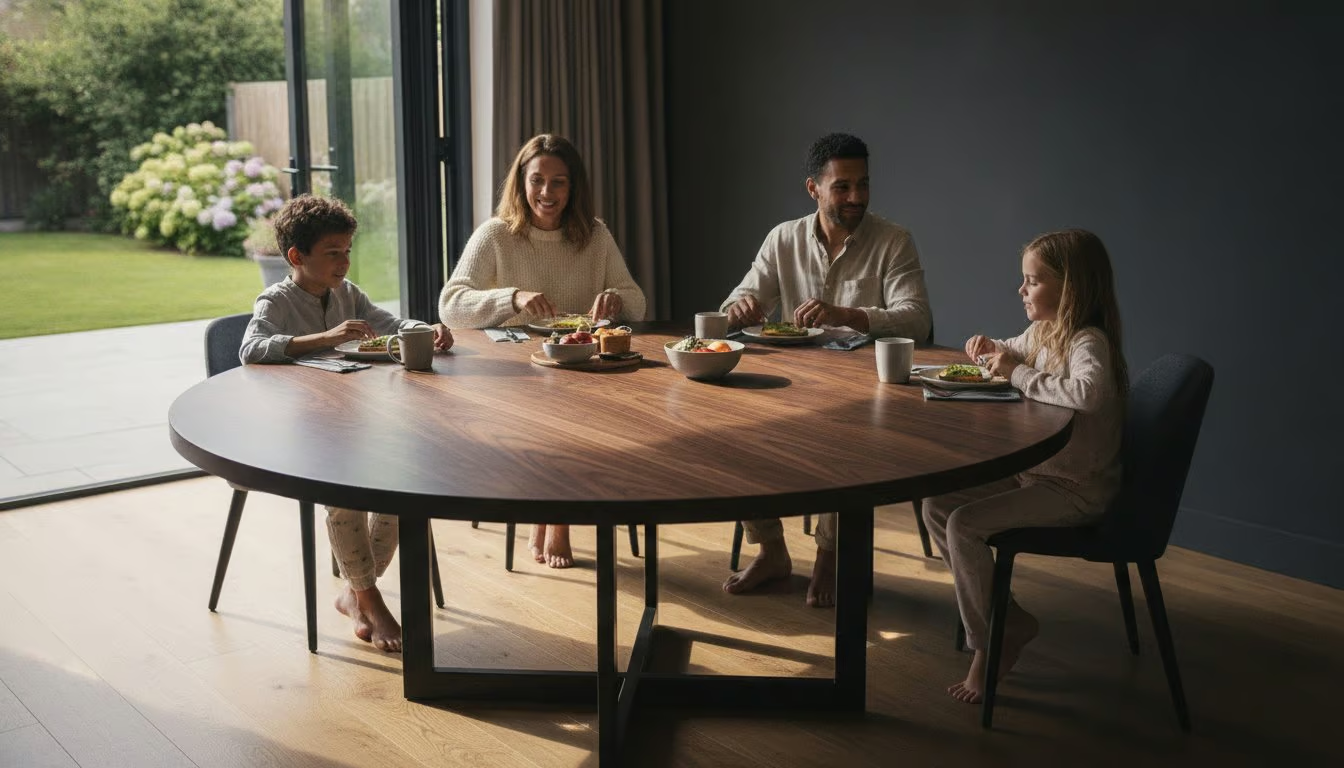
A 120cm walnut dining table isn’t a compromise for a smaller room; it’s a deliberate choice to make every square inch of your home feel intentional and luxurious. You’ve likely felt the frustration of furniture that looks beautiful in a catalog but arrives with thin veneers that chip at the slightest touch or legs that never quite sit level on your floor. It’s difficult to find that perfect balance between a compact footprint and the substantial, grounding presence of genuine, solid timber.
We believe your dining table should be the heart of your daily rituals, from the first quiet coffee of the morning to intimate dinners with friends. You deserve a piece that feels as honest as the materials it’s made from. In this article, you’ll discover why a handcrafted 120cm walnut dining table is the ultimate investment for those seeking small-space luxury. We’ll explore how to distinguish real walnut from clever imitations, how our signature leg frames like the Mensa or Spider designs provide ample room for four guests, and why choosing solid wood ensures your focal point will endure for generations.
Key Takeaways
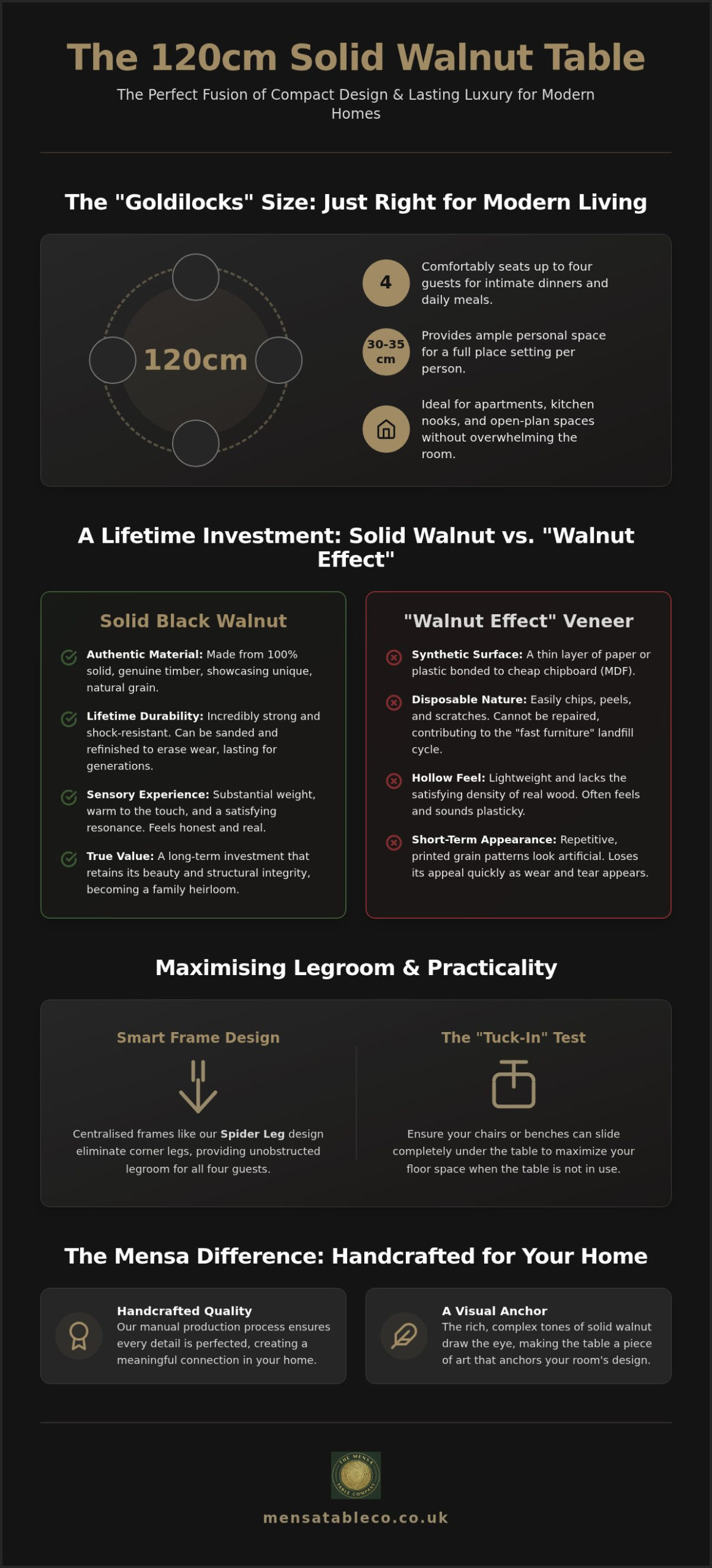
- Learn why the 120cm size is the perfect choice for modern homes, balancing a compact footprint with enough room to comfortably host a dinner for four.
- Understand the lasting value of solid black walnut compared to “walnut effect” veneers so you can invest in a piece that truly stands the test of time.
- Discover how choosing the right frame, like our Spider Leg design, makes your 120cm walnut dining table feel spacious and inviting for everyone at the table.
- Master the “tuck-in” test to ensure your seating fits perfectly, whether you’re pairing your table with chairs or space-saving matching benches.
- Gain insight into our manual production process and why we believe a handcrafted table creates a more meaningful connection within your home.
Why the 120cm Walnut Dining Table is the “Goldilocks” of Modern Interiors
Modern living often demands we do more with less. A 120cm walnut dining table sits in that perfect middle ground where functionality meets elegance without stealing all the floor space in your home. It’s large enough to serve as a family hub for daily meals but compact enough to tuck into a kitchen nook or a corner of an open-plan apartment. Unlike massive banquet tables that can feel cold when only two people are eating, this size preserves a sense of intimacy and warmth. It’s a size that invites you to lean in, stay a little longer, and truly connect with the people across from you.
We’ve found that this specific diameter or length works beautifully for those who want a high-end feel without the bulk. The rich, dark character of the timber ensures the table never looks insignificant. Instead, it becomes a grounding presence in the room. It’s a deliberate choice for those who value quality over sheer volume, providing a functional four-seater surface that doesn’t overwhelm your interior flow.
Seating Capacity: Can You Really Fit Four?
The most common question we hear in our workshop is whether four adults can actually dine comfortably at this size. The answer lies in the geometry of the piece. A 120cm top provides approximately 30-35cm of linear space per person. This is just enough for a standard dinner plate, cutlery, and glassware without feeling cramped. While a square table offers more surface area in the corners for serving dishes, a round 120cm walnut dining table often feels more inclusive and allows for easier movement in tight rooms. It’s about finding that balance between personal elbow room and the shared experience of a meal.
The Aesthetic Impact of Walnut in Smaller Spaces
There’s a common misconception that dark furniture makes a small room feel closed in. In reality, the complex, chocolatey tones of Black Walnut (Juglans nigra) do the opposite by providing a clear visual anchor. The deep, swirling grain of solid black walnut draws the eye inward, making the table feel like a piece of art rather than just a utility item. When we select the timber for our dining tables, we look for those natural variations that tell a story of longevity and heritage.
Pairing this timber with lighter walls or neutral flooring creates a sophisticated contrast that feels both modern and timeless. It’s a tactile experience too. You can feel the history in the grain when you run your hand across the hand-finished surface. This sensory connection is what elevates a meal from a simple transaction of eating into a social ritual that lingers long after the plates are cleared. By choosing this size, you’re not just saving space; you’re creating a dedicated site for human connection.
Solid Black Walnut vs. Walnut Effect: Choosing a Lifetime Investment
When you’re searching for a 120cm walnut dining table, the market often presents a confusing array of “walnut finishes” and “walnut effects.” These terms usually mask a reality of thin paper or plastic veneers bonded to compressed chipboard. While they might mimic the look from a distance, they lack the soul and structural integrity of the real thing. Choosing solid timber is an act of environmental responsibility. It’s a move away from the “fast furniture” cycle where items are destined for a landfill after a few years of wear. We believe in creating pieces that respect the natural world they came from.
The Sensory Experience of Solid Black Walnut
The first thing you’ll notice about solid black walnut is its weight. There’s a satisfying “thud” when you set a glass down, a resonance that veneer simply can’t replicate. The grain patterns are never repetitive; they tell the story of the tree’s life through deep chocolate hues and occasional hints of creamy sapwood. Timber movement is the natural expansion and contraction of wood in response to humidity, a hallmark of authentic solid wood that proves your table is a living, breathing material. Understanding Black walnut wood properties reveals why this timber is so prized for its strength and shock resistance. It’s a material that feels substantial under your fingertips, offering a tactile warmth that synthetic surfaces never achieve.
Durability and Repairability
Life happens around a dining table. Spills, scratches, and the occasional dent are inevitable parts of a home well-lived in. With a veneer table, a deep scratch is a permanent scar that exposes the pale chipboard beneath. Solid wood is different. It’s a lifetime investment because it can be sanded back and refinished, looking as good as the day it left our workshop even decades later. This repairability is what allows a 120cm walnut dining table to transition from a functional piece of furniture into a cherished family heirloom.
We build our pieces using traditional joinery rather than the flimsy cam-locks found in flat-pack alternatives. This ensures the legs stay sturdy and the top remains level, even as the years pass. While the initial cost of a handcrafted table is higher, the lifetime value is far greater. You’re buying one table for the next fifty years rather than three or four mass-produced replacements. If you have questions about how a specific timber will age in your home, feel free to get in touch with our team for a chat about your space.
Over time, your walnut table will develop a unique patina. The wood mellows and deepens, recording the history of your family gatherings in its very fibers. It becomes a site for human connection, something with a story to pass down, rather than just another commodity in a box.
Maximising Legroom: Frame Styles for the 120cm Table
When choosing a 120cm walnut dining table, the frame you select is just as vital as the timber itself. In a smaller space, every millimetre of legroom counts. Standard four-leg designs often force guests into fixed positions, which can make a 120cm surface feel more restrictive than it needs to be. By opting for a central or recessed frame, you open up the perimeter of the table, allowing chairs to be placed wherever they are needed. This flexibility is what transforms a compact piece of furniture into a versatile social hub for your home.
The Spider Leg Dining Table is perhaps our most practical solution for this size. Its legs meet at a central point beneath the tabletop, branching out like a piece of industrial sculpture. This design means there are no corner posts to navigate, giving your guests total freedom to find a comfortable position. It’s a masterclass in unobstructed seating, ensuring that even with four people at the table, nobody is left straddling a wooden leg. We find that this layout encourages a more relaxed, communal atmosphere during meals.
The Signature Mensa Frame
Our signature Mensa frame was born from a desire to create something that felt both light and architectural. It’s designed to support the incredible weight of solid black walnut while maintaining a minimal footprint on your floor. When you view the table as the centrepiece of your room, the frame should feel like a pedestal that elevates the natural beauty of the wood rather than competing with it. It’s a quiet, confident design that respects the materials and the space it occupies, providing a stable foundation that feels almost weightless.
Industrial Lines: X-Frame and Trapezium
For those who lean towards a more structured, urban aesthetic, our X-Frame and U-Frame designs offer a striking contrast. There’s something deeply satisfying about the pairing of cold, black steel against the organic warmth of walnut. If your style is more geometric, the Trapezium frame provides a clean, modern silhouette that feels grounded and secure. These frames are carefully positioned to ensure they don’t impede chair tuck-in on a 120cm walnut dining table, keeping your dining area tidy when not in use.
We believe the balance between the top and the base is essential. We carefully calibrate the weight of these steel frames to match the thickness of your walnut top. A substantial 40mm slab requires a frame with enough visual and physical weight to feel balanced, while a more slender top might call for a lighter, more delicate touch. This attention to proportion is what separates a truly handcrafted piece from something mass-produced.
Practical Planning: Seating and Styling Your 120cm Table
Once you’ve chosen the perfect timber and frame for your 120cm walnut dining table, the focus shifts to how it functions within the flow of your home. A table of this size is a masterclass in efficiency, but its success depends on the seating you pair it with. You want to maintain that sense of airy openness while ensuring everyone has a comfortable place to sit. It’s about creating a rhythm that feels natural, where furniture serves the needs of your life rather than obstructing your walkways. When every centimetre counts, the way you style and arrange your space determines whether the room feels cluttered or curated.
The “tuck-in” test is a vital part of this planning process. For a 120cm walnut dining table, you must ensure that your chairs or benches can slide neatly under the tabletop when they aren’t in use. This is particularly important in narrow kitchens or open-plan apartments where the dining area often doubles as a thoroughfare. If you’re choosing chairs with arms, measure the height of the chair arms against the underside of the table frame to avoid frustrating clashing. Keeping the seating tucked away preserves the visual integrity of the room and makes the table feel like a deliberate, integrated part of the architecture.
Lighting also plays a silent but powerful role in framing your dining experience. A single pendant light, hung low over the centre of the table, creates a pool of warmth that defines the dining zone. This focal point draws people in, making the experience feel intentional and private. In an intimate setting, this soft illumination highlights the rich, swirling grain of the walnut, turning a simple meal into a sensory event.
The Case for Benches
We often suggest matching benches for those looking to maximise both seating and floor space. A bench offers a flexible, social way to dine that particularly suits families or casual gatherings. Unlike a row of chairs, a bench can slide completely out of sight beneath the table, instantly reclaiming valuable floor space when the meal is over. You can choose a bench with a matching walnut top for a harmonious look, or opt for a steel-leg design that echoes the industrial edge of your table frame. It’s a practical choice that doesn’t sacrifice the artisanal spirit of your furniture.
Daily Care for Solid Walnut
Owning a handcrafted solid wood table means embracing its natural character rather than hiding it under a tablecloth. Simple cleaning rituals are all that’s required to protect the surface and keep the wood looking vibrant. Use a soft, damp cloth for daily spills and avoid harsh chemicals that might strip the natural oils. While walnut is incredibly durable, we always recommend using coasters or heat mats for hot dishes to prevent thermal shock to the timber. To keep your table in peak condition, aim for a consistent room humidity of around 40 to 60 percent to prevent the timber from warping or checking. If you’re unsure which seating configuration will work best for your home, talk to us about your dining space and we can help you plan the perfect layout.
The Mensa Difference: Handcrafted Quality for Your Home
In an era defined by assembly lines and the convenience of the “add to cart” culture, we’ve chosen a different path. We don’t offer flat-pack furniture or mass-produced items that arrive in a box with a bag of plastic fittings. Every 120cm walnut dining table that leaves our workshop is built from scratch, starting with the careful selection of raw timber. This isn’t just about making furniture; it’s about a commitment to a slower, more intentional way of creating. We believe that your home’s focal point should be as unique as the conversations held around it, which is why we handle every stage of production ourselves here in the UK.
Our process begins long before the first cut is made. We look for specific characteristics in the grain that will best suit a compact 120cm surface, ensuring the natural beauty of the wood is balanced across the entire top. By avoiding mass-production, we can focus on the structural integrity of every joint and the smoothness of every hand-sanded edge. This manual approach allows us to create durable pieces that reject the throwaway nature of modern retail. When you’re ready to bring a piece of our workshop into your space, we offer national UK delivery to ensure your investment arrives safely at your door.
Crafted by Hand, Not by Machine
There’s a quiet confidence that comes from manual production. While machines can replicate a shape, they can’t appreciate the nuances of a specific piece of walnut. We celebrate the natural variations in the timber, from the deep swirls of the grain to the subtle shifts in colour. This means no two tables we produce are ever identical. Each one carries the marks of its organic origin and the hands of the specialist who shaped it. This creates a direct relationship between the creator and the end user, a connection that’s often lost in the transactional world of big-box furniture stores.
Investing in Your Home’s Future
A table is more than just a surface for plates. It’s the site of a generation’s shared meals, late-night talks, and family milestones. We build our tables to withstand the rigours of daily life because we want them to be part of your home’s future. The emotional value of a handcrafted piece only grows as it ages and develops its own history within your walls. By choosing a 120cm walnut dining table from our team, you’re investing in a piece of furniture that values substance over flashy marketing. It’s an honest, grounded choice for a home that values quality and heritage. Invite craftsmanship into your home today and experience the difference that a personal, manual approach makes.
Bring Artisanal Craftsmanship into Your Dining Room
Choosing a 120cm walnut dining table is a deliberate act of choosing quality over convenience. You’ve discovered how the right architectural frame can transform a compact space into an inviting hub for four guests, and why the enduring strength of solid timber far outweighs the temporary appeal of thin veneers. Every table we create is handcrafted in the UK from solid, sustainably sourced timber, ensuring that your furniture is as environmentally responsible as it is beautiful.
Our unique architectural leg designs are more than just structural; they’re a testament to the manual skill and professional expertise we bring to every project. We believe that the items you bring into your home should have a story and a soul, acting as the quiet witnesses to your family’s daily rituals. It’s about investing in a piece that will age with grace and host a generation of shared meals.
Explore our range of handcrafted solid walnut dining tables and let’s talk about how we can build a lasting focal point for your home. We’re here to help you create a space where memories are made and craftsmanship is celebrated every single day.
Frequently Asked Questions
How many people can comfortably sit at a 120cm round dining table?
A 120cm round table comfortably accommodates four adults for a full dinner service. Each guest receives approximately 30cm to 35cm of linear space, which is the standard requirement for plates, cutlery, and glassware. This size fosters an intimate atmosphere without guests feeling crowded, making it a perfect hub for daily family meals and small social gatherings.
Is solid walnut better than walnut veneer for a dining table?
Solid walnut is the superior choice for anyone seeking a lifetime investment. While veneers are thin layers of wood glued to chipboard that chip and peel over time, solid timber is substantial and naturally repairable. A solid 120cm walnut dining table can be sanded and refinished to remove scratches, allowing it to become a cherished heirloom rather than a temporary piece of furniture.
What is the best leg style for a small 120cm dining table?
The best leg style for a compact table is one that moves the support away from the corners, such as our Spider Leg or Mensa frames. These central designs provide unobstructed seating around the entire perimeter of the top. By removing the traditional four corner legs, you ensure that your guests have maximum legroom and flexibility when positioning their chairs.
How do I care for a solid walnut table top to prevent staining?
Preventing stains on your walnut table is a matter of simple, daily habits rather than complex chemicals. We recommend wiping away any spills immediately with a soft, damp cloth to protect the natural oils in the timber. Using coasters and heat mats is essential to prevent thermal shock and moisture rings, keeping the hand-finished surface pristine for decades to come.
Can I use a 120cm walnut table as a kitchen breakfast bar?
You can certainly use a 120cm walnut table as a breakfast bar, particularly in open-plan kitchens where space is limited. Its compact footprint allows it to function as a casual morning hub while still being large enough for formal evening meals. If you’re looking for something taller, we also craft bespoke breakfast bars designed specifically for stool-height seating in contemporary homes.
What is the difference between European Walnut and Black Walnut?
The primary difference lies in the colour and grain density of the timber. Black Walnut is prized for its deep chocolate tones and consistent strength, while European Walnut tends to be lighter with more varied, swirling patterns. We focus on Black Walnut for our dining tables because of its rich character and exceptional durability, ensuring the piece remains a grounding focal point in your home.
Does a 120cm dining table arrive fully assembled or flat-packed?
Our tables arrive as two main components: the solid wood top and the architectural steel frame. We don’t sell flat-pack furniture; instead, we deliver these substantial pieces separately to ensure their safety during transit. The top and frame are easily joined with a few bolts, providing a structural integrity that’s far superior to mass-produced items held together by flimsy cam-locks.
How do I know if a 120cm table will fit in my dining room?
To ensure a 120cm walnut dining table fits, you should allow for 60cm to 90cm of clearance between the table edge and your walls or other furniture. This space is necessary for pulling out chairs and walking around the room comfortably. Marking the 120cm diameter on your floor with masking tape is a practical way to visualize the footprint before you place your order.

Leave a Reply