
Last Sunday, Sarah discovered a swollen, bubbling edge on her three year old dining table, feeling a sharp pang of regret that a simple spill could cause such permanent damage. It’s a common frustration for many who find that their supposed investment piece was actually just fast furniture in disguise. We know you want more for your home than something that looks cheap after a few seasons of use. Choosing between a solid wood vs mdf dining table is a decision that dictates whether your furniture will be a fleeting purchase or a lifelong companion.
You’ll discover the fundamental differences between natural timber and engineered board to choose a dining table that truly stands the test of time. We will guide you through the tactile warmth of handcrafted European Oak and the structural integrity of designs like the Mensa or X-Frame, comparing them against the 10 to 15 year average lifespan of MDF. By the end, you’ll understand why a piece that can be sanded and refinished is the only way to ensure your home’s focal point remains authentic for generations to come.
Key Takeaways
- Learn the structural differences between slow-grown European Oak and engineered wood-fibre composites to understand how each material reacts to your home’s environment over time.
- Discover why the solid wood vs mdf dining table debate often comes down to repairability, specifically how natural timber can be sanded and reborn while damaged MDF is typically destined for a landfill.
- Understand the sensory and emotional value of natural grain patterns and hand-applied oil finishes that bring a unique, tactile warmth to your daily social rituals.
- Evaluate the true environmental cost of your furniture by comparing the carbon sequestration of responsibly sourced timber against the chemical binders found in mass-produced boards.
- See how design-led structures like the X-Frame or U-Frame utilize the inherent strength of raw materials to create a generational heirloom rather than a temporary fix.
Understanding the Foundations: Solid Wood vs. Engineered MDF
The choice between a solid wood vs mdf dining table begins long before the piece enters your home. It starts in the forests of Europe or within the industrial heat of a manufacturing plant. Every material carries its own history and physical limitations. While one is a living, breathing entity that matures alongside your family, the other is a carefully engineered product designed for consistency. Understanding these foundations helps you look past the surface finish to see what truly supports your daily life.
What is Solid Wood? Nature’s Unique Fingerprint
Solid timber is nature’s own masterwork. We primarily work with species like Solid European Oak and Ash because they offer a density and character that synthetic boards cannot replicate. When you run your hand across a real wood surface, you feel the history of a slow growing tree. Medullary rays, those silver ribbons that dance across the grain, and the unique placement of knots act as nature’s fingerprint. No two slabs are identical.
This material is hygroscopic, meaning it gently breathes by absorbing and releasing moisture. This movement is a sign of life. It’s a characteristic that allows the wood to settle into the specific atmosphere of your home, whether you’re facing a damp British winter or the dry heat of central heating. Because the wood is solid all the way through, it possesses an inherent structural integrity that engineered boards struggle to match over long spans.
What is MDF? The Science of Engineered Board
On the other side of the workshop spectrum lies Medium-density fibreboard (MDF). This is an engineered product created by breaking down hardwood or softwood residuals into wood fibres. These fibres are combined with wax and a resin binder, then formed into panels by applying high temperature and pressure. While MDF offers a perfectly flat, uniform surface that won’t warp or crack like natural wood, this uniformity is also its greatest weakness.
It lacks the internal grain structure that provides tensile strength. In large scale furniture like dining tables, MDF often relies on a thin veneer of real wood or plastic to mimic the look of timber. However, once that surface is breached by a scratch or water, the underlying composite can swell and bubble. Recent regulations, such as the EU REACH Annex XVII Entry 77 effective August 2026, have tightened formaldehyde emission limits to 0.062 mg/m³, reflecting a growing awareness of the chemical binders used in these boards. MDF is a material built for the present moment, not for the decades of social rituals a family home demands.
Durability and Longevity: The ‘Forever Table’ vs. The Temporary Fix
A dining table is the stage for your life’s most messy and beautiful moments. Whether it’s a child’s art project or a wine-heavy dinner party, the material you choose dictates how many of these memories the surface can actually handle. When evaluating a solid wood vs mdf dining table, the most critical factor isn’t how it looks on delivery day, but how it looks five years later. True durability is the ability to withstand the rigours of a busy home without losing its soul.
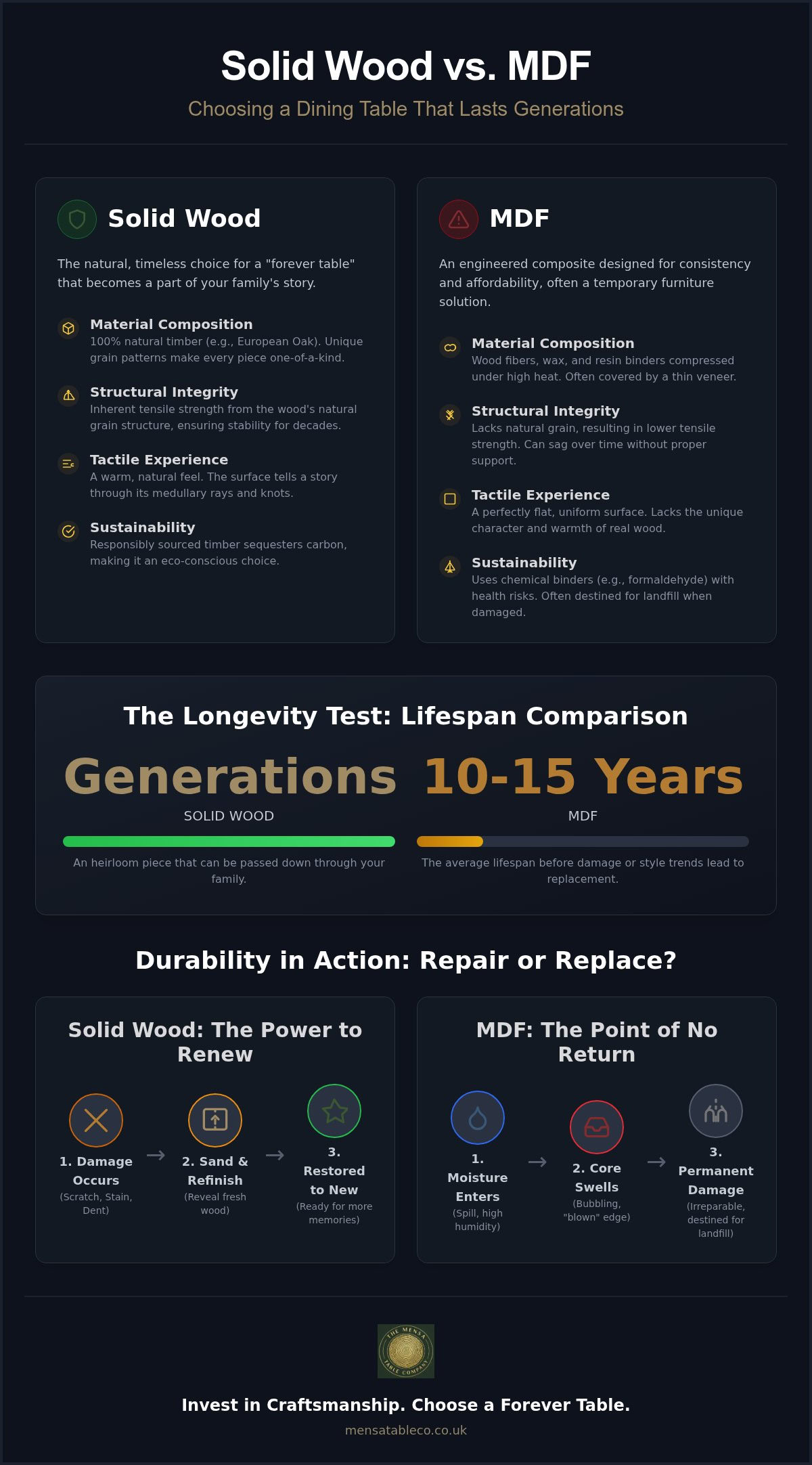
Solid timber possesses a unique superpower: restorability. If a deep scratch or a heat ring from a pizza box mars the surface, you don’t have to live with the scar. You can sand it back. By removing a millimetre of the surface, you reveal fresh, untouched grain underneath. MDF offers no such grace. Because its look is merely a thin veneer or a printed laminate, any attempt to sand it will simply expose the grey, fibrous core beneath. The piece becomes a temporary fixture rather than a permanent part of your home’s story.
The Restorability Factor
A solid oak table can be sanded and refinished to look brand new even after two decades of heavy use. This inherent longevity makes it an investment that moves house with you, adapting to your life as your style evolves. In contrast, when moisture seeps into the edges of an engineered board, it triggers a permanent physical change. The fibres swell, causing a “blown” edge that bubbles and flakes. This damage often stems from the resins used to bind the board, which carry various health risks of formaldehyde and other volatile organic compounds. Once the core is compromised, the piece is effectively on a countdown to the skip.
Structural Strength and Joinery
Longevity is also about what’s happening underneath the surface. High-impact designs like our Spider Leg Dining Table require the immense structural strength that only solid timber provides. MDF is notoriously poor at holding screws over time; the compressed fibres eventually crumble under the stress of movement and weight. Solid wood joinery, however, creates a mechanical bond that grows stronger as the piece settles into its environment.
Whether you’re hosting a 10-seater family gathering or just leaning on the edge with a morning coffee, the table remains steadfast. It doesn’t wobble or sag, because it’s built from the same materials that have supported heritage homes for centuries. If you’re unsure which timber species will best suit your home’s daily rhythm, reach out to our workshop team for a personal recommendation.
The Tactile Experience: Why Natural Grain Trumps Uniformity
Beyond the structural resilience discussed in previous sections, the most immediate difference in the solid wood vs mdf dining table debate is one of sensation. A home’s focal point should do more than just hold plates; it should invite touch and evoke a sense of calm. Natural materials possess a soul that engineered boards simply cannot replicate. While a factory-made surface prioritises clinical perfection, a handcrafted timber table celebrates the organic rhythm of the natural world. This tactile connection transforms a simple piece of furniture into a meaningful investment in your daily wellbeing.
The Warmth of Natural Timber
There is a physical warmth to real timber that synthetic materials lack. Because wood is a natural insulator, it feels ambient and inviting to the touch, unlike the often cold, plastic-like feel of lacquered or veneered boards. Resting your palms on a Solid Black Walnut dining table offers a grounding experience, accompanied by the subtle, earthy scent of natural wax. This sensory connection helps transform a house into a home. It creates an environment that feels intentional and rooted in the earth rather than the assembly line.
Character and Authenticity
Visual depth is where the contrast becomes most apparent. Light interacts with the cellular structure of real wood, creating a three-dimensional quality that shifts as you move around the room. In contrast, Medium-Density Fibreboard (MDF) typically relies on a printed image of wood grain or a very thin veneer. This results in a visual flatness where the pattern repeats and lacks the authentic variation found in nature. The lack of true grain means the surface cannot absorb light in the same way, often resulting in a duller appearance over time.
What some might call imperfections, we see as character. A slight variation in tone or a beautifully placed knot tells the story of the tree’s life. Over time, solid wood develops a patina, a soft sheen that comes from years of use and social rituals. This aging process is a mark of quality. While an MDF surface begins to look tired and worn as it ages, a solid timber table grows more beautiful, carrying the history of every family dinner and shared conversation within its grain. Choosing an artisanal piece means embracing this evolution, ensuring your furniture remains a unique reflection of your life.
Sustainability and the True Cost of ‘Fast Furniture’
When we look at the price tag of a solid wood vs mdf dining table, it’s tempting to focus only on the immediate transaction. However, the true cost of furniture extends far beyond the checkout. It lives in the longevity of the materials and the footprint left on our planet. Fast furniture has created a cycle of disposability that treats the focal point of a home as a short term commodity rather than a generational investment. Choosing a table is as much an ecological decision as it is a stylistic one.
Ecological Responsibility
Solid timber acts as a natural carbon sink. Throughout its life in the forest and its subsequent decades in your home, it sequesters carbon, keeping it safely stored within its grain. MDF, while often made from wood residuals, relies heavily on synthetic resins and chemical binders to maintain its form. As of August 6, 2026, the EU has significantly tightened formaldehyde emission limits for wood-based products to 0.062 mg/m³, reflecting the ongoing concern over the chemical off-gassing common in engineered boards. By choosing slow grown European Oak or Ash, you’re opting for a material that can eventually be recycled or repurposed, rather than one destined for a landfill once its veneer fails.
The Investment Perspective
Consider the “cost-per-year” of ownership. A well-maintained solid wood piece can last for over 30 years, often becoming a family heirloom that gains character with age. In contrast, even quality MDF furniture typically has a lifespan of just 10 to 15 years before structural fatigue or surface damage takes its toll. While the initial outlay for handcrafted timber is higher, its resale value remains significant, typically retaining 30% to 60% of its original price. MDF furniture, unfortunately, holds minimal to no value on the secondary market. Global research shows that consumers are now willing to pay approximately 9.7% more for goods that are sustainably produced, acknowledging that quality is a form of environmental stewardship. You can shop our range of solid wood tables to find a piece that breaks the cycle of constant replacement.
Supporting local UK craftsmanship also reduces the carbon miles associated with mass importation. We take pride in a manual approach that values substance over flashy marketing. Our workshop team believes that a table should be built once and built well. If you’re ready to invest in a piece that respects both your home and the environment, get in touch with our workshop team to discuss your requirements.
Investing in Craftsmanship: Why We Choose Solid Timber
Our approach at The Mensa Table Company is rooted in a simple belief: furniture should be honest. In an era of mass production and digital shortcuts, we choose to look back at traditional methods that value substance over flashy marketing. Choosing between a solid wood vs mdf dining table is ultimately a decision about what kind of story you want your home to tell. We believe that a home’s focal point should be a site for human connection, built with a quiet confidence that only raw, natural materials can provide.
The Artisan’s Touch
Every piece that leaves our workshop begins with the careful hand-selection of boards. When we select the timber for a Mensa Dining Table, we aren’t just looking for raw material; we’re looking for the specific grain patterns and character that will define your dining room for decades. This manual production process stands in stark contrast to the automated machinery used to churn out engineered panels. We value the physical connection between the creator and the wood, ensuring that every knot and medullary ray is given its due respect.
Structural integrity is paramount for our design-led styles. Pieces like our X-Frame and U-Frame tables require the inherent strength of structural timber to support their bold, architectural lines. These designs celebrate the raw material, allowing the weight and texture of the wood to take centre stage. We refuse to compromise with flat-pack or engineered alternatives because they lack the density required for such ambitious joinery. By offering bespoke sizing, we ensure that your table isn’t just a commodity, but a tailored investment that fits the specific rhythm of your life.
Creating a Focal Point for Connection
The emotional value of a table is found in the social rituals it hosts. It’s the backdrop for noisy Christmas dinners, quiet Sunday roasts, and the late-night conversations that define a family. A solid timber surface survives the bumps, spills, and scratches of real life, wearing these marks as a badge of history rather than a sign of failure. While the solid wood vs mdf dining table debate often focuses on technical specs, the true winner is the one that grows more beautiful as it ages alongside you.
We take immense pride in knowing that our work facilitates these moments of connection. From our workshop to your dining room, there is a direct line of human intent and artisanal spirit. This personal approach ensures that your furniture is a meaningful life investment rather than a temporary fix. If you’re ready to move away from the cycle of fast furniture, we invite you to explore our handcrafted collection and discover a piece that truly stands the test of time.
Choosing a Legacy for Your Home
Deciding on a solid wood vs mdf dining table is a choice between a temporary fixture and a lifelong companion. While engineered boards offer a clinical, short-term uniformity, they lack the soul and restorability of natural timber. We’ve seen how handcrafted European Oak and Ash provide a tactile warmth that grounds a room, offering a surface that can be sanded and reborn rather than discarded. By investing in quality, you’re choosing a piece that values substance over flashy marketing and respects the environment through carbon sequestration.
Our commitment to generational durability means we strictly avoid flat-pack or MDF alternatives in our workshop. Every table is handmade in the UK using traditional methods, ensuring that your home’s focal point is as sturdy as it is beautiful. We believe your dining space should be a site for human connection, anchored by a material that tells a story across multiple generations. Your home deserves a piece that doesn’t just fill a space, but actually grows more beautiful with every shared meal and conversation.
Discover the Beauty of Handcrafted Solid Wood Tables and let us help you create a piece that your family will cherish for years to come.
Frequently Asked Questions
Is solid wood better than MDF for a kitchen table?
Solid wood is superior for kitchen environments where spills and heavy use are daily occurrences. Unlike MDF, which is a composite of wood fibres and resins, natural timber possesses a dense cellular structure that resists deep damage. If a solid surface is marked, you can sand it back to its original glory. MDF often bubbles or peels when exposed to the humidity and heat common in a busy kitchen focal point.
Does an MDF table last as long as a solid wood one?
A well-maintained solid wood piece can last for generations, often exceeding 30 years of use. In contrast, quality MDF furniture typically has a lifespan of 10 to 15 years. The difference lies in the material’s ability to be restored. Once the thin veneer of an engineered board is compromised, the structural integrity of the composite core begins to fail, leading to a permanent decline in its appearance and function.
Why is solid wood furniture so much more expensive than MDF?
The higher cost reflects the slow growth of hardwood trees and the manual, artisanal spirit required to work with them. While MDF uses mass-produced industrial wood waste and chemical resins, species like European Oak require decades to mature. Our team hand-selects every board, using traditional methods that ensure a unique, structural output. You aren’t just paying for a surface; you’re investing in heritage and manual production.
Can you repair a scratched MDF table top?
Seamlessly repairing a scratched MDF top is nearly impossible because the surface is usually a thin laminate or print. Sanding a scratch on an engineered board will simply reveal the grey, fibrous core beneath the surface. In the solid wood vs mdf dining table debate, repairability is a key differentiator. Solid timber allows you to remove marks and refinish the grain, effectively resetting the table’s life whenever it’s needed.
Does solid wood warp or crack in a heated home?
Natural wood is hygroscopic, meaning it gently breathes by absorbing and releasing moisture. While poorly dried timber might warp, our slow-grown European Oak is carefully seasoned to handle the dry heat of modern central heating. Small, natural movements are part of a table’s character and don’t compromise its structural integrity. This living quality is exactly what gives handcrafted furniture its unique, grounded feel compared to static, synthetic alternatives.
How can I tell if a table is solid wood or just a veneer?
You can identify a solid piece by examining the end grain and the underside of the surface. On a solid timber table, the grain pattern will continue naturally over the edges and through the thickness of the board. Veneered MDF often shows a distinct seam where the surface layer meets the edge banding. Additionally, look for repeating patterns; natural wood grain is unique and never repeats perfectly across the surface.
Is MDF toxic for use in home furniture?
Modern MDF must adhere to strict safety standards, such as the EU’s 2026 formaldehyde emission limit of 0.062 mg/m³. While compliant boards are safe for home use, they still rely on chemical binders and resins that natural timber doesn’t require. For those seeking a home environment with the lowest possible chemical footprint, solid wood remains the gold standard. It offers a pure, natural alternative to the glues found in mass-produced composite furniture.
Which wood species is the most durable for a dining table?
Hardwoods like European Oak, Ash, and Black Walnut are the most durable choices for a family focal point. These species offer a high density that resists dents and scratches while providing the structural strength needed for design-led styles like our X-Frame tables. Oak is particularly favoured for its resilience and beautiful medullary rays. Each of these timbers provides a robust foundation that can survive the bumps and rituals of a busy household.

Leave a Reply