

Your hallway is your home’s first handshake, yet most mass-produced entry furniture feels more like a limp, temporary greeting that won’t survive a single season of damp coats and central heating. We believe the entrance to your home deserves more than a flimsy solution that wobbles under the weight of daily life. You’re likely looking for a piece that doesn’t just fill a gap but adds a sense of permanence and warmth to your space. It’s a common struggle to find furniture that respects the unique, often narrow proportions of British homes while offering the rich character of real grain and texture.
In this guide, we’ll help you discover how to choose a solid wood hallway bench UK artisans have built for longevity, combining natural beauty with the durability to withstand the rigours of a busy household. You’ll learn what makes a handcrafted bench a superior investment over high-street alternatives and how a bespoke fit can transform your entryway into a functional sanctuary. We’ll explore the essential details of timber selection and joinery that ensure your furniture ages gracefully alongside your family memories for generations to come.
Key Takeaways
- Understand why choosing a solid wood hallway bench UK crafted from Oak or Walnut provides the structural integrity needed to thrive in our unique British climate.
- Explore how different architectural bases, such as the Spider or X-frame, can balance the visual weight of your space without compromising on floor area.
- Learn the essential dimensions for a comfortable seat and a clear walkway, ensuring your furniture enhances rather than obstructs your home’s flow.
- Trace the path of sustainable timber from the workshop floor to your front door, discovering the emotional value of the handcrafted “human touch.”
The Entryway Statement: Why Solid Wood Outlasts the Trends
The entryway is more than just a corridor; it’s where the story of your home begins. Choosing a solid wood hallway bench UK makers have poured their soul into means opting for a piece that stands its ground against the fleeting nature of modern trends. While mass-produced items often feel like temporary fillers, a handcrafted bench is a permanent fixture. We see it as the slow furniture movement in action. It’s a deliberate rejection of the buy and discard culture that often dominates the high street. With wood accounting for 55.92% of the UK furniture market in 2025, it’s clear we have a national affinity for the material, yet the true value lies in the quality of the build rather than just the appearance of the grain.
In a typical British home, the hallway acts as a high-pressure transition zone. It’s the place where soaking wet umbrellas meet the dry blast of central heating and where heavy school bags are dropped without a second thought. This constant shift in temperature and humidity, combined with relentless foot traffic, makes the hallway the most demanding room for furniture. Only the natural resilience of solid timber can truly thrive in these conditions. A well-crafted Bench (furniture) provides a steady, reliable anchor that won’t warp or wobble as the seasons change.
Solid Wood vs. Veneers: The Durability Gap
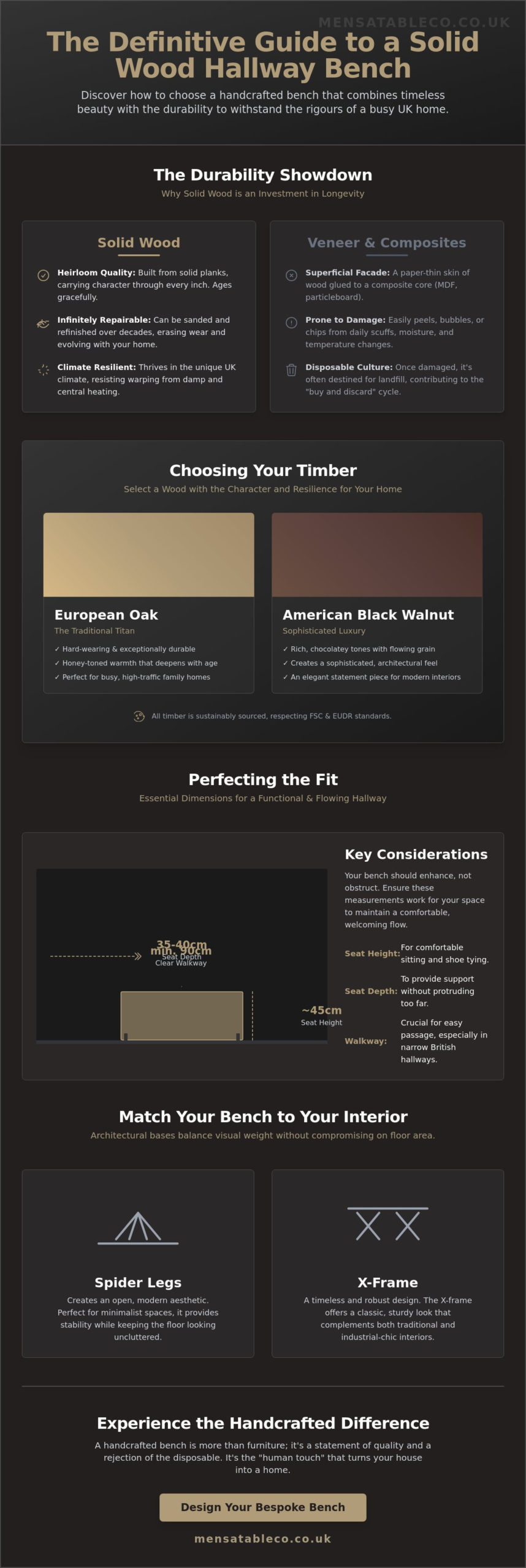
The difference between solid wood and a veneer is the difference between substance and a facade. Veneers are merely paper-thin skins of wood glued onto composite boards. They often peel, bubble, or chip when faced with the daily scuffs of boots and bags. In contrast, our benches are built from solid planks that carry their character through every inch of the timber. Heirloom quality describes furniture that possesses the structural depth to be sanded and refinished over decades, allowing it to evolve with your home. When a solid wood surface takes a knock, it adds to the story; when a veneer is damaged, the piece is often destined for the skip.
The Emotional Value of a First Impression
Walking through your front door should feel like a deep breath. There is a distinct psychological shift that happens when you’re greeted by the tactile warmth of natural grain and the quiet confidence of an artisanal piece. A handcrafted bench sets a deliberate tone for the rest of your interior design, signaling that this is a home that values quality and the human touch. It serves as a vital place of transition. It offers a moment of stillness where you can shed the weight of the outside world and settle into the sanctuary of your own space. This emotional connection transforms a simple seat into a meaningful life investment.
For those who want to carry this standard of quality into the rest of their home, you can visit Belfast Bed Superstore to find beds and mattresses that offer the same sense of permanence and sanctuary.
Understanding the Grain: Selecting the Best Solid Timbers for the UK Climate
The wood we choose is a living history of the forest. In the UK, that history must be resilient enough to survive our damp, coastal winters and the parched air of modern central heating. Selecting the right timber for a solid wood hallway bench UK homes can rely on is a balance of aesthetics and physics. We focus on European Oak and American Black Walnut, not just for their beauty, but for their density and structural stability. With the EU Regulation on Deforestation-free Products (EUDR) becoming enforceable from 31st December 2026, we ensure every plank meets rigorous standards. This commitment to ethics is mirrored in the new UK FSC Risk Assessment published in early 2026, which guides our due diligence in sourcing sustainable timber that respects the planet as much as your home.
When you browse our workshop, you’ll encounter two distinct philosophies of wood: character grade and prime grade. Character grade timber celebrates the knots, shakes, and wild swirls of the tree’s life, offering a rustic narrative that feels deeply personal. Prime grade is more selective, providing a cleaner, more uniform aesthetic for those who prefer a minimalist look. This guide to furniture woods illustrates how these natural variations define the soul of a piece long before the first saw cut is made.
Oak vs. Walnut: Choosing Your Character
Oak is the traditional titan of the British entryway. It’s incredibly hard-wearing and possesses a honey-toned warmth that deepens into a rich amber over the years. Walnut offers a different kind of luxury. Its chocolatey tones and flowing grain patterns bring a sophisticated, architectural feel to a space. While Oak fits perfectly in a busy family home with muddy boots, Walnut often suits a more refined, contemporary setting.
| Feature | European Oak | American Black Walnut |
|---|---|---|
| Hardness | High (Very resistant to dents) | Medium-High (Sturdy but softer) |
| Grain Pattern | Strong, prominent rays | Flowing, velvet-like swirls |
| Light-Ageing | Darkens to a golden hue | Mellows and lightens slightly |
Timber Movement: Why Your Bench Needs Room to Breathe
Wood never truly stops moving. It breathes, expanding when the air is humid and contracting when the radiators kick in during a cold January. This is where mass-produced furniture often fails; it’s held together too rigidly, causing the wood to crack or warp under pressure. Our artisanal joinery techniques, such as using floating tops and Z-fasteners, allow the timber to shift naturally without compromising the bench’s integrity. To help your furniture settle, we recommend keeping it at least 30cm away from direct heat sources. If you’re looking for a piece designed to handle these transitions, you can explore our collection of matching benches to find a build that suits your environment.
From Spider Legs to X-Frames: Matching Bench Styles to Your Interior
A hallway bench shouldn’t just be a functional place to sit; it’s a piece of architectural sculpture that dictates the rhythm of your home, similar to how Marbella Floating Stairs can transform a multi-level space into a design statement. While many high-street retailers focus on bulky “monks benches” or traditional storage boxes, we believe in a more refined approach. A solid wood hallway bench UK homes deserve is one that balances the raw, organic texture of timber with the clean, deliberate lines of bespoke steelwork. This combination allows the bench to act as a visual bridge, particularly in open-plan layouts where the entryway flows into a living or dining space. By choosing a leg design that mirrors your dining furniture, you create a sense of cohesive narrative throughout the house.
The choice of base significantly alters the visual weight of a narrow UK hallway. In smaller spaces, a heavy wooden base can feel claustrophobic, whereas a slender steel frame allows light to pass through, making the area feel larger. We take immense pride in our trade, following the standards of excellence championed by The Furniture Makers’ Company to ensure every weld and joint is built to last. Whether you’re drawn to the minimalist “Japandi” trend or a more rugged industrial aesthetic, the foundation of your bench defines its character.
Industrial Sophistication: Spider and U-Frame Designs
For those looking to make a bold statement, the Spider leg design offers geometric complexity that catches the eye immediately. It’s a centerpiece that suggests modern artistry. If your home leans toward a minimalist or urban apartment style, the U-Frame or Trapezium designs provide clean, uninterrupted lines. These steel bases aren’t just about looks; they provide superior stability for narrow benches that might otherwise feel precarious. The strength of the steel allows for a slimmer profile, ensuring your hallway remains easy to navigate while still offering a sturdy seat for the daily routine of putting on shoes.
Rustic Heritage: X-Frame and A-Frame Classics
If you’re aiming to evoke the warmth of a traditional farmhouse, the X-Frame is a timeless choice. It grounds a space with a sense of history and sturdy reliability. Similarly, the A-Frame silhouette offers a classic, balanced look that feels deeply rooted in artisanal tradition. These styles are particularly effective in hallways with high ceilings, where they provide a strong visual anchor that prevents the space from feeling too airy or impersonal. They celebrate the “slow-fashion” approach to furniture, where the focus is on a silhouette that will look as relevant in thirty years as it does today.
Perfecting the Fit: Dimensions, Sizing, and Hallway Layouts
Achieving the perfect fit for your home is a delicate dance between utility and space. In the narrow corridors typical of British architecture, every centimetre counts. This is where the limitations of high-street furniture become apparent. While most retailers offer only standard 110cm or 150cm lengths, a solid wood hallway bench UK makers create is often tailored to the specific alcove or wall it will inhabit. We believe that a piece of furniture should never feel like an intrusion. Instead, it should sit in harmony with the architecture, offering a quiet invitation to sit without obstructing the natural flow of your morning routine. Our workshop thrives on these specific challenges, turning the constraints of a small space into an opportunity for a bespoke design that feels purposeful and integrated.
If you have a specific space in mind, you can explore our range of Matching Benches to see how we can adapt our designs to your home’s unique dimensions.
The Golden Rules of Hallway Clearance
When you’re planning your layout, we recommend maintaining a minimum of 90cm of clearance for walking past the bench comfortably. This ensures that even during the busiest times of day, your hallway remains a clear artery through the home. You should also consider the “swing” of your front door. It’s a simple check that prevents frustrating collisions and protects the finish of your timber over time. Take a moment to calculate the ideal length by looking at existing fixed points like radiators or coat racks. A bespoke fit allows you to tuck the bench neatly into these gaps, making the furniture feel like an original part of the room’s design rather than a late addition.
Height and Depth: The Ergonomics of Entryways
The comfort of a solid wood hallway bench UK families use daily is dictated by the subtle physics of the human form. For most adults, a standard height of 45cm to 48cm provides the most comfortable position for the daily task of tying laces or pulling on boots. We often create custom heights for families with unique needs, ensuring that everyone from the youngest to the oldest can use the piece with ease. Depth is equally vital. A 30cm to 40cm seat is the sweet spot for UK hallways; it’s wide enough to feel secure but shallow enough to preserve precious floor space. A bench should be as functional as it is beautiful. By balancing these dimensions, we ensure that your investment serves your family’s needs perfectly while elevating the aesthetic of your entryway.
The Mensa Touch: Handcrafting Your Bespoke Hallway Bench
Step inside our workshop, and the first thing you’ll notice isn’t the hum of heavy machinery, but the scent of freshly cut Oak and the quiet concentration of our makers. Every solid wood hallway bench UK customers receive from us begins as a raw plank, hand-selected for its unique character and grain. We don’t believe in mass production; we believe in the deliberate, steady pace of true craftsmanship. This “human touch” is what separates a piece of furniture from a lifelong companion. Our team treats every bench with the same reverence as our larger centerpiece tables, ensuring that the joinery is precise and the finish is flawless. It is a process that values substance over speed, resulting in furniture that carries the soul of the workshop into your home.
We choose to finish our timber with natural oils and waxes rather than heavy, plastic-like varnishes. This approach doesn’t hide the wood’s story; it celebrates it. It allows the texture to remain tactile, so you can feel the life of the tree every time you sit down. By using these breathable finishes, we ensure the wood can adapt to the shifting humidity of a British home, a challenge we’ve mastered through years of working with natural materials. This dedication to quality is why our benches feel as sturdy as they look, providing a reliable anchor for your daily life.
Bespoke as Standard: Your Bench, Your Story
Customisation is at the heart of our philosophy. You aren’t limited to a catalogue of fixed sizes that may or may not fit your narrow entryway. Instead, you can specify the exact millimetre to ensure a perfect fit for your home. Many of our clients find deep satisfaction in matching their entryway seating to their Mensa Dining Table, creating a visual thread that pulls the entire interior together. Buying direct from our local workshop means you’re in conversation with the people actually making your furniture. This direct connection ensures total quality control and a piece that is truly unique to your family.
Caring for Your Legacy Piece
A legacy piece is an investment in the future of your home. Because we use solid timber, these benches are an inherently sustainable choice. You buy once and keep forever. Caring for your solid wood hallway bench UK is a simple, rewarding task. A light application of wax every few months will keep the grain vibrant and the surface protected from the scuffs of daily use. This small act of stewardship ensures your furniture ages gracefully, developing a patina that tells the story of your family’s comings and goings. If you’re ready to bring the warmth of handcrafted timber into your entryway, explore our range of handcrafted benches today and discover the difference of true artisanal quality.
Elevating Your Entryway for Generations
Your entryway is the threshold to your sanctuary, and it deserves a piece of furniture that reflects the care you put into your home. By prioritising the enduring strength of solid Oak and Walnut timber, you choose a legacy of quality that far outlasts mass-produced alternatives. We’ve seen how bespoke sizing ensures a perfect harmony with your hallway’s layout, while artisanal joinery allows the wood to breathe and thrive for generations. Every solid wood hallway bench UK families receive from us is handcrafted in our UK workshop with a quiet confidence in its longevity.
We invite you to browse our collection of handcrafted solid wood benches and discover how a piece tailored to your specific home can elevate your daily routine. Investing in slow furniture is a commitment to sustainability and the beauty of the human touch. We’re here to help you create a centerpiece that isn’t just a place to sit, but a backdrop for a lifetime of memories. Your home’s first handshake is waiting to be made.
Frequently Asked Questions
What is the best wood for a hallway bench in the UK?
European Oak and American Black Walnut are the premier choices for a hallway bench in the UK due to their high density and structural stability. These timbers are resilient enough to handle the high traffic of an entryway while resisting the warping often seen in softer woods. Oak offers a golden, traditional warmth that deepens with age, while Walnut provides a sophisticated, darker grain that suits modern architectural interiors perfectly.
How deep should a hallway bench be for a narrow corridor?
A depth of 30cm to 40cm is the ideal range for a narrow corridor. This measurement provides enough surface area for a comfortable seat while putting on shoes without encroaching on the 90cm of walking space required for a clear thoroughfare. Choosing a solid wood hallway bench UK artisans have measured for these specific proportions ensures your home remains easy to navigate during the morning rush.
Can a solid wood bench be placed near a radiator?
You can place a solid wood bench near a radiator, provided you maintain a clearance of at least 30cm to allow for proper airflow. We use specific joinery techniques, such as Z-fasteners and floating tops, to accommodate the natural movement of the wood as it responds to heat. Keeping this distance helps prevent the timber from drying out too quickly, which preserves the integrity and beauty of the grain over time.
Do solid wood hallway benches come fully assembled?
Every piece we create arrives fully assembled and ready to take its place in your home. We don’t sell flat-pack furniture; we believe the structural integrity of a bench is best ensured by the hands of a craftsman in a workshop environment. This means your bench is sturdy and stable from the moment it crosses your threshold, with every joint and weld already checked for perfection.
How do I maintain the finish on my handcrafted wooden bench?
Maintaining the finish requires only a simple application of natural wax or oil every three to six months. This routine keeps the timber hydrated and enhances the natural character of the grain. You should avoid harsh chemical cleaners, as they can strip away the protective layers we apply in the workshop. A soft, dry cloth is usually all that’s needed for daily dusting and care.
What is the difference between an industrial bench and a rustic bench?
The primary difference lies in the base design and the visual weight the piece brings to a room. An industrial bench typically features architectural steel legs, such as our Spider or U-frame designs, which offer a modern, airy feel. A rustic bench often uses traditional timber bases, like the X-frame or A-frame, to ground the space with a sense of heritage and farmhouse warmth.
Can I get a bench made to a specific length for my hallway?
We specialise in creating benches to your exact millimetre requirements to ensure a perfect fit for your specific hallway. Whether you have a small alcove or a long, grand entrance, our bespoke service allows you to dictate the length. This ensures the solid wood hallway bench UK makers build for you sits in harmony with your home’s unique architecture rather than fighting against it.
Are solid wood benches sustainable?
Solid wood furniture is one of the most sustainable choices you can make because it’s built for longevity rather than disposal. We source our timber from responsibly managed forests, adhering to the latest UK FSC standards and EUDR regulations. By investing in a handcrafted piece that lasts for generations, you reduce the environmental impact associated with the cycle of replacing cheap, mass-produced items.

Leave a Reply