A knot is a trace of a branch’s life, not automatically a defect. It forms where a branch once grew from the trunk, bending the surrounding fibres around it. Appreciating the knots and grains of solid wood means recognising this natural history while understanding that a knot’s effect on strength depends on its size and position.
A distinctive knot or flowing grain can draw the eye, but no two solid wood tabletops share exactly the same pattern. The wood species, how it was cut and the tree’s growth all shape the finished surface.
This article explains how knots form and why grain patterns vary, then explores how walnut and oak change with age and light. It also compares solid wood with veneer, which can show natural knots too, helping you look beyond the surface and understand what gives each piece its character.
Key Takeaways
- Read grain as both a visual pattern and a clue to how the timber was cut, its species and how it may behave when worked.
- Judge a knot by how firmly it sits in the surrounding wood and where it appears, not by its presence alone.
- Expect walnut to lighten slightly in natural light, while oak gradually takes on a richer, more golden tone.
- Limit prolonged direct sunlight to help reduce uneven colour change as a wood surface ages.
- Look beyond knots when comparing solid wood with veneer, since either can show natural knots and distinctive patterns.
Are Knots in Wooden Furniture a Defect?
Knots are traces of branches, while grain describes the arrangement and direction of timber fibres. Whether either feature is a defect depends on its condition, position and effect on the wood.
Natural Knots and Wood Defects
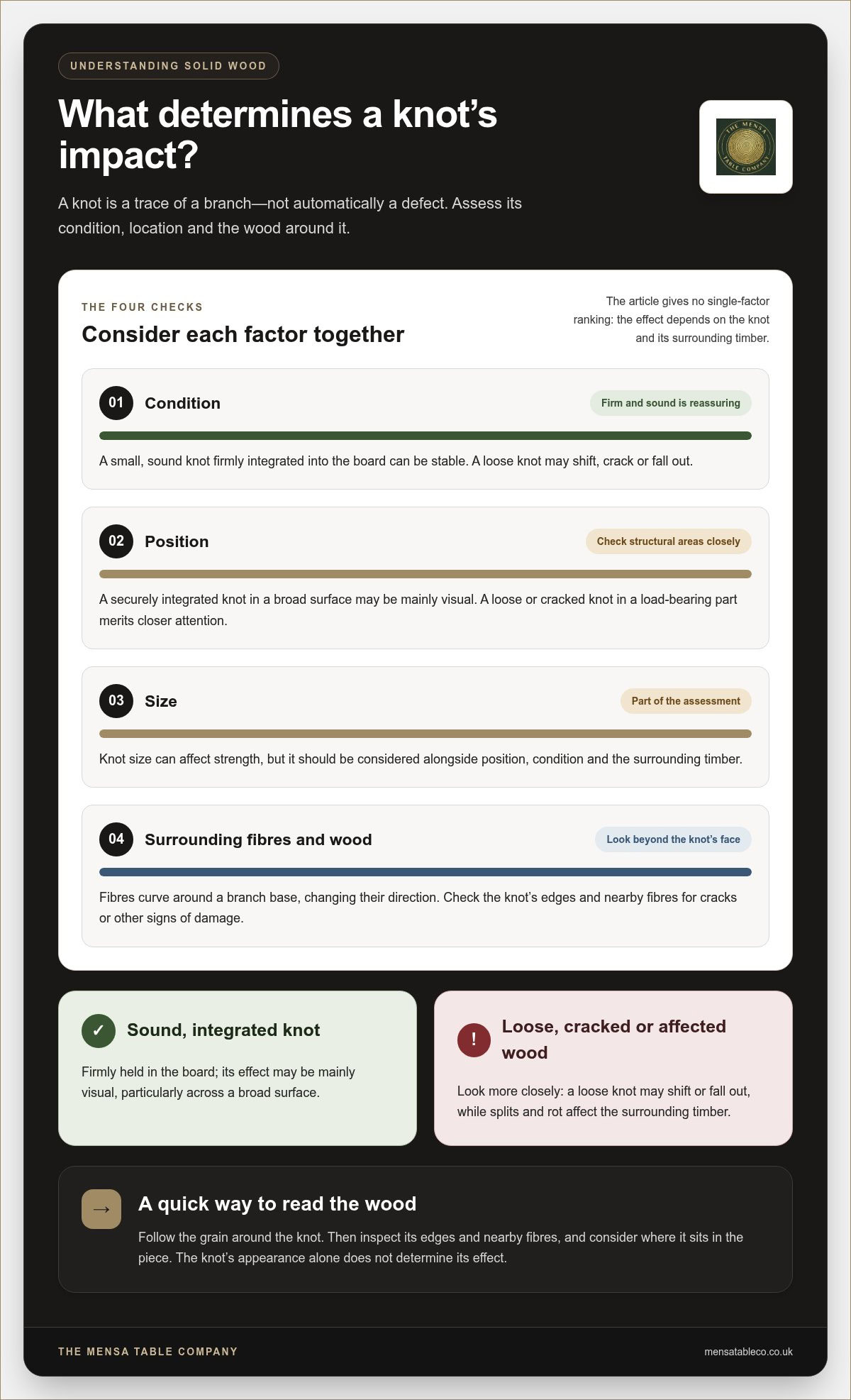
A natural knot is a branch base enclosed by the tree’s trunk, with surrounding fibres curving around it. A small, sound knot firmly integrated into a board can be stable; a loose knot may shift, crack or fall out. Splits are cracks through the timber, while rot weakens the surrounding material. Look closely at the knot’s edges and nearby fibres: their condition matters more than appearance alone.
Knots show where branches once grew, recording the tree’s development and creating distinctive patterns. Their presence doesn’t automatically mean poor quality. There is no universal premium for solid wood with pronounced knots or distinctive grain: cost depends on factors such as species, board selection and the piece being made.
Knots and Wood Strength
A knot can affect strength because it changes the direction of the wood fibres, interrupting their otherwise continuous alignment. The effect depends on the knot’s size, position and condition, as well as the surrounding timber. A securely integrated knot in a broad surface may be mainly visual, while a loose or cracked knot in a load-bearing part merits closer attention.
Cracks around knots also vary in significance. Their effect depends on their size, location and impact on nearby material. Grain may bend sharply around a knot, so a striking feature can also mark a change in fibre direction. When assessing structural parts, look at the wood around the knot, not just its face.
Species, Cutting Angles, and Grain
Species and cutting angle shape the grain’s appearance. Straight grain follows the board’s length; cathedral patterns form sweeping arches, while figured grain reflects different cuts through the tree. American white oak often has open, linear grain and occasional ray flecks. Oak and ash are open-grained hardwoods; black walnut has an intermediate grain. These clues can help identify timber, but the cut changes what is exposed.
Grain alignment affects workability. Straight-grained timber is generally easiest to shape, while interlocked or irregular fibres can split, crack or tear during working. Around a knot, fibres may slope up to 90 degrees as they curve past the branch base. Grain and knots offer useful clues to species, but neither gives a certain identification on its own.
To highlight knots and grain, choose a finish that keeps the wood’s figure visible. Open-grained oak and ash have a coarser surface, and grain filler can create a smoother finish before the final coating. The finish changes how the surface looks and feels, so consider whether you want the pores to remain noticeable or the surface to look flatter.
Seasoning and later indoor conditions influence stability. Timber responds to changes in humidity and temperature by expanding and contracting slightly, which can affect the surface over time. For care, wipe spills promptly with a dry or lightly damp cloth; use coasters and placemats, avoid prolonged direct sunlight and strong heat, and keep moisture exposure modest. Periodic wood conditioner helps maintain the grain and finish.
Why knot patterns vary between wooden tables
Every solid wood table has a pattern shaped by its boards, species, growth and cut. Even boards from the same species differ in their knots and grain because every tree grows differently. Where boards meet across a tabletop, their contrasting lines create a surface no other table repeats. That variation comes from the timber, not a printed or repeated surface pattern.
Board selection also changes the overall effect. A maker can bring together boards with visible knots and flowing grain, or select timber with a cleaner, more uniform appearance. The position and direction of each board influence how the grain travels across the surface. Aligned boards may create continuity, while varied grain directions give the tabletop a more varied character.
Softwood growth rings add another visible pattern. Earlywood forms at the start of the growing season and is usually lighter; latewood forms later and is often darker and denser. The contrast between these bands creates much of the grain seen in softwoods. Faster-growing softwoods can develop wider rings, making the difference between light and dark bands more noticeable across a table.
Knots alter those lines locally. As fibres approach a branch base, they curve around it rather than continuing in a straight path. The grain pattern can slope by as much as 90 degrees while passing around the knot, creating a striking change in direction. The effect depends partly on the cut: a different angle through the same knot can expose a different shape.
That is why one knot may look like a small oval, while another appears broader and more dramatic. The timber species, the branch’s position in the trunk and the board’s orientation all contribute. A tabletop assembled from boards with several knots can show distinct islands of curved grain, while a board cut away from branches may look more uniform.
To read a table’s character, follow the grain across each board and notice where the lines bend around knots. Then look at the growth-ring contrast, especially in softwood, and observe how the boards meet. These details explain why two wooden tables can share a species yet look entirely different. The natural pattern is particular to the tree and to how its timber was cut and arranged.
How walnut and oak change with age and light
Walnut and oak don’t keep exactly the colour they had when first made. Walnut tends to lighten slightly in natural light, while oak gradually deepens towards a richer, more golden tone as it ages. These changes are part of solid wood’s evolving appearance, not a sign that its grain has disappeared. The starting shade and visible figure still matter, but the surface develops its own history through light and everyday use.
Walnut’s flowing tonal variation gives a tabletop warmth from the outset. As natural light reaches the surface, its colour can become lighter, changing the contrast between darker and paler areas. The change may be more noticeable where one part of the table receives daylight and another stays shaded. For example, a section near a window and a covered section may not change at the same pace.
Oak follows a different visual path. Its tone gradually becomes richer and more golden with age, bringing warmth to the grain. On a table used each day, handling and gentle wear also contribute to a patina. Solid wood can deepen in tone and become smoother with use, so the surface may feel less freshly finished while retaining its distinctive pattern.
Uneven light has a particular effect. Prolonged direct sunlight can accelerate colour change, leaving exposed areas looking different from shaded sections. Moving objects across a tabletop can reveal contrasts between previously covered and uncovered patches. The room’s light, therefore, affects how evenly walnut or oak matures, which is why interior elements such as internal doors with glass are often used to balance and soften daylight entering living spaces.
Protect the finish by avoiding prolonged direct sunlight and strong heat sources. If a table sits near a bright window, changing its position within the room or adjusting nearby furnishings can reduce persistent exposure on one area. Coasters and placemats also help shield the surface from heat and moisture during everyday meals. Wipe spills promptly with a dry or lightly damp cloth.
Temperature and moisture matter alongside daylight. Timber expands and contracts slightly as these conditions vary, so stable indoor conditions help limit movement. That movement can put stress on the finish over time, especially when the surface is also exposed to strong sunlight or excess moisture. Re-oil periodically to care for the wood and its finish.
When appreciating the knots and grains of solid wood, notice how walnut’s lighter tones or oak’s golden ageing reveal different details. Look at the table in daylight and room lighting, then compare exposed areas with protected ones. A gradual colour shift and smoother feel can show how a wooden surface has lived with its home.
Knots as decorative features
A knot can become the visual centre of a solid wood surface, with surrounding fibres drawing attention towards it. On a dining tabletop, one dark knot may create a focal point; several smaller knots can spread natural variation across the boards. Placement matters as much as appearance. A knot near an edge reads differently from one surrounded by open space at the centre.
Timber selection shapes that effect. Boards with visible knots suit a more expressive, irregular look, while boards with fewer noticeable features create a calmer, more uniform surface. Neither choice removes the wood’s natural character; it changes how strongly the pattern stands out. Across a tabletop, notice whether knots cluster together or sit among long, quieter lines of grain.
Colour variation adds another layer. A solid wood panel can show differences between heartwood and sapwood, the inner and outer parts of the tree. Mineral streaks reflect the conditions in which the tree grew, distinguishing one board from another. In walnut, tonal shifts can make a knot stand out; in oak, contrasting areas can sit alongside the timber’s linear grain.
Some decorative patterns come from changes beyond ordinary grain. Spalting creates dark lines, streaks or patches through fungal activity in timber. These marks can form intricate details, unlike a branch knot’s curved fibres. Each feature has a different origin, so the direction of the lines can help you read the surface. A curve around a knot differs from a dark spalted line crossing the board.
Finishing influences how these details look and feel. Oak and ash are open-grained woods, so their pores can leave a coarser surface; grain filler is often used before finishing for a smoother, flatter result. A flatter finish changes the tactile impression, while knots, streaks and colour variation remain visible. The choice is about the surface you prefer, not concealing the tree’s history.
To assess the decorative effect, look at the whole tabletop rather than judging a knot in isolation. Follow the grain from board to board, notice how the colour shifts around each feature, and consider whether the pattern feels balanced in the room. Appreciating the knots and grains of solid wood means recognising that each mark contributes differently. One table may feel lively and expressive; another may have a quieter pattern with subtler variation.
Solid wood compared with engineered wood and veneers
Solid wood is cut directly from timber, so each plank carries marks shaped by the tree’s growth and surroundings. Its knots, grain and colour variation extend through the material, not just across the visible face. Engineered wood uses wood-based components assembled into a panel or structure. Veneer is a thin layer of natural wood applied over a core, which may itself be engineered.
That difference matters when you consider appearance and construction together. A solid oak tabletop shows oak at its surface and through its thickness; a veneered panel shows oak on its face, while the core provides the underlying structure. Both can have a carefully finished, natural-looking surface. The choice comes down to how the material is made and what you value in its visible character.
Knots alone can’t identify solid timber. Natural wood veneer can contain real knots because it comes from a tree, while manufactured surfaces can reproduce the look of knots and grain. Examine more than one feature: look at the edges, visible end grain and how the pattern runs across the face. A natural pattern may vary from place to place, whereas a repeated printed design can look unusually uniform. These clues help, but a knot by itself proves nothing.
Veneer can show vivid grain, figured patterns and natural marks, so it isn’t necessarily plain or artificial-looking. Its face layer may show knots just as solid wood does. The key distinction is depth: in solid wood, the timber’s characteristics extend through the piece; in veneer, the decorative wood layer sits over another material. If you’re drawn to a particular knot, this distinction is more informative than its appearance alone.
Engineered wood and veneer aren’t interchangeable terms. Engineered wood describes a broad family of products made by combining wood materials; veneer describes a surface layer. A panel may use veneer over an engineered core, but the terms refer to different parts of its construction. Understanding this relationship makes comparisons clearer, especially when a table’s surface looks convincingly like a single plank.
Choose according to the qualities that matter in your home. Solid wood offers the direct presence of timber, with individual variation across the surface and through the material. Veneer offers a real wood face over a separate core, while manufactured finishes can imitate natural patterns. Neither knots nor attractive grain alone reveal the construction. Consider the visible face, edges, core and intended use together.
If you’re weighing these material differences for a table, share what matters most to you and discuss the character you want in your space.
The Mensa Table Company: The Mensa Dining Table
The Mensa Table Company offers The Mensa Dining Table for readers choosing a table to become part of everyday life at home. If you’re weighing natural wood character against different table designs, compare The Mensa Dining Table with The Spider Leg Dining Table, The X-Frame Dining Table and The U-Frame Dining Table to consider which design suits your space.
Knots and grain vary naturally from board to board, making the details you notice in a wooden surface part of its individual character. Keep that variation in mind as you consider how a table will fit into your home and bring people together.
For information about The Mensa Dining Table and the other designs, contact The Mensa Table Company.
Choose a Table That Feels at Home
A wooden table becomes part of a room’s daily rhythm: shared meals, quiet pauses and conversations that linger. Let the surface’s natural character guide your choice, while considering how its shape and presence will work with the space around it. Appreciating the knots and grains of solid wood can make the decision less about finding a flawless pattern and more about choosing details you’ll enjoy living with.
The Mensa Table Company offers The Mensa Dining Table, The Spider Leg Dining Table and The X-Frame Dining Table. Each gives you a different design to consider as you imagine the table in your home and the moments it may hold.
If you’re ready to explore which design feels right for your space, contact The Mensa Table Company. Take your time choosing a piece that feels welcoming today and meaningful in the years ahead.
Frequently Asked Questions
How Do Knots Form in Trees?
Knots form where branches grow from a tree trunk and become enclosed as the trunk develops. The branch’s base remains within the timber, leaving fibres that curve around it. When the wood is sawn, the cut reveals that branch base as a visible mark. A knot’s shape on a finished board depends partly on the direction of the cut through the trunk.
Are knots in wood normal?
Yes, knots are a normal feature of timber from trees with branches. Their number and visibility vary with species, board selection and the section of trunk used. A table may show a few prominent marks or a more restrained surface. For a practical comparison, look across all the boards rather than judging one knot alone, since the overall arrangement shapes the tabletop’s character.
Tight Knots vs Loose Knots: What’s the Difference?
A tight knot is firmly joined to the surrounding wood; a loose knot has a weaker connection and may move, crack or fall out. On a tabletop, a firmly integrated knot can remain a stable natural feature. In a structural part, looseness matters more because movement can affect the surrounding timber. Check whether the knot’s edges appear connected to or separated from nearby fibres.
What Is a Knot in Wood?
A knot is the enclosed base of a branch within a piece of wood. Grain describes how fibres are arranged, though they curve around a knot and create a visible pattern. On a finished tabletop, a knot may appear as a small oval, a dark circle or an irregular shape, depending on the cut through the timber.
What about cracked knots?
A crack in a knot needs to be considered alongside its position and the condition of the nearby wood. A fine mark on a decorative surface has a different role from a crack affecting timber that supports weight. Look for separation extending beyond the knot or signs of damage to the surrounding fibres. The crack’s size, location and effect on nearby material determine its significance.
Why Do Some Wooden Tables Have More Knots Than Others?
Tables differ because their boards come from different trees and trunk positions, and timber selection can favour either visible character or a more uniform look. A maker assembling a top from knotty boards creates a different pattern from one using boards with fewer visible marks. Species and cut also affect which knots appear and how prominently they show across the surface.
What are the different types of wood grain and how do they affect appearance?
Straight grain runs consistently along a board, while cathedral grain forms sweeping arches; figured grain creates more unusual visual movement. These patterns reflect the timber species and cutting angle. An arching pattern, for example, may draw the eye along a tabletop, while straighter lines can create a calmer impression. Grain also influences the surface’s texture and workability.
How do knots and grain affect the strength and durability of solid wood?
Knots alter fibre direction, while straight, aligned grain generally behaves more predictably during woodworking. Irregular or interlocked fibres can be more prone to splitting, cracking or tearout during shaping. For a finished table, consider where a knot sits and whether it’s sound, especially in parts that carry structural loads. Natural variation alone doesn’t determine durability; the timber’s condition and construction matter too.

Leave a Reply