

You shouldn’t have to sacrifice the soul of your home for fear of the floorboards beneath you. Many urban dwellers find themselves asking: is solid wood furniture too heavy for an apartment, particularly when moving into a storied older building or a sleek new high-rise? It’s a natural hesitation. The dense, tactile weight of a handcrafted table feels fundamentally different from the hollow lightness of disposable alternatives. You want a piece that carries history and heart, but you don’t want to risk structural strain or a delivery disaster.
The reassuring truth is that most homes are built with far more resilience than we imagine. According to the 2026 building standards, residential spaces are typically designed to support a live load of at least 30 pounds per square foot. This guide will help you understand those structural limits and how to safely bring the warmth of solid timber into your living space. We will explore how to manage weight distribution, provide practical tips for measuring narrow access points, and give you the confidence to invest in an heirloom that belongs in your home for a lifetime.
Key Takeaways
- Understand how modern building codes and floor load limits ensure your apartment can safely support the weight of substantial timber pieces.
- Learn how to choose a frame style that distributes weight effectively to protect your floorboards from concentrated pressure points.
- Discover why the common question of is solid wood furniture too heavy for an apartment is more about delivery logistics than structural capacity.
- Explore the emotional and practical value of choosing solid timber over the fragile, temporary nature of mass-produced veneer furniture.
- See how custom measurements and artisanal craftsmanship allow you to introduce a meaningful focal point without compromising on space or accessibility.
Understanding Floor Loads: Can Your Apartment Handle Solid Wood?
The weight of a handcrafted table is more than just a physical measurement; it’s a testament to the decades of growth held within the timber. When you’re standing in a fifth-floor flat, looking at a thick slab of solid European oak, it’s natural to wonder if solid wood furniture is too heavy for an apartment. You aren’t just buying a piece of furniture. You’re bringing a significant piece of the natural world into a man-made structure, and that brings a sense of responsibility for the space you inhabit.
To understand how your home supports this weight, we look to the principles of structural engineering. We distinguish between live loads and dead loads, where dead load refers to the weight of the building itself and live load accounts for the furniture and people within it. While the timber feels substantial in your hands, it’s helpful to remember that floors are designed to host life in all its forms, from heavy bookshelves to gatherings of friends and family.
The Math of Modern Apartment Floors
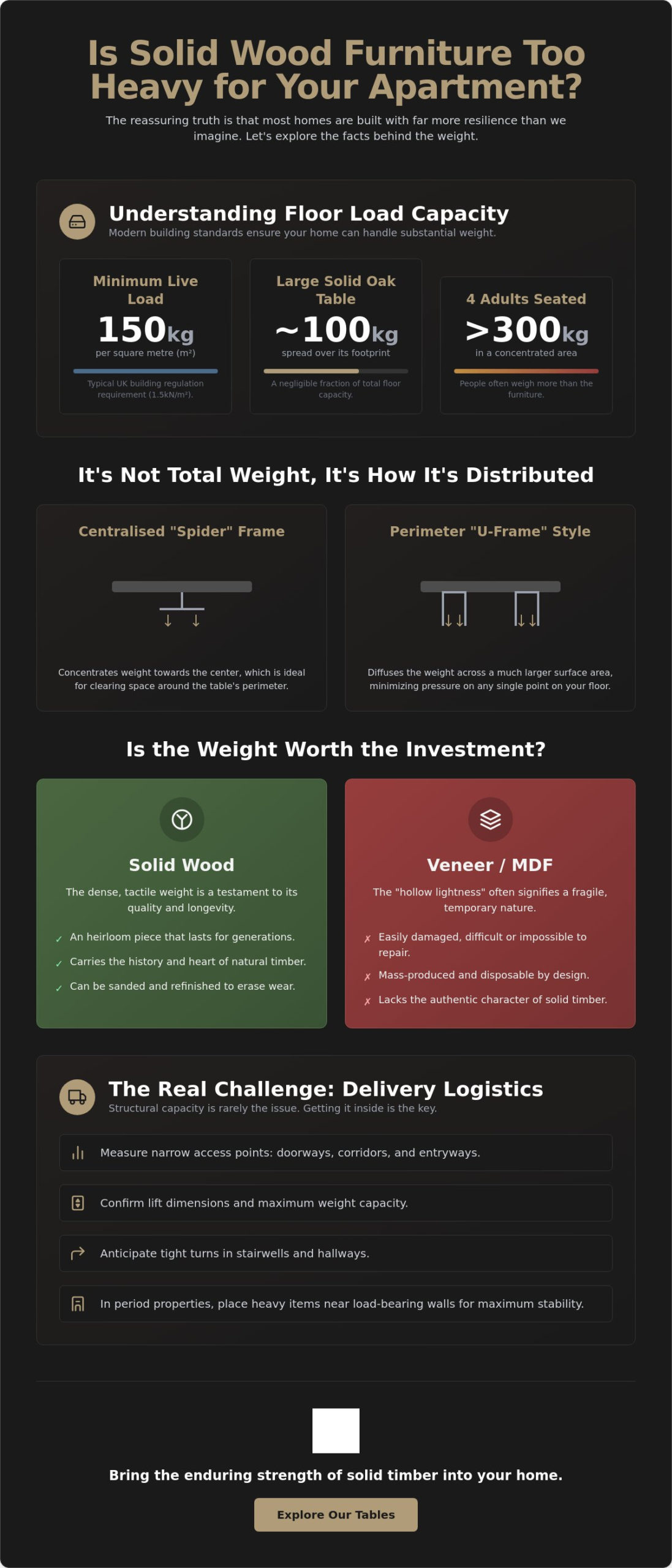
In the UK, modern building regulations generally require residential floors to support a minimum live load of 1.5kN/m2. This translates roughly to 150kg for every square metre of floor space. When you consider that a large solid wood dining table might weigh around 100kg, it becomes clear that the furniture is a negligible fraction of the floor’s total capacity. In fact, four adults sitting down for dinner actually exert more pressure on the structure than the table itself. Your apartment is more than capable of cradling these heirloom pieces without a hint of strain.
Period Conversions: What to Look For
Victorian and Georgian conversions offer a unique charm, but they require a slightly more thoughtful approach. These buildings have stood for over a century, their timber joists settling into place long ago. If you’re moving a substantial piece into a period property, look at the “bones” of the room. Placing heavier items near load-bearing walls or directly over the floor joists provides the most stable foundation. Most floors in these historic homes remain incredibly robust. However, if you notice significant dipping in the floorboards or springiness when you walk, it’s wise to consult a professional before placing exceptionally large items in the centre of a wide, unsupported span.
Choosing a piece for an older home is about harmony. We often find that the enduring strength of solid timber mirrors the resilience of the buildings themselves. By understanding the simple physics of your space, you can move forward with the confidence that your floor is ready to support a lifetime of shared meals and memories.
Weight Distribution: How Leg Design Protects Your Floor
The structural integrity of your home is rarely compromised by the total mass of a piece of furniture. Instead, the focus should shift to how that weight makes contact with your floorboards. When people ask if solid wood furniture is too heavy for an apartment, they’re often envisioning a single, crushing weight. In reality, the pressure is divided across the footprint of the piece. This is known as “point load.” A heavy oak tabletop might weigh 80kg, but if it’s supported by a well-designed frame, that weight is diffused across a much larger surface area than you might expect.
Modern engineering ensures that residential structures are built to withstand significant pressure. Standard building codes specify minimum design loads that account for both the static weight of your belongings and the movement of people. By choosing furniture with a thoughtful leg design, you’re working in harmony with your building’s architecture. Steel frames, which we pair with our solid timber tops, offer a unique advantage here. They provide a rigid, stable foundation that prevents the timber from bowing while spreading the weight evenly, ensuring your floor remains as level and true as the day you moved in.
Comparing Frame Styles: Spider vs. U-Frame
The silhouette of your table legs does more than define your room’s aesthetic; it dictates how the floor experiences the weight. Our Spider Leg Dining Table centralises the mass, making it an excellent choice for smaller spaces where you want to keep the perimeter clear. Conversely, a U-Frame or Trapezium design spreads the load across a wider area. These frames often bridge multiple floor joists, which is particularly beneficial in older apartment conversions where the subfloor might be less uniform. A wider footprint offers peace of mind by ensuring no single point of the floor is under undue stress.
Practical Floor Protection for Heavy Furniture
Even the most robust solid wood piece needs a soft touch where it meets the ground. For engineered wood or laminate flooring, felt pads are essential. They act as a sacrificial barrier, preventing the steel or timber from leaving a permanent mark. If your apartment has a newer, “floating” floor, you might notice slight settling over the first few weeks. This is a natural adjustment as the floorboards compress under the new focal point of the room. Placing an area rug beneath your table not only adds a layer of tactile warmth but also serves as a structural cushion, further distributing the pressure and protecting your investment. If you’re unsure which frame style suits your floor type, get in touch with our team for a personal recommendation.
The Logistics of Apartment Delivery: Stairs, Lifts, and Turns
Often, the anxiety around whether is solid wood furniture too heavy for an apartment isn’t about the floorboards at all. It’s about the narrow corridor on the third floor or the compact lift that seems designed for suitcases rather than substantial, handcrafted furniture. The weight of solid timber is most apparent during those crucial first twenty minutes of arrival. Once the piece is settled on its protective pads, it becomes a permanent, peaceful part of your home’s architecture. The challenge is simply the journey from the delivery van to your dining room.
The journey from our workshop to your home is a carefully choreographed process. While a solid oak slab is undeniably dense, it’s also incredibly predictable. Unlike flimsy alternatives that might flex or snap under their own weight when tilted, solid wood maintains its structural integrity. This honesty in material makes it easier for a professional team to handle. They can pivot, tilt, and lift the piece with confidence, knowing the timber won’t fail them at a critical moment in a tight stairwell.
The Apartment Access Checklist
Before the delivery team arrives, we recommend conducting a personal “dry run” of the access route. This simple preparation removes the guesswork and ensures a smooth installation. Consider these three vital measurements:
- The Lift Capacity: Check the weight limit posted inside the cabin. Most residential lifts handle between 400kg and 600kg, which is significantly more than any single dining table.
- The Pivot Point: Measure the height of your door frames and the width of any hallway corners. If the table top is two metres long, you’ll need enough clearance to turn it vertically.
- Communal Restrictions: Review your leasehold agreement for any rules regarding delivery times or the use of service lifts.
Why Solid Wood is Often Easier to Move than Flat-Pack
There’s a common misconception that lightweight, flat-pack items are the only choice for high-rise living. In reality, the modular nature of our designs, such as The Mensa Dining Table, makes them remarkably apartment-friendly. By creating pieces with detachable steel frames, we ensure the heaviest components are manageable. The tabletop can be carried as a single, slim profile, while the legs are moved separately. This approach allows a solid wood piece to navigate spaces that would be impossible for a pre-assembled, hollow-core alternative. When you combine this design with a professional two-man delivery service, the perceived weight of the timber ceases to be a hurdle, leaving you with a beautiful heirloom that feels like it was always meant to be there.
Solid Wood vs. Veneer: Is the Weight Worth the Investment?
When you lift a piece of mass-produced veneer furniture, its lightness often feels like a convenience. In the context of a high-rise home, it’s easy to assume this portability is an advantage. However, the question of whether is solid wood furniture too heavy for an apartment often overlooks the hidden cost of that lightness. Veneer and MDF are essentially compressed wood fibres held together by resins and glues. They lack the cellular structure and inherent strength of solid European oak, which possesses a density that speaks to its years of slow growth in the forest. This physical substance isn’t just weight; it’s a marker of quality and a promise of endurance.
Choosing a lighter, disposable alternative often results in a “false economy,” especially for those in rental apartments. While a flat-pack desk might be easy to carry up the stairs, it rarely survives the disassembly required for the next move. The cam-locks pull through the particle board, and the thin veneer edges begin to peel at the first sign of friction. In contrast, the weight of a solid timber piece represents a structural honesty. It provides a tactile connection to the natural world that elevates a living space from a temporary dwelling to a home with a true centrepiece.
Longevity and the Moving Cycle
Life in an apartment often involves transitions. Whether you’re moving between boroughs or upgrading to a larger space, your furniture should be a constant companion rather than a casualty of the journey. Solid wood is a generational investment that outlasts multiple apartment moves and adapts to the changing chapters of your life. Because the material is consistent throughout, any scuffs or bruises earned during a move can be sanded away and refinished. Our steel frames are designed for this cycle. They don’t strip or weaken when unbolted; they remain as rigid and dependable as the day they were forged in our workshop.
The Environmental Impact of Your Choice
The weight of a table is a physical record of the carbon it has sequestered over decades. By choosing substantial materials like solid black walnut, you’re making a conscious decision to step away from the “fast furniture” cycle that fills landfills with broken chipboard. A heavy, durable piece is an act of environmental responsibility. It’s a choice that values the slow, manual process of production over the frantic pace of mass manufacturing. These pieces aren’t just objects; they are sites for human connection that gain character and history with every passing year.
If you’re ready to move away from temporary solutions and invest in a piece that brings the authentic warmth of nature into your apartment, reach out to us today to discuss your custom project.
Making Solid Wood Work for Your Space: The Mensa Approach
At the heart of our workshop is a belief that every home, regardless of its size or floor level, deserves a piece of furniture that feels like an anchor. While we have explored the structural reality that is solid wood furniture too heavy for an apartment, the practical beauty of these pieces lies in how they are tailored to your specific environment. We don’t believe in the one-size-fits-all approach of mass manufacturing. Instead, we see every apartment as a unique canvas that requires a thoughtful balance of scale, material, and movement. Our goal is to ensure your table isn’t just a physical object, but a backdrop for the rituals of your daily life.
The “Mensa Approach” is rooted in the marriage of substantial, raw materials with a design philosophy that respects urban constraints. We understand that in a high-rise setting, every centimetre of floor space is a precious commodity. By handcrafting each piece to order, we can adjust the proportions of a tabletop or the profile of a steel frame to ensure it enhances the room without overwhelming it. This manual, intentional process allows us to create furniture that feels light and airy in its aesthetic while retaining the reassuring weight and history of solid timber.
Bespoke Sizing for Apartment Dining
Creating a sense of “flow” is essential in open-plan apartment living. A table that is too large can disrupt the natural pathways of your home, while one that is too small can feel lost. We work with you to find the perfect dimensions, often suggesting Matching Benches as a space-saving solution. Benches can be tucked completely under the table when they aren’t in use, keeping your sightlines clear and your floor space open. For those with compact urban kitchens or studio layouts, a solid wood Breakfast Bar offers a slimmer alternative that still provides the tactile warmth and durability of a full-sized dining table.
Expert Advice for Your Specific Building
We take immense pride in being more than just creators; we are specialists who value the connection with the end user. When you choose a piece from our workshop, you are invited to talk to our craftsmen about the specific constraints of your building. Whether you’re concerned about a narrow Victorian stairwell or the weight limits of a modern service lift, we provide the expertise to navigate these hurdles. We remain committed to high-quality, non-flat-pack furniture because we believe an heirloom should be built to last, not just to fit through a door. It is this dedication to substance over flashy marketing that ensures your investment will be cherished for generations to come.
Ready to bring the enduring beauty of handcrafted timber into your home? Explore our full range of handcrafted dining tables and find the perfect focal point for your apartment.
Bringing Nature Home with Confidence
Choosing a handcrafted piece means inviting a legacy into your home. We’ve explored how modern structural standards and intelligent leg designs ensure that your floor remains secure, addressing the common fear that is solid wood furniture too heavy for an apartment. From the density of Solid European Oak to the rich tones of Black Walnut, these materials offer a longevity and repairability that lightweight, disposable alternatives simply don’t provide. There’s no need to sacrifice the tactile warmth of real timber for the sake of urban living.
Our workshop focuses on the connection between the maker and the home. Every table is handcrafted in the UK using traditional joinery and premium timbers like Ash, Oak, and Walnut. These pieces are built to survive the rigours of apartment living and multiple moves, supported by our expert two-man delivery service. We believe in creating items that tell a story for generations rather than those destined for a landfill. View our collection of apartment-ready solid wood tables and let’s start creating a focal point that grows more beautiful with every passing year.
Frequently Asked Questions
Can a second-floor apartment handle the weight of a 2.4m oak table?
Yes, your second-floor apartment is designed to support significantly more than the weight of a 2.4m oak table. Residential building codes require floors to support a minimum live load of 1.5kN/m2, which is roughly 150kg per square metre. Since a large table’s weight is distributed across its frame, it represents only a small fraction of what your home can safely hold.
What happens if the solid wood furniture is too heavy for the lift?
It’s highly unlikely that a piece of furniture will exceed the weight limit of a residential lift, as most are rated for at least 400kg. The more common challenge is the physical dimensions of the tabletop. In these cases, our professional two-man delivery team will carry the components via the stairs, ensuring the timber is protected throughout the climb to your floor.
Will a heavy table leave permanent indents in my apartment’s carpet or laminate?
A heavy table can leave impressions in deep-pile carpets, but these are often temporary and can be revived with steam. On laminate or engineered wood, the risk is more about scratches than indents. We recommend using felt pads or a thick area rug to cushion the contact points, which helps distribute the pressure and preserves the pristine finish of your flooring.
Is solid wood furniture heavier than reclaimed timber pieces?
Solid wood furniture isn’t inherently heavier than reclaimed pieces, as the weight depends entirely on the timber species and its moisture content. A new solid oak top will have a similar density to a reclaimed oak beam of the same size. However, some reclaimed softwoods like pine may feel slightly lighter than dense hardwoods like walnut or ash due to their different cellular structures.
How do I know if my floor joists are strong enough for a solid wood desk?
You can trust that standard residential floor joists are more than strong enough to support a solid wood desk. If you’re concerned about whether is solid wood furniture too heavy for an apartment, look for signs of excessive deflection or “bounce” in the floor when you walk. In most modern and period builds, the joist system is engineered to handle heavy bookshelves and desks without any structural risk.
Do I need to inform my landlord before buying heavy solid wood furniture?
You generally don’t need to inform your landlord about purchasing a solid wood table or desk, as these are considered standard household items. Unlike waterbeds or grand pianos, which have extreme point loads, a dining table falls well within the expected use of a residential space. It’s always worth checking your specific lease for clauses regarding heavy deliveries to ensure you follow communal building rules.
Is solid ash lighter than solid oak for an apartment setting?
Solid ash is slightly lighter than oak, but the difference is minimal in a domestic setting. European Oak has a density of roughly 720kg/m3, while European Ash sits around 670kg/m3. While ash might be marginally easier to handle during delivery, both timbers provide a similar structural presence and will feel equally substantial once they are placed in your dining room.
What is the best leg style for distributing weight on a floating floor?
The U-Frame or Trapezium leg styles are the best choices for distributing weight on a floating floor. These designs feature a long horizontal base that bridges multiple floorboards, preventing any single board from taking the full pressure. This wide footprint is ideal for apartments with laminate or engineered wood, as it minimises the risk of the floor “dipping” or shifting over time.

Leave a Reply