
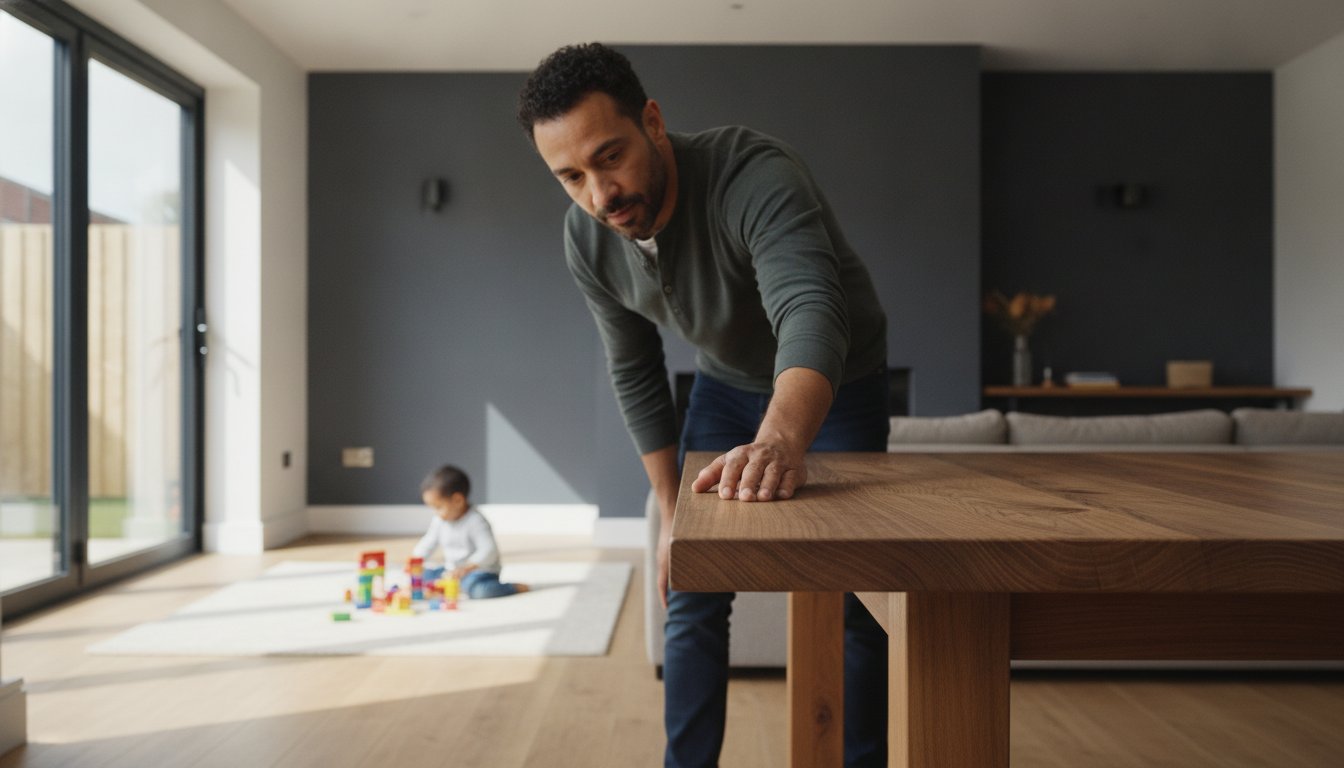
What if the ‘solid oak’ dining table you’ve been dreaming of is actually just a thin, printed skin hiding a core of industrial waste? It’s a valid concern when you’re looking for a piece to anchor your home for decades. You want a surface that survives spilled wine and late-night talks without peeling at the edges. You’re likely tired of vague marketing terms like ‘real wood finish’ that often mask mass-produced imitations. Learning how to check if a table is truly solid wood is the only way to ensure your money buys a legacy rather than a temporary fix.
A genuine timber piece is a living narrative, revealing its history through every unique knot and grain pattern. Since solid wood furniture in timeless profiles like oak or walnut retains 40 to 65 percent of its original value, making the right choice is a significant financial decision. We’ll share the tactile secrets and technical markers we use in our workshop to verify authenticity. You’ll learn how to read the end-grain like a map and why the underside of a table tells the truest story. This guide provides the confidence to spot construction red flags and choose a table that will serve your family for generations.
Key Takeaways
- Learn to decode confusing marketing labels like ‘real wood finish’ to ensure you aren’t paying premium prices for a clever veneer over a composite core.
- Master the end-grain continuity test to understand how to check if a table is truly solid wood by tracing the natural growth rings from the top surface to the edges.
- Identify the ‘honest’ markers of craftsmanship by inspecting the underside for traditional joinery, such as mortise and tenon, instead of industrial staples or cam-locks.
- Understand why natural expansion and seasonal ‘breathing’ are the hallmarks of a living material that will retain its beauty and value for generations.
- Discover why a handcrafted piece is a sustainable investment that offers long-term repairability compared to the disposable nature of mass-produced furniture.
Understanding the ‘Solid Wood’ Marketing Trap
Stepping into a modern furniture showroom can feel like a linguistic maze. You’re surrounded by labels like “natural finish” or “hand-selected hardwoods,” yet these phrases often mask a more industrial reality. Truly Understanding Solid Wood is the first step in avoiding the disappointment of a piece that fails after just a few years of use. When you are learning how to check if a table is truly solid wood, you are essentially learning to see past the clever marketing that prioritizes profit margins over artisanal longevity.
The Language of the Showroom
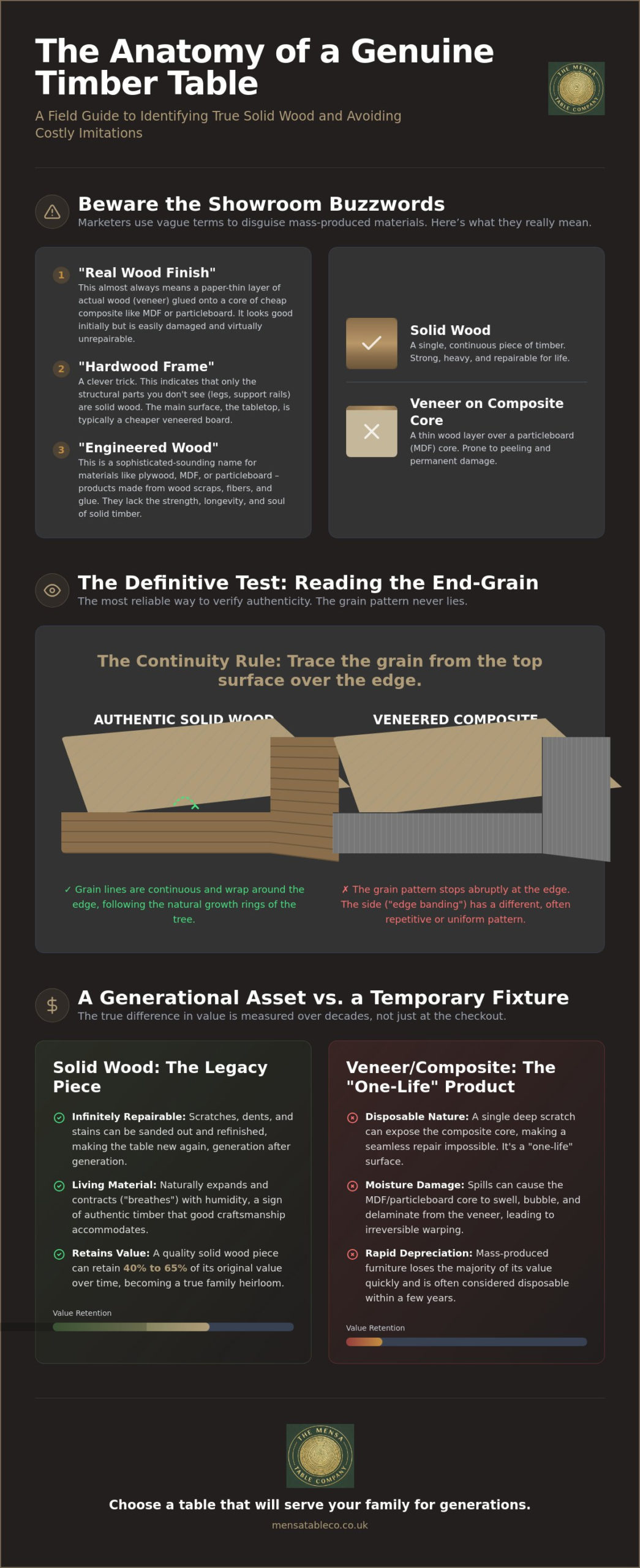
Vague terminology is the most common tool used to confuse buyers. You’ll often see the phrase “Real Wood Finish,” which sounds promising but usually indicates a thin veneer glued over a core of Medium Density Fibreboard (MDF) or particleboard. These mass-produced pieces frequently employ a “veneer wrap” technique. This involves folding a thin slice of wood over the edges to hide the tell-tale layers of the composite core. If you’re unsure how to check if a table is truly solid wood, watch out for these common loopholes:
- Hardwood Frame: This usually means the legs and support rails are solid, but the tabletop, the part you interact with most, is a veneered imitation.
- Engineered Wood: While marketed as a stable, high-tech alternative, it’s often just a way to make plywood or MDF sound more sophisticated than it is.
- All-Natural Materials: This can refer to the glues or the finish rather than the timber itself.
Why Authenticity Matters for Longevity
The difference between a solid slab and a veneer isn’t just about weight; it’s about the future of the piece. Solid timber is a living material. It has the unique ability to be sanded down, repaired, and refinished as the decades pass. If a bespoke dining table suffers a deep scratch during a lively dinner party, it isn’t ruined. It can be restored to its original glory. Veneer, however, is a “one-life” product. The wood layer is often so thin that a single deep scratch exposes the grey, dusty core beneath, making a permanent repair nearly impossible.
Moisture also plays a decisive role. While solid timber naturally breathes and moves with the seasons, it remains structurally sound. When moisture hits an MDF core, the fibers swell and the glue fails. The result is a tabletop that bubbles and warps, often beyond any hope of fixing. A solid wood table isn’t just furniture. It’s a generational anchor that grows more beautiful with time.
The End-Grain Test: The Fingerprint of True Timber
If the tabletop is the face of your furniture, the end-grain is its soul. End-grain is the cross-section of the tree’s growth rings, visible at the ends of a plank where the wood was cut across the grain. It’s the most honest part of the timber. When you’re learning how to check if a table is truly solid wood, this is where you should start your inspection. Think of the wood grain like a bundle of straws; the top of the table shows the length of the straws, while the end-grain shows the open circles at the tips. This natural continuity is nearly impossible for mass-producers to fake convincingly.
The “Continuity Rule” is your primary tool here. Tracing a single grain line from the top surface over the side edge is the most effective way to verify that you aren’t looking at a cleverly wrapped composite core. In a solid piece, that specific line will continue around the corner, following the natural path of the wood fibers. When researching Solid Wood vs. Veneer, you’ll find that many manufactured pieces use “edge banding.” This is a thin strip of wood or plastic glued to the side to hide the ugly layers of MDF. If the grain on the side looks like a long, flat board while the top looks like a cross-section, or if the patterns don’t align at the corner, you’ve found a veneer.
Matching the Face to the Edge
Look closely at where the horizontal surface meets the vertical edge. A 90-degree mismatch where the grain direction abruptly changes or looks “printed” is a definitive red flag. However, don’t be fooled by a “Breadboard End.” This is a traditional joinery technique where a narrow piece of wood is attached perpendicularly to the ends of the main planks. It’s a hallmark of quality that allows for natural wood movement. If you see this, check the very end of that breadboard piece; it should still show its own authentic end-grain fingerprint.
End-Grain Textures and Patterns
Different species reveal their identity through these cross-sections. When inspecting solid European oak, you’ll notice a porous, open texture in the end-grain that feels slightly rougher than the face. In contrast, solid black walnut reveals a rich, dark heartwood with growth rings that tell a story of decades of slow growth. Watch out for the “Repeating Pattern” trap. If you see the exact same swirl or knot appearing every few inches, it’s a printed veneer. Nature never repeats itself so perfectly. If you’re ever in doubt about a specific piece you’ve seen, ask our craftsmen for a second opinion; we’re always happy to help you identify the markers of true quality.
Construction and Joinery: Looking Beneath the Surface
To find the truth about a piece of furniture, you must be willing to look where the marketing team didn’t expect you to. While the top surface is polished to a high sheen, the underside remains the most honest part of any build. When you are investigating how to check if a table is truly solid wood, the bottom of the table tells the story of its creation. In our workshop, we view the underside as a record of the maker’s hand, where the raw timber meets the structural skeleton of the piece. This is where the shortcuts of mass production are most easily exposed.
The Underside Inspection
Manufacturers of mass-produced furniture rarely waste expensive veneers on surfaces that aren’t visible. If you flip a table over and see a rough, unfinished wood surface that matches the top grain, you’re likely looking at solid timber. However, if the bottom is a flat, featureless grey or a completely different wood species, it’s a clear sign of a composite core. Look specifically for ‘Plank Lines’. A genuine Mensa Dining Table is constructed from several carefully joined boards rather than one seamless, suspiciously perfect sheet. You might even spot small remnants of glue squeeze-out or rough-sawn marks. These aren’t defects; they are the fingerprints of a manual process.
Joinery as a Quality Marker
The way a table is held together reveals its intended lifespan. Artisanal joinery, such as the mortise and tenon, creates a physical interlock between the legs and the apron. This connection is far superior to the cam-locks and staples found in flat-pack alternatives. When learning how to check if a table is truly solid wood, look for ‘Pocket Holes’. These are angled holes drilled into the wood to hide screws. While common in faster production, they don’t allow for the natural expansion and contraction that solid timber requires.
A well-built table uses fasteners that give the wood room to breathe. The ‘Apron’, which is the wooden frame beneath the top, should be securely attached but allow the top to move slightly across its width. This prevents the wood from cracking as humidity changes throughout the year. If you see metal brackets or plastic clips that look like they belong in a toolbox rather than a workshop, the piece is likely designed for shipping efficiency rather than generational durability. True quality is found in the hidden details that ensure the table remains a stable backdrop for your family’s social rituals for decades to come.
The Weight and Movement Test: Signs of a Living Material
Many people believe that heavy furniture is the ultimate indicator of quality. This is the ‘Density Fallacy.’ While weight can be a clue, it isn’t a definitive proof of authenticity. Modern composite boards, packed with dense resins and glues, can often weigh more than natural timber. When you’re discovering how to check if a table is truly solid wood, you must look for how the material interacts with its environment. True wood is a living substance that breathes, shifts, and responds to the world around it in ways that factory-made boards simply cannot mimic.
The Physics of Timber
The weight of a piece depends entirely on the species used. For instance, solid Swedish pine is naturally lighter and softer than dense oak or walnut. This doesn’t make it less ‘real’; it simply reflects the tree’s unique biology. You can try the ‘Tap Test’ to hear the difference. Solid wood has a resonant, clear ring when tapped with your knuckles. In contrast, MDF or particleboard produces a dull, muffled thud. This resonance comes from the continuous cellular structure of the timber, which carries sound differently than compressed dust and glue.
Authenticity also reveals itself through seasonal movement. Solid wood expands and contracts as humidity levels change in your home. In an older piece, you might see tiny gaps in the joinery or a slight curve in the grain. While mass-producers see this as a flaw to be engineered away, artisans recognize it as the ‘breathing’ of a natural material. If a table remains perfectly, unnaturally static over years of changing seasons, it may actually be a stable but lifeless composite. These subtle shifts are the marks of a piece that is aging alongside your family.
Thermal Conductivity and Tactile Feel
Your sense of touch is a powerful tool for verification. Wood is a natural insulator. It feels warm and inviting to the palm because it doesn’t pull heat away from your body as quickly as stone, metal, or plastic. Cold plastic laminates and factory-sprayed lacquers feel sterile and slick. A hand-finished solid surface has a subtle tactile ‘drag’ that lets you feel the microscopic pores of the grain through the finish. If you want to experience these sensory markers firsthand, reach out to our team to visit our workshop. Feeling the raw timber before it becomes a table is the best way to understand the soul of the material.
Beyond the Surface: Why Handcrafted Solid Wood is a Generational Investment
Choosing furniture for your home is an act of curation that extends far beyond simple aesthetics. When you invest in genuine timber, you’re making a choice for sustainability that mass-produced alternatives can never match. Longevity is the truest form of environmental responsibility. A table that can be sanded down, refinished, and passed to the next generation prevents the cycle of waste inherent in disposable, veneer-clad furniture. Every mark on a bespoke dining table is intentional, reflecting a narrative of slow growth and careful craftsmanship that honors the natural origin of the material.
The Soul of Handcrafted Furniture
Mass production often strips the life out of timber, treating it as a uniform commodity rather than a unique, organic element. In our workshop, we see the wood as a partner in the process. We value the connection between the craftsman’s hands and the family meals that will eventually take place around the finished piece. Unlike factory-made items that rely on chemical glues and thin skins, a solid piece offers the promise of repairability. If your life leaves its mark on the surface in fifty years, a simple refinishing can restore its soul, a feat impossible for any “real wood finish” over an MDF core.
Before you make your final decision, remember this 30-second inspection. It’s the quickest way to apply everything you’ve learned about how to check if a table is truly solid wood in any showroom environment:
- The Continuity Check: Trace a grain line from the top over the edge. If it breaks or changes direction, it’s a veneer.
- The Underside Truth: Feel the bottom of the tabletop. It should feel as raw and textured as the top, not like a flat, sealed board.
- The Thermal Test: Rest your palm on the surface. Genuine wood will feel warm and inviting, never sterile or cold like plastic.
- The Joinery Look: Peer into the corners for mortise and tenon joints instead of industrial staples or cam-locks.
Your Next Steps Toward Authenticity
Don’t be afraid to ask the direct questions that showroom staff might not expect. Ask if the piece is “solid throughout” or if it features a “hardwood frame with a veneered top.” Understanding these distinctions is your best defense against overpaying for imitation. You have the freedom to explore materials that suit your home’s character, from the light, modern grain of solid European ash to the deep, traditional warmth of walnut. We invite you to discover the authenticity of a handcrafted Mensa Dining Table and see how true timber can transform your space into a site for human connection and lasting heritage.
Choosing Your Legacy Piece
Your dining table’s more than just a surface for meals; it’s the silent witness to your family’s history. By mastering the end-grain test and looking for the markers of traditional joinery, you now have the tools to distinguish between a temporary fixture and a generational investment. Knowing how to check if a table is truly solid wood ensures that your home’s anchored by a piece that breathes, ages gracefully, and retains its value over time. We believe that furniture should be as honest and enduring as the memories you create around it.
Our workshop’s dedicated to this artisanal spirit, using only sustainably sourced European and American timbers. Every piece we create is handcrafted with traditional joinery designed to last for generations, not just a few seasons. We invite you to explore our collection of authentically handcrafted solid wood dining tables and find the focal point your home deserves. Take your time, trust your senses, and choose a table that’ll tell your story for decades to come.
Common Questions About Solid Wood Tables
Can a table be solid wood but still have a veneer on top?
Yes, it’s common for furniture to feature a solid wood frame paired with a veneered tabletop. This hybrid construction allows brands to market the piece using “solid wood” terminology while using a cheaper composite core for the largest surface area. You should always check the edges and the underside to ensure the entire piece meets your standards for artisanal quality and long-term durability.
Is solid wood better than veneer for a kitchen table?
Solid wood’s the better choice for a kitchen table due to its natural durability and ability to be restored. Kitchens are high-moisture environments where veneers often fail; the heat and humidity can cause glue to weaken and thin wood layers to peel. A solid table can be sanded back and resealed, allowing it to survive decades of spills and lively family gatherings without losing its structural integrity.
How can I tell if a table is made of MDF or solid wood?
The easiest way to tell the difference is by using the “tap test” and looking at the underside for raw texture. If you want to know how to check if a table is truly solid wood, listen for a clear, resonant ring when you knock on the surface. MDF produces a dull, muffled thud because it lacks the continuous cellular structure of natural timber, and its underside is usually unnaturally smooth or grey.
Does solid wood furniture always have a grain pattern?
Yes, every piece of genuine solid timber carries a unique grain pattern that never repeats. Trees are organic and grow in response to their environment, meaning no two planks are exactly alike. If you see identical knots or grain swirls appearing in a regular, repeating pattern across the tabletop, it’s a clear sign of a printed veneer or a mass-produced laminate rather than a unique piece of nature.
Why does my solid wood table have small gaps between the planks?
Those gaps are a sign of “seasonal movement,” where the wood expands and contracts as humidity levels shift throughout the year. It’s a natural process that allows the timber to breathe without cracking or warping permanently. These small changes prove your table is a living material, responding to the seasons just as it did when it was a standing tree, and it’s a mark of true authenticity.
Is heavy furniture always made of solid wood?
No, weight can be misleading because industrial resins and glues make many composite boards heavier than natural timber. A dense MDF table might feel more substantial than a solid pine piece, but it lacks the longevity and repairability of the real thing. Learning how to check if a table is truly solid wood involves looking for grain continuity and joinery markers rather than just relying on the scales.
What is the best way to clean a truly solid wood table?
Clean your solid wood table with a soft, damp cloth and a small amount of mild, pH-neutral soap. It’s important to avoid industrial sprays or silicone-based polishes that can leave a sticky residue and damage the wood’s natural patina over time. Always wipe in the direction of the grain to keep the surface smooth and protect the artisanal finish from unnecessary wear or moisture buildup.
Can you sand down and refinish a veneered table?
You generally can’t sand down a veneered table because the wood layer is incredibly thin. Most modern veneers are less than a millimeter thick, meaning even light sanding can easily expose the grey particleboard or MDF core underneath, ruining the piece permanently. Solid wood doesn’t have this limitation; you can refinish it many times over its lifespan to remove deep scratches or simply update its appearance.

Leave a Reply