

What if the best way to choose furniture is to stop searching for the “best” piece? When styles, materials and measurements compete for attention, it’s easy to keep comparing and worry you’ll regret spending money on the wrong thing. The answer to how to avoid analysis paralysis when buying furniture is to start with what your home and everyday routine need, not with every option available.
You don’t need a piece that’s perfect in every way. You need a manageable shortlist that reflects your priorities and works in your space. Start by setting practical limits, then weigh function, fit and appearance together. Picture each option in your room and daily life, whether you’re choosing a dining table for shared meals or furniture for another part of your home. Once you have clear criteria, details such as materials and craftsmanship can help you decide instead of sending you back into another round of browsing. The goal is to choose with confidence because the piece suits your home, even if it isn’t everyone’s idea of the perfect option.
Key Takeaways
- Learn how to avoid analysis paralysis when buying furniture by identifying your needs and room constraints before browsing.
- Set priorities around who’ll use the furniture, how often and which everyday activities it needs to support.
- Compare no more than three options, focusing on details that matter to your priorities.
- Notice when fear of regret is keeping you searching, and decide once an option meets your real requirements.
- Consider craftsmanship when carefully made furniture is important to you.
Why buying furniture can trigger analysis paralysis, and how to reset
Buying furniture means balancing practical needs with how you want your home to feel. A dining table, for example, needs to fit the room and support the way people gather there, while also feeling at home in its surroundings. It’s reasonable to take time over a choice that will be part of everyday life. The pause becomes analysis paralysis when repeated comparison or fear of choosing badly stops you from deciding, even though you already have enough information to move forward. Analysis paralysis describes this pattern of overthinking until action stalls.
The answer isn’t to rush or ignore important details. Instead, separate research that could change your decision from browsing that simply adds options. Checking whether a table fits your available space is useful research. Looking at more designs without learning anything new about your needs is less likely to help. A short list of personal criteria makes it easier to compare furniture against your real requirements, rather than an imagined perfect choice.
What does analysis paralysis look like when buying furniture?
You might open page after page, return to the same two or three pieces, then rethink what matters most: size, appearance, material or how the furniture will be used. Fear of future regret can make small differences feel decisive. You start picturing yourself wishing you had chosen another finish, shape or design, even when both options suit your home.
Careful thought is useful when it gives you new insight. If another round of browsing only repeats information you’ve already considered, pause and ask what new information could actually change your choice.
Why more furniture research does not always create confidence
Every extra option adds more details to remember and compare. That effort doesn’t necessarily improve the choice; it can make it harder to recognise a clear preference. Conflicting reviews and style advice can add to the noise, especially when they reflect someone else’s home or priorities rather than your household’s everyday needs.
Decision-useful research answers a question that could change your choice; repetitive browsing adds options without adding clarity. For a dining table, advice about a popular look matters less than whether the table suits your room and the way you’ll use it. Knowing how to avoid analysis paralysis when buying furniture starts with gathering information to test your needs, not trying to gain certainty about every alternative.
Turn your needs into clear criteria before comparing options. This gives your search a boundary and helps you recognise when you’ve found a piece that fits your life.
How to set furniture-buying criteria before comparing options
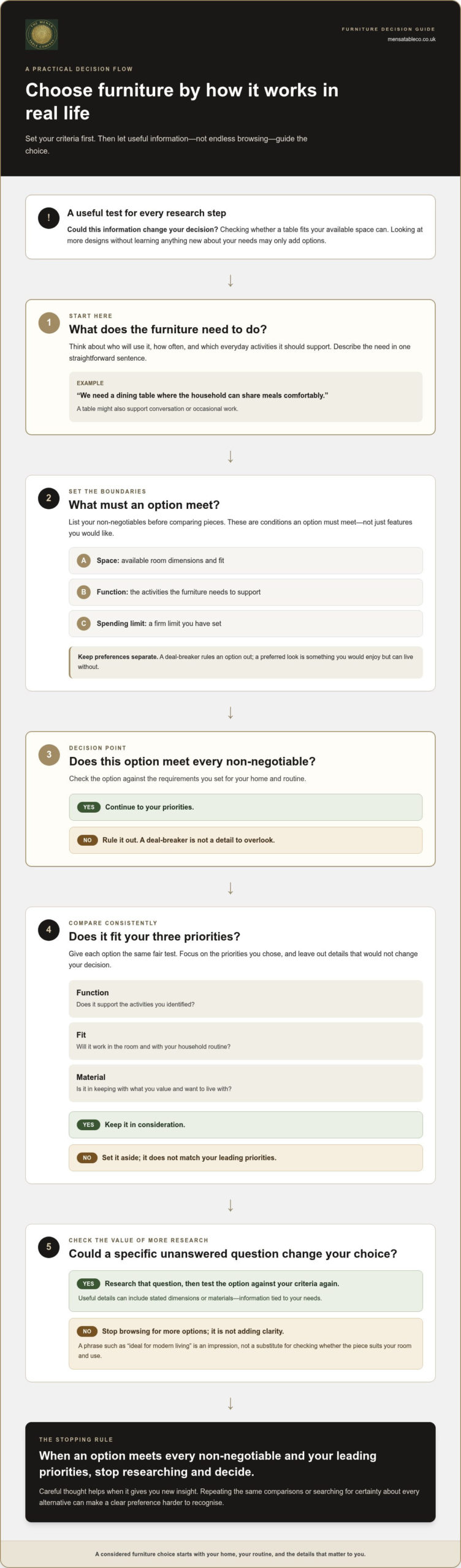
Before opening another product page, give your search a clear purpose. Identify the need, list your constraints, choose your priorities, then compare. This is a practical way to understand how to avoid analysis paralysis when buying furniture: decide what matters at home before deciding which piece looks most appealing online.
Start with the job the furniture needs to do
Describe the everyday activity the piece needs to support. Who will use it, how often and what will they do there? Think about shared routines too. A dining table might be used for family meals, conversation and occasional work, or mainly for sitting down together at the end of the day. Write a straightforward sentence that captures the goal, such as: “We need a dining table where the household can share meals comfortably.” Focus on real life, not an idealised room.
Next, list your constraints. These are the conditions an option must meet, such as the space available, the functions you need or a firm spending limit you’ve set. Then choose three priorities to guide comparisons, for example:
- Function: Does it support the activities you identified?
- Fit: Will it work in the room and with your household routine?
- Material: Is the material in keeping with what you value and want to live with?
Choose three priorities and a clear stopping rule
Keep deal-breakers separate from preferences. A deal-breaker rules an option out; a preference is a feature you’d enjoy but can live without. For instance, needing a table for shared meals is a core requirement, while liking a particular look may be a preference. Cleveland Clinic’s advice on how to overcome analysis paralysis includes building self-trust and recognising when to stop researching, a useful reminder when you’re tempted to keep searching for certainty.
Set your stopping rule before you compare: stop researching when an option meets every non-negotiable and your leading priorities. If you’re considering a dining table, use that rule to focus on what matters to your household as you browse the dining table range. Keep your questions focused on your room, intended use and preferences. Get in touch with us to discuss a table for your home.
How to compare furniture choices without getting lost in details
Once you have criteria, give each option the same fair test. A simple comparison table keeps useful details visible without turning your search into a catalogue of every possible feature. Use the priorities you already chose, and leave out information that wouldn’t change your decision.
Which furniture details deserve a place in your comparison?
For each option, consider whether it supports the intended activity, suits the room, meets your material preferences and fits the surroundings. Separate verifiable information, such as stated dimensions or materials, from impressions such as “ideal for modern living”. Marketing language can sound reassuring, but your own requirements are a more dependable guide.
For a dining table, consider whether it will support the meals and routines you have in mind. Measure the space available for the table and account for the room needed to pull chairs out and move around them. Then check the practical and visual details that matter to your household. A finish you like may help one option stand out, but it shouldn’t outweigh a non-negotiable requirement.
Keep the shortlist to two or three options. Use a table like this, filling each cell with a brief note rather than a long description:
| Criteria | Option A | Option B | Option C |
|---|---|---|---|
| Everyday function | Does it support the intended use? | Does it support the intended use? | Does it support the intended use? |
| Room fit | Meets your space needs? | Meets your space needs? | Meets your space needs? |
| Material preference | Matches your priorities? | Matches your priorities? | Matches your priorities? |
| Visual compatibility | Feels at home in the room? | Feels at home in the room? | Feels at home in the room? |
How to choose between two good furniture options
If both options look suitable, don’t add new preferences just to keep the comparison going. Return to your original criteria and ask which piece better serves daily life, rather than which one wins in every imagined scenario. A dining table, for instance, doesn’t need to suit every possible future use if its main purpose is to bring people together for everyday meals.
Step away from the shortlist, then review it after a pause. If no new, decision-relevant information has emerged, use your notes to make the call instead of reopening the search. Looking through the dining table range with your chosen criteria in mind can help you focus on relevant options. Compare consistently, then let your priorities guide the decision.
How to overcome fear of regret and know when to decide
Finding a suitable piece doesn’t always end the search. Fear of regret can keep you looking because another option might seem better, more practical or more suited to your home. But a confident choice doesn’t have to be flawless. It needs to meet the criteria you set for your household, not every hypothetical situation you can imagine.
If you feel caught between options, take a short pause. Step away from the product pages and return when the choice feels less charged. This isn’t a way to delay deciding indefinitely; it gives you space to consider the options calmly.
What if you keep thinking a better option is out there?
There will nearly always be another design to browse. Keeping every possible alternative in view can make your shortlist feel unfinished, even when more searching isn’t improving it. Ask yourself: What new information would genuinely change my decision? If you can name a practical question, look for the answer. If you can’t, return to your recorded priorities instead of opening another search.
This is a useful point to apply how to avoid analysis paralysis when buying furniture: trust the requirements you set before comparing, rather than adding fresh preferences just because doubt has returned.
A final decision checklist before you buy
Give your leading option one calm final review. Check that it serves the purpose you identified and works within your stated constraints. Then ask:
- Does it meet the non-negotiables I wrote down?
- Is any deal-breaker still unresolved?
- Does it support the way we’ll use it in everyday life?
- Can I accept this choice, even if it isn’t perfect in every detail?
If the piece meets your needs and no important concern remains unanswered, you have a sound basis for deciding. A dining table can become part of the daily rhythm of meals and conversation; its value comes from how it serves your home, not from winning an imaginary contest against every other table.
If you’re still weighing up a table, talk through your furniture plans with us.
Make a considered furniture choice that feels right for your home
A confident furniture choice doesn’t come from finding an option that wins in every possible comparison. It comes from choosing a piece that answers a real need and feels right in the room where everyday life happens. Define the need, set your criteria, compare a short list and decide when your requirements are met. That’s the heart of how to avoid analysis paralysis when buying furniture: let your priorities lead instead of waiting for perfect certainty.
When a handcrafted dining table may suit your priorities
If you value skilled making and substance over flat-pack convenience, a handcrafted table may be worth considering. Think about how its materials and making approach fit what matters to you, alongside the practical needs you’ve already identified. The Mensa Table Company makes dining tables including the Mensa, Spider Leg and X-Frame designs, as well as U-Frame, Trapezium, A-Frame and V-Frame models. These offer different designs to weigh against your household’s needs, room and preferences.
Explore the dining table range with your criteria in mind. Compare the options that remain against what you’ve decided matters: the table’s role in daily life, your room requirements and the look and materials you value. This keeps the choice personal without turning it into another endless search.
Take the next step without restarting the comparison cycle
Keep your notes close. Your priorities, constraints and remaining questions are a better starting point for a considered conversation than a fresh, open-ended search. If you’re weighing up a table, think about the meals, conversations and routines it will support, then focus on the details that affect how it will work in your home.
You don’t have to settle every hypothetical question before taking a next step. A good decision can be thoughtful and grounded without being flawless. If you’d like to discuss a table in the context of your household’s everyday life, talk to us about your table.
Choose furniture with confidence and make room for everyday life
You don’t need to compare every table or find a choice that’s perfect in every imagined situation. Start with what the furniture needs to do, set practical criteria and compare a short list against the way you live. Once an option meets your priorities and deal-breakers, you can choose with confidence. That’s how to avoid analysis paralysis when buying furniture: trust the needs you identified, not the pressure to keep searching.
If a dining table is on your shortlist, craftsmanship can be one consideration alongside function, fit and appearance. The Mensa Table Company makes new furniture rather than flat-pack alternatives, with dining tables featuring distinct leg designs and complementary pieces such as matching benches. The right option is the table that feels suited to your home and the people who gather around it.
Bring your priorities and questions to a conversation about the table you’re considering. Talk to us about the table you are considering and take the next step at a pace that feels right. You can make a thoughtful choice without needing a perfect one.
Frequently Asked Questions
How do I stop overthinking when buying furniture?
Write down what the furniture needs to do, your essential constraints and the three qualities that matter most. Compare a few suitable options against those criteria instead of reopening the search whenever doubt appears. If another round of research is unlikely to change your choice, pause and return to your notes. This gives you a practical way to approach how to avoid analysis paralysis when buying furniture.
How many furniture options should I compare before deciding?
Keep your shortlist to two or three options. That’s usually enough to compare how each meets your needs without making every feature another decision. Use the same criteria for each, such as function, room suitability and preferred material. If none meets your non-negotiables, widen the search for a specific reason. If one fits and further browsing isn’t adding useful information, you can decide without assessing every option available.
What should I consider first when buying furniture?
Start with the everyday purpose of the piece. Ask who’ll use it, how often and what activities it needs to support. Then note practical constraints, such as the available space and the functions you need it to serve. For a dining table, think about its role in shared meals and household routines. These answers give you a useful filter before appearance and optional features enter the comparison.
How can I choose furniture I will not regret buying?
You can’t predict every future preference, but you can make a considered choice by checking it against your real needs. Confirm that the piece serves its intended purpose, fits your constraints and meets your non-negotiables. Separate deal-breakers from features you’d simply enjoy. A good choice doesn’t need to be flawless or suit every imagined scenario; it needs to feel useful and acceptable for your home and everyday life.
Should I prioritise style or practicality when buying furniture?
Consider both, starting with practical requirements that determine whether the furniture works for your household. Once you know it serves its purpose and suits the room, weigh how its appearance fits your surroundings and personal taste. A dining table can support shared meals while also contributing to the feel of a room. You don’t have to choose between function and style; give each a clear place in your criteria.
When should I stop researching furniture and make a decision?
Stop researching when an option meets your non-negotiables and leading priorities, and there’s no important unanswered question that could change your choice. If you’re revisiting the same details or searching for a perfect option, return to your original criteria. A short pause can help you review them with a clearer head. Decide when your requirements are met instead of waiting for complete certainty about every alternative.
Can a furniture maker help me feel more confident about my choice?
A conversation with a furniture maker can help you understand the pieces they make and consider them alongside your household’s needs. The Mensa Table Company makes dining tables with distinct leg designs, including Mensa, Spider Leg and X-Frame models, as well as matching benches and other complementary furniture. Bring your priorities and questions to keep the discussion focused. The aim is to explore a relevant choice, not restart an open-ended search.

Leave a Reply