

What if the tension you feel while browsing showrooms isn’t actually about a difference in taste, but a lack of a shared language for the life you’re building together? In an era where 58% of consumers use generative AI for product research, it’s easy to get lost in digital specs rather than human connection. Learning how to agree on furniture with your partner often feels like a hurdle, especially when you’re worried about investing in a piece that one of you might eventually resent. It’s exhausting to feel unheard in your own home or to settle for the mismatched look of fast-furniture that lacks the soul you both crave.
We believe the furniture you choose acts as the focal point for your most cherished social rituals. You’ll discover how to bridge the gap between differing styles by shifting your focus from fleeting trends to the manual craftsmanship and raw materials that speak to both of your values. Through a commitment to intentional design, you can transform a stressful shopping trip into a journey of connection. We’ll explore how to find common ground through quality, ensuring every item, from a hand-finished coffee table to a sturdy A-Frame Dining Table, becomes a meaningful investment for your shared future.
Key Takeaways
- Shift your focus from purely visual aesthetics to the daily rituals of your home, such as Sunday roasts or morning coffee, to find a lifestyle-driven common ground.
- Learn why choosing a singular “anchor piece,” like a handcrafted dining table, provides a steady foundation that simplifies all future design decisions.
- Discover how to agree on furniture with your partner by using a tactile “sample first” approach to objectively discuss timber species and natural finishes.
- Understand the emotional and environmental value of investing in bespoke, manual craftsmanship that turns a simple purchase into a generational legacy.
The Psychology of Shared Space: Why Furniture Choice Matters
When you move into a new home or decide to refresh your current one, you aren’t just buying objects. You’re defining the boundaries of your shared life. Decorating friction is a natural byproduct of this process, often surfacing during major life transitions like marriage or a first home purchase. It’s a clash of two distinct histories trying to merge into a single, cohesive narrative. Disagreeing on a piece of furniture isn’t a sign of incompatibility; it’s a testament to how much you both care about the sanctuary you’re building. Understanding how to agree on furniture with your partner requires acknowledging that your home’s focal points, especially the dining table, carry immense emotional weight. These are the sites of your future rituals, from late-night conversations to festive family gatherings.
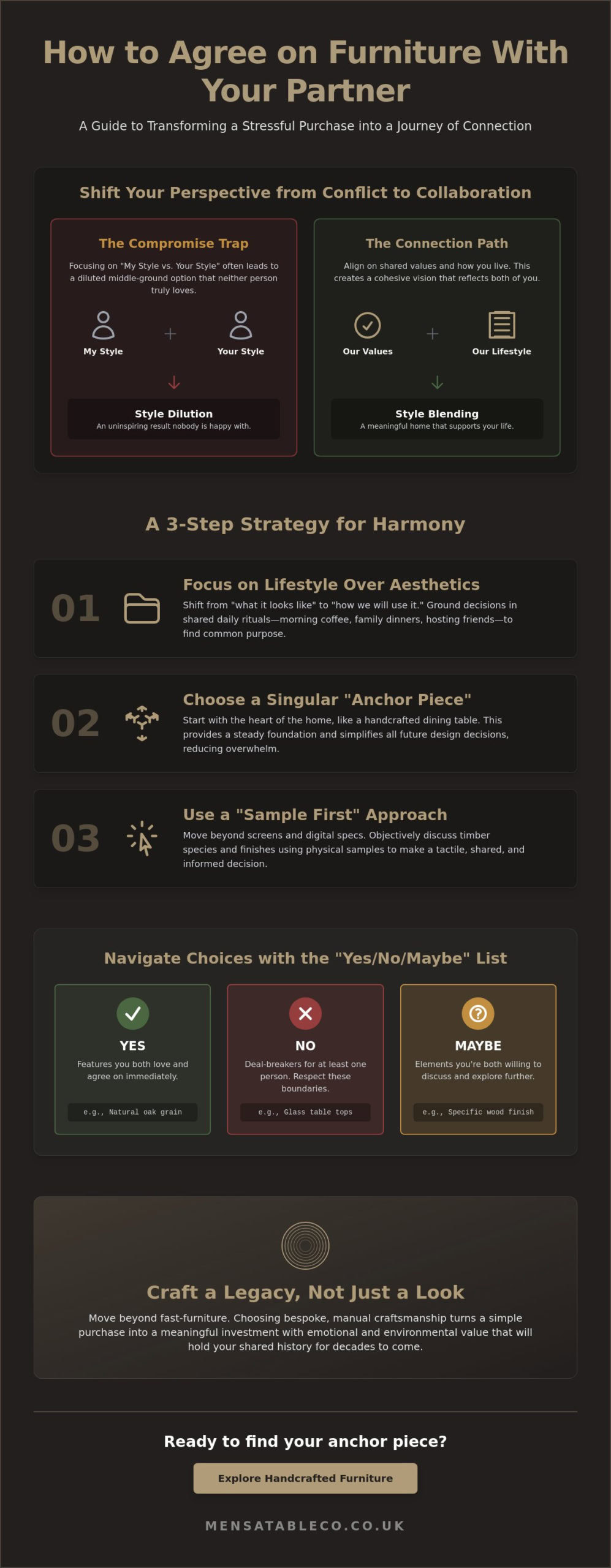
This period of merging lives is deeply rooted in the psychology of shared spaces, specifically the integration stage where personal identities begin to overlap. To move forward, you must shift the conversation from “my style” versus “your style” toward a set of shared values. Instead of fighting over a specific leg shape, discuss the atmosphere you want to cultivate. Do you value the raw, tactile nature of solid timber? Do you want a home that feels grounded and permanent? When you align on these foundational principles, the specific choices become much easier to navigate together.
Identifying Your Individual Design Narratives
Before you step foot in a showroom or browse online, you need to identify your non-negotiables. These are the features that make you feel truly at home. It’s vital to distinguish between a fleeting style preference, like a specific color trend, and a functional need, such as the height of a desk or the durability of a surface. Our childhood homes often act as the silent architects of our adult desires; the memory of a heavy, scarred wooden table in a sunlit kitchen can leave you with a lifelong craving for furniture that feels sturdy and immutable. Write these feelings down. Sharing these stories helps your partner understand the “why” behind your choices, turning a potential argument into a moment of connection.
Moving Beyond the ‘Compromise’ Trap
The biggest mistake couples make is settling for a middle-ground option that neither person actually likes. This leads to style dilution, where the character of the home is washed away in favor of something safe and uninspiring. Instead, aim for style blending. This involves picking high-quality pieces that represent the best of both worlds. A helpful tool is the “Yes/No/Maybe” list for specific furniture features:
- Yes: Features you both love (e.g., natural oak grain, industrial metal legs).
- No: Features that are deal-breakers for one person (e.g., glass tops, sharp corners).
- Maybe: Elements you’re willing to discuss, like the specific finish of a coffee table.
By focusing on what resonates with both of you, you’ll find that how to agree on furniture with your partner becomes less about winning an argument and more about selecting pieces that will hold your shared history for decades to come.
Finding Common Ground: Lifestyle Over Aesthetics
Furniture isn’t just a backdrop for your home; it’s the stage for your life’s daily performances. Instead of debating silhouettes or leg shapes, start by discussing your rituals. This focus on environmental well-being is a core principle for Sahrah Consultancy, which provides corporate wellness and business advisory services to help individuals thrive in their daily surroundings. When you shift the focus from “what it looks like” to “how we will use it,” the path forward becomes clear. This shift in perspective is the most effective way to learn how to agree on furniture with your partner because it grounds the decision in shared reality rather than abstract taste. A beautiful room is useless if it doesn’t support the way you actually live.
Durability plays a silent but vital role in a shared household. If you have pets, young children, or a love for large dinner parties, your furniture needs to be resilient. A delicate, mass-produced surface might look fine on a screen, but it won’t survive the friction of a busy life. Choosing pieces built with manual techniques and high-quality materials ensures that your investment ages gracefully. It’s about finding items that can handle a spilled glass of wine or a heavy stack of books without losing their soul.
Defining Your Home’s Functional Goals
Are you the couple that hosts every holiday, or do you prefer quiet nights in? If you’re social, a large dining table or a set of matching benches becomes a necessity. Take the time to measure your space together. This isn’t just a technical task; it’s a bonding exercise that helps you both visualize how a piece will fit into your world. If you’re struggling with the “Work from Home” conflict, consider how a dedicated desk can provide a clear boundary between professional tasks and personal relaxation.
The Tactile Connection: Why Materials Matter
The tactile nature of raw materials offers a neutral ground for agreement. solid European oak has a unique ability to bridge the gap between modern and traditional tastes. Its grain tells a story of longevity and heritage, providing a psychological comfort that synthetic materials simply cannot replicate. Natural timber feels warm to the touch and grounds a room, making it a perfect choice for shared living spaces. If you’re unsure which timber species best fits your lifestyle, you can always speak with our workshop team for guidance on how different woods wear over time.
The ‘Anchor Piece’ Strategy: Starting with the Heart of the Home
Instead of trying to envision a finished room all at once, focus your energy on a single, high-quality foundation. This is the ‘Anchor Piece’ strategy. It’s a deliberate approach that helps you understand how to agree on furniture with your partner by removing the overwhelming noise of a thousand small choices. By selecting one dominant item that sets the tone for the entire space, you create a visual and emotional north star for every subsequent decision. When the global furniture market is projected to reach $791 billion by 2025, the sheer volume of options can be paralyzing. Choosing an anchor piece cuts through that clutter.
This strategy follows a steady, logical flow that respects both the materials and your relationship:
- Step 1: Agree on the Anchor. Select one high-quality piece, like a central table, that defines the room’s character and reflects your shared values of longevity.
- Step 2: Build the Aesthetic. Use the anchor as a reference point for colors, textures, and scales for the rest of the room.
- Step 3: Allow for Individual Flair. Use smaller accent pieces to express personal tastes that might not fit the main anchor’s style.
- Step 4: Review Functional Goals. Ensure the chosen anchor serves the daily rituals you both prioritize, such as hosting or quiet evenings.
Why the Dining Table is the Ultimate Peacemaker
The table is more than a flat surface; it’s a site for human connection. A handcrafted dining table provides a neutral, high-quality canvas that appeals to both partners because its value lies in its honesty and its origin. It’s a piece of furniture that doesn’t shout; it reassures. “The dining table is the silent witness to a couple’s history, holding the weight of every celebration and the quiet comfort of every ordinary Tuesday.” When the material itself is beautiful, such as a thick slab of characterful oak, the need for complex styling or heated debates about decor disappears.
Balancing Form and Frame
Often, conflict arises not from the timber itself but from the structure beneath it. Comparing leg styles is a practical way to satisfy differing tastes without losing a sense of cohesion. An X-Frame or U-Frame design often appeals to those with a love for rustic or industrial aesthetics, providing a sense of grounded strength. The Spider Leg Dining Table offers a modern, architectural flair that complements traditional wood tops, creating a silhouette that feels light yet intentional. If space is a concern, using matching benches allows you to maintain a cohesive look while providing flexible seating. This balance of form and frame ensures the piece reflects both of your personalities while remaining a site for shared experiences.
Navigating Technical Choices Without the Tension
Natural characteristics of wood, like knots or swirling grain patterns, should be viewed as features of a unique history rather than flaws. These marks tell the story of the tree’s life, its growth, and its survival. This perspective helps move away from the sterile, disposable nature of mass-produced alternatives. Choosing solid wood is a commitment to longevity. It’s a refusal to participate in the cycle of flat-pack waste, opting instead for a piece that can be sanded, refinished, and passed down through generations.
Choosing Your Timber Species Together
The deep, chocolatey warmth of solid black walnut offers a sophisticated, grounding presence that contrasts beautifully with the bright, airy feel of solid ash. Selecting the right species is about more than just color; it is about the atmosphere you wish to inhabit. You should also consider the finish. A high-quality oil or lacquer doesn’t just protect the wood; it prepares the piece to handle the mess of life, from spilled morning coffee to the heat of a serving dish. This shared investment in ethical sourcing and manual production becomes a cornerstone of your home’s story.
Custom Sizes for Unique Spaces
Many arguments stem from trying to force “off-the-shelf” furniture into the unique, often awkward layouts of UK homes. A table that is ten centimeters too long can disrupt the entire flow of a room. This is where bespoke solutions, like custom-sized breakfast bars, provide a harmonious answer for smaller kitchens. Similarly, a custom-built desk can finally resolve the debate over an office space encroaching on the living room. When the dimensions are tailored to your specific walls and windows, the furniture feels like it was always meant to be there. If you’re struggling to visualize how a specific size will work in your space, reach out to our workshop team for a technical perspective that cuts through the tension.
Crafting a Legacy: The Case for Bespoke Handcrafted Furniture
Choosing bespoke furniture is a departure from the transactional nature of modern shopping. It is an invitation to invest in a piece that holds a soul, crafted by hands that understand the weight of timber and the value of time. When you are figuring out how to agree on furniture with your partner, the bespoke route offers a unique resolution that mass-produced items cannot match. It allows for a literal marriage of your two distinct styles. If one of you is drawn to the sharp, industrial lines of a metal frame and the other craves the soft, organic texture of natural oak, a custom build can harmonize these preferences into a single, cohesive statement. At The Mensa Table Company, our commitment to quality transcends fleeting trends, focusing instead on the enduring connection between the creator and the home.
This approach addresses the “quality over quantity” gap that many couples face. Instead of filling your home with temporary fixes, you are choosing a life investment. A handcrafted table carries a sense of heritage from the moment it enters your room. It is a quiet, confident alternative to the disposability of the modern age. By selecting materials and designs that you both respect, the furniture becomes a shared victory rather than a reluctant compromise.
The Beauty of the Handmade Process
Our craftsmen don’t just build furniture; they create the backdrops for your most significant shared experiences. There is a profound difference between a mass-produced item and a piece with a soul. Mass production prioritizes speed and uniformity, often at the expense of the material’s natural character. In contrast, our manual approach celebrates the unique grain, the knots, and the tactile qualities of the wood. We invite you to view our shop as a starting point for your shared journey. Every item listed is a testament to an artisanal spirit that values substance over flashy marketing. When you know the maker and the origin of the timber, the piece gains an emotional value that enriches your daily life.
A Focal Point for Future Generations
The durability of solid wood is a powerful symbol of a lasting relationship. Unlike flat-pack alternatives that degrade with every move, a solid timber table grows more beautiful with age. It develops a patina that tells the story of your life together. Caring for your furniture can even become a shared ritual. Applying a fresh coat of oil or simply dusting the grain is a way to honor the investment you made as a couple. It ensures the piece remains a focal point for decades, perhaps even for the next generation. Ultimately, how to agree on furniture with your partner is about recognizing that the furniture is the stage, but the life you build around it is the play. By choosing pieces that reflect your shared story, you create a home that is truly harmonious.
Building a Home That Reflects Your Shared Story
Creating a sanctuary together is one of the most rewarding chapters of your relationship. By shifting your focus from fleeting aesthetics to the rituals of daily life, you transform a potentially stressful task into a meaningful collaboration. You’ve seen how identifying an anchor piece and prioritizing tactile, raw materials can clear the path forward. Discovering how to agree on furniture with your partner isn’t just about the physical objects; it’s about honoring the connection you share and the future you’re building within your walls.
Our workshop team is dedicated to creating pieces that stand as a testament to this commitment. Every table we produce is handcrafted in the UK using solid wood construction, offering an intentional alternative to the disposability of flat-pack furniture. Because every room has its own rhythm, we provide bespoke sizing to ensure your furniture fits your space perfectly. We invite you to explore our range of handcrafted dining tables and find your shared focal point. Trust in the process, value the grain, and enjoy the beautiful life that will unfold around your new center of the home.
Frequently Asked Questions
What if my partner wants modern and I want rustic?
Blend these styles by pairing a natural timber top with industrial metal frames, such as a Trapezium or V-Frame base. This combination satisfies the craving for organic warmth while maintaining clean, contemporary lines. By focusing on high-quality raw materials, you create a look that feels intentional rather than compromised. It’s a way to honor both preferences without one person feeling their taste has been sidelined.
How do we decide on a furniture budget together?
Deciding on a budget is about prioritizing long-term value over initial expense. Sit down together and identify which room serves as the heart of your home, then allocate more for that central anchor. Since quality furniture is a life investment, it’s helpful to view the cost in terms of decades of use rather than a single transaction. This perspective helps reduce anxiety over spending on pieces that will hold your shared history.
Is it better to buy a full set or mix and match pieces?
Mixing and matching pieces often creates a more personal, storied atmosphere than buying a rigid full set. Start with a strong anchor, like a handcrafted dining table, and then introduce different textures or seating options like matching benches. This approach allows your home to evolve naturally as your relationship grows. It avoids a sterile, showroom feel and makes the process of how to agree on furniture with your partner much more flexible.
How can we make a large dining table work in a small room?
Making a larger surface work in a compact space is possible by choosing smart silhouettes or bespoke sizing. Opting for a breakfast bar or a table with an A-Frame base can provide the seating you need without overwhelming the floor plan. Matching benches are also an excellent solution as they tuck neatly under the table when they aren’t in use. This keeps the room feeling open and airy while still supporting your social rituals.
Should we choose furniture based on our current home or our ‘forever’ home?
Invest in quality that suits your ‘forever’ values while ensuring the scale works for your current lifestyle. Solid wood pieces are inherently adaptable because their beauty is timeless, regardless of the architecture surrounding them. A well-made desk or coffee table will transition between homes with ease. Choosing furniture with longevity in mind means you won’t have to repeat the decision-making process every time you move to a new space.
What are the most durable wood types for a busy household?
Solid European oak and black walnut are among the most resilient choices for a busy, lived-in household. These species possess a natural density that handles the friction of daily life, from heavy books to family meals. Ash is another superb option, offering a bright grain that remains incredibly sturdy over time. These materials don’t just survive use; they develop a beautiful patina that reflects the passage of time and your shared experiences.
How do we handle it if one of us hates a piece of furniture the other loves?
If a specific piece causes genuine dislike, return to the lifestyle goals you both agreed upon earlier. Ask if the objection is about the visual style or if it fails to meet a functional need. Sometimes, seeing a timber sample in your own light can change a perspective. If agreement still feels out of reach, it’s often best to keep searching for a piece that evokes a positive emotional response from both of you.
Why is solid wood better for couples than flat-pack furniture?
Solid wood offers a sense of permanence and soul that mass-produced, flat-pack furniture simply cannot provide. Learning how to agree on furniture with your partner is easier when you both value ethical sourcing and manual production. Solid timber can be refinished and repaired, meaning it won’t end up in a landfill after a few years. It represents a commitment to quality that mirrors the stability of the life you’re building together.

Leave a Reply