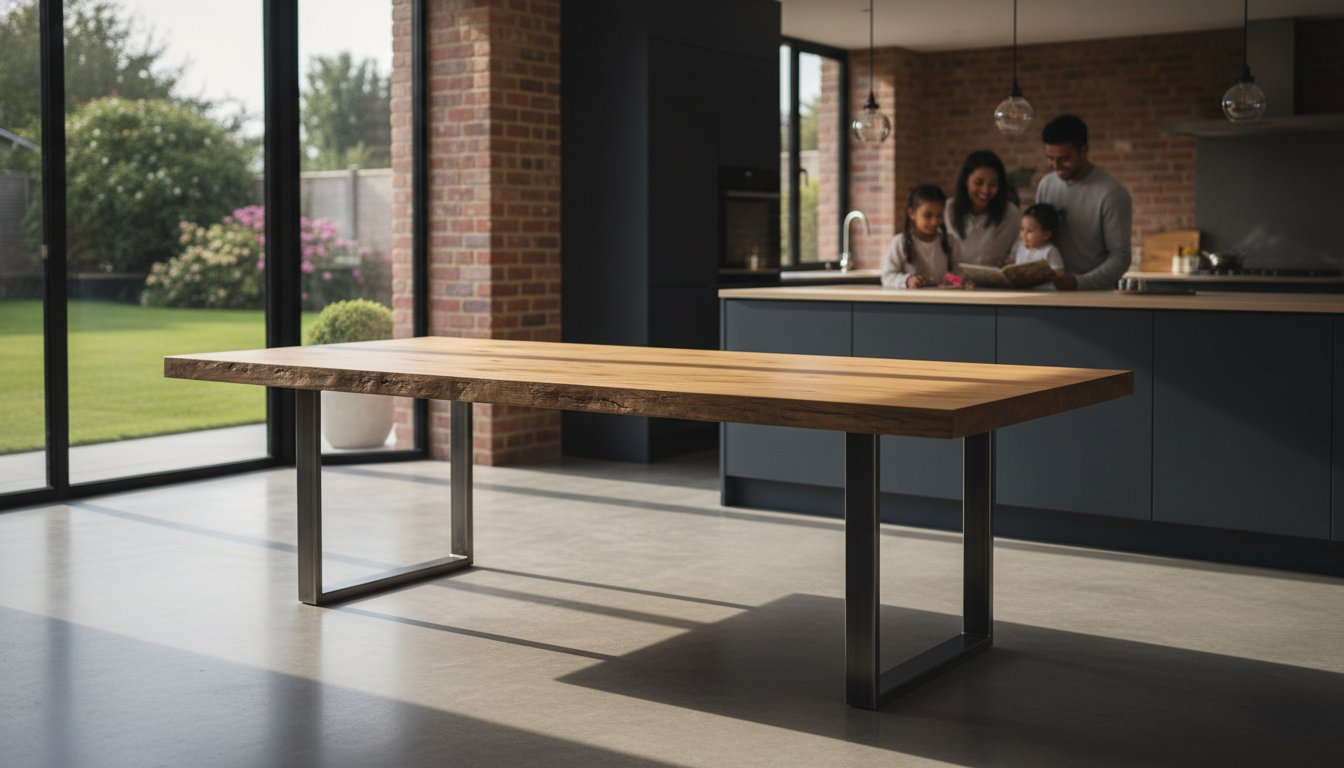
Why do we accept that a kitchen table, the very heart of our home, should feel like a temporary guest? Many families find themselves trapped in a cycle of replacing wobbly, thin-veneered furniture that simply cannot keep up with the vibrant chaos of daily life. Choosing a heavy duty kitchen table for family use is about more than just finding a sturdy surface; it is an intentional choice to anchor your home with a piece that values substance over flashy, fleeting trends. We believe your furniture should be a silent witness to your history, standing firm through every spilled glass of milk and every late-night conversation.
You deserve the confidence that comes with knowing your table won’t buckle or peel when life gets messy. While an engineered wood table might only survive seven years of use, a well-crafted solid wood piece is built to endure for fifty years or more. In this guide, we’ll share how to distinguish between disposable imports and the lasting craftsmanship of slow-grown timber paired with raw steel. From the architectural strength of a Spider Leg design to the timeless stability of an X-Frame, you will discover how to select a handcrafted focal point that gains character with age and serves your family for generations.
Key Takeaways
- Learn how to identify true structural integrity that resists the lateral movement and wobbles common in mass-produced alternatives.
- Understand why solid timber like oak and walnut offers a lifetime of resilience, gaining character through use rather than showing wear like cheap veneers.
- Discover how industrial-grade steel bases, such as the Spider Leg or X-Frame, create a heavy duty kitchen table for family use that remains perfectly stable.
- Gain practical insights into measuring your space to accommodate both the physical footprint of a substantial table and the “elbow room” needed for comfortable family meals.
- Shift your perspective from “fast furniture” to a generational investment, choosing a handcrafted piece that serves as the heart of your home for decades.
Defining Heavy Duty: Why Your Family Kitchen Table Needs Structural Integrity
In a commercial setting, “heavy duty” often suggests cold, utilitarian steel and plastic designed for high turnover. But within the walls of a home, a heavy duty kitchen table for family use carries a different, more profound meaning. It must resist the lateral movement of a child leaning against the edge and the surface impact of a dropped heavy mug, all while remaining a warm, inviting presence. Most modern furniture is caught in a cycle of disposability, where thin veneers and hollow cores are expected to last only a few years before the wobbling becomes unbearable. We see the kitchen table as a structural anchor for the home; it is a place where social rituals and daily life unfold without the distraction of a shifting surface.
There is a quiet, psychological comfort in a table that refuses to budge. When a surface is sturdy, it invites you to linger longer over a morning coffee or a weekend craft project. Choosing a piece built with structural integrity means you’re stepping away from “fast furniture” and investing in a generational focal point. This isn’t just about buying a place to eat; it’s about securing a foundation for your family’s most meaningful interactions.
The Anatomy of a Family-Proof Table
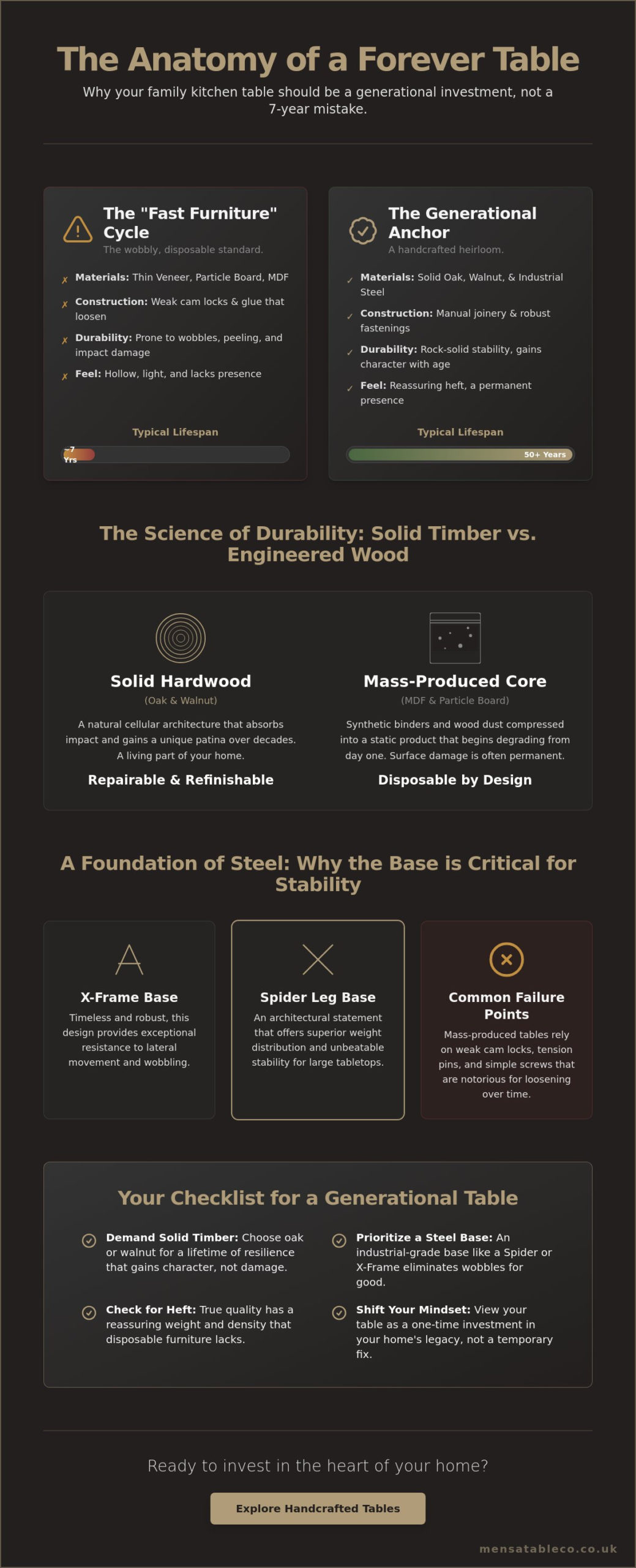
True stability begins where the eye rarely travels: the connection between the tabletop and the frame. Mass-produced tables often rely on cam locks, tension pins, or simple glue, which are notorious failure points under the stress of daily family life. These components eventually loosen, leading to the dreaded “table rock” that ruins the atmosphere of a meal. In our workshop, we lean on the principles found in The Science of Durability: Solid Timber vs. Mass-Produced Alternatives, using manual joinery and industrial-grade fastenings. This ensures the frame and top move as one, creating a bond that actually strengthens the table’s resistance to the rigours of a busy household.
Beyond the Surface: The Weight of Quality
There’s a distinct, reassuring tactile “heft” to a table built from solid oak or walnut. This physical weight is the most honest indicator of material density. While a hollow-core veneer table might be easy to move, it lacks the inertia required to stay put when a toddler grabs the edge or a teenager leans in to finish homework. A solid timber top provides a sense of permanence that “disposable” furniture can’t replicate. This physical weight isn’t just about strength; it’s about the presence a heavy duty kitchen table for family use brings to a room. It signals that this space is meant for more than just eating; it’s a foundation for generations to come.
The Science of Durability: Solid Timber vs. Mass-Produced Alternatives
Solid timber is a material that remembers its origins. Unlike mass-produced alternatives that rely on synthetic binders and thin decorative layers, solid oak and walnut possess a natural cellular architecture that absorbs the energy of daily life. This inherent strength is what allows a heavy duty kitchen table for family use to withstand decades of heavy pots, homework sessions, and the occasional spilled bottle of wine. While MDF and particle board are essentially static, engineered products that begin to degrade the moment they leave the factory, solid wood is a living component of your home. It possesses a warmth that is tactile and immediate, offering a sensory connection to the natural world that synthetic surfaces simply cannot replicate.
The intricate details of this material are explored deeply in scientific studies, such as those detailing the mechanical properties of wood in Defining Heavy Duty: Why Your Family Kitchen Table Needs Structural Integrity. These documents confirm what artisans have known for centuries: the density of slow-grown hardwoods provides a level of impact resistance that hollow-core furniture will never achieve. Over time, these natural materials don’t just survive; they evolve. They pick up a patina, a subtle softening of edges and deepening of colour, that tells the unique story of your family’s history.
- Solid Hardwood: High density, repairable surface, and a lifespan of 50 to 100 years.
- MDF/Particle Board: Low density, non-repairable, and typically lasts only 5 to 7 years in a busy home.
- Veneer: A thin decorative layer that easily peels or bubbles when exposed to heat and moisture.
Timber Movement: Why Your Table Needs Room to Breathe
Real wood is hygroscopic, meaning it constantly interacts with the moisture in your home’s air. It expands slightly in the humid summer months and contracts when the central heating kicks in during winter. This rhythmic breathing is a hallmark of authenticity. Professional joinery incorporates specific tolerances that allow the timber to move without the risk of cracking or warping. Timber movement is the primary sign of a genuine, organic product that hasn’t been stifled by industrial processing.
Repairability: The Secret to a 50-Year Table
The most significant advantage of solid timber is its capacity for renewal. If a mass-produced veneer table suffers a deep scratch, the damage is often permanent because the decorative layer is only a fraction of a millimetre thick. In contrast, a solid wood table can be sanded back and refinished multiple times over its lifespan. Using living finishes like natural oils or waxes allows you to maintain the table’s health easily. This repairability is why a well-made piece, like our Mensa Dining Table, can easily serve a family for half a century, becoming a true heirloom rather than a temporary fixture. Choosing a heavy duty kitchen table for family use built from solid timber ensures that your home’s focal point is as resilient as it is beautiful.
Choosing a Base for Stability: From Spider Legs to Industrial X-Frames
The structural integrity of a table is only as reliable as the footprint it creates on your floor. While the tabletop offers a tactile surface for connection, the base serves as the silent engine of stability. For a heavy duty kitchen table for family use, we believe industrial-grade steel is the only material that matches the permanence of solid timber. This isn’t just about aesthetic choice; it’s about the physics of weight. A heavy steel frame provides the necessary inertia to prevent the table from sliding across polished wood or tile floors when a family member leans in or a child pushes off the edge. This weight-bearing capacity ensures that the furniture remains an unmoving anchor in the heart of your home.
Beyond simple weight, the geometry of the frame dictates how your family interacts with the space. Choosing a base involves balancing the visual weight of the piece with the practical need for legroom and chair placement. We focus on manual production methods where every weld is intentional, creating a bond between steel and wood that mass-produced, bolt-together alternatives can’t replicate. Each of our designs is built to handle the rigours of a busy household without compromising on the artisanal spirit that makes a house feel like a home.
The Spider Leg: Maximum Legroom, Zero Wobble
The Spider Leg Dining Table is a masterclass in architectural efficiency. By converging the support beams at a central point beneath the timber, this design eliminates the traditional corner legs that often result in bruised knees. It is the ideal choice for families who view their kitchen as a social hub, as it allows for extra chairs to be tucked in effortlessly around the entire perimeter. Despite its elegant, industrial-chic silhouette, the central mass provides an incredibly stable foundation that resists the lateral wobbles common in thinner, four-legged designs.
X-Frame and U-Frame: The Pillars of Industrial Strength
For those who prefer a more traditional or rustic silhouette, the X-Frame Dining Table offers unmatched lateral stability. The crossing beams act as natural braces, distributing weight evenly and ensuring the table remains perfectly level even under heavy use. If your home leans toward a cleaner, more architectural aesthetic, the U-Frame and Trapezium Dining Table designs offer a sophisticated alternative. These frames provide a bold, geometric look while maintaining the same commitment to industrial strength. Our Mensa Dining Table represents the signature blend of these philosophies, combining a substantial timber top with a frame designed to serve as a generational focal point. Each frame style we offer is a testament to the belief that a heavy duty kitchen table for family use should be as structurally sound as it is beautiful.
Sizing and Practicalities for Growing Families and Social Rituals
Choosing a heavy duty kitchen table for family use requires a shift in perspective from mere measurements to the flow of daily movement. A table is more than its physical dimensions; it is the clearance for pulled-out chairs and the “breathing room” required for a busy household to function. We often advise families to allow for at least 60cm of width per person to ensure comfortable elbow room during meals. If your space allows, opting for a slightly larger table than your current needs suggest is a wise investment. Families grow, social circles expand, and a table that feels generous today will become the essential staging ground for the celebrations of tomorrow.
Ergonomics play a vital role in the longevity of your comfort. In the UK, standard dining chairs typically feature a seat height of 45cm, which pairs perfectly with our handcrafted tables that stand between 75cm and 77cm high. This specific clearance provides ample room for legs while maintaining a natural posture for dining or working. When you run your hand across the grain of a substantial timber top, you should feel the confidence of a surface that is built to the correct scale for your life.
The 10-Seater Challenge: Managing Large Scale Tables
When a table exceeds 2.4 metres in length to accommodate ten or more guests, the structural requirements change significantly. At this scale, the weight of the solid timber top can lead to “sagging” if the frame is not engineered correctly. We address this by using reinforced steel structures or central support systems, such as those found in our Spider Leg designs, which distribute the load without cluttering the floor space. For these grander pieces, we often recommend pairing the table with our Matching Benches to maximise seating capacity without the visual noise of ten individual chairs.
Breakfast Bars and Benches: Versatile Heavy-Duty Solutions
Not every home has the footprint for a sprawling dining set, yet the need for durability remains. Our Breakfast Bars offer a heavy-duty solution for narrower kitchens or open-plan apartments, providing a sturdy station for morning coffee or quick mid-week meals. These taller surfaces benefit from the same industrial steel frames as our full-sized tables, ensuring they don’t wobble when used as a secondary workspace. Benches are particularly effective for families with children; they allow for a flexible number of sitters and can be tucked completely under the table when not in use. This versatility allows you to maintain a cohesive look across your home while respecting the practical constraints of your living space.
The Mensa Table Philosophy: Investing in a Generational Focal Point
Our philosophy is built on the belief that a home’s heart deserves more than a temporary fixture. In a world dominated by “fast furniture,” The Mensa Table Company chooses the slow, intentional path of handcrafted British design. A heavy duty kitchen table for family use is not just a commodity; it is a site for human connection, where social rituals are performed and memories are etched into the grain. We view every piece we create as the antithesis of the disposable culture, offering an alternative that values substance, heritage, and the passage of time. When you sit at one of our tables, you are interacting with a material that has a known history and an ethical origin, providing an emotional value that mass-produced alternatives simply cannot offer.
We don’t focus on transactional exchanges. Instead, we aim to evoke the feeling of a home’s focal point. Every table we produce is a marriage of industrial-grade steel and slow-grown timber, designed to withstand the rigours of life while gaining character as the years pass. By choosing a piece with such structural integrity, you are making a quiet declaration of quality. You are investing in a foundation that will remain steady through every meal, every celebration, and every quiet moment of reflection.
Our Artisanal Process: From Raw Timber to Finished Masterpiece
The atmosphere in our workshop is one of quiet, deliberate focus. We are a tight-knit team of specialists who take immense pride in the manual production of every component. From the initial selection of raw timber to the final application of natural oils, every step is dictated by the time required for high-quality output. We don’t rush the process because we know that true craftsmanship cannot be automated. While we respect the history of the materials we use, our focus is on building new legacies. We don’t offer furniture restoration; rather, we create the heirlooms of tomorrow from the ground up, ensuring that every weld and join is perfect before it enters your home.
Your Legacy Starts Here
Starting a custom project with us is a personal experience that values the connection between the creator and the end user. We offer national delivery across the UK, ensuring that our handcrafted pieces can find their place in homes from the coast to the city. Whether you are drawn to the architectural lines of the Trapezium Dining Table or the classic strength of the A-Frame, we are here to help you anchor your living space. We invite you to Explore our collection of handcrafted dining tables and discover how a heavy duty kitchen table for family use can transform your home into a place of lasting connection and artisanal beauty.
Building the Foundation for Your Family’s Future
Choosing a heavy duty kitchen table for family use is a quiet commitment to the permanence and warmth of your home. We’ve explored how the deliberate marriage of slow-grown solid oak or walnut with industrial-grade steel frames creates a sanctuary that resists the wobbles and surface damage common in disposable alternatives. By prioritising manual joinery and thoughtful sizing, you’re moving beyond the transactional and investing in a piece that gains character through decades of shared meals and late-night conversations. It’s about securing a structural anchor that stays put while your family grows around it.
Our tight-knit team takes immense pride in our five-star artisanal reputation, handcrafting every table right here in the UK with a focus on ethical sourcing and manual production. We believe that the right table doesn’t just fill a space; it invites a deeper connection to the natural world and to those you love. It’s time to embrace a legacy of quality that will stand firm for generations to come. Browse our signature heavy-duty dining tables and begin the journey of creating a handcrafted focal point that is as resilient as the family it serves. We look forward to bringing a piece of our workshop into the heart of your home.
Frequently Asked Questions
What makes a kitchen table “heavy duty” for family use?
A heavy duty kitchen table for family use is defined by the marriage of high-density solid timber and industrial-grade steel frames. It must possess the structural integrity to resist lateral movement when leaned upon and the density to withstand the daily impacts of a busy household. We focus on the thickness of the tabletop and the quality of the manual welds in the base to ensure the piece remains a permanent, unmoving anchor in your dining space.
Is solid wood better than veneer for a busy family home?
Solid wood is significantly superior because it offers the unique capacity for renewal and repair. Veneers are merely thin decorative layers glued over unstable cores; once the surface is scratched or scorched, the damage is often permanent. Choosing solid oak or walnut ensures your table has the natural resilience to withstand spills and impacts. If the surface eventually shows its age, it can be sanded back and refinished to look new again.
How much weight can a solid oak dining table hold?
A well-constructed solid oak table paired with industrial steel legs can support several hundred kilograms without compromising its structural integrity. While exact limits depend on the specific frame design, these raw materials are chosen for their exceptional load-bearing capacity. This strength allows the table to serve as a reliable, sturdy platform for everything from heavy festive feasts to elaborate children’s craft projects without any risk of bowing.
What is the best table leg design for maximum stability?
The X-Frame and Spider Leg designs offer the most robust stability by providing a wide footprint and natural bracing against lateral forces. While traditional four-legged designs can sometimes develop a wobble, central support systems or crossed steel frames distribute the weight of the timber top more effectively. These industrial-grade bases ensure that the table won’t slide or rock, even when placed on polished wood or tile flooring.
How do I protect my handcrafted wooden table from daily spills?
We recommend using high-quality natural hard-wax oils to create a breathable yet water-resistant barrier on the timber. These finishes allow the wood to retain its tactile, organic quality while preventing liquids from soaking into the grain. For daily care, a simple damp cloth is all that’s required. Because the wood is solid through to the core, you always have the option to lightly sand and re-oil the surface if a stubborn mark occurs.
Why should I choose a handmade table over high-street alternatives?
Handmade tables offer a level of manual precision and material density that mass-production lines simply cannot replicate. High-street options frequently rely on hollow cores and cheap cam-lock fastenings that inevitably loosen over time. Our tight-knit team builds every piece from raw components in our workshop, ensuring that every weld and join is a deliberate choice made to create a lasting legacy rather than a disposable item.
Can I customise the size of a heavy-duty kitchen table?
We tailor the dimensions of our tables to fit the specific flow and architectural requirements of your home. Whether you need a compact breakfast bar for a narrow kitchen or a grand 10-seater focal point, we can adjust the timber and frame to suit. This personal approach ensures that your heavy duty kitchen table for family use perfectly balances its bold aesthetic presence with the practical need for comfortable movement in your space.
How long does a solid wood table typically last?
A solid wood table can easily last between 50 and 100 years when it receives basic care. Unlike mass-produced furniture that often requires replacement within seven years, solid timber actually gains character and beauty as it ages. It is a generational investment that can be passed down through your family, serving as a silent witness to decades of shared meals, social rituals, and meaningful connections.

Leave a Reply