
The most important tool for a successful dinner party isn’t the oven or the glassware; it’s the architecture of the table itself. We’ve all felt the frustration of a wobbly, mass-produced surface or the physical discomfort of dodging bulky corner legs during a long evening with friends. It’s a common struggle to find furniture that feels both modern and substantial enough to anchor a large room without compromising on comfort. By choosing a handmade spider leg table, you’re opting for a piece where heavy-gauge steel meets the tactile, storied grain of solid European oak or walnut. This article explores why the spider leg design has become the ultimate centrepiece for modern UK homes, offering a blend of industrial strength and social flexibility that traditional frames simply can’t match. We’ll guide you through the artisanal details of our “no flat-pack” philosophy, demonstrating how these bespoke creations provide a sturdy, wobble-free foundation for your family’s most meaningful rituals. From seating ten guests with ease to appreciating the natural heritage of the timber, you’ll see why this investment lasts for generations.
Key Takeaways
- Understand how the interlocking geometry of a central steel base creates a striking architectural focal point while removing the physical barriers of traditional legs.
- Learn why choosing a handmade spider leg table crafted from solid European timber provides a level of structural integrity and character that mass-produced furniture cannot replicate.
- Discover the practical benefits of a central support system, which maximises knee room and allows for total seating flexibility during large social gatherings.
- Master the “90cm walk-around” rule to ensure your bespoke table fits perfectly within your space, allowing for comfortable movement and flow.
- Explore the “no flat-pack” philosophy and why pre-assembled, artisanal craftsmanship is the key to creating a dining surface that lasts for generations.
What is a Handmade Spider Leg Table?
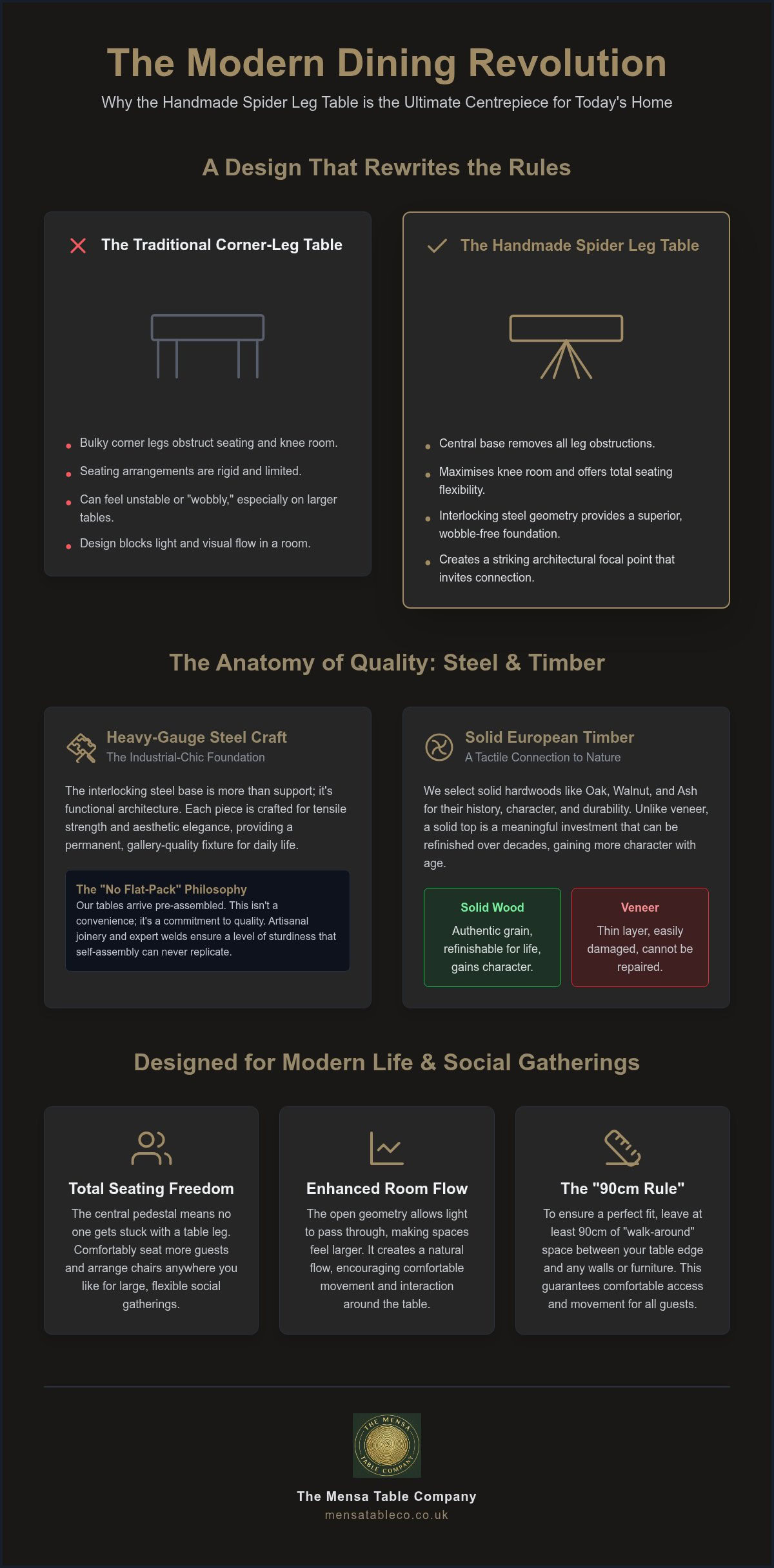
The handmade spider leg table is defined by its striking central support, a departure from the perimeter legs found throughout the history of the table. This design uses four interlocking steel prongs that meet at a singular point beneath the timber, creating a silhouette that is both delicate and immensely strong. It’s a piece of functional architecture. While traditional tables rely on four corner posts, the spider leg geometry provides a level of structural balance that allows for massive spans of wood without the “wobble” associated with mass-produced imports. Our craftsmen focus on the manual assembly of these frames, ensuring that every weld and joint is a testament to artisanal joinery rather than a compromise of the assembly line.
Choosing a handmade spider leg table represents a shift in how we view our living spaces. It moves the focus from the edges of the room to the very centre, turning the dining table into a definitive statement piece. In a world of disposable goods, the value of manual production lies in the details; the way the steel is finished to a soft lustre and how the timber is selected to complement the frame’s industrial weight. It’s about creating a focal point that invites people to gather, linger, and connect.
The Evolution of Industrial-Chic Furniture
British interior design has seen a move toward the “statement base,” where the legs of the table are as much a work of art as the surface itself. This trend bridges the gap between raw, industrial strength and the organic warmth of a family home. In modern, light-filled extensions, the open geometry of the spider leg design allows light to flow through the room rather than being blocked by heavy wooden corners. With the UK furniture market projected to reach £11.2 billion in 2026, there’s a clear consumer appetite for pieces that offer both long-term durability and a unique, handcrafted aesthetic that reflects personal heritage.
Solid Wood vs. Veneer: Choosing the Right Surface
A truly exceptional table requires a top with enough physical substance to anchor the heavy-gauge steel frame. We believe in the sensory appeal of solid European Oak and solid European Ash, materials that offer a tactile connection to the natural world. Mass-produced veneers are simply too thin and fragile to survive the life of a busy household. They lack the ability to be refinished over decades, whereas solid Black Walnut or Oak gains character with age. When you run your hand across a solid surface, you’re feeling the history of the timber, a quality that ensures your furniture remains a meaningful life investment for generations.
The Anatomy of Quality: Timber Selection and Steel Craft
The creation of a handmade spider leg table begins with a deep respect for the raw materials. We don’t see steel and wood as mere components; they’re the physical language of the home. The steel provides the tensile strength required to support a massive dining surface, yet it’s shaped with an aesthetic elegance that feels light and airy. This balance ensures the table remains a permanent fixture, standing firm against the hustle of daily life while looking like a piece of gallery art. A handmade spider leg table is more than a purchase; it’s a legacy.
Selecting the timber is a slow, deliberate process. We source solid European hardwoods, valuing the history written into every ring and knot. While mass-produced furniture often hides the wood’s natural character under thick, plastic-like coatings, our craftsmen work to highlight it. You can explore our solid European ash collection to see how the “open grain” and olive streaks create a surface that is unique to every home. By honouring the grain through manual sanding, we bring the wood’s history to the forefront of the design.
European Hardwoods: A Tactile Journey
The choice between Ash and Oak is often a matter of touch and light. Ash offers a vibrant, energetic grain pattern, often featuring darker heartwood that adds a contemporary edge to the room. In contrast, solid Oak provides a dense, reassuring character that has defined British homes for centuries. We embrace the natural imperfections, from small knots to subtle colour variations, as they prove the timber’s authenticity. It’s vital to remember that solid timber must be allowed to expand and contract naturally against the rigid steel frame to prevent splitting over time. This technical understanding is what separates artisanal work from temporary, flat-pack alternatives.
Finishing Techniques for Longevity
Our approach to finishing is rooted in the “manual touch.” We avoid industrial spray lines that can mask the tactile quality of the wood. Instead, we use manual sanding and high-quality natural oils to protect the surface. This method ensures the table is resistant to the spills of a busy Sunday roast while maintaining a “raw” and organic appearance. Using oils rather than heavy lacquers allows the wood to age gracefully, developing a rich patina over the decades. If you have questions about which timber species or finish best suits your lifestyle, our team is always happy to discuss your bespoke requirements.
Why the Spider Leg Design is the Ultimate Social Choice
A dining table is the heartbeat of the home, a place where the day’s stories are shared and celebrations take flight. While traditional furniture often dictates where guests must sit, the handmade spider leg table offers a liberating sense of social flexibility. By moving the support to the centre of the frame, we remove the physical barriers that corner legs create. This “no-corner” advantage means you’re no longer limited by the four corners of the timber. You can slide an extra chair in wherever it’s needed, making it the perfect solution for those who love to host but hate the logistical puzzle of seating arrangements.
The practical benefits of choosing a handmade spider leg table are immediate. Maximising knee room is a priority for us, as nothing ruins a long dinner party faster than a guest constantly banging their legs against a wooden post. Because the four steel prongs interlock at a central point, every person around the table enjoys the same level of comfort, regardless of their position. This design is particularly effective for those looking to accommodate larger groups of 8 to 12 people. You can browse our full range of dining tables to see how this architectural base transforms the seating capacity of a standard room.
The End-of-Table Comfort Factor
The “head” of the table has historically been a place of compromise, where the person in charge of the roast often ends up straddling a bulky table leg. The spider leg geometry eliminates this issue entirely. It creates a communal atmosphere where every seat is the best seat in the house. When the meal is over, the central base allows chairs to tuck in fully. This keeps your dining area tidy and maximises floor space in smaller UK homes, ensuring the table doesn’t feel like an obstacle when it’s not in use.
Stability for Large Solid Wood Tops
Physics plays a vital role in the beauty of the spider base. By distributing the weight of the timber across a wide, four-pronged footprint, we achieve a level of stability that is often missing in mass-produced furniture. This design is superior for supporting heavy, thick-cut timber tops that would otherwise be prone to slight movements. Our use of heavy-gauge steel in the manufacturing process ensures a wobble-free dining experience. It’s about providing a solid, reassuring foundation that can handle the weight of a generational investment without ever feeling precarious.
Choosing the Right Size for Your National UK Home
UK homes often present unique spatial challenges, from expansive open-plan barn conversions to the more intimate proportions of Victorian dining rooms. Selecting the perfect dimensions for your handmade spider leg table is a delicate balance of aesthetics and utility. It’s not just about the physical footprint of the timber; it’s about how the piece interacts with the light and the movement of people within the room. We advocate for the “90cm walk-around” rule, a simple yet effective guide that ensures your dining area remains a place of calm rather than a cramped thoroughfare.
While standard sizes work for many, the beauty of artisanal furniture lies in the ability to adapt. A table that is even 10cm too long can disrupt the flow of a room, while one that is too small can feel lost in a large space. Bespoke sizing allows us to tailor the piece to the specific character of your home, ensuring the architectural steel and solid wood feel like they were always meant to be there.
Sizing Guide for Spider Leg Tables
Deciding between a 6-seater and a 10-seater depends largely on your hosting rituals. A 180cm table typically serves as a comfortable 6-seater, while larger gatherings of 10 or more require a length of at least 240cm. For the most comfortable dining experience, you should aim for a minimum of 90cm of clearance between the table edge and the nearest wall or piece of furniture. The centralised footprint of the spider base is a significant advantage here. It allows for chairs to be positioned with greater freedom than traditional four-legged designs, accommodating wider armrests or more modern, sculptural chair profiles without interference.
The Bench Advantage
We often find that finding matching benches for your table is the most effective way to balance style with utility. Benches echo the linear beauty of the timber and offer a streamlined look that chairs can sometimes clutter. A “bench-and-chair” hybrid setup is particularly popular for families, providing a flexible space for children on the bench side while keeping formal seating on the other. Because the spider legs angle toward the centre, benches can often be tucked further under the table when not in use, reclaiming valuable floor space in narrower rooms. This setup maximises the social potential of the room without overwhelming it.
If you’re unsure which dimensions will best serve your home’s layout or need advice on timber species, you can get in touch with our craftsmen for a sizing consultation.
The Mensa Table Company: A Commitment to British Craft
At The Mensa Table Company, we don’t just build furniture; we create the stage for your family’s most important stories. A handmade spider leg table is a significant investment in your home’s future. It’s a commitment to quality that transcends the temporary nature of modern retail. We believe that every piece should carry the quiet confidence of artisanal skill, serving as a reliable focal point for decades of shared meals and quiet morning coffees. Our work is rooted in the belief that the objects we live with should possess a soul and a history of their own.
We maintain a strict “no flat-pack” philosophy. This isn’t just a matter of convenience; it’s about structural integrity. By delivering our tables fully assembled and hand-finished by our UK-based craftsmen, we ensure that every joint and weld is exactly as intended. Mass-produced furniture often fails because the connection points are designed for shipping efficiency rather than generational longevity. Our artisanal approach ensures that your handmade spider leg table remains as sturdy and wobble-free on its fiftieth anniversary as it was on its first day in your home.
The journey of your table begins with the selection of raw European timber, chosen for its density and unique character. From the initial cuts in our workshop to the final application of protective natural oils, every step is deliberate. We handle the national delivery ourselves or through trusted partners, ensuring that your investment arrives safely at your door, ready to become the centrepiece of your dining room.
The Human Connection in Every Piece
Every table we create is treated as a unique commission. Our signature lies in the way we balance the industrial weight of the steel with the organic, tactile warmth of the wood. Choosing a handcrafted piece is an intentional choice to support local craftsmanship and ethical sourcing. We take immense pride in our trade, valuing the connection between the creator and the end user. It’s a more responsible way to furnish a home, prioritising substance over flashy marketing and ensuring that your furniture reflects your values.
Extending the Aesthetic
To create a truly cohesive living space, you might consider extending the aesthetic beyond the dining room. We offer matching coffee tables that carry the same architectural language into your lounge. For those with modern kitchen islands, our custom breakfast bars provide a high-quality alternative to standard worktops. Every piece is crafted with the same dedication to heritage and durability that defines our larger dining pieces. If you’re ready to bring a piece of authentic British craftsmanship into your home, Contact us to start your bespoke journey.
Investing in Your Home’s Future Focal Point
Choosing the right dining surface is about more than just filling a room; it’s about selecting the backdrop for your family’s most cherished rituals. We’ve explored how the architectural geometry of a handmade spider leg table removes the physical barriers of traditional furniture, offering unparalleled knee room and the social flexibility to seat large groups with ease. By prioritising solid European timber over fragile veneers and rejecting the structural compromises of flat-pack imports, you’re investing in a piece designed for generational longevity.
Our team of UK-based craftsmen has been dedicated to this manual approach since 2018, ensuring every table reflects a deep respect for natural materials and artisanal skill. We take pride in delivering these substantial pieces nationally across the UK, ensuring your new centrepiece arrives ready to anchor your home. Whether you’re planning festive roasts or quiet morning coffees, a bespoke table provides a sturdy, wobble-free foundation for a lifetime of connection.
Contact our craftsmen to discuss your bespoke spider leg table and begin the journey of bringing authentic British craftsmanship into your home. We’re ready to help you create a space that truly feels like the heart of your household.
Frequently Asked Questions
Is a spider leg table stable enough for everyday family use?
A handmade spider leg table is exceptionally stable for daily family life because the heavy-gauge steel base is engineered to distribute weight across a wide central footprint. Unlike mass-produced furniture that relies on screws and brackets, our pre-assembled frames are welded for maximum rigidity. This ensures that even with a heavy solid wood top, the surface remains wobble-free during busy dinners or children’s homework sessions. It’s a robust foundation built to endure generational use.
How many people can comfortably sit at a 2-metre spider leg table?
A 2-metre table typically accommodates 8 people with ease, though the central base design allows for even greater flexibility. Since there are no corner legs to navigate, you can comfortably position three chairs along each side and one at each head. This “no-corner” advantage is a hallmark of this design, making it an ideal choice for hosts who need to adapt their seating arrangements for larger social gatherings or festive celebrations.
What is the best wood for a handmade spider leg table?
We recommend solid European hardwoods such as Oak or Ash for their superior density and natural character. Oak offers a classic, dense grain that has defined British homes for centuries, while Ash provides a vibrant, contemporary pattern with excellent shock resistance. Both species are ideal for this frame style as they possess the physical weight necessary to balance the industrial steel base, ensuring your furniture remains a tactile and enduring life investment.
Can I get a custom size spider leg table for a narrow dining room?
Bespoke sizing is essential for non-standard rooms, and we frequently craft tables tailored to narrower dining spaces. While a standard width is 90cm to 100cm, we can adjust the timber dimensions to fit your specific floor plan without compromising the architectural integrity of the spider base. This custom approach ensures that your handmade spider leg table feels like an intentional part of the room’s architecture, maintaining the “90cm walk-around” rule for comfortable movement in tighter areas.
Does the spider leg design interfere with legroom?
The spider leg design actually improves legroom by removing the bulky corner posts found on traditional furniture. Because the four steel prongs meet at a single central point, guests have total freedom to move their legs without obstruction. This is particularly beneficial for those sitting at the corners or the heads of the table, as they no longer have to straddle a wooden leg. It creates a more communal and physically comfortable dining experience.
How do I care for a solid wood table top with a steel base?
Caring for your table is a simple process rooted in protecting the natural timber grain. We recommend regular dusting with a lint-free cloth and using coasters to prevent water rings on the oil-finished surface. Every 6 to 12 months, a light application of natural wood oil will maintain the wood’s resilience and keep the “raw” aesthetic alive. Since the solid wood is attached to a rigid steel base, it simply needs a stable environment to breathe.
Do you deliver spider leg tables nationally across the UK?
We provide a dedicated national delivery service across the entire UK to ensure your investment arrives in perfect condition. Every piece is handcrafted by our artisanal team and delivered fully assembled, adhering to our “no flat-pack” philosophy for superior durability. We handle the logistics with the same care we put into the manufacturing process, taking the stress out of furnishing your home and ensuring your new centrepiece is ready for immediate use.
What is the difference between a spider leg and an X-frame table?
The primary difference lies in the placement and geometry of the steel support. A spider leg frame consists of four prongs meeting at a single central point, which maximises seating flexibility around the entire perimeter. In contrast, an X-frame table features two separate “X” shaped supports positioned toward the ends of the timber. While both offer an industrial-chic aesthetic, the spider design is often preferred for social rituals where end-of-table comfort and central legroom are priorities.

Leave a Reply