
Most modern dining tables aren’t built to host a lifetime of Sunday roasts; they’re designed to fit inside a flat box and survive just long enough for the next trend to arrive. We’ve all experienced the sinking feeling of a wobbly leg or the stress of deciphering a confusing manual only to find a piece of chipboard has crumbled. When you compare handcrafted vs flat pack furniture, the choice is about more than just the initial price tag. It’s a decision between a temporary fixture and a permanent foundation for your home.
We believe your home should feel personal and grounded, serving as a sanctuary rather than a carbon copy of a showroom. This guide will help you discover the hidden differences between artisanal craftsmanship and mass-produced items so you can make a lasting investment. We’ll explore the tactile beauty of solid European Oak, the expert joinery found in signature pieces like the Mensa Dining Table, and why choosing furniture that acts as a site for human connection is the most sustainable path for your family.
Key Takeaways
- Learn why solid European Oak and Black Walnut provide structural integrity that mass-produced particle board and thin veneers cannot replicate.
- Evaluate the true cost of your investment by comparing the lifespan of handcrafted vs flat pack furniture, moving beyond the initial price tag to consider generational value.
- Identify the hallmarks of expert joinery and timber density with a practical checklist designed to help you spot authentic craftsmanship.
- Discover how a bespoke dining table acts as a permanent foundation for your home, evolving from a piece of furniture into a site for shared rituals and stories.
- Understand the environmental benefits of choosing durable, ethically sourced materials that reduce waste and honour the natural history of the wood.
Handcrafted vs Flat Pack Furniture: More Than Just a Price Tag
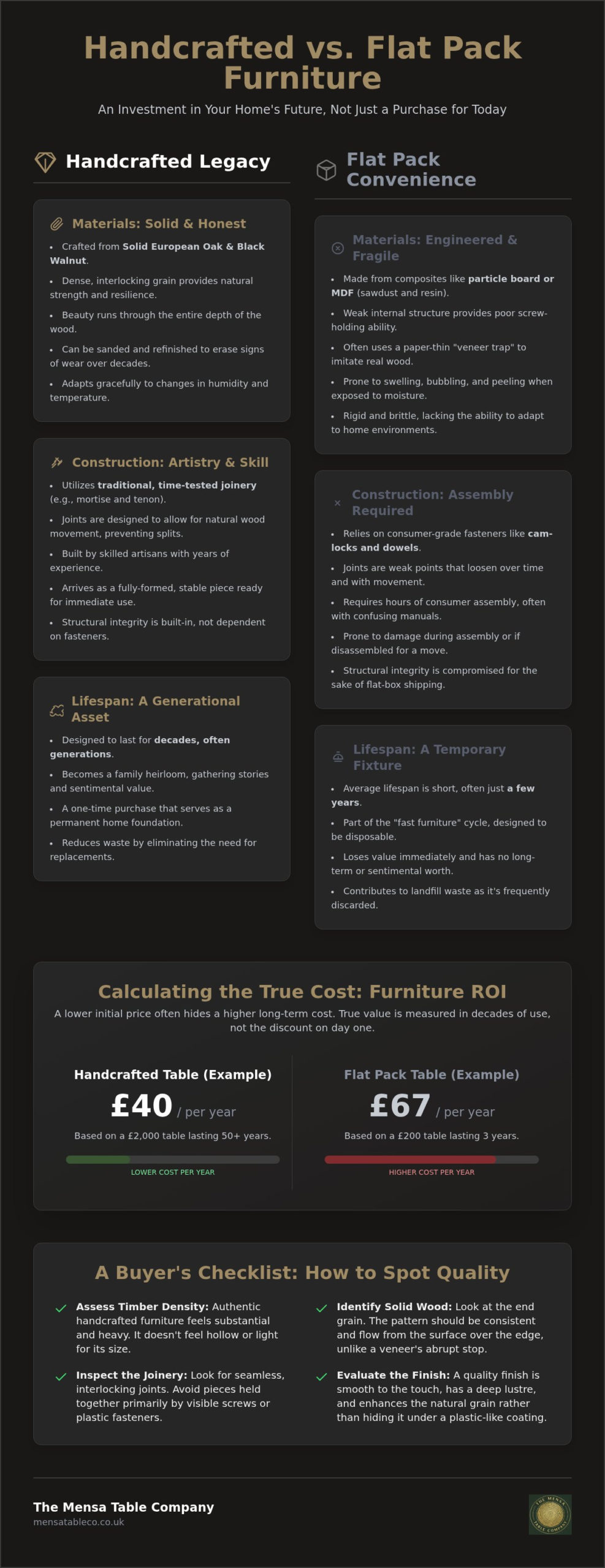
Choosing between handcrafted vs flat pack furniture often feels like a choice between the wallet and the heart. However, it’s actually a decision about how you value time and space. Flat pack furniture is born from a desire for speed and high-volume shipping; it’s modular, mass-produced, and arrives in cardboard boxes filled with particle board and confusing diagrams. Handcrafted furniture is built by skilled artisans who use traditional joinery and solid timbers to create something that breathes and endures.
Over the last twenty years, the rise of ‘fast furniture’ has turned many UK homes into transient environments. We’ve traded durability for a quick aesthetic fix, leading to a cycle where tables are discarded after a single house move or a minor spill. To find the true value of a piece, we must look at ‘Furniture ROI’. A cheap composite table might cost £200 but only lasts three years before the veneer peels or the joints wobble. A solid wood table is a foundation that serves for decades, making the cost per year of use significantly lower while its sentimental value only grows.
The Philosophy of the Home Focal Point
A dining table is rarely just a surface for plates. It’s the heart of social rituals, the site for morning coffees, heated debates, and the quiet gathering of a Sunday roast. Mass-produced items often feel soulless because they lack a story; they are commodities designed to be identical and replaceable. A legacy piece carries the weight of its natural origins, reflecting the unique grain of the tree it came from and the quiet intent of the person who shaped it.
Assembly vs. Artistry: The Time Factor
We often overlook the hidden tax of some assembly required. It isn’t just the stress of a lost weekend or the frustration of a missing cam lock; it’s the compromise of structural integrity that comes with consumer-grade fasteners. When you choose a professionally realized piece, you’re investing in the peace of mind that comes with expert construction. Handcrafted furniture is a commitment to material history and human skill, delivered as a fully formed anchor for your home. It’s the difference between a project you have to finish and a masterpiece you get to start using immediately.
The Structural Difference: Solid Wood vs. Engineered Composites
When we look beneath the surface, the divide between handcrafted vs flat pack furniture becomes a matter of biology versus chemistry. Solid European Oak and Black Walnut are dense, fibrous materials that grew over decades, storing strength in every ring. In contrast, engineered composites like particle board or MDF are essentially sawdust and wood chips held together by synthetic resins. While a composite board might look uniform, it lacks the internal architecture required to hold a screw securely over time.
The ‘Veneer Trap’ is a common pitfall in mass-produced design. A paper-thin layer of real wood is glued over a core of compressed dust, giving the illusion of quality. However, if this surface is scratched or exposed to a spilled drink, the composite core absorbs moisture and swells, causing the veneer to bubble and peel. Solid wood doesn’t have a ‘surface’ that can fail in this way; the beauty goes all the way through. It’s a material that handles the humidity and heat of a UK kitchen with grace.
One of the most misunderstood aspects of fine furniture is timber movement. Wood is a living material that expands and contracts with the changing seasons. Artisans account for this by using traditional joinery that allows the wood to breathe without splitting. This level of foresight is entirely absent in flat pack furniture, which is rigid and prone to snapping when environmental conditions shift. Our craftsmen spend years learning how to work with these natural forces rather than fighting them.
The Strength of Solid Timber
Using Solid European Oak provides a natural resilience that engineered boards can’t match. Its interlocking grain structure allows it to withstand the heavy weight of family life without bowing or cracking. Because it’s a single, honest material, it can be sanded back and refinished if it picks up the scars of a busy household. This tactile experience, the warmth of the grain and the sensory richness of the wood, creates a connection to the natural world that feels grounding in a modern home.
The Fragility of Flat Pack Components
Flat pack stability relies on cam-locks and dowels that often tear through the soft composite board during assembly or after a house move. Once the hole for a fastener is stripped in MDF, the structural integrity is lost forever. Beyond the ‘wobble factor’, these components carry a hidden environmental cost. The glues and resins used in mass-produced boards often contain chemicals that make them difficult to recycle. Choosing solid timber is an intentional step away from this disposable cycle, and if you’re curious about how we select our sustainable materials, you can ask us about our sourcing process.
Calculating the True Value: Longevity, Sustainability, and ROI
When we weigh the merits of handcrafted vs flat pack furniture, the conversation often stops at the checkout. This is a mistake. To understand the true cost, we must look at the lifecycle of the item rather than just the initial transaction. A mass-produced table often begins to show its age within two years; joints loosen, surfaces chip, and it eventually finds its way to a landfill. In contrast, a table built from solid timber is designed for a fifty-year lifespan or more. If you replace a cheap table several times over a decade, you’ve spent more than the cost of a single, high-quality artisanal piece that would still be in its prime.
Sustainability isn’t just about labels; it’s about endurance. Choosing one well-made object over several disposable ones is the most effective way to reduce your personal environmental impact. Beyond longevity, handcrafted pieces serve as financial assets. While flat pack furniture has almost zero resale value once assembled, unique designs like our Spider Leg or X-Frame tables hold their worth. They are recognized as premium additions to an interior, often increasing the perceived value of a property because they feel like a permanent, intentional part of the home’s architecture.
Environmental Stewardship in Craftsmanship
Our commitment to the planet is reflected in the materials we select and the way we work. Sourcing premium species like Solid Black Walnut involves a deep respect for slow-growth timbers and ethical forestry. By maintaining an artisan-led production model right here in the UK, we significantly reduce the carbon footprint associated with international shipping and mass manufacturing. We advocate for a repair culture where a table can be sanded, oiled, and renewed, standing in direct opposition to the throwaway culture that defines the modern high street.
The Emotional Return on Investment
There is a quiet joy in owning something that grows more beautiful as it ages. Every mark on a solid wood surface becomes a part of your family’s history, a map of the dinners and celebrations held there. Supporting local UK craft provides a sense of pride that no flat-box retailer can offer. It’s a connection to a person, a workshop, and a tradition of manual skill. Ultimately, the dining table acts as the backdrop for a lifetime of shared experiences, evolving from a simple piece of furniture into a cherished member of the household.
A Buyer’s Checklist: Identifying Quality in Handcrafted Furniture
Distinguishing between handcrafted vs flat pack furniture requires more than a passing glance; it demands a sensory inspection of the piece’s soul. Start with the weight. A solid timber table possesses a reassuring gravity that hollow composites simply cannot mimic. When you run your hand across the surface, you should feel the organic texture of the wood rather than a cold, plastic-like lacquer. A deep, natural oil finish preserves this tactile connection, allowing the timber to age gracefully while protecting the fibres from within.
Stability is another clear indicator of artisanal intent. While mass-produced legs often feel flimsy or disconnected, frames like the U-Frame or Trapezium provide a robust, architectural foundation. These industrial-style steel bases are designed to support the immense weight of solid wood without the inevitable wobble found in bolt-on flat pack alternatives. We ensure every weld is clean and every support is positioned to handle the rigours of daily life.
Inspecting the Grain and Species
The character of the wood tells a story of its own. Solid European Ash, for instance, is prized for its pale, olive-flecked grain and immense shock resistance. In a high-quality build, you’ll see continuous grain patterns where the maker has carefully matched planks to create a visual flow across the entire top. You might also encounter a ‘live edge’, which preserves the natural silhouette of the tree. This isn’t just an aesthetic choice; it’s a technical challenge that requires an expert hand to sand and seal correctly.
Hardware and Underside Finishing
If you want to know the true quality of a table, look at the parts the maker thought you’d never see. Flip the piece over. The underside should be finished with the same care as the top, free from visible glue drips or rough, unsanded patches. High-quality steel frames should be powder-coated and joined with precision welds rather than flimsy plastic brackets or machine-pressed staples. Red flags are easy to spot once you know where to look: paper-thin veneers that reveal a grainy core at the edges or cam-locks that feel like they might snap under pressure. If you’re looking for a piece built with this level of transparency, get in touch with our workshop team to discuss your requirements.
The Mensa Table Co: Handcrafting the Heart of Your Home
At The Mensa Table Company, we don’t just manufacture furniture; we curate the setting for your life’s most meaningful moments. Since our founding in 2018, our focus has remained steadfast on the concept of ‘gathering’. When you weigh up handcrafted vs flat pack furniture, you’re choosing between an item that merely occupies space and one that defines it. Our philosophy is rooted in warmth and authenticity, ensuring that every piece leaving our workshop carries the quiet confidence of expert joinery and artisanal pride.
Our collection is designed to grow with your home, providing a sense of continuity across different rooms. From the foundational presence of our dining tables to our Matching Benches and Coffee Tables, each piece shares a common DNA of durability and timeless design. We also extend this craftsmanship to functional spaces with our breakfast bars and desks, ensuring that even your workday is anchored by the tactile beauty of solid timber and professional UK craftsmanship.
Our Signature Designs
The Mensa Dining Table serves as our namesake and a study in perfect balance. It represents the pinnacle of our joinery expertise, offering a silhouette that feels both contemporary and heritage-inspired. For those who prefer a bolder, more architectural aesthetic, the Spider Leg and X-Frame designs merge industrial steel strength with the natural, flowing beauty of European Oak or Black Walnut. These frames provide the absolute stability required for a generational piece, acting as a permanent foundation for your home’s social rituals.
Start Your Journey with Us
Every home is unique, and we believe your furniture should reflect that individuality. Our bespoke process begins with a conversation about how you live and how you use your space. We work alongside you to select the ideal species, whether it’s the rich, dark depth of Black Walnut or the resilient, olive-flecked character of Ash, and determine the exact dimensions to suit your dining room. We’ve built a national delivery model that ensures our handcrafted pieces reach every corner of the UK with the same personal care we put into building them.
It’s time to move away from the temporary cycle of disposable goods and invest in the timeless. Speak to our craftsmen about your perfect table today and let us help you build a focal point that will host your family’s stories for decades to come.
Building a Foundation for Generations
Choosing between handcrafted vs flat pack furniture is a decision that fundamentally shapes the atmosphere of your home for decades. You’ve discovered how solid European Oak and Black Walnut offer a structural resilience that engineered composites simply cannot match. These natural materials don’t just survive the passage of time; they age with a sensory grace that tells your family’s unique story, evolving from a simple surface into a cherished heirloom.
Since 2018, our team has been dedicated to creating these permanent anchors for gathering. Every piece is handcrafted in the UK by our local craftsmen, ensuring that your investment supports traditional skill and environmental responsibility. Whether you’re drawn to the pale elegance of Ash or the deep, inviting warmth of Walnut, our national delivery service brings this artisanal spirit directly to your dining room. Your home deserves a focal point that remains stable and beautiful through a lifetime of shared rituals.
It’s time to step away from the cycle of temporary furniture and embrace a legacy piece that grows more meaningful with every meal. Design your legacy table with our expert craftsmen today and begin the journey toward a truly timeless home. We look forward to helping you create the heart of your house.
Frequently Asked Questions
Is handcrafted furniture always more expensive than flat pack?
Handcrafted furniture usually carries a higher initial price than flat pack alternatives, but it’s a more economical choice over time. While mass-produced items are built for short-term trends, a solid wood table is designed to last for fifty years or more. When you calculate the cost per year of use, the investment in quality craftsmanship often proves far cheaper than replacing a fragile, temporary table every few seasons.
How do I maintain a solid wood table compared to a laminated one?
Maintaining a solid wood table involves simple, periodic care that isn’t possible with laminated surfaces. While a laminate top is essentially a plastic layer that can’t be fixed once scratched, real timber benefits from an occasional application of natural oil. This nourishes the fibres and enhances the grain. If the surface suffers heavy wear over the years, it can be sanded back and refinished, a process that isn’t an option for composite boards.
Can handcrafted furniture be delivered as easily as flat pack?
We’ve designed our national delivery model to make receiving a bespoke piece just as convenient as ordering from a high-street retailer. Unlike the stress of a flat-boxed delivery, our furniture arrives as a fully realized, professional build. You won’t spend your weekend wrestling with cam-locks or missing screws. We ensure your table is handled with the same care we used to build it, arriving ready to serve as your home’s new focal point.
Why does solid wood furniture sometimes have small cracks or movement?
Small movements or hairline cracks are natural characteristics of timber as it breathes and reacts to the humidity in your home. This is the hallmark of a living material rather than a static, synthetic composite. We account for this timber movement in our joinery, allowing the wood to expand and contract without compromising the table’s structural integrity. These subtle shifts are part of the piece’s history and don’t affect its long-term durability.
What are the best wood species for a durable dining table?
For a dining table that can withstand the rigours of daily life, we recommend dense hardwoods like Solid European Oak, Ash, or Black Walnut. Oak is celebrated for its immense strength and classic grain, while Ash offers exceptional shock resistance and a lighter aesthetic. Black Walnut provides a rich, dark sophistication. Each of these species is chosen for its ability to hold up under the weight of family gatherings while growing more beautiful with age.
How can I tell if a table is solid wood or just veneered?
You can identify a veneered piece by looking closely at the edges where the top meets the sides. In a solid wood table, the grain pattern will wrap naturally around the corner or show the end-grain of the timber. Veneered tables often have a thin, repetitive tape at the edge that masks a particle board core. Weight is another giveaway; solid timber has a reassuring gravity that mass-produced, hollow-feeling furniture simply lacks.
Do you offer custom sizes for your handcrafted dining tables?
We specialize in tailoring our designs to fit the specific dimensions of your home and the needs of your family. Whether you require a grand version of the Mensa Dining Table for large gatherings or a compact X-Frame for a kitchen nook, we work with you to find the perfect scale. This bespoke approach ensures your table isn’t just a piece of furniture, but a custom-built foundation for your unique living space.
Is handcrafted furniture more sustainable than mass-produced options?
Choosing handcrafted vs flat pack furniture is a significantly more sustainable choice because it breaks the cycle of disposable consumption. Our furniture is produced locally in the UK using ethically sourced timbers, which drastically reduces the carbon footprint compared to mass-manufactured items shipped from overseas. By building one table that lasts for generations, we reduce the demand for the glues, resins, and waste associated with the five cheap tables it replaces.

Leave a Reply