
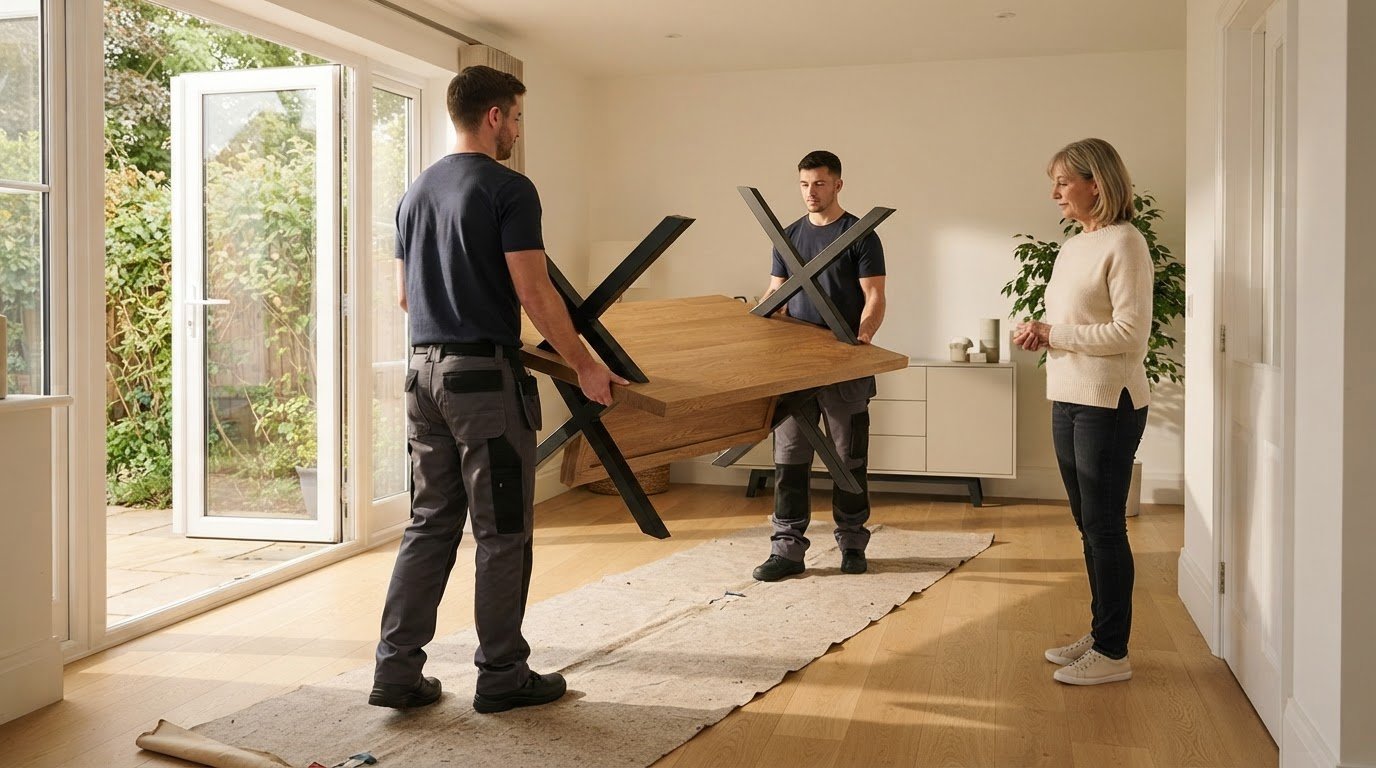
A furniture delivery date depends on when the piece is ready and when an appointment can be coordinated with the route and delivery crew. For made-to-order furniture, delivery can be booked on the day the supplier confirms the piece has arrived. Knowing how dates, time slots and updates work helps make the excitement of a scheduled furniture delivery feel easier to plan around.
It’s natural to look forward to a new piece taking its place at home, while wanting a clear idea of when it will arrive. Delivery arrangements vary: some furniture shops send a text with a two-hour delivery window the day before, and room-of-choice drivers may call half an hour before arrival.
This guide explains how delivery dates are arranged, what can affect timing, which updates to look out for and how to prepare your home. You’ll also learn what to do if plans change, so you can make space for the furniture and the moments that will gather around it.
Key Takeaways
- Look out for delivery texts and calls, and keep your contact details and appointment information close to hand.
- Understand what can affect an estimated date, including whether the furniture is ready and the delivery route can be arranged.
- Prepare the route into your home by considering access restrictions, bulky pieces and anything that could be moved out of the way.
- When your furniture arrives, check the items against your order and look over their condition before the delivery is complete.
- Compare the Mensa, Spider Leg, X-Frame and U-Frame dining tables to find a focal point that suits your home and the way you gather.
Text confirmations and automatic updates
A delivery update tells you what to expect and gives you a chance to respond if plans change. Read each message carefully, as the time-slot notification may set a deadline for rescheduling.
Delivery Time Slots
A delivery time slot is the period when the delivery team expects to arrive at your address. Some furniture shops send a two-hour delivery window by text the day before.
When the message arrives, note the delivery date and full time window, then confirm any requested appointment details. For room-of-choice delivery, the driver may also call half an hour before arrival with an update from the road.
Keep your phone available on delivery day and make sure the number on your order can receive calls and texts. If someone else will be home, share the time slot and any confirmation instructions with them. That way, the person receiving the furniture knows when to expect the delivery team.
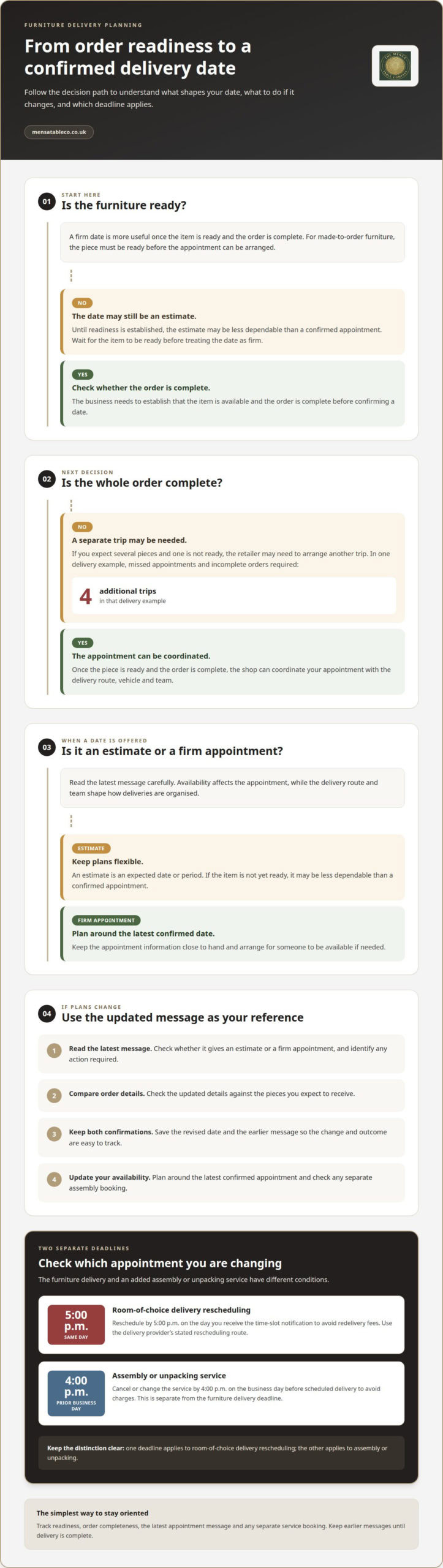
Please note the notification time as well as the delivery slot. For a room-of-choice delivery, customers must reschedule by 5:00 p.m. on the day they receive the time-slot notification to avoid redelivery fees. If the appointment no longer works, use the delivery provider’s stated rescheduling route before that deadline.
Arrival Checks and Delivery Problems
Arrival checks mean comparing the delivered furniture with your order and looking over its visible condition. If an item is damaged or incorrect in the UK, report the problem to the retailer and explain what remedy you’re seeking under your consumer rights. Take clear photographs and keep your order confirmation and delivery messages.
Where practical, compare the item description and quantity with your order paperwork before the delivery team leaves. Check visible surfaces, edges and packaging for signs of impact or damage. If you spot a problem, describe exactly where it is, such as a mark on the tabletop or a missing item, and record it in the delivery paperwork if possible.
Send the retailer a concise written report with photographs and your order details, creating a record of what arrived and when. Keep any reply and note the agreed next steps. A message confirming delivery records the appointment outcome, but it doesn’t replace your own account of a problem you noticed.
Automatic updates can also help explain changes to an appointment. A furniture delivery record may include the scheduled date, actual dispatch, delivery outcome and reason for rescheduling. If a date changes, compare the new confirmation with the earlier message and update anyone who needs to be present.
Some delivery customer pages show available slots and let customers book or change a date, with the change appearing on a shared calendar. Use the latest confirmation as your reference and keep earlier messages until delivery is complete. This gives you a clear record of the appointment, any changes and the outcome.
Delivery estimates and delays
A delivery estimate is the expected date or period for an order to arrive. A firm date is more useful once the furniture is ready and the order is complete. Before confirming a date, a furniture business needs to establish that the item is available and the order is complete. This helps avoid scheduling delivery for a piece that has not arrived or an order that still needs attention.
For made-to-order furniture, the delivery date depends on the piece being ready first. Once the item is ready, the furniture shop can coordinate your appointment with the route, vehicle and delivery team. Until readiness is established, an estimate may be less dependable than a confirmed appointment.
A delay is anything that prevents delivery on the expected date. An incomplete order is one example: if you’re expecting several pieces but one is not ready, the retailer may need to arrange another trip. Missed appointments can also lead to repeat journeys. In one delivery example, missed appointments and incomplete orders required four additional trips.
If the date changes, read the revised message for the new appointment and any action required, and keep the earlier confirmation too. Together, the messages show the change from the original date to the updated one. If you need to be home, plan around the latest confirmed date rather than an earlier estimate.
Some factors affect an order before dispatch; others come into play after delivery has been planned. Availability and order completeness determine whether a firm date can be offered. Your availability affects the appointment, while route and team coordination shape how deliveries are organised. An order can be ready before its delivery appointment is arranged.
Assembly or unpacking arranged alongside delivery can have a separate cancellation deadline. Customers must cancel or change an unpacking or assembly service by 4:00 PM on the business day prior to scheduled delivery to avoid charges. Treat that as a separate appointment condition, not as the deadline for changing the furniture delivery itself.
If a delay affects your plans, take these steps:
- Read the latest message and identify whether it gives an estimate or a firm appointment.
- Compare the updated order details with the pieces you expect to receive.
- Save the revised date and any message explaining the changed delivery outcome.
- Rearrange your availability around the latest appointment, including any separate assembly booking.
Keeping these steps distinct helps you track the order, delivery date and any additional service. A clear record also makes it easier to see which appointment changed and what remains outstanding.
Preparing access and protecting property
Access planning means checking the route from the entrance to the room where the furniture will go. Furniture can be bulky and an order may include several pieces, so a clear route helps the delivery team work out how to bring everything in.
Start at the entrance and follow the route indoors. Look for narrow doorways, tight turns, stairs, low ceilings and access restrictions that could affect a large item. A table, for example, may fit through the front door but be difficult to turn into a hallway. Check each transition, not just the destination room.
Measure the relevant spaces and compare them with the dimensions of your furniture. Check door openings, hallways and stairwells, then consider how the item must be angled to pass through. A straight measurement may not show whether a broad tabletop can turn around a landing. If your order includes several pieces, plan the route for each one.
Preparing the route means moving belongings and clearing surfaces to reduce avoidable knocks and obstructions. Move loose items, rugs and small furniture out of the way, and clear the destination room before the delivery team arrives. For instance, move a lamp beside a narrow hallway so larger pieces can pass through.
Choose a clear place for packaging and keep any components together. Keep pets and household activity away from the route during delivery. These simple steps make it easier for the delivery team to move through your home without navigating around everyday clutter.
Use your delivery details to provide specific instructions. If the entrance is difficult to find, the building has restricted access, or a doorway needs special attention, write a concise note for the delivery team. Be specific: “Use the side entrance” is clearer than a general warning about access. Send useful directions through the delivery communication channel.
Before the scheduled date, walk the route again and check for changes. A parcel, newly placed chair or open cupboard door can narrow a passage that was clear before. Make sure the destination room has enough space for the furniture and for the team to position it. This is especially helpful when several pieces are arriving together.
Keep access preparation separate from optional assembly or installation. Furniture delivery can involve bulky items, several pieces, access restrictions and optional assembly or installation. Clearing the route helps the delivery team reach the room, but doesn’t determine what work is included. Keep your order details handy so you can follow the agreed plan when the furniture arrives.
Delivery scheduling
Furniture delivery scheduling coordinates order readiness, appointments, routes, vehicles and teams around the delivery window. The key steps for you are knowing when your order is ready, arranging a suitable appointment and understanding how the destination affects delivery charges.
For made-to-order furniture, a shop can book delivery on the day the supplier confirms the piece has arrived. Readiness is only one part of the plan: the retailer also has to coordinate your appointment with its route and available crew. If your order contains several pieces, the scheduled delivery needs to account for the order as a whole.
Once an appointment is arranged, keep the order details and date together. Check that the date suits your availability and that the delivery address is correct. If the retailer provides a customer page, it may show available slots and let you book or change a date. The change may then appear on a shared calendar, keeping the appointment record consistent.
Delivery charges can vary by destination and delivery method. Some shops, for example, offer free delivery within a town, charge a set fee for the county and provide a quote for other destinations. This is a delivery charge, separate from the furniture price.
Scheduling a delivery and scheduling a payment are separate processes. Delivery scheduling coordinates the movement of furniture; payment scheduling tracks outgoing cash. Keeping the records distinct helps avoid confusing a delivery appointment with a payment date, especially when managing several orders.
Before finalising a delivery appointment, keep the practical details together:
- Match the order reference and delivery address to the appointment.
- Check which pieces are expected in that delivery.
- Record the agreed date and any slot details.
- Keep any revised appointment information with the original order details.
For delivery to Northern Ireland, the pallet charge can be considered alongside the delivery arrangement, while the route and appointment still need coordination. Keeping the order, destination and date together helps you follow the booking from readiness to delivery. It also makes changes easier to identify without confusing them with payment arrangements or other orders.
What should I check when furniture arrives?
An arrival check means comparing the furniture with your order and looking over its visible condition. A careful check helps you spot missing pieces, incorrect items or damage before the delivery is complete.
Start with your order confirmation and delivery paperwork. Match each item description and quantity to the pieces brought into your home. If you ordered a table and matching bench, for example, check that both are listed and present. Compare finishes and other listed details too, rather than relying on general appearance alone.
Next, look over each piece while it is accessible. Inspect surfaces, edges, corners and legs for visible marks, cracks or impact damage. Check the top and edges of a tabletop, and the seat and supports of a bench. Where possible, look at more than one side and use good lighting to see details clearly.
If an item is incorrect or damaged, describe the problem clearly to the retailer as soon as you can. Identify the affected piece and exact location, such as a dent near a corner or a finish that differs from the order description. Take photographs of the whole item and a close-up of the problem, then keep them with your order confirmation.
Record what happened while the details are fresh. Note the delivery date, which pieces arrived and anything still outstanding. If the delivery paperwork has space to report an issue, describe it specifically rather than writing a general comment. For example, “scratch on the left edge of the tabletop” is more useful than “damaged”. Keep a copy or photograph of the completed record.
Packaging can help identify which item or component has a problem, so keep labels and paperwork until you’ve matched the delivery to your order. If several pieces arrive together, keep each item’s labels and instructions with it. This makes it easier to explain whether the issue concerns one piece or the whole order.
Before the delivery team leaves, make a final check against your order list. Confirm which items are present, which need reporting and whether the delivery record reflects what happened. An appointment marked complete doesn’t prove that every item arrived in the expected condition. Your notes and photographs provide a useful account of what you observed.
For a furniture order you’re planning, get in touch with our team to discuss the details before delivery day.
The Mensa Table Company: The Mensa Dining Table
The Mensa Table Company makes dining tables for readers looking for a lasting centrepiece at home. Once you’ve planned the delivery, the next step is finding a table that suits your room and the way you gather around it.
The Mensa Dining Table is one option, while the Spider Leg, X-Frame and U-Frame Dining Tables offer different frame designs. Consider where the table will sit, how much space you have around it and how it will serve everyday meals and shared occasions. These practical details can help guide your choice.
Explore The Mensa Table Company’s dining table designs and consider which one feels right for your home. Contact the team to discuss your choice.
Make room for what comes next
A new piece of furniture becomes part of home life through ordinary moments: a shared meal, a quiet cup of tea or friends gathering around the table. Let the excitement of a scheduled furniture delivery prompt you to imagine how the space will feel once it’s in use. Thinking about where people will sit, talk and come together can help you make a choice that feels personal as well as practical.
If you’re considering a dining table for your home, take time to think about the role it should play in everyday life. The Mensa Table Company offers designs made to become a natural part of those routines and gatherings. When you’re ready to discuss your plans, contact The Mensa Table Company.
May the next piece you welcome home give the people around it a place to connect, return and make new memories.
Frequently Asked Questions
Does my furniture arrive fully assembled?
Assembly depends on the item and delivery option. The Mensa Table Company’s dining tables require minimal assembly: attaching the legs. Full instructions are provided, and you can select optional full assembly at checkout. Check the product and delivery details for another furniture order to see whether assembly is included or offered separately. A table, for example, may need its legs attached before it is ready to position.
Why is waiting for a scheduled furniture delivery exciting?
Waiting gives you time to picture how a new piece will change your everyday space. A dining table, for example, can become the setting for breakfast, family meals and long conversations with friends. The excitement of a scheduled furniture delivery often comes from imagining those moments before the furniture arrives. Use the anticipation to plan how the room will feel and what you’ll enjoy doing there.
Do UK furniture delivery companies offer timed or next-day delivery?
Some furniture shops offer timed delivery slots, but next-day delivery depends on whether the order is ready and a suitable delivery arrangement is available. A shop may, for example, send a two-hour time window by text the day before. A made-to-order item needs to be ready before delivery can be arranged, so timing depends on readiness and a suitable appointment fitting the delivery route.
What should I do to prepare for a furniture delivery?
Before delivery day, make sure the person receiving the order has the details and knows which items to expect. Keep access instructions easy to find, such as a note explaining which entrance to use. If a neighbour or family member will receive the delivery, share the relevant information beforehand. After arrival, keep the order paperwork and delivery messages together with notes about the items received.

Leave a Reply