
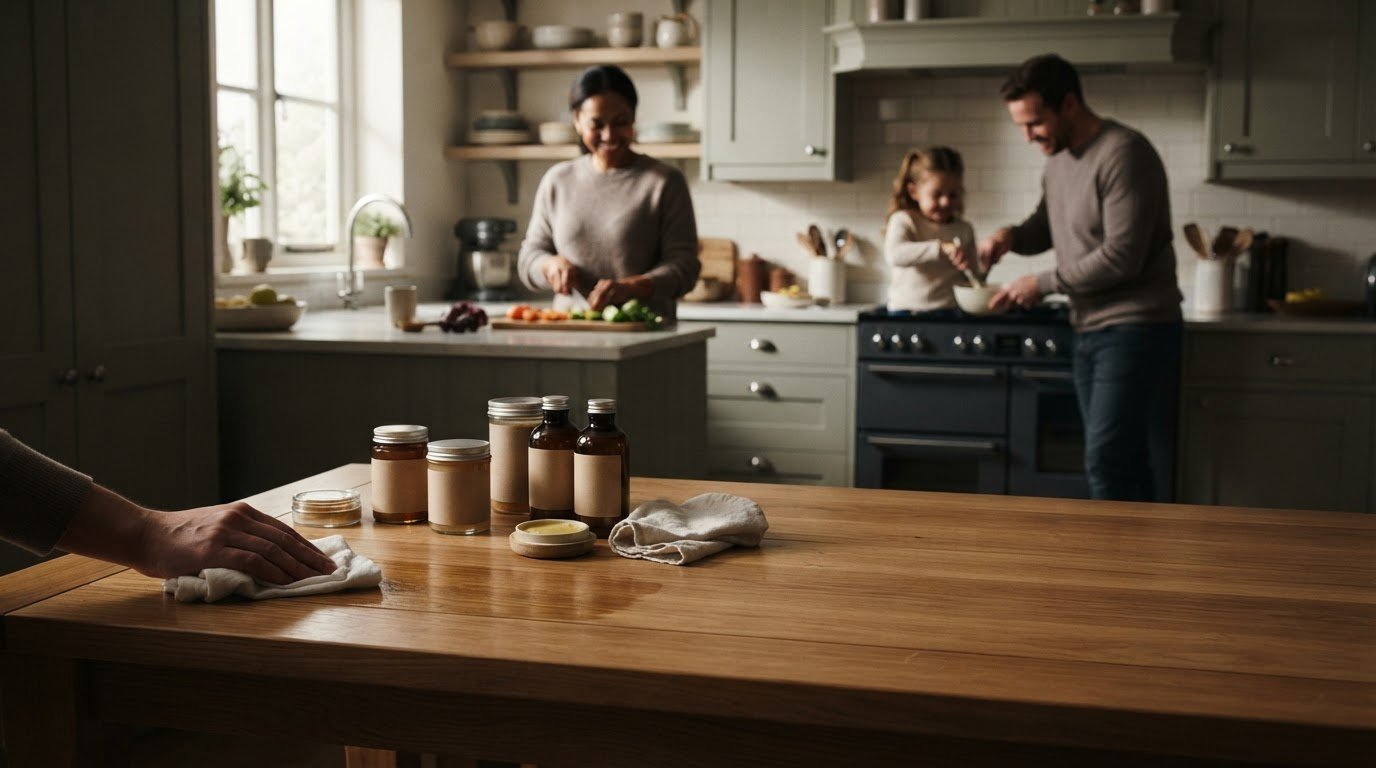
The most natural-looking finish isn’t automatically the safest choice for every kitchen table. What matters is how the finish behaves once fully cured and whether it’s suited to the way you use the surface. That distinction can be hard to see on a label, especially when a tabletop needs to handle shared meals, spills and everyday cleaning without losing its character.
If you’re comparing food-safe finishes for kitchen tables, you’re right to look beyond reassuring words on a tin. “Dry to the touch” doesn’t always mean fully cured, and a finish made for a chopping surface may have different qualities from one intended for a dining table. This guide explains what food-safe means, compares common options such as oils, waxes and film finishes, and explores their protection and upkeep. We’ll also cover why cure times and care instructions matter, so you can choose a surface that feels right for your kitchen and the rhythm of daily life around the table.
Key Takeaways
- Food safety depends on a finish’s intended use and fully cured condition, not simply its ingredients or a “natural” label.
- Use the finish maker’s instructions to understand when a tabletop is ready for use; dry to the touch doesn’t necessarily mean fully cured.
- Compare oils, oil-and-wax blends and film-forming finishes by their feel, spill protection and maintenance needs before choosing among food-safe finishes for kitchen tables.
- Match the finish to your routine, including how you serve food, manage spills and prefer to care for the surface.
- Consider finish alongside the table’s construction and materials to choose a handcrafted dining table that fits everyday life at home.
Food-safe finishes for kitchen tables: what does food-safe actually mean?
The ingredients in a finish don’t, by themselves, prove that it’s suitable for food contact. What matters is the product’s stated use, how it’s applied and whether it has reached the condition specified by its manufacturer. A finish can begin as oil, wax or another material, then leave a different surface once it has dried or cured on the wood. A broad overview of wood finishing techniques helps show why finishes vary, but product-specific instructions are the guide to using a particular one.
In practical terms, “food-safe” should mean that the specific finish, applied and fully cured as directed, is stated by its manufacturer to be suitable for the intended kind of food contact. That direction should make clear whether it covers an ordinary dining tabletop or direct food preparation. The phrase alone isn’t a substitute for those details.
Does a natural oil automatically make a table food-safe?
No. A natural origin doesn’t establish suitability for every use. The raw ingredient and the dried or cured finish left on the tabletop aren’t necessarily the same thing: a formulated product may include other ingredients, and its performance depends on how it’s used. Read the full label and technical instructions, including any limits on food contact and the required curing conditions. Don’t assume an oil is suitable for direct food preparation simply because it sounds familiar or natural.
What does food-safe mean for a dining tabletop?
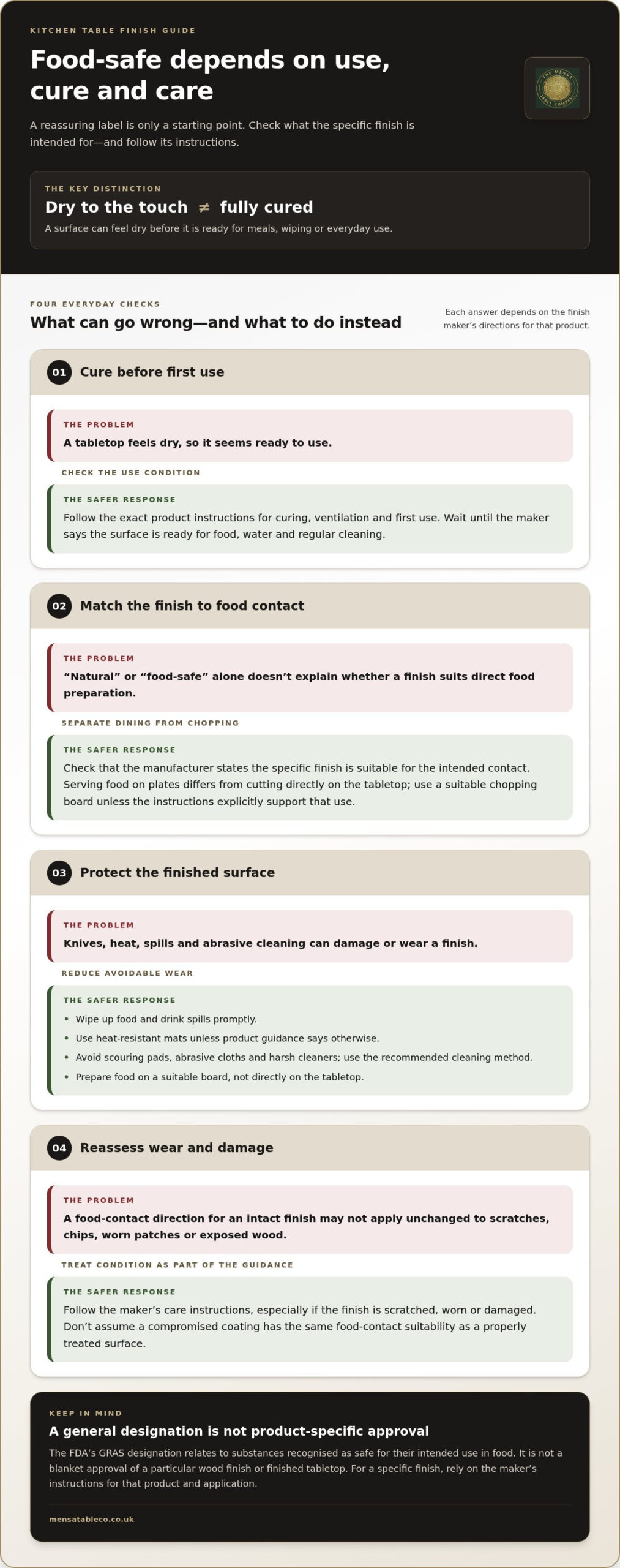
Serving a meal on a finished table is different from chopping food directly on its surface. Plates and serving boards keep most food from touching the finish; cutting can score or chip a coating and expose bare wood. For food preparation, use a surface specifically intended for that purpose, such as a suitable chopping board, unless the finish instructions explicitly support direct contact and that kind of use.
Wear matters, too. Deep scratches, chipped areas and worn patches can interrupt the finish, so a claim for an intact, properly treated surface shouldn’t automatically be applied to a damaged one. Follow the manufacturer’s guidance for cleaning and upkeep, and treat any limits on use as part of the food-contact advice.
For a table that hosts regular meals, finish is one part of choosing a satisfying piece: the material, construction and care routine matter as well. Exploring handcrafted dining tables can help put surface choices in the context of how the table will live in your kitchen.
How curing, contact and care affect food-safe table finishes
A finish reaches its stated use condition through a product-specific process called curing. The instructions may set out how long to wait, how to ventilate the room and when the surface can be exposed to food, water or regular cleaning. These details vary, so don’t rely on a general rule or another product’s timetable.
Safety reminder: follow the exact manufacturer’s curing and first-use instructions before putting a finished table into service. The FDA’s GRAS designation relates to substances recognised as safe for their intended use in food; it isn’t a blanket approval of a particular wood finish or finished tabletop. For food-safe finishes for kitchen tables, the finish maker’s guidance on the specific product and application is what matters.
Why dry-to-touch is not always the same as fully cured
Dry to the touch means the surface no longer feels wet or tacky. Fully cured means the finish has continued to develop towards the use condition described by its maker. A surface can feel dry before it’s ready for meals, wiping or other everyday demands. Follow the product-specific cure time and ventilation directions, and don’t use the table until its instructions say it’s ready.
How everyday kitchen use affects the finished surface
Once the table is in use, ordinary routines put the finish to work in different ways. Wipe up drinks and food spills promptly rather than letting moisture or stains sit. Hot pans and dishes can mark some finishes, so use heat-resistant mats unless the product guidance says otherwise. Abrasive cloths, scouring pads and harsh cleaners may wear or dull a surface; choose cleaning methods recommended by the finish maker.
Routine wiping is gentler than scrubbing, but repeated friction still affects a tabletop over time. Follow care instructions for the specific finish, especially if the surface becomes scratched, worn or damaged. A food-contact direction for a properly finished surface shouldn’t be assumed to apply unchanged to exposed wood or a compromised coating.
And a finished dining table isn’t automatically a chopping board. Knives can cut into the coating, so prepare food on a suitable board rather than directly on the tabletop. For a table that will be part of everyday family meals, thoughtful construction and material choice matter alongside care. If you’re considering a handcrafted dining table for your home, get in touch to discuss your table plans.
Oil, wax or varnish: comparing finishes for kitchen tables
The finish category offers a useful starting point, not a guarantee of performance. Two products described as “oil” or “varnish” can differ in ingredients, application, food-contact directions and care requirements. For food-safe finishes for kitchen tables, compare the exact product instructions with the way you use the table, rather than choosing by category name alone.
Penetrating oil
Surface feel: Often leaves a natural-looking feel, though the result depends on the formulation and application.
Spill protection: Varies; don’t assume an oil will resist standing water or spills.
Upkeep: May require periodic reapplication according to the maker.
Food contact: Follow the specific product’s stated use and curing instructions.
Oil-and-wax blend
Surface feel: Can feel soft or low-sheen, depending on the blend and how it’s applied.
Spill protection: Wax may add some resistance, but protection varies and shouldn’t be taken for granted.
Upkeep: Check whether the maker recommends refreshing the finish and how to clean it.
Food contact: Check the exact product’s food-contact directions and cure requirements.
Film-forming finish, such as some varnishes
Surface feel: Forms a distinct layer over the wood; sheen and texture depend on the product.
Spill protection: An intact film can provide a barrier, but resistance varies by formulation and application.
Upkeep: Use the specified cleaning method; scratches or chips may affect the coating.
Food contact: Use only as directed for the stated application and after the specified cure.
Oil and oil-and-wax finishes: a natural-looking surface
Penetrating oils soak into the wood rather than creating the same kind of continuous surface layer as a film finish. Some products leave a low-sheen, tactile surface that keeps the grain prominent, while oil-and-wax blends may add a subtly different feel. Neither appearance nor “natural” ingredients prove food-contact suitability. Water resistance, maintenance and safe-use directions depend on the exact formulation and how it’s applied.
Varnish and other film-forming finishes: a protective surface layer
Film-forming finishes sit over the wood as a coating, unlike a penetrating oil. That layer may help shield the surface from spills while intact, but damage can expose the wood and may be more noticeable. Varnishes, lacquers and water-based coatings aren’t interchangeable: each product has its own application, cure, food-contact and care instructions. Read them before deciding which trade-off suits your kitchen.
Ultimately, choose by the maker’s guidance for the exact product, not a broad label. Match its stated food-contact use, spill protection and upkeep to your household routine.
How to choose and care for a food-safe kitchen-table finish
A useful finish is one that suits both the way you use the table and the care you can realistically give it. Frequent family meals, young children, the occasional spill and a preference for a smooth or more tactile surface can all shape your choice. Use this checklist to compare food-safe finishes for kitchen tables by their instructions and everyday demands, not just their labels.
A five-step checklist for comparing finish products
- Start with intended use. Check that the product is made for a tabletop and the kind of food contact you expect. A finish intended for furniture may not be directed for direct food preparation.
- Read the food-contact wording. Look for clear, product-specific guidance. Broad terms such as “natural” or “non-toxic” don’t explain how the finish may be used once applied.
- Review application instructions. Note how the maker says to prepare and apply the product. Application can affect the final surface, so don’t assume instructions for a similar finish will apply.
- Check cure and first-use requirements. Follow the stated curing conditions and wait until the manufacturer says the table can be used. If wording about food contact or readiness is unclear, seek clarification from the product maker before relying on the claim.
- Match upkeep to your routine. Compare cleaning, reapplication and repair guidance with daily life at home. A finish that needs more regular attention may not suit a busy household, while another surface may better match the feel you prefer.
Simple habits that help protect a finished tabletop
Good care starts with small, steady habits. Wipe up spills promptly, then clean the surface only as the finish instructions allow. Use placemats to help manage food stains and moisture, and trivets beneath hot dishes where heat could mark the table. These precautions can help protect the surface, but no finish should be assumed immune to damage.
Use a chopping board rather than cutting directly on the table, and keep an eye on scratches, worn patches or other changes that may affect the finish. Follow the maker’s advice if the surface needs attention; don’t apply a new product over an existing finish without checking compatibility and instructions.
Timber choice also shapes the table’s character and how its grain appears in your kitchen. Explore handcrafted dining tables to consider form alongside your finish priorities. If you’re weighing up what may suit your home and routine, talk with us about your table plans.
Choosing a handcrafted dining table around the way you live
A kitchen table earns its place through the everyday moments it supports: breakfast before the day begins, homework between meals, a cup of tea with a friend, or a long dinner shared with family. Choosing a handcrafted table means thinking beyond its first impression. Consider how its size, timber and design will work in your home, then weigh finish preferences against the care routine you’re comfortable keeping.
Match the table to meals, company and daily routines
Start with the way you expect to use the table. If it’s mainly for meals, think about how many people usually sit around it and whether you often host extra guests. If it also needs to accommodate a laptop or children’s activities, allow for that in your choice of size and shape. A table that feels generous enough for daily life can make a kitchen more welcoming without becoming awkward to move around.
Timber contributes its own character, from the grain and tone to the feel of the surface. Table design matters, too: the base and proportions influence how the piece sits in the room and how people gather around it. Finish is one part of this larger decision. A preference for a particular sheen or texture should sit alongside practical questions about spills, cleaning and the maker’s care guidance for the chosen surface. Learning about handcrafted dining tables can help you compare designs with your home and routines in mind.
With food-safe finishes for kitchen tables, the aim isn’t to find a label that promises the most. It’s to understand the exact product guidance and choose a table whose material, construction and care expectations feel right for the life you’ll share around it. Thoughtful craft brings those decisions together in a piece made to be part of everyday home life.
Bring your table plans to the Mensa team
Perhaps you have a clear idea of the timber and shape you’d like, or perhaps you’re still picturing where the table will sit and what it needs to do. Either way, a conversation about your plans is a good place to begin. Share what matters to you, from everyday meals to the way you like a tabletop to feel, and discuss your dining-table plans with us.
Choose a table that feels right for everyday life
The best food-safe finishes for kitchen tables aren’t chosen by a reassuring label alone. Look for product-specific food-contact guidance, follow the maker’s curing and first-use instructions, and compare the finish’s protection and upkeep with the way your household uses the table. Oils, wax blends and film-forming finishes each have trade-offs, so the right choice depends on your priorities and routine.
A tabletop is only one part of a table you’ll live with every day. Its timber, design and handcrafted construction all contribute to how it looks and feels as meals, conversation and daily tasks gather around it. The Mensa Table Company makes handcrafted furniture, including a range of dining-table designs, with the table’s place in your home at the heart of the choice.
Have a shape, timber or way of gathering in mind? Discuss your dining-table plans with us. We’d be glad to hear what you’re looking for and help you take the next step towards a table that feels at home in your kitchen.
Frequently Asked Questions
Is oil a food-safe finish for a kitchen table?
Some oils may be suitable for a kitchen table once used and cured exactly as their manufacturer directs, but “oil” alone isn’t proof of food-contact suitability. Products differ in ingredients, application and intended use. Check the specific label and technical instructions for food-contact wording, curing requirements and care guidance. A finish suitable for serving meals on a tabletop may not be intended for chopping food directly on it.
Can you eat off a table finished with varnish?
Often, a fully cured varnish may be suitable for ordinary dining-table use if its manufacturer’s instructions say it’s appropriate for that application. Follow the stated cure time and first-use guidance, and don’t treat every varnish as interchangeable. A coating that’s scratched, chipped or worn may no longer perform like an intact surface. Use plates and serving boards, and avoid cutting directly on the finish.
How long should a table finish cure before using the table?
There isn’t one waiting period that applies to every finish. A product may feel dry before it has reached the use condition described by its maker, and cure requirements can vary with formulation and application. Read the specific instructions for cure time, ventilation and first use. Don’t put the table into service for meals or routine cleaning until the manufacturer’s directions say it’s ready.
What is the difference between food-safe and food-grade finishes?
The terms can be used differently on product labels, so neither phrase alone tells you exactly how a finish may be used. “Food-grade” may describe ingredients or a material, while “food-safe” is often used to describe suitability for a particular use once applied and cured. Check the manufacturer’s instructions for the exact product, intended contact and curing conditions rather than relying on wording without context.
Is beeswax safe for a kitchen table?
Beeswax is a natural material, but that alone doesn’t establish whether a particular beeswax product is suitable for a tabletop or food contact. Some products combine wax with oils or other ingredients, and application and curing directions matter. Read the label for intended use, food-contact guidance and care instructions. For a dining table, also consider how the product handles spills and what maintenance the maker recommends.
Can I cut food directly on a finished wooden table?
It’s best to use a suitable chopping board rather than cut directly on a finished table. A knife can scratch or break through a coating, exposing the wood and damaging the surface. Even if a finish’s instructions support a form of food contact, that doesn’t automatically mean it’s intended to withstand chopping. Keep the finish in good condition and follow its maker’s guidance for cleaning and care.
How do I clean a food-safe finished kitchen table?
Clean it according to the instructions for the specific finish. For everyday spills, wipe them up promptly with a soft cloth, then use only the cleaning products and methods the maker permits. Abrasive pads, harsh cleaners or excess water may damage some surfaces. Don’t assume a finish can tolerate repeated scrubbing or standing moisture. If the surface becomes scratched or worn, follow the manufacturer’s advice for its condition.

Leave a Reply