
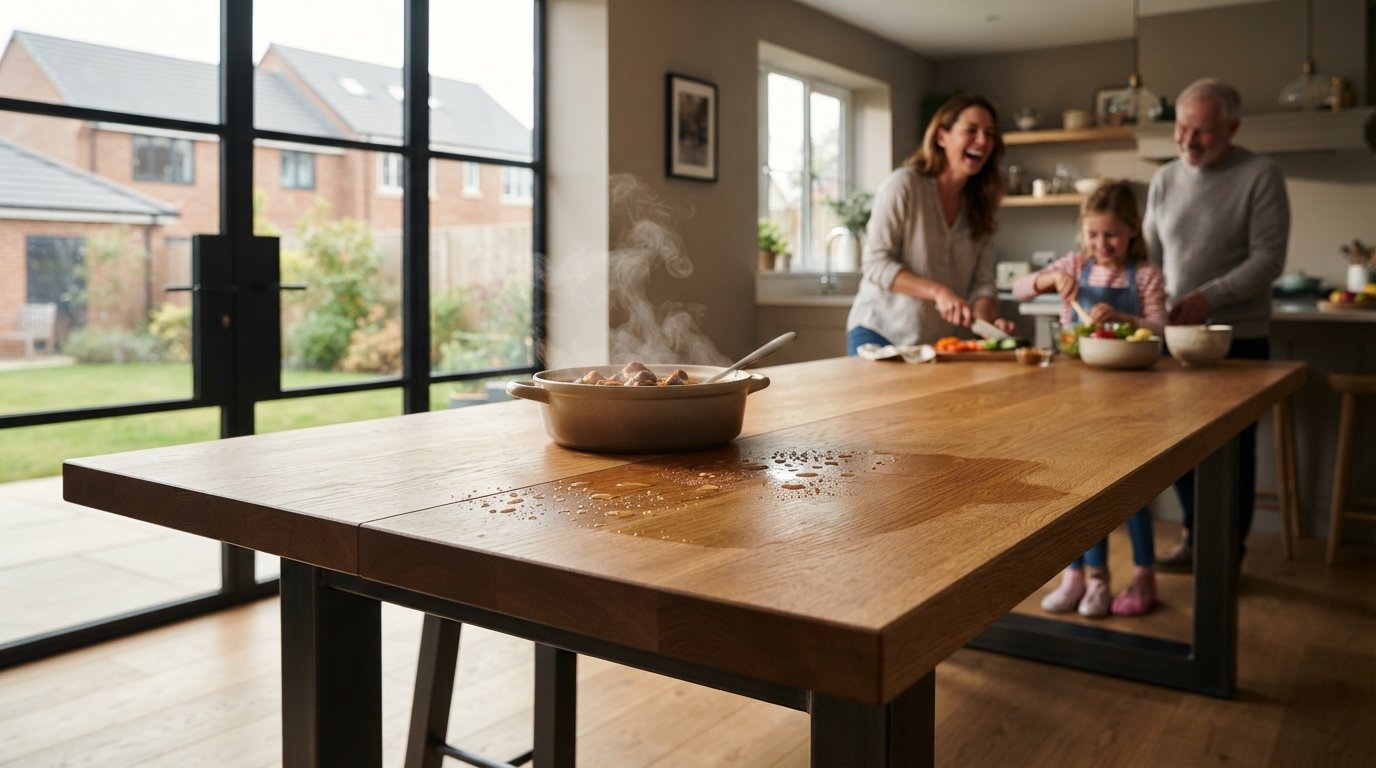
Imagine the sinking feeling of clearing away a Sunday roast only to discover a ghostly white ring left by a hot serving dish on your new European Oak table. It is a moment of pure anxiety that every furniture lover dreads, especially when you’ve invested in a piece meant to last a lifetime. When comparing wood finishes for durability, the choice often feels like a confusing battle between the rugged, synthetic shield of polyurethane and the tactile, breathable warmth of a professional hardwax oil.
We believe your home’s focal point should be a source of pride, not a constant worry about water damage or heat marks. You don’t have to be a master craftsman to choose a finish that stands up to the rigours of a busy household. Discover which wood finishes offer the best protection against heat, spills, and daily wear to ensure your handcrafted furniture lasts for generations. This guide explores the science behind professional-grade coatings, clarifies the difference between film-forming and penetrating oils, and provides the confidence you need to maintain that pristine look through years of shared meals and social rituals.
Key Takeaways
- Understand the vital balance between immediate surface protection and long-term repairability when comparing wood finishes for durability.
- Learn why traditional film-forming finishes often succumb to white heat rings while modern hardwax oils offer a more resilient, breathable alternative for daily use.
- Discover the hidden truth of longevity: a finish that is easy to spot-repair often outlasts a tougher, synthetic coating that requires full sanding to fix.
- Gain the confidence to select a finish that matches your lifestyle, ensuring your solid European Oak or Black Walnut table remains a beautiful backdrop for family rituals.
- Realise how artisanal, manual application methods provide a depth of protection that mass-produced, factory-sprayed alternatives simply cannot replicate.
Defining Durability in Wood Finishes: More Than Just a Surface Layer
Durability is often misunderstood as a simple measure of hardness, yet for a piece of furniture that lives at the heart of your home, it is a far more nuanced story. When comparing wood finishes for durability, we must look beyond the initial shine to see how a coating handles the rigours of daily life. True protection is a multi-factor metric. It involves the finish’s ability to repel moisture from a spilled glass of water, resist the heat of a morning coffee cup, and withstand the inevitable mechanical impacts of a busy household. A finish that is exceptionally hard but brittle may crack under pressure, while a softer, more flexible finish might offer better long-term resilience.
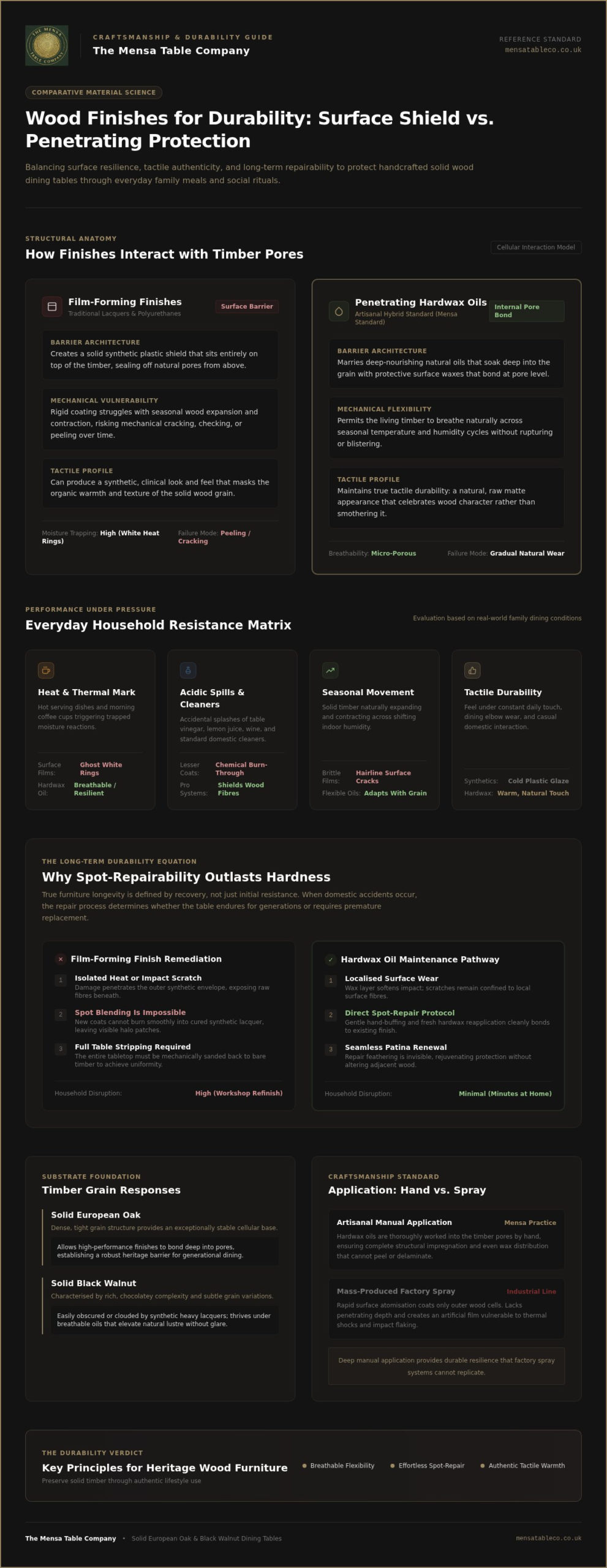
The way we understand different wood finishing systems depends largely on how they interact with the wood’s pores. Surface-film finishes, like traditional lacquers or polyurethanes, create a solid synthetic shield that sits on top of the timber. In contrast, penetrating finishes soak deep into the grain, protecting the wood from within. The intended use of your furniture dictates which path is best. A decorative shelf may only require a light wax, but a dining table requires a robust solution that can handle constant contact. The choice is also influenced by the timber itself. The dense, tight grain of Solid European Oak provides a stable foundation that allows high-performance finishes to bond effectively, ensuring the piece remains a heritage investment for generations.
Mechanical vs. Chemical Resistance
A finish fails when it can no longer protect the timber or maintain its appearance. Mechanical failure often looks like cracking or peeling, which occurs when a rigid surface film cannot keep up with the natural movement of the solid wood beneath it. Timber is a living material that breathes, expanding and contracting with the seasons. Chemical resistance is equally vital. It is what prevents a splash of vinegar or an acidic spill from burning through the coating and staining the fibres. Professional-grade finishes are designed to survive these domestic accidents, keeping the wood safe from the common household cleaners that would strip away lesser products.
The Aesthetic Trade-off
There is often a delicate balance between maximum protection and natural beauty. High-durability industrial coatings can sometimes result in a ‘plastic’ look that masks the very texture you fell in love with. We believe in finding a middle ground where the timber’s character is celebrated, not smothered. We define tactile durability as the ability of a finish to maintain its feel under constant touch, ensuring the wood remains inviting rather than clinical. By comparing wood finishes for durability with an eye for aesthetics, you can find a solution that offers a matte, raw appearance while still providing a formidable barrier against the chaos of family life.
The Contenders: Comparing Oils, Waxes, and Lacquers
Selecting the right protection for your furniture is a balancing act between the raw, tactile nature of the timber and the practical demands of your home. When comparing wood finishes for durability, we often look at how traditional drying oils like Linseed or Tung have evolved into the high-performance hardwax oils we use today. These modern evolutions provide a level of resilience that our ancestors could only dream of, yet they preserve the authentic spirit of the wood. Hardwax oils have become the hybrid standard for the signature Mensa Dining Table because they marry the deep, nourishing qualities of oil with the protective strength of natural waxes.
Different species respond uniquely to these treatments, and understanding this interaction is key to a piece that ages gracefully. For example, Solid Black Walnut possesses a deep, chocolatey complexity that can be easily obscured by heavy-handed lacquers. It thrives under a finish that enhances its natural lustre without adding a cloudy, synthetic sheen. Research found in the USDA Forest Service guide to wood finishing highlights how moisture and temperature fluctuations impact these different systems, confirming that the choice of finish must respect the timber’s inherent density and oil content. If you’re unsure which path suits your space, you can always speak with our workshop team for tailored advice on your specific project.
Penetrating Oils and Hardwax Oils
Penetrating oils work by soaking deep into the grain, becoming part of the wood’s structure rather than just a layer on top. This approach is favoured in contemporary UK furniture making because it celebrates the wood’s natural texture. Hardwax oils are the pinnacle of this category, offering a matte, organic look that is incredibly easy to repair. While they require a simple ‘feeding’ or maintenance coat every few years to keep the timber hydrated, the trade-off is a finish that will never peel or flake. They are the honest choice for those who value the connection between the maker’s hand and the final user’s touch.
Film-Forming Finishes: Lacquer and Polyurethane
Lacquers and polyurethanes act as the ‘armour’ of the finishing world, creating a continuous, waterproof barrier over the timber. This is why high-traffic breakfast bars often benefit from film finishes, as they frequently encounter standing liquids and heavy wear. These coatings provide maximum spill protection and a high degree of chemical resistance. However, they come with a significant catch: if the surface is deeply scratched or the barrier is breached, the repair is often complex and requires sanding the entire surface back to raw wood. They offer a synthetic shield that, while tough, lacks the easy maintenance of oiled surfaces.
Performance Testing: Heat, Water, and Scratches
A handcrafted table faces a gauntlet of daily life that no laboratory test can fully replicate. Between the steam of a Sunday roast and the inevitable slide of a ceramic bowl, the finish is the only thing standing between your investment and a permanent mark. When comparing wood finishes for durability, we must evaluate them against these common household “villains” to see how they perform in a real-world home office or family dining room. A finish that looks impeccable in a showroom might tell a different story after six months of morning coffees and homework sessions.
The resilience of the surface also depends on how it manages environmental stressors like UV light. Over time, sunlight can strip the vibrant character from timbers, causing the deep chocolates of Solid Black Walnut to fade or making the pale straw tones of ash turn a golden yellow. Professional finishes often include UV inhibitors to slow this process, but understanding the museum-standard principles found in the Canadian Conservation Institute’s furniture care guidelines helps us see how these resin coatings eventually degrade and how we can best protect them from the British sun.
The Heat Resistance Hierarchy
The dreaded “white ring” is the most common casualty of a poor finish choice. Traditional wax finishes, while beautiful and organic, fail the hot plate test almost immediately because heat softens the wax and allows moisture to cloud the surface. Modern catalyzed lacquers and high-end hardwax oils offer far superior thermal performance for dining tables. However, even the most robust industrial coating has a thermal limit. We always suggest using coasters and heat mats as a simple ritual of care to prevent the finish from reaching its breaking point.
Liquid Defence: Coffee, Wine, and Water
There is a vital distinction between a finish being waterproof and being water-resistant. You can easily spot a healthy finish by the way liquids “bead” on the surface, sitting as tight droplets rather than spreading into the grain. Alcohol-based spills, such as a splashed gin and tonic or a drop of perfume on a coffee table, are particularly aggressive and can dissolve certain traditional coatings. We define ‘dwell time’ as the window of opportunity to clean a spill before a stain sets. For a piece finished in our workshop, this window is designed to be generous, giving you peace of mind during a busy dinner party.
Scratch and Abrasion
Mechanical wear is the silent enemy of furniture longevity. The constant sliding of cutlery, ceramics, and laptops creates micro-abrasions that can eventually dull a high-gloss surface. While a hard film finish like polyurethane resists these light scratches well, it can develop a “cloudy” look over time that is difficult to fix without a full sand-down. Penetrating finishes allow the wood to develop a natural patina, where minor marks from daily life blend into the story of the piece rather than standing out as failures of the coating.
Maintenance vs. Protection: The Long-Term Durability Equation
A hidden truth exists in the furniture world: the finishes that offer the highest level of immediate surface protection are often the most difficult to restore once they eventually fail. When comparing wood finishes for durability, it is easy to be seduced by the synthetic armour of a thick lacquer, yet the lifetime value of a piece often lies in its repairability. We believe that true longevity isn’t measured by how long a coating stays perfect, but by how easily it can be brought back to life after years of shared memories and daily use. A single deep scratch on a factory-lacquered surface can become a permanent scar, whereas a handcrafted oiled surface remains a living, breathing entity that you can maintain yourself.
You can easily tell when your coffee table or dining surface needs attention. If the wood begins to look ‘thirsty’ or the grain feels slightly raised and rough to the touch, it is likely time for a maintenance coat. This simple act of feeding the timber ensures the protective barrier remains intact, preventing moisture from reaching the fibres beneath. For those who want to ensure their furniture remains a heritage piece for decades to come, you can discuss your project’s long-term care needs with our workshop team.
The Repairability Factor
Hardwax oils are particularly favoured by families with young children because they offer a unique ‘spot-repair’ capability. If a child’s toy leaves a mark or a dropped utensil causes a dent, you don’t need to strip the entire tabletop. Instead, a light sanding of the affected area followed by a fresh dab of oil can make the damage vanish in minutes. This process requires only basic tools: a high-grit sandpaper and a lint-free cloth. This approach avoids the high cost of professional refinishing and keeps the piece looking its best without the need for industrial intervention.
Longevity Across Generations
How a finish ages is just as important as how it protects. Traditional film finishes tend to ‘wear out’, eventually cracking or yellowing in a way that feels like failure. In contrast, penetrating finishes ‘patinate’, allowing the timber to develop a rich character that tells the story of your home. The underlying timber density plays a vital role here; the resilient fibres of Solid European Ash hold a finish differently than the softer grain of Swedish Pine. Choosing a repairable finish is also an environmental decision. By selecting a coating that can be maintained indefinitely, you are choosing a sustainable alternative to the ‘throwaway’ culture of mass-produced goods.
The Artisanal Standard: How Professional Finishing Protects Your Investment
Mass-produced furniture often relies on factory-sprayed finishes that prioritise speed over substance. These thin, automated coatings can fail prematurely because they don’t account for the unique character of every individual plank. In our workshop, we take a different path. When comparing wood finishes for durability, the artisanal standard is defined by the time spent preparing the surface before the first drop of oil even touches the grain. We believe in material-first protection, where the finish is chosen to complement the timber’s natural strengths rather than simply hiding its flaws. It’s a humble approach that respects the years the tree spent growing before it reached our hands.
The structural design of our pieces also influences our finishing decisions. The combination of industrial steel frames and solid timber tops, like those found on our A-Frame or Spider Leg designs, creates a beautiful contrast but requires a thoughtful approach to care. While the powder-coated steel legs are virtually maintenance-free, the wood remains a living element that responds to its environment. We ensure the transition between these materials is seamless, providing a finish that protects the wood without compromising the industrial aesthetic of the base. It isn’t just about a transactional sale; it’s about ensuring the focal point of your home stands strong against the passage of time.
From Raw Timber to Finished Masterpiece
The journey to a resilient surface begins long before the final coat. We practice ‘raising the grain’, a process where we lightly dampen the timber to lift the fibres before a final, delicate sanding. This prevents the wood from feeling rough later if it encounters moisture in your kitchen or dining room. Multi-coat application is where our patience truly pays off. We don’t rush the curing times; instead, we allow each layer to bond deeply with the wood cells. Every Mensa Dining Table undergoes a final, manual quality check to ensure the finish is flawless, resilient, and ready to become the backdrop for your family’s history.
Your Bespoke Finishing Consultation
We don’t believe in a one-size-fits-all approach to durability. Your household needs, whether you have young children, frequently host large dinner parties, or need a desk that can withstand daily office use, should dictate the finish. Our team is here to help you navigate these choices, offering the benefit of UK-based craftsmanship for ongoing advice long after the table has arrived in your home. If you’re ready to start your project, contact our craftsmen today to discuss your perfect finish and discover how we can create a piece that truly lasts for generations.
Invest in a Lifetime of Shared Moments
Choosing a finish is about more than just picking a sheen; it’s about deciding how your furniture will age alongside your family. We have explored the vital balance between immediate protection and long-term repairability, finding that the most resilient surfaces are often those that allow for simple, manual care. When comparing wood finishes for durability, remember that a handcrafted approach using solid European timber ensures your table remains a robust backdrop for generations of rituals.
Our commitment to UK-based craftsmanship means every piece is built with an artisanal spirit that values longevity over mass-produced speed. By selecting a finish that can be maintained and spot-repaired, you are protecting not just the wood, but the emotional value of your home’s focal point. Speak to our craftsmen about your durable bespoke table to find the perfect match for your lifestyle. We look forward to helping you create a heritage piece that feels as beautiful in twenty years as it does today.
Frequently Asked Questions
What is the most durable wood finish for a dining table with daily use?
The most durable finish depends on whether you value immediate surface hardness or long-term repairability. For high-traffic surfaces like a family dining table, we often recommend professional hardwax oils. These finishes soak into the grain and offer excellent resistance to spills and heat while allowing you to fix minor scratches without sanding the whole surface. This balance is crucial when comparing wood finishes for durability in a busy home environment where life actually happens.
Can I change the finish on my solid wood table later on?
Yes, because our pieces are crafted from solid European timber rather than veneers, you can sand the surface back to raw wood and apply a new finish in the future. This flexibility is a hallmark of high-quality furniture. While we don’t offer restoration services ourselves, the solid nature of our tables means they can be transformed to match changing interior trends, ensuring the piece remains a cherished part of your home for many generations.
Is hardwax oil better than polyurethane for water resistance?
Polyurethane creates a plastic-like film that is technically more waterproof in the short term, but hardwax oil offers superior long-term water resistance for most households. Hardwax oils bond with the wood fibres to repel liquids, causing them to bead on the surface. If a polyurethane film is breached by a deep scratch, water can get trapped underneath and cause peeling, whereas hardwax oil can be easily topped up to maintain its protective barrier indefinitely.
How do I prevent white heat marks on my wooden table top?
Preventing white heat rings starts with choosing a finish with high thermal resistance, such as a modern hardwax oil. These marks occur when heat traps moisture within the finish layer. We always suggest using coasters and heat-resistant mats as a simple daily ritual to protect the grain. If a mark does appear on an oiled table, it is often much easier to treat and repair than one trapped beneath a thick, synthetic factory coating.
How often do I need to re-oil a solid oak dining table?
Most solid oak tables benefit from a maintenance coat every one to three years, depending on how heavily the surface is used. You will know it is time when the timber begins to look slightly dull or if water no longer beads on the surface. This simple process involves a light clean and a thin application of fresh oil, which keeps the wood hydrated and ensures the protective barrier remains formidable against the rigours of daily wear.
Are natural wood finishes safe for food preparation surfaces?
Many modern hardwax oils and natural finishes are certified as food-safe once they have fully cured. We select finishes that are non-toxic and environmentally responsible, making them ideal for breakfast bars and dining surfaces where food is frequently present. It is important to wait for the full curing period, which can take up to 30 days, before placing food directly on the surface to ensure the finish has reached its maximum chemical stability and safety.
Which wood finish is best for resisting scratches from pets and children?
For households with pets and children, a matte hardwax oil is often the best choice for camouflaging and repairing scratches. While a high-gloss polyurethane might be harder, it shows every micro-abrasion and is difficult to fix. A matte finish on a dense timber like Solid European Oak hides minor marks, and any deeper scratches can be sanded out and re-oiled in minutes without needing to strip the entire tabletop back to the raw wood.
Does a darker wood stain affect the durability of the finish?
A darker wood stain does not inherently reduce the durability of the piece, as the protection comes from the clear topcoat applied over the colour. However, when comparing wood finishes for durability, remember that deep scratches may be more visible on stained wood because they reveal the lighter natural timber beneath. Using a professional tinted hardwax oil can help mitigate this, as the colour penetrates the grain alongside the protective oils and waxes for deeper integration.

Leave a Reply