
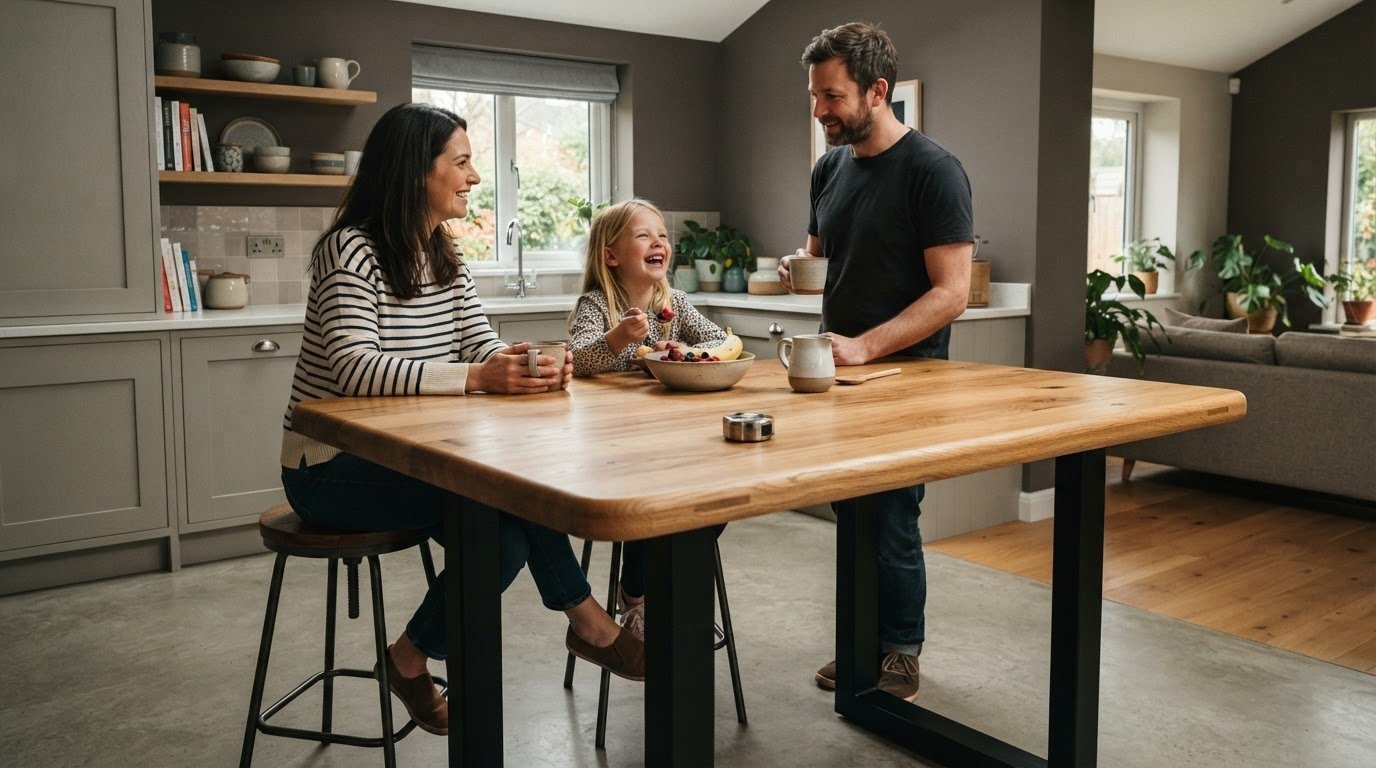
A truly enduring kitchen piece must unite the character of living timber with precise spatial ergonomics. When commissioning a custom wooden breakfast bar, UK homeowners often discover that off-the-shelf furniture fails to fit the natural rhythm of daily life. You likely envision a warm, tactile gathering point for slow morning coffees and lively evening catch-ups, yet practical concerns around cramped knee clearance, awkward stool spacing, and timber movement can quickly stall your plans.
You shouldn’t have to compromise on proportions or settle for disposable flat-pack worktops just because your kitchen features an unconventional layout. In this guide, you will master the exact dimensions needed for comfortable seating, discover how distinct hardwood and softwood species perform in busy cooking environments, and explore heavy-duty handcrafted bases tailored to your space. Here is your complete walkthrough to commissioning a solid timber breakfast bar built to anchor your home for generations to come.
Key Takeaways
- Calculate the critical overhang depths, counter heights, and stool clearances needed to prevent awkward bottlenecks and ensure relaxed dining.
- Compare the natural moisture tolerance, structural density, and distinct grain patterns of solid European oak, ash, black walnut, and Swedish pine.
- Discover why a custom wooden breakfast bar UK craftsmen shape from solid timber outlasts flat-pack worktops and creates an enduring focal point for daily rituals.
- Identify how heavy-duty steel frames, including Trapezium, U-Frame, and X-Frame profiles, provide rigid structural stability for substantial timber slabs.
- Learn how commissioning bespoke furniture lets you specify exact dimensions down to the millimetre, perfectly suiting awkward alcoves or open-plan layouts.
Why Choose a Custom Wooden Breakfast Bar for Your UK Kitchen?
The modern British kitchen rarely operates simply as a cooking room. It has evolved into the genuine heartbeat of the home, an active setting where culinary prep, evening conversations, and morning routines naturally collide. Standard store-bought worktops often struggle in these spaces, especially when dealing with structural pillars, awkward radiator runs, or unconventional room layouts. With a custom wooden breakfast bar UK homeowners gain the freedom to tailor overall depth, leg placement, and surface overhangs to fit their specific floor plan rather than compromising around rigid modular units.
Mass-produced laminate boards and engineered composites might mimic raw materials, yet they lack the soul, tactile warmth, and repairability of genuine lumber. Appreciating the properties of wood helps explain why natural cellular density resists decades of heavy daily life while developing a rich, unique patina. Solid timber does not end up in landfill when marked; it can be nurtured, restored, and appreciated for a lifetime. You can explore distinct handcrafted designs across our dedicated breakfast bars collection to see how solid timber slabs integrate into contemporary and classic interior styles alike.
Solid Timber vs Veneered Flat-Pack Worktops
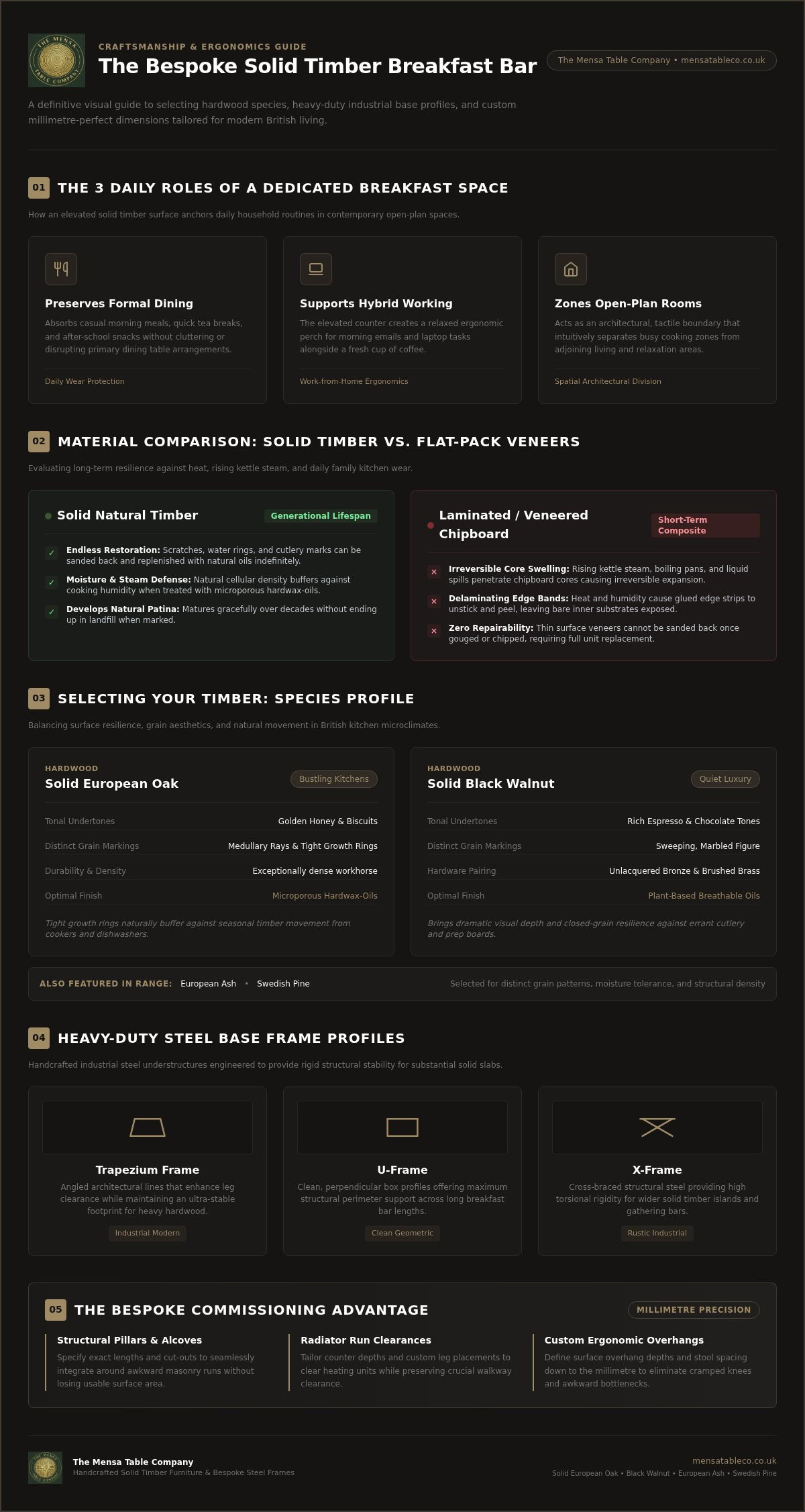
Laminated chipboard and thin veneers quickly expose their vulnerabilities in high-humidity kitchens. Daily exposure to rising kettle steam, boiling pans, and minor liquid spills causes edge banding to unstick, resulting in irreversible core swelling. In contrast, solid timber thrives through years of energetic family meals. Surface scratches from dropped cutlery or water rings are never catastrophic, as solid timber can be sanded back and replenished with natural oils indefinitely.
The Daily Value of a Dedicated Breakfast Space
Beyond aesthetic warmth, an elevated solid wood counter transforms everyday household routines by serving multiple practical roles:
- Preserves the formal dining table: It absorbs quick morning meals, casual tea breaks, and after-school snacks without disrupting formal dining arrangements.
- Supports hybrid working: The elevated surface creates an ergonomic perch for morning emails on a laptop alongside a fresh cup of coffee.
- Zones open-plan rooms: It acts as a tactile, welcoming boundary that separates active cooking spaces from adjoining living and relaxation areas.
Selecting Your Timber: Oak, Walnut, Ash, and Pine Compared
Every tree carries its own unique record of growth rings, mineral deposits, and tension wood. When shaping a custom wooden breakfast bar, UK kitchens present a specific microclimate of fluctuating ambient humidity and rapid temperature shifts from cookers and dishwashers. Selecting the right timber species means balancing surface resilience against the natural movement of raw lumber. Responsibly sourced European hardwoods offer tight growth rings that naturally buffer against seasonal timber movement, giving your counter exceptional structural stability.
A well-chosen species also establishes chromatic harmony with your cabinetry. Whether your space features modern handless units in moody forest greens or classic shaker units in warm taupes, the right grain direction and natural timber undertones elevate the overall interior architecture.
European Oak and Black Walnut: Enduring Hardwoods
Dense hardwoods provide unmatched defense against everyday domestic hazards. Heavy coffee mugs, errant cutlery, and prep boards can easily mark softer surfaces, but closed-grain hardwoods shrug off impact with ease:
- Solid European oak: Revered for centuries, oak features biscuits, medullary rays, and golden honey undertones. Its sheer density makes it an exceptionally forgiving workhorse for bustling family kitchens.
- Solid black walnut: Offering rich espresso tones and sweeping, chocolate marbled grain, walnut delivers quiet luxury. It brings dramatic visual depth, pairing beautifully with unlacquered bronze or brushed brass fixtures.
Both hardwoods thrive when finished with breathable, microporous hardwax-oils. Rather than forming a brittle plastic film, these plant-based treatments bond directly within the surface fibres, repelling spills while letting the natural tactile texture shine through.
European Ash and Swedish Pine: Brightness and Character
Lighter timbers bring open, airy qualities into breakfast areas that need an uplifting focal point:
- Solid European ash: Ash features a striking, clean cream tone marked by bold, olive-tinted grain ripples. Its elasticity and toughness rival oak, making it a brilliant modern candidate for Scandinavian-inspired spaces.
- Solid Swedish pine: Grown slowly in northern European climes, Swedish pine offers tighter grain than domestic softwoods, dotted with distinctive amber knotting. It creates an inviting, tactile farmhouse presence at a practical price point.
While pine softens gracefully with age and gathers honest life marks, ash and oak maintain crisp, rigid edges under heavy daily use. If you are torn between grain textures, feel free to get in touch with our craftsmen to discuss which species suits your daily kitchen routines.
Kitchen Sizing and Ergonomics: Calculating Heights, Depths, and Clearance
A beautifully finished timber slab quickly loses its charm if you spend your mornings knocking knees against a frame or squeezing through narrow walkways. Spatial comfort relies on millimetre-precise calculations rather than guesswork. When configuring a custom wooden breakfast bar, UK layouts demand careful planning around existing worktop lines, seating heights, and the natural flow of kitchen foot traffic. Getting these measurements right ensures your seating area feels like an organic extension of your home rather than an intrusive obstacle.
Standard Heights vs Raised Breakfast Bar Elevations
Working counter heights in British kitchens standardise at around 900mm from the finished floor level. An integrated or flush breakfast bar matching this 900mm elevation pairs seamlessly with counter stools sporting seat heights between 600mm and 650mm. Conversely, a raised breakfast bar sits at approximately 1050mm, creating a clear architectural boundary between cooking and dining zones while pairing with 750mm bar stools. Aim for a 250mm to 300mm vertical drop from the stool seat to the underside of the timber to ensure comfortable thigh clearance.
Overhang Depths and Seating Width Formulas
To avoid cramped posture and clashing elbows during casual meals, keep these baseline spatial clearances in mind:
- Knee overhang depth: Provide a minimum overhang of 300mm. Anything shallower forces guests to perch sideways or bang their shins against support cabinetry.
- Seating width allowance: Dedicate at least 600mm of linear width per seated person, expanding to 650mm if using wide, arm-supported bar stools.
- Walkway clearance: Preserve a clean 900mm corridor behind occupied stools. This allows family members to comfortably pass by without interrupting whoever is eating.
- Full tuck-in depth: Verify that your stool footprints do not protrude into your primary kitchen walkway when pushed neatly away.
Planning for Solid Timber Movement in Humid Kitchens
Timber never stops interacting with its surroundings. As steam from cooking pots and seasonal atmospheric changes alter ambient moisture, solid wood naturally expands across its grain. To accommodate this living movement without splitting, we secure tops using slotted metal fixing channels that let the timber glide slightly sideways under changing indoor humidity. Never pin solid boards down with unyielding screws, and avoid mounting raw wood directly against high-heat radiator casings without reflective thermal baffling.
Leg Profiles and Base Frames: Industrial Steel to Match Your Decor
A substantial 40mm solid timber slab possesses considerable weight. Left unsupported over long spans, even the densest oak or walnut will risk deflection over time. Pairing organic grain with precision-welded industrial steel solves this mechanical challenge while introducing striking architectural contrast. When designing a custom wooden breakfast bar, UK homeowners often choose heavy-gauge metal frames because they deliver maximum structural rigidity without the bulky floor footprints of traditional wooden cabinetry.
Finished with durable architectural powder coatings, these metal understructures comfortably endure stray shoe scuffs, pet paws, and vacuum cleaner bumps without chipping. The profile geometry you select also governs how naturally bar stools tuck beneath the timber surface when not in use.
U-Frame and Trapezium Bases: Clean Geometric Lines
Clean-lined steel profiles create an uncluttered, modern presence in both galley layouts and open-plan kitchen diners:
- U-Frame profiles: These parallel uprights offer clean vertical symmetry. Because the uprights rise straight to the counter edge, they leave maximum open legroom across the entire span, making it effortless to slide stools in and out from either end.
- Trapezium profiles: Tapering gently inward from the floor toward the timber underside, Trapezium bases visually lighten the lower half of the piece. This inward angle reduces the physical footprint right at floor level, eliminating stubbed toes along tight walkways.
Both designs provide unyielding support across wide expanses, preventing centre sag while keeping the visual sightlines beneath the counter completely open.
X-Frame Profiles and Wall-Mounted Cantilever Brackets
For spaces where structural ironwork takes centre stage, bold X-Frame bases evoke timeless industrial craftsmanship. Their diagonal cross-bracing delivers exceptional lateral stability, which suits standalone kitchen island units that experience daily side-to-side knocks. In more compact breakfast nooks or narrow studios, heavy-duty wall-mounted steel cantilever brackets can eliminate floor legs entirely, freeing every inch of floor space below.
If you are coordinating your open-plan living and dining areas, you can mirror these metal profiles with matching seating from our handcrafted benches collection for a unified aesthetic across the entire room. Ready to design a tailored support frame that fits your exact space? Contact our workshop team to discuss bespoke steel leg dimensions and finishes.
Commissioning Your Bespoke Breakfast Bar with The Mensa Table Company
True craftsmanship lies in honouring both the architectural demands of your kitchen and the organic character of natural wood. When investing in a custom wooden breakfast bar, UK homeowners gain furniture shaped to their exact spatial requirements, bypassing the rigid restrictions of off-the-shelf units. Rather than pulling mass-produced components from warehouse racking, we hand-select individual timber boards that harmonise with the existing light, cabinetry, and daily movement of your home.
From Initial Workshop Sketch to Finished Piece
The commissioning journey begins with a conversation about how your household uses the kitchen. We assess your room measurements, desired stool clearance, and preferred species, whether you love the golden warmth of European oak or the pale clarity of ash. You also specify your steel leg profile, selecting from robust U-Frame or Trapezium fabrications. In our workshop, timber boards are precision-squared, joined, and sanded through progressive grits before receiving hand-buffed coats of protective, plant-based hardwax-oil.
Caring for Handcrafted Timber Surfaces Long-Term
Solid wood rewards simple, mindful care. For routine cleaning, wipe the counter using a soft cloth dampened with warm water and a mild, pH-neutral soap. Steer clear of aggressive household sprays and bleaches, which strip away protective wax layers. Placing simple coasters under piping hot mugs and ovenware shields the organic grain against thermal rings. A light reapplication of nourishing maintenance oil every twelve months replenishes water repellency and preserves the wood’s deep, tactile lustre.
Nationwide UK Delivery and Safe Installation
Once finished, each piece travels securely wrapped direct from our workshop to homes across England, Scotland, and Wales. We engineer assembly to be straightforward and permanently stable. Robust metal threaded inserts set into the timber underside allow our heavy-duty steel base profiles to bolt tight without wearing down the raw grain. Every joint, edge, and surface plane is inspected by hand before dispatch. Contact our team to discuss your bespoke breakfast bar and start crafting an enduring anchor for your morning routines.
Shape the Heart of Your Kitchen Around Enduring Timber
A kitchen breakfast counter is far more than a practical perch; it is where daily conversations take root and quiet morning rituals unfold. By matching exact spatial clearances with sustainable solid European hardwoods or Swedish pine, you eliminate awkward bottlenecks and elevate your room’s flow. Supporting these characterful timber slabs with rigid welded steel profiles, including Trapezium, U-Frame, or X-Frame designs, ensures your investment will never sag or lose structural composure under the demands of family life.
Commissioning a custom wooden breakfast bar UK makers build to your exact dimensions frees you from the compromises of mass-market furniture. With nationwide delivery across the UK direct from our dedicated furniture workshop, bringing genuine artisanal joinery into your home is simple and collaborative. Contact our team to discuss your bespoke breakfast bar today, and let’s craft a timeless gathering point your household will cherish for decades.
Frequently Asked Questions
What is the ideal overhang depth for a wooden breakfast bar?
The ideal overhang depth for comfortable adult seating is at least 300mm. This clearance ensures knees don’t bump against supporting under-structures or base cabinetry while sitting upright. If you intend to tuck deep bar stools entirely out of sight beneath the counter when not in use, consider expanding the overhang to 350mm or 400mm, provided your room’s walkway remains unblocked.
Can a solid wooden breakfast bar handle spills and kitchen humidity?
Yes, properly sealed solid wood easily handles normal kitchen humidity and daily spills. When finishing a custom wooden breakfast bar, UK workshops apply breathable hardwax-oils that sink deep into raw timber fibres. This natural barrier repels water, wine, and coffee drops on contact. Simply wipe liquids away with a damp cloth; the timber won’t bubble or peel like veneered particle boards.
What is the standard height for a breakfast bar in the UK?
Standard UK breakfast bars are typically built at one of two heights. Counter-height bars sit flush with kitchen worktops at roughly 900mm from the finished floor, pairing with 600mm to 650mm counter stools. Raised bars stand at approximately 1050mm, creating a clear boundary between cooking zones and living spaces while accommodating taller 750mm bar stools. Always maintain a 250mm vertical gap for your legs.
How many people can sit at a two-metre wooden breakfast bar?
A two-metre bar comfortably seats three adults along a single open side. We recommend allowing a minimum linear width of 600mm per person, expanding toward 650mm if you use wide stools with armrests. This prevents clashing elbows during busy morning meals. If the outer end of the counter features an overhang, you can often add a fourth stool around the corner.
How do you prevent a solid wood breakfast bar from warping?
Preventing warp requires respecting natural timber movement through slotted steel fixings. Because timber expands and contracts across its grain as indoor humidity fluctuates, rigid screw holes will split the wood. We machine slotted channels into our heavy-duty steel bases so the timber glides smoothly sideways. Applying protective oil evenly across both top and bottom faces also maintains balanced moisture absorption.
What is the best wood species for an everyday kitchen breakfast bar?
Solid European oak and solid European ash are exceptional choices for busy family kitchens. Both hardwoods possess dense cellular structures that resist impact marks from heavy crockery, keys, and cutlery. Oak brings classic golden warmth, while ash introduces a crisp, contemporary Scandinavian aesthetic. If you prefer rich chocolate tones, black walnut offers equal resilience with unmatched visual depth.
Can I commission a custom breakfast bar to fit an awkward kitchen nook?
Absolutely, adapting to unique spaces is the primary advantage of commissioning a custom wooden breakfast bar. UK layouts frequently feature protruding chimney breasts, radiator runs, or uneven alcoves that standard modular furniture cannot accommodate. We handcraft each timber top and weld steel frames to your exact measurements, ensuring a flawless fit that turns neglected kitchen corners into functional morning sanctuaries.

Leave a Reply