

A deposit is only one part of the payment plan. For custom furniture, the timing of payments can shape the whole order. A deposit and payment schedule for custom furniture might begin when you commission a piece, continue during production and end with a final balance before delivery. Terms vary, so make sure the maker sets out the amount and timing of each payment before you place your order.
It’s reasonable to want clarity before committing, especially when timber, hardware or upholstery may need to be ordered specifically for your piece. A clear agreement links each payment to a real step in the work, so you know what’s due and when.
This guide explains how deposits, payments for materials, progress instalments and final balances can be arranged, and which terms to put in writing. It focuses on payments made before materials are ordered, then explains how later payments can relate to production, delivery and completion.
Key Takeaways
- Link each instalment to a clear stage of the work, such as order placement, production progress or delivery.
- Put the final payment trigger in writing, including how completion and any remaining snagging will be handled.
- Separate the cost of materials or products from the maker’s work, and clarify when product payments are due before orders are placed.
- Record the total price, payment dates, amounts, and what happens if the project changes or a payment is delayed.
- For made-to-order furniture, agree whether the balance is due before delivery, on collection or after installation.
1. Payment milestones linked to project progress
A progress schedule connects each instalment to a defined step, rather than an arbitrary date. For custom furniture, that step might be approval of drawings, the start of fabrication, completion of the main build or readiness for delivery. The agreement should name the milestone and the amount due when it happens. This gives both sides a shared reference as materials become a finished piece.
Choose milestones that reflect actual progress. A payment due when materials are ordered is different from one due when fabrication begins, so specify which event triggers it. “Work in progress” is less clear than “fabrication has started” or “the finished piece is ready for delivery from the workshop”. Define how progress will be confirmed, for example, with a dated update or photographs.
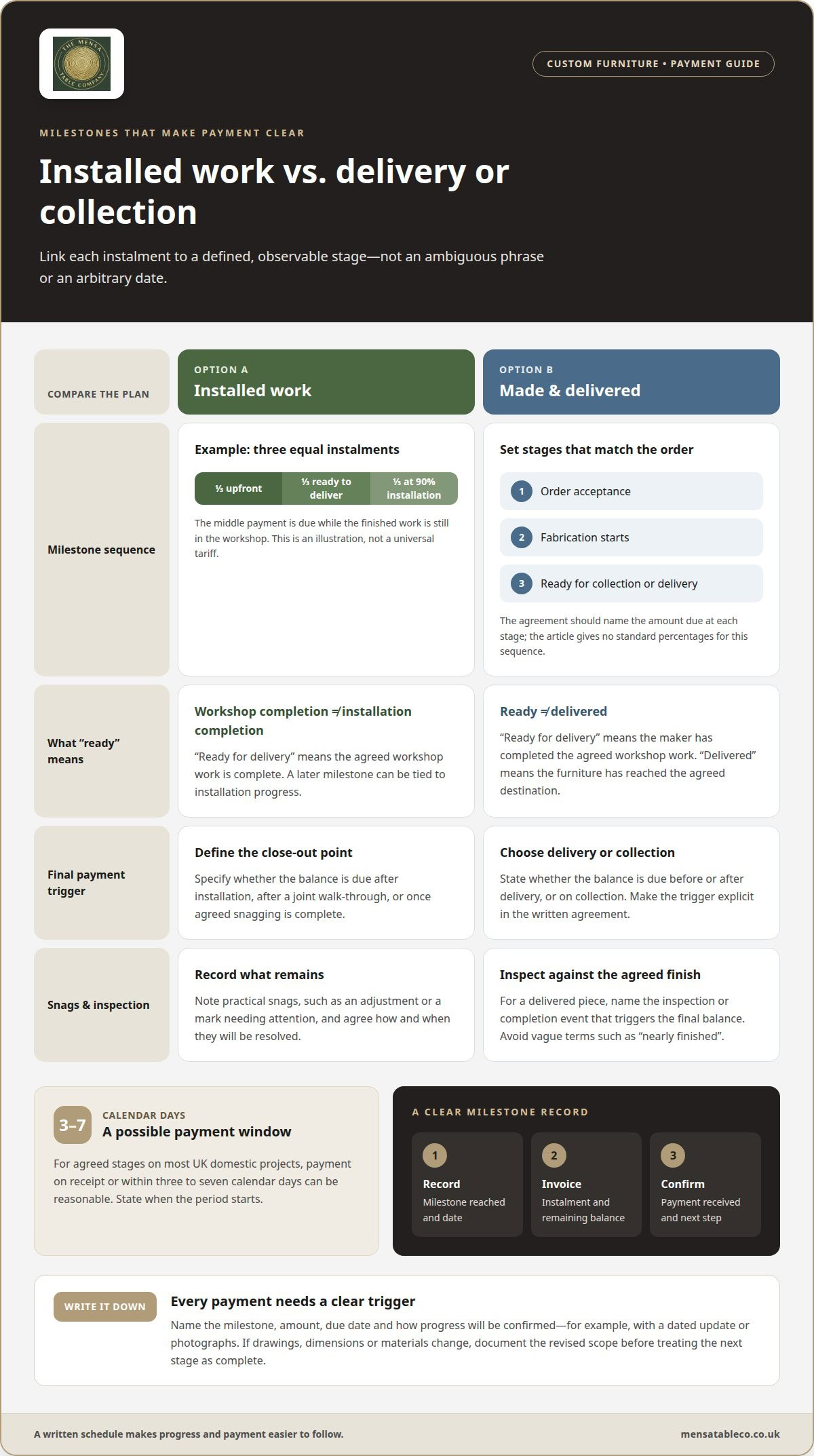
One example for installed work divides payment into three equal instalments: one-third upfront, one-third when the work is ready to deliver but still in the workshop, and one-third when installation is 90% complete. This is an illustration, not a universal furniture tariff. It shows how a schedule can link payment to ordering, workshop completion and installation, instead of collecting every instalment at the outset.
For work made and delivered without installation, the milestones may follow a different sequence. The written plan can connect instalments to order acceptance, the start of fabrication and the piece being ready for collection or delivery. Each trigger should describe an observable event. That distinction matters: “ready for delivery” means the maker has completed the agreed workshop work, while “delivered” means the furniture has reached the agreed destination.
Set a payment deadline alongside each milestone. For agreed stages on most UK domestic projects, payment on receipt or within three to seven calendar days can be reasonable. State whether the period starts when the milestone is reached, when notice is sent, or when an invoice arrives. Avoid relying on a verbal update that leaves the due date uncertain.
Payment confirmation should also move the project forward in a traceable way. A useful sequence is simple:
- Record the milestone reached and the date.
- Send an invoice showing the instalment and remaining balance.
- Confirm receipt of payment and the next production step.
That record connects each payment to the work completed. If approval of a drawing changes the dimensions or materials, document the revised scope before treating the next stage as complete. A clear deposit and payment schedule for custom furniture keeps approvals, fabrication and delivery aligned, and makes progress easier to follow.
For jobs of $50,000 or more, one shop takes 20% on acceptance, 20% at fabrication start or shop approval, 20% midway, 20% before finishing, 10% on delivery and the balance upon completion.
For the £8,000 building job, the proposed plan required a 25% deposit on order confirmation, then 25% weekly payments based on completed work.
2. Final payment after installation
The final balance should have a clear trigger in the written agreement. For installed furniture, that might be completion of installation and a walk-through together. For a piece delivered without installation, the trigger could be delivery or collection. State which event makes the final payment due, and whether the balance is payable before or after it.
Some makers divide the closing amount into separate steps. One example collects 40% after the customer inspects the completed build, then the final 10% after inspection of the finish. The percentages are an example, not a universal schedule. The useful principle is to define what each inspection covers, so a payment isn’t triggered by an unclear phrase such as “nearly finished”.
For installed work, the agreement can also explain how practical snags affect the balance. A small adjustment to a door or a mark needing attention may be recorded on a snag list, with a clear plan for resolving it. For many UK domestic building jobs, retaining around 5 per cent to 10 per cent for final snagging and handover can be balanced. Furniture commissions differ, so the amount and release trigger should reflect the actual work.
Another common UK construction schedule allocates 10% to final completion and snagging, minus retention. These construction examples don’t automatically set terms for a furniture order. They show why the contract should distinguish completion, outstanding work and any retained balance. A final payment shouldn’t depend on an undefined standard; describe the agreed finish and the process for noting a problem.
Before paying, match the invoice to the written terms. Confirm the amount due, the milestone reached, any agreed changes and the remaining balance. If installation isn’t complete, record what remains and when it will be addressed. Keep the invoice and payment confirmation with the order documents. This creates a clear record if either side needs to clarify what was completed.
For a domestic building contract agreed online, by phone or in the customer’s home, the UK Government says the Consumer Contracts Regulations 2013 may provide a 14-day cancellation period. That rule shouldn’t be assumed to cover every bespoke furniture purchase. If furniture is delayed or not delivered, start with the written delivery terms and the agreed date, then raise the issue with the seller in writing.
If a bespoke table project includes installation, the payment plan can state whether the balance is due before delivery, after fitting, or once agreed snagging is complete. To discuss the details of a table project, get in touch about your furniture requirements.
3. Written contract terms and payment triggers
A written agreement turns an agreed price into a clear payment plan. Include the furniture description, materials, dimensions, finish, delivery or installation arrangements, total price, deposit, instalments and final balance. For each payment, name its trigger, amount and due date. If a drawing or material choice changes, record the revised scope and any price adjustment before production continues.
Payment terms vary between makers and retailers because their order and production processes differ. A maker may connect instalments to fabrication stages, while a retailer may take payment at checkout or order confirmation. There’s no universal approach. Compare the actual triggers in the agreement, including whether payment is due before materials are ordered, delivery or installation.
For an established client relationship, a maker may agree credit terms instead of requiring payment at every production stage. Set out the invoice date, payment deadline and any process for disputed items in writing. A 30-day payment term can leave a small firm carrying several weeks of labour and supplier costs, so timing should be agreed rather than assumed.
Credit-card payment may provide Section 75 protection for eligible purchases, but card acceptance alone doesn’t guarantee that protection. Eligibility depends on the transaction and circumstances. The payment method and any applicable card terms should therefore be understood separately from the furniture contract and its delivery obligations.
A useful quote and payment schedule gives enough detail to connect the price with the finished piece. It should identify the agreed design, materials, dimensions, finish, delivery arrangements, payment stages and what each stage means. It should also state how changes are priced, how revised dates are handled and when the final balance falls due. Keep a signed copy for reference.
Invoices should repeat the relevant milestone, amount, due date and balance remaining. For example, a cabinetmaker’s schedule may request 50% upfront, 40% when the work goes to finishing, and 10% upon delivery. Another arrangement splits the remaining 50% into 30% at finishing and 20% on delivery. These are examples, not fixed industry rules.
Fair terms link payments to identifiable work or costs. If an invoice is raised for a change, describe the change and its effect on the schedule. Keep payment receipts with the signed quote and invoices. This record helps clarify what was agreed, which milestone occurred and whether the balance reflects the completed work.
4. Furniture and product payments before ordering
Timber, hardware and upholstery may need ordering specifically for a commission. A payment before ordering can cover those product costs, protecting workshop cash flow while allowing production to progress. The agreement should clearly separate the amount for materials from charges for design, making, delivery or installation, so each payment reflects its purpose.
A maker may ask for full payment upfront, but you can decide whether to accept those terms before placing an order. A staged plan may instead collect materials costs before ordering, then link the remaining charges to production or delivery. Make sure you understand what the upfront sum covers and what work remains.
One proposed approach is to collect 100% of product costs before placing furniture or other product orders. That recommendation concerns the products being purchased, not necessarily the whole custom commission. In practice, the written quote can identify the relevant materials or items, the amount due before ordering, and the separate balance for the maker’s work.
For example, if a commission needs particular materials or components, the agreement can state that the materials payment is due before those orders are placed. A later instalment might be due when fabrication begins, with the balance due at an agreed completion or delivery stage. The triggers should follow actual steps, so you know whether an order has been placed.
Are deposits for custom furniture refundable in the UK? It depends on the contract’s cancellation terms and the circumstances. The written terms should explain how the deposit is treated if an order ends early, including how materials already ordered and work already completed are accounted for.
If you cancel a custom furniture order, the agreed cancellation clause explains how the deposit and any later payments are handled. It should distinguish money covering committed materials from payment for work not yet carried out, and explain how the final amount is calculated.
Before paying, make sure the invoice matches the quote and identifies the payment’s purpose. A clear record might show the amount allocated to materials, the due date and the next production step. Keep payment confirmation with the order documents. This makes it easier to see whether a payment funded an order, marked progress in fabrication or reduced the remaining balance.
A payment for materials shouldn’t be confused with a deposit simply because both are due early. The agreement can name each separately, explain its trigger and show how it affects the amount remaining. That distinction is useful when a commission involves both specially ordered materials and hands-on making, because each payment relates to a different stage.
5. When is the balance due for made-to-order furniture?
The balance is due at the point stated in the written order, not on a universal date. For made-to-order furniture, the trigger may be when the piece is ready for collection, before delivery or after agreed installation. Clarify whether payment is required before the furniture leaves the workshop or follows handover.
For work that doesn’t require installation, one reported payment arrangement is 50% upfront and 50% on collection. This ties the remaining balance to a clear event: the finished piece is ready, and the customer collects it. A delivery order may use a different trigger, such as payment before dispatch or upon delivery. The contract should say which applies.
“Ready” needs a practical meaning. It could mean the piece has completed the agreed workshop work and is available at the stated collection point. If delivery is included, clarify whether the balance is due before the delivery date or once the furniture arrives. Avoid leaving the trigger as “on completion” if that could mean workshop completion, delivery or installation.
Before paying the balance, compare the final invoice with the order. Confirm that it shows the agreed total, previous payments, remaining amount and payment trigger. If the order includes more than one piece, such as a table and matching bench, the invoice can show whether the balance covers both items together or separate handovers. This makes partial delivery easier to understand.
For an installed commission, the final payment may instead follow completion of fitting. The agreement can state what counts as complete and how any remaining adjustments are recorded. If a snag remains, note the specific work and agreed next step in writing. This helps distinguish a minor outstanding adjustment from furniture that has not reached the agreed completion stage.
Delivery timing also affects the practical payment plan. A piece can be finished in the workshop before a delivery date is arranged, so the agreement should link the invoice trigger to an event both parties can identify. If the balance is due before dispatch, state when the invoice will be sent and how payment confirmation relates to delivery arrangements.
Keep the signed quote, payment confirmations and final invoice together. They show how much has been paid, what remains and which event makes the balance due. If a change affects the order, record its impact before settling the final amount. The written terms should make the payment stage clear whether you collect the piece or have it delivered.
Planning a made-to-order table? Discuss your furniture requirements and the payment stages for your project.
The Mensa Table Company
The Mensa Table Company makes dining tables for homes where meals, conversation and daily life gather. Its range includes The Mensa Dining Table, The Spider Leg Dining Table, The X-Frame Dining Table and The U-Frame Dining Table.
Before placing an order, make sure the written terms explain the deposit, any payments during production and when the balance is due. A clear schedule shows how payments relate to the order and its progress, helping you plan with confidence.
Contact The Mensa Table Company to discuss your furniture requirements.
Make the next step part of the design
A well-considered deposit and payment schedule for custom furniture is part of a good commission, but it shouldn’t overshadow the piece itself. Start with how you want the furniture to serve your home: the meals it will gather around, the space it needs to fit and the materials you’d like to live with every day. Those choices give the conversation a useful starting point.
From there, the order can bring the practical details and the personal vision together. A written agreement gives the project a clear framework, while thoughtful design choices shape a piece that belongs in your home and feels ready for the years ahead. It’s worth taking the time to get both right.
If you’re ready to explore a table for your home, contact The Mensa Table Company to discuss your requirements. A considered start can lead to a piece made for everyday life and the moments shared around it.
Frequently Asked Questions
Can I refuse to pay a deposit?
You can decline a deposit before placing an order, but the maker can also decline to begin work without one. Before deciding, consider whether the commission requires materials to be bought specifically for you or workshop time to be reserved. If you prefer not to pay upfront, discuss an alternative schedule before accepting the quote, such as an initial payment tied to an agreed order or production step.
Should I withhold final payment until defects are fixed?
Don’t assume you can withhold any amount without considering the contract and the nature of the issue. Photograph the defect, describe it in writing and ask for a clear plan to put it right. If the agreement sets a snagging process or a retained balance, follow those terms. For a disagreement about a substantial defect, seek independent advice before deciding what to pay.
What deposit is typically required for custom furniture in the UK?
There isn’t one deposit amount that suits every custom furniture commission. The amount depends on the order, the materials involved and the maker’s agreed terms. A piece requiring specially ordered materials may call for a different opening payment from one made using materials already held in the workshop. Ask for the deposit amount and its purpose to appear in the written quote before you accept it.
What payment stages are common for bespoke furniture projects?
Payment often follows the project’s sequence: the commission is accepted, materials are sourced, the furniture is made, then it’s delivered or collected. A project with installation may include another stage linked to fitting. For example, a maker could separate the cost of specially ordered materials from later payments for making. The schedule should explain what each instalment covers and what event triggers it.

Leave a Reply