

Why should your home’s most important gathering spot feel like a compromise just because your floor plan is modest? We understand the frustration of measuring a room only to realize that standard furniture is either too bulky for the walkway or so small it feels like an afterthought. You deserve a piece that reflects the heart of your home, yet many homeowners find themselves stuck between poor-quality flat-packs and designs that simply don’t respect the unique geometry of a tight corner.
Investing in a handcrafted custom dining table for small space allows you to transform a restricted area into a warm, functional focal point that will last for generations. We promise to show you how a made-to-measure approach can reclaim your floor plan while providing the tactile beauty of sustainably sourced timber. We’ll walk through the essential considerations for compact design, including how specific leg styles like our Mensa or Trapezium frames offer the most freedom and how to choose materials that bring “warm minimalism” into your daily rituals. From the initial grain selection to the final finish, we’ll help you create a space where every centimeter is used with intention.
Key Takeaways
- Learn the “Golden Rule” of clearance to ensure your home remains easy to navigate, even when the table is fully occupied.
- Discover how a custom dining table for small space bypasses the rigid size increments of mass-produced furniture to reclaim every centimeter of your floor plan.
- Explore the ergonomics of leg placement and how specific geometries can maximize your seating capacity without blocking chair movement.
- Understand how selecting the right timber grain and species can visually expand a compact room while adding a sense of artisanal warmth.
- Gain insight into the manual production process that transforms raw, sustainably sourced materials into a heritage-quality piece built for generations.
The Challenge of the Compact Home: Why High-Street Tables Often Fail
Living in a compact home often feels like a constant negotiation between utility and beauty. We see it every day: a kitchen that’s just a few centimeters too narrow for a standard four-seater, or a dining nook that becomes a bottleneck the moment a chair is pulled out. This is the small space dilemma. You want to host friends and share meals, but a standard high-street table forces you to sacrifice floor flow. This is where a custom dining table for small space becomes more than just furniture; it’s a strategic solution that respects the boundaries of your room while honoring your need for connection.
Most retailers design for the “average” room, relying on rigid increments like 120cm or 150cm. In a Victorian terrace or a modern apartment, these measurements often leave awkward “dead space” that’s too small for a plant but large enough to look like a mistake. Worse, these oversized pieces often block essential walkways, making the room feel cluttered and stressful. When every piece of furniture must earn its place, a mass-produced item that almost fits is a missed opportunity for both comfort and style.
The Myth of the “Standard” Kitchen
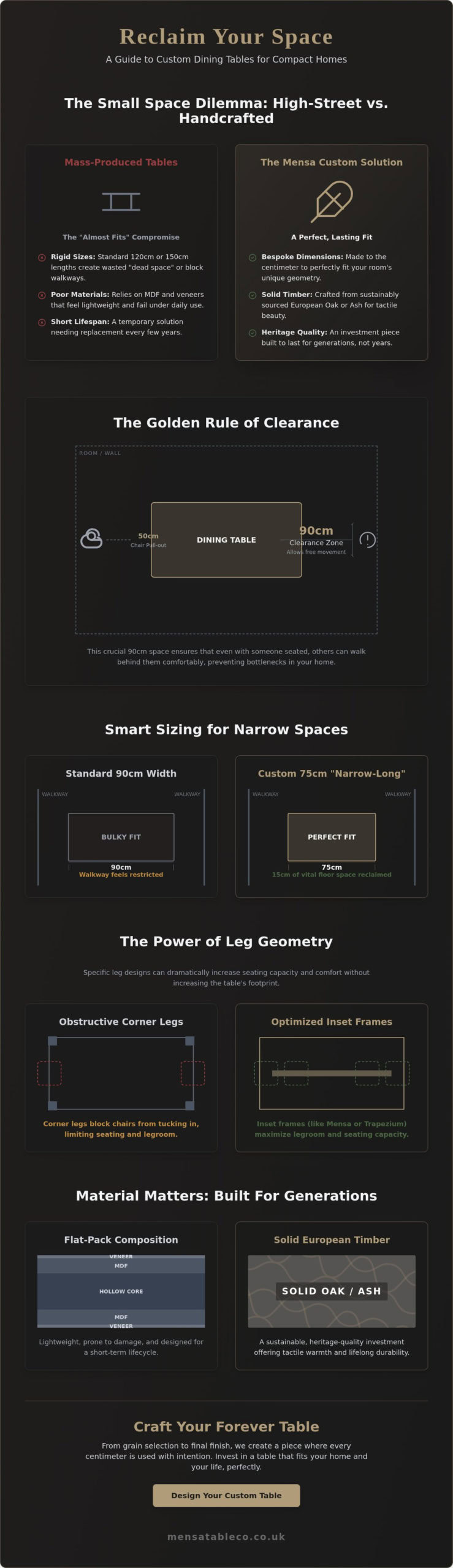
Modern UK architecture presents unique layout challenges that high-street retailers often ignore. We frequently encounter narrow dining areas where a traditional 90cm width is simply too bulky. While designers often stick to a standard height for a dining table, they rarely account for the specific width restrictions of a narrow galley kitchen. Our approach allows for a slimmer profile, perhaps 75cm or 80cm, which maintains full 4-seater functionality while reclaiming vital floor space. It’s about finding that sweet spot where the table feels substantial but never intrusive.
Beyond the Flat-Pack: Investing in Longevity
There’s a hidden cost to the flat-pack furniture found in the small-space category. These items often rely on hollow-core boards, MDF, and thin veneers that fail to handle the heavy, daily use of a primary dining surface. They feel lightweight and temporary. In contrast, our bespoke dining tables are crafted from solid European timber, offering a tactile depth and weight that mass-produced items cannot match.
A handmade table acts as a site for human connection, even in a studio apartment. It’s where you start your morning with a coffee and where you end your day sharing a meal. By choosing solid European oak or ash, you’re not just buying a surface; you’re investing in a heritage piece. It’s a commitment to sustainability, buying once for a lifetime rather than replacing a failing laminate table every three years. In a small home, quality shouldn’t be a luxury, it should be the standard.
Designing for Proportions: How to Size a Custom Dining Table
Proportion is the silent language of a well-designed room. When we discuss a custom dining table for small space, we aren’t just looking at the physical footprint of the timber. We’re considering the “negative space” that allows your home to breathe and function. The most critical guideline we follow is the “Golden Rule” of clearance. Ideally, you should leave 90cm between the edge of your table and the nearest wall or piece of furniture. This ensures that even when someone is seated, others can move freely behind them without the frustration of a bottleneck.
In many UK homes, especially those with narrow galley kitchens, a standard square or round table can feel like an obstacle. We often recommend “Narrow-Long” designs as a solution. These tables provide ample length for seating while maintaining a slimmer profile that keeps walkways clear. By aligning the table length with existing architectural features, such as a large window or a radiator, the piece feels like it was born into the room rather than forced into it. While we adjust the width and length to your specific floor plan, we maintain standard heights to ensure your dining experience remains ergonomic and comfortable.
Measuring Your Space for a Bespoke Fit
Before we begin the artisanal process of crafting your table, we encourage you to visualize the piece in your own home. Use masking tape on your floor to outline the proposed dimensions. It’s a simple but effective way to see how much floor space remains for movement. Don’t forget to account for the chair “pull-out” distance, which usually requires about 50cm to 60cm of space to be used comfortably. For many of our clients, a width of 75cm or 80cm provides the perfect balance. It’s wide enough for a shared meal but narrow enough to preserve the room’s flow. Understanding the characteristics of different woods can also help you decide how heavy or light the piece will feel in that space.
The Role of Benches in Small Space Design
One of the most effective ways to reclaim space is through the use of matching benches. Unlike chairs, which remain visual and physical obstacles even when not in use, a bench can be tucked completely under the table. This clears the walkway entirely during the day. Benches also offer a visual “lightness” that prevents a small room from feeling overcrowded with high-backed furniture. From a practical standpoint, they are incredibly versatile for families. You can easily fit three children on a bench where two bulky chairs would normally sit. If you’re unsure which dimensions would best suit your specific nook, reach out to our workshop for a chat about your layout.
Leg Geometry: Maximising Legroom and Chair Clearance
While the tabletop provides the stage for your morning coffee and evening meals, the frame dictates the choreography of your room. In a compact home, the placement of the legs is just as vital as the surface area of the wood. Standard tables often feature legs at the very corners, creating a physical barrier that we call the “corner hit.” This makes sliding into a seat a clumsy affair in tight spots. When you choose a custom dining table for small space, you gain the freedom to select a base that maximises your effective seating area and preserves the flow of your home.
The stability of our handcrafted steel frames offers a significant advantage over mass-produced, bolted-on wooden legs. Our frames are hand-welded for permanence, ensuring a wobble-free experience that lasts for generations. This structural integrity allows us to use thinner, more elegant profiles that reduce visual weight. A heavy, chunky base can make a small room feel cluttered, whereas our architectural steel designs create a sense of openness. When you’re learning how to size a dining table, it’s essential to look beneath the surface to see how the base interacts with your chairs and your legs.
The Spider Leg and X-Frame: Centralised Support
The Spider Leg Dining Table is a true hero for the compact home. By centralising the support, it removes all obstacles from the corners, allowing chairs to be tucked in deeply and people to sit comfortably at every edge. It’s an ideal choice for “wraparound” seating, where you might need to squeeze in an extra guest during a celebration. Similarly, our X-Frame Dining Table offers a rustic, industrial charm with an inset design. This geometry is specifically engineered to avoid knee-knocking, providing a generous amount of legroom even when the table width is reduced to suit a narrow alcove.
U-Frame and Trapezium: Modern Architectural Lines
For those who prefer clean, industrial lines, the U-Frame Dining Table provides a sturdy, architectural feel without the bulk of traditional furniture. In narrow spaces, the U-Frame acts as a bold visual anchor that doesn’t overwhelm the room. If you want to maximise the feeling of floor space, the Trapezium Dining Table is an exceptional choice. Its angled steel legs taper inwards towards the top, creating a wider stance at the floor that suggests movement and lightness. This “open” geometry makes the surrounding floor more visible, which trickles into the subconscious to make the entire room feel larger. We offer these frames in various finishes, from raw steel to deep blacks, allowing you to match the palette of your home perfectly.
Timber Selection: Aesthetics and Durability in Close Quarters
Selecting the right timber is an act of curation that defines the soul of your room. In a compact environment, the surface of your table is constantly within your field of vision, making the choice of grain and color vital to the overall atmosphere. A custom dining table for small space often serves as a multi-functional hub, transitioning from a morning coffee station to a focused home office and finally to an evening dining spot. This high-traffic reality demands a material that offers both sensory warmth and uncompromising durability. We believe in using only sustainably sourced, solid timbers that tell a story of longevity and respect for the natural world.
The tactile experience of natural wood is something mass-produced laminates can never replicate. When you run your hand across the surface, you feel the history of the tree and the care of the artisans who shaped it. Because our pieces are finished with high-quality natural oils, they maintain a matte, organic look that invites touch rather than reflecting harsh light. This is particularly important in smaller rooms where glare can make a space feel clinical or cramped. The wood you choose becomes a backdrop for your daily rituals, maturing and gaining character as the years pass.
Light Woods for an Airy Feel: Oak and Ash
For rooms that struggle with natural light, choosing a paler species can visually expand the boundaries of the space. Solid European Oak remains a timeless favorite for its golden hues and reliable strength. It brings a sense of calm and brightness that makes even the tightest corners feel more breathable. If you’re looking for something with a bit more visual energy, solid European ash offers stunning “swirling” grain patterns. These intricate details provide a focal point that draws the eye, making the table feel like a deliberate piece of art rather than just a functional necessity.
Character and Contrast: Walnut and Pine
If your goal is to create a sophisticated “jewel-box” effect, solid black walnut is an unparalleled choice. Its deep, chocolatey tones and rich character add a layer of luxury that anchors a room, proving that you don’t need a massive floor plan to make a bold statement. Conversely, solid Swedish pine allows for a rustic, farmhouse aesthetic that feels grounded and honest. It’s important to remember that solid wood is a living material. It breathes and moves with the seasons. Our workshop uses traditional joinery techniques to account for this natural timber movement, ensuring your table remains stable and beautiful for generations. If you’re ready to discuss which wood species will best complement your home, talk to us about your timber preferences today.
The Mensa Approach: Crafting Your Forever Table
Our philosophy is simple: we believe that your home deserves better than the temporary convenience of mass production. We don’t do flat-pack. Every piece that leaves our workshop is a deliberate alternative to the disposable culture that has come to dominate modern interiors. When you commission a custom dining table for small space, you aren’t just buying a piece of furniture. You’re entering into a partnership with a tight-knit team of makers who value substance over flashy marketing and quality over quick turnover.
The journey begins with the raw material. We hand-select each plank of timber, looking for the unique physical characteristics that will give your table its soul. From the initial cut to the final hand-applied oil finish, the process is slow and intentional. This deliberate pace is what allows us to guarantee a level of quality that mass-produced items simply can’t achieve. Creating a custom dining table for small space requires this level of care to ensure the proportions are perfect for your specific layout. Once your piece is ready, we provide national delivery, bringing artisanal craftsmanship from our workshop to every corner of the UK. It’s a journey that starts with a simple measurement and ends with a family heirloom.
Handcrafted in Our Workshop
There is a quiet confidence in traditional joinery and hand-welded steel fabrication. Our artisans take immense pride in their trade, blending professional expertise with a passionate spirit. We build our tables to be lived on, not just looked at. They are designed to withstand the spills of a family dinner, the weight of a laptop during a long workday, and the vibrant energy of a home’s focal point. Every weld and every joint is a testament to our commitment to a manual, personal approach in every interaction. We don’t rush the process because we know that high-quality output takes time.
Completing the Look: Benches, Bars, and Coffee Tables
A cohesive home often requires more than just a single standout piece. To help you coordinate your living area, we offer matching coffee tables that carry the same architectural lines and timber character as your dining set. For those with even tighter kitchen nooks where a full table might be a stretch, our custom breakfast bars provide a slim, high-impact solution for morning rituals. We invite you to explore our full range of handcrafted dining tables and discover how bespoke design can transform your space into a site for lasting human connection.
Reclaim Your Space with Artisanal Craftsmanship
Your home should be a place where you feel unburdened and inspired. By prioritizing clever geometry and precise proportions, you can turn a cramped corner into a site for meaningful connection. We’ve explored how the right leg design can reclaim essential legroom and how choosing the perfect timber species can visually expand your room. A custom dining table for small space is more than a functional surface; it’s a commitment to quality that respects the unique character of your floor plan.
Every piece we create is handcrafted in the UK using solid European timber. We specialize in custom sizes available to fit your exact needs, ensuring that your furniture earns its place without compromise. You don’t have to settle for the limitations of mass production when artisanal expertise is within reach. We invite you to Browse our Signature Mensa Collection and start the journey toward a home that truly fits your life. We look forward to helping you create a piece that will be cherished for generations.
Frequently Asked Questions
How small can a custom dining table actually be?
We can craft a table as small as 60cm by 60cm for a single person or a cozy bistro nook. However, for a functional dining experience for two, we suggest a minimum of 75cm in length or diameter. This ensures there’s enough room for place settings and a central serving dish without the surface feeling overcrowded. Every piece is built to your exact specifications, allowing us to match the specific constraints of your home.
Which leg style is best for a small room to maximise seating?
The Spider Leg Dining Table is our most effective design for maximizing seating in a tight area. By placing the support in the center, we remove the corner obstacles that often lead to bumped knees and restricted movement. This centralized geometry allows you to tuck chairs in completely when the table isn’t in use, which is essential for maintaining clear walkways and a sense of openness in a compact floor plan.
Is solid wood too heavy for a small apartment?
Solid wood is naturally dense and heavy, but this weight provides the stability and durability that a high-use surface requires. While the physical weight is higher than flat-pack alternatives, the “visual weight” can be managed through your choice of timber and frame. Selecting a lighter species like ash or a slim steel frame like the Trapezium can help a custom dining table for small space feel airy and proportionate rather than overbearing.
Can I get a custom width for a narrow kitchen?
Yes, providing custom widths is a core part of our artisanal process. Many modern UK kitchens are narrow, and a standard 90cm width can often block the room’s flow. We frequently craft tables at 75cm or 80cm widths, which offers a slim profile while still providing enough surface area for comfortable dining. This made-to-measure approach ensures your table fits the architecture of your home perfectly and functions without compromise.
How do I care for a solid oak table in a high-use small space?
Caring for solid oak is straightforward and requires only a small amount of regular attention. Because we finish our tables with natural oils, the wood is protected from spills while maintaining its organic feel. We recommend a quick wipe with a damp cloth for daily cleaning and a fresh coat of oil once or twice a year to keep the timber hydrated. This simple routine ensures your table remains a beautiful focal point for generations.
Do you offer matching seating for small dining sets?
We offer matching benches for all our table designs, which are a popular choice for smaller rooms. Benches are particularly useful because they can be tucked entirely under the table when not in use, instantly clearing floor space. This creates a cleaner visual line and allows for more flexible seating arrangements when you have extra guests or children joining you for a meal. It’s a practical way to maximize your room’s utility.
What is the standard lead time for a bespoke handcrafted table?
The creation of a handcrafted piece takes time, as every stage from timber selection to the final finish is handled with manual care. Generally, you can expect the process to take several weeks from the moment we finalize your design. This steady, deliberate pace is what ensures the quality and longevity of your furniture. We’ll keep you updated on the progress as your table moves through our workshop, ensuring it’s ready for its new home.
How do I know if a table will fit through my narrow hallway?
We design our tables with accessibility in mind, so most of our frames are delivered with the legs detached. This allows the tabletop to be carried through narrow hallways or up tight staircases on its side without difficulty. Once the piece is in its final location, the legs are easily secured to the pre-drilled holes in the timber. We take the stress out of delivery by ensuring the assembly process is simple, robust, and safe.

Leave a Reply