
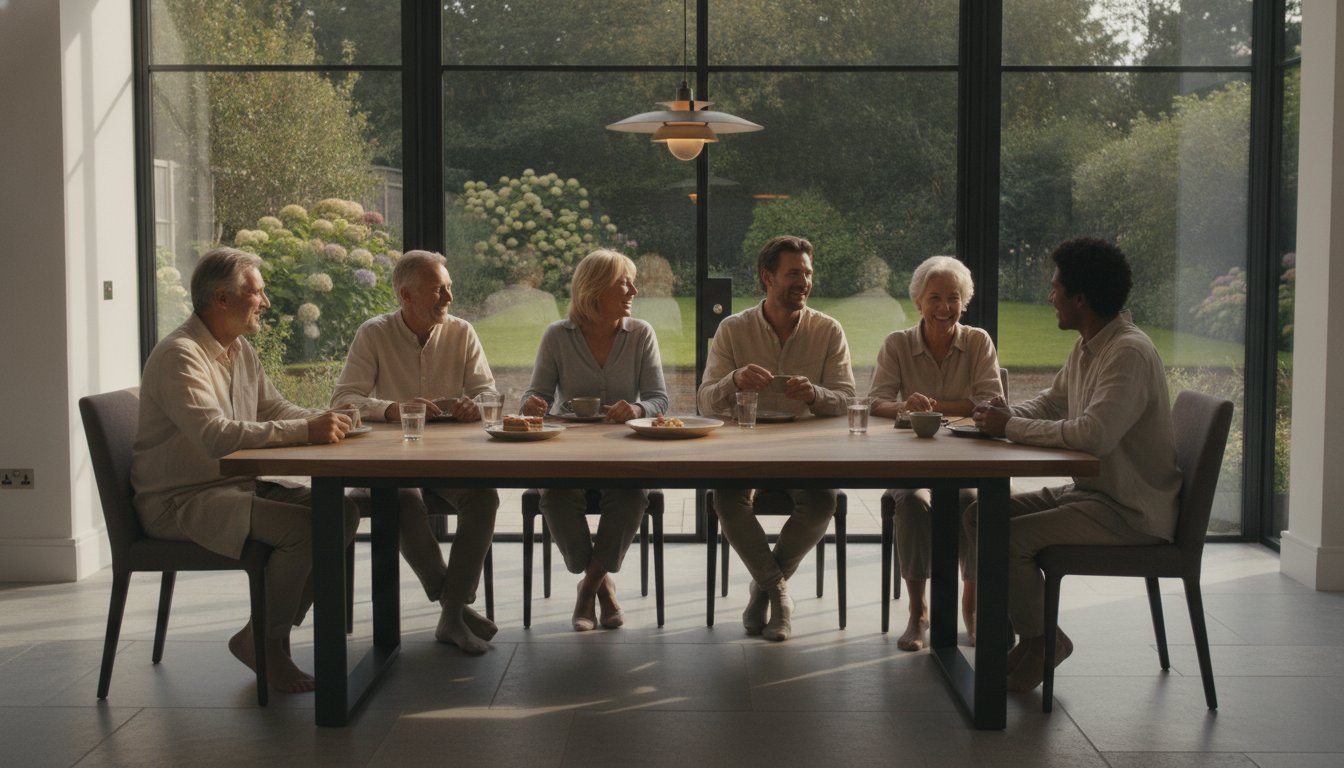
Imagine the excitement of hosting your first holiday dinner, only to find your guests are squeezing past one another because the table is too large for the room, or seeing a beautiful surface ruined by a single spilled glass of water. These moments of frustration represent the most common regrets when buying a dining table, turning what should be a meaningful investment into a source of daily stress. We believe that the dining table is the true heart of the home, a place where stories are told and heritage is built through every shared meal.
Choosing a piece that lasts for generations requires looking past flashy marketing and focusing on the honest quality of the materials. This article will help you avoid the expensive mistakes most homeowners make by understanding the critical balance of scale, material, and craftsmanship. We’ll explore how to identify the tactile beauty of solid wood over flimsy veneers, how to measure for perfect flow in your space, and how to select a design that facilitates connection. By the end, you’ll know how to choose a table that fits your life perfectly and ages with a grace that only manual, intentional production can provide.
Key Takeaways
- Prioritize room clearance over table dimensions to ensure your space remains breathable and functional for every guest.
- Distinguish between the lasting value of solid timber and the hidden fragility of veneers to ensure your surface ages beautifully over time.
- Avoid the most common regrets when buying a dining table by choosing a frame design that offers generous legroom and seating flexibility for everyone at the table.
- Select a finish that aligns with your daily lifestyle, balancing the tactile warmth of natural oils with the durable protection of professional lacquers.
- Discover how investing in intentional, manual craftsmanship turns a simple piece of furniture into a meaningful backdrop for generations of shared stories.
The Error of Scale: Why “Roughly Right” Is Often Wrong
Walking into a dining room should feel like an invitation, a soft exhale after a long day. One of the most common regrets when buying a dining table is failing to account for the physical weight a large piece of furniture carries within a room’s atmosphere. A table that dominates the floor space can make a room feel cramped and hurried, while a piece that is too small often feels lost, failing to anchor the home’s social center. We often see homeowners choose a standard retail size because it looks about right on a screen, only to find it disrupts the natural rhythm of their daily life. The history and construction of dining tables shows us that these pieces were always intended to be the steady, functional heart of a gathering, but that function relies entirely on the space left around the timber.
The Golden Rule of Clearance
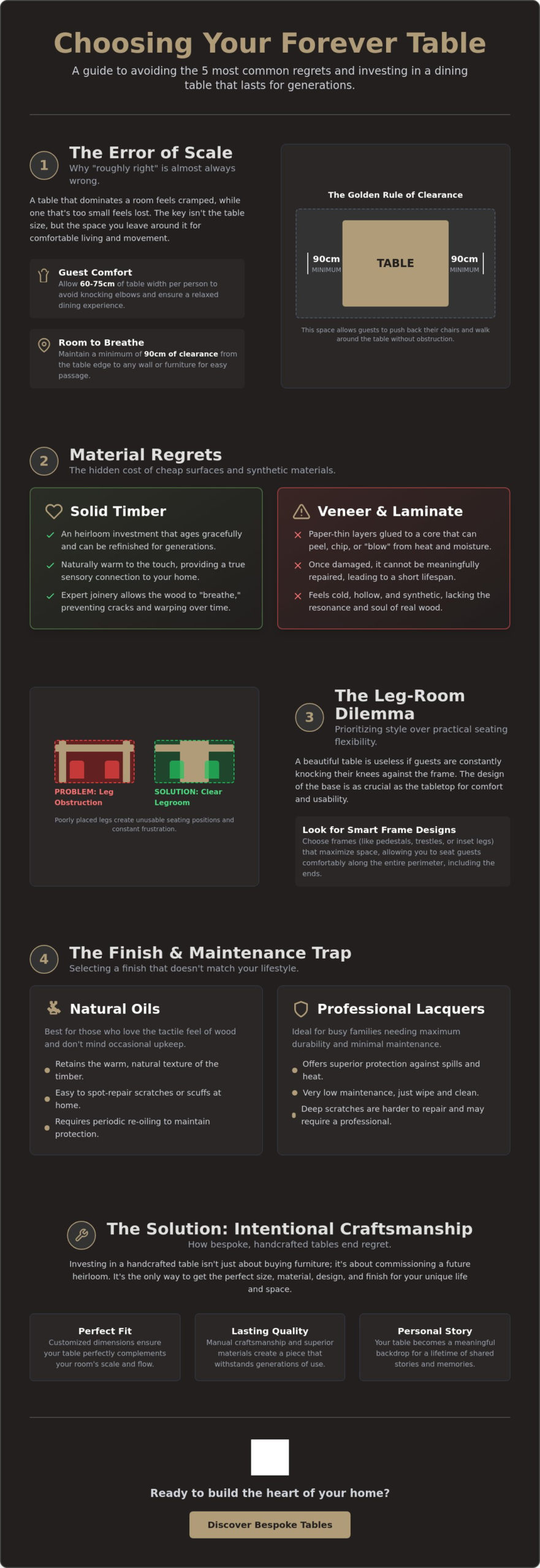
Measuring the wood is easy, but measuring the air around it is where the real magic happens. We recommend a minimum of 90cm of clearance between the table edge and the nearest wall or piece of furniture. This isn’t just a number; it’s the space required for a guest to comfortably push back their chair and stand without a struggle. If you’re working in an open-plan living area, you must also consider traffic flow. A table shouldn’t be a barrier you have to navigate around to reach the kitchen or the sofa. We always suggest mapping out the footprint on your floor with masking tape. Walk around it. Sit where the chairs will be. It’s better to discover a tight squeeze now than after the delivery truck has left. A table that fits the room but traps the guest is a failure of ergonomics.
Seating Capacity vs. Comfort
We all want to host the whole family at Christmas, but squeezing a ten-seater table into a space designed for six is a recipe for knocking knees and awkward elbows. True comfort requires roughly 60cm to 75cm of width per person. If you try to pack too many bodies into a small perimeter, the conversation suffers because everyone is focused on their lack of personal space. For those who need flexibility without the visual clutter of many chairs, matching benches are a thoughtful solution. They tuck neatly under the table when not in use, opening up the room and providing a communal, inclusive feel that individual chairs sometimes lack. By choosing a bespoke size, you eliminate the compromise of standard dimensions and ensure your table serves your life, not the other way around.
Material Regrets: The Hidden Cost of “Cheap” Surfaces
There is a distinct, cold disappointment that comes from sitting at a table made of high-pressure laminate or thin veneer. While these surfaces might look convincing in a catalog, they lack the resonance and soul of a piece of furniture that once lived and breathed. One of the most common regrets when buying a dining table is choosing a material based solely on its initial price tag, only to realize later that the surface feels synthetic and hollow under your fingertips. Real wood has a natural thermal quality; it feels warm to the touch because it is an organic insulator. In contrast, synthetic finishes often feel sterile and unforgiving, failing to provide that sensory connection that makes a house feel like a home.
Solid Timber vs. Veneer: A Longevity Comparison
We view furniture as an heirloom investment rather than a disposable commodity. Solid wood furniture is a living entity that matures alongside your family. This is especially true for materials like Solid European Oak, which offers a level of durability and strength perfect for the high-use environment of a family home. Veneers, however, are merely paper-thin slices of wood glued to a core of MDF or particleboard. Over time, exposure to the heat of a coffee cup or the moisture from a spilled drink can cause these thin layers to “blow” or peel away. Once a veneer is damaged, it cannot be meaningfully repaired. A solid timber surface can be sanded back and refinished decades from now, allowing it to age beautifully and tell the story of your home for generations.
Understanding Timber Movement
A frequent source of regret is the misunderstanding of how real wood behaves. Timber is a living material that reacts to the humidity and temperature of its surroundings. It expands and contracts with the seasons. Without expert joinery that accounts for this natural movement, a table can crack or warp. Our manual approach ensures that every joint is crafted to allow the wood to breathe. We also believe that the “character” of the timber, including its unique knots and swirling grain patterns, should be celebrated. These aren’t flaws; they are the fingerprints of nature. If you’re unsure which timber species or finish will best suit your home’s unique environment, you can always speak with our craftsmen for personalized guidance. Choosing a material that respects these natural laws ensures your investment won’t just last; it will thrive.
The Leg-Room Dilemma: Style vs. Practical Seating
A shared meal should be a slow, rhythmic dance of conversation and flavors, not a constant battle for personal space. One of the most common regrets when buying a dining table is realizing too late that the frame design dictates exactly how your guests will sit and move. While a table base might look striking in an empty showroom, its true test comes when the chairs are pulled in and the room is full of life. We believe that the foundation of a table should be as thoughtful as the timber it supports, blending structural necessity with the freedom to sit comfortably without the constant frustration of bruised shins.
Stability is the silent partner of a great dining experience. A solid timber top, rich with density and natural history, requires a foundation that won’t falter under the weight of daily use. We lean into the use of heavy-duty steel frames, meticulously welded by hand, to provide an unwavering stance. This is a deliberate choice. Many mass-produced alternatives rely on lightweight materials that eventually wobble, leading to a sense of fragility that undermines the warmth of the wood. Our frames are built to anchor the room, ensuring that every elbow rested on the table is met with steady, quiet confidence.
Spider Legs and X-Frames: Maximising Space
The Spider Leg design is often the ultimate solution for those who prioritize seating flexibility. By drawing the support toward the center, it removes the corner obstacles that lead to the all-too-familiar frustration of knocking knees. Our X-Frame or Trapezium bases offer a different kind of architectural charm, drawing on industrial heritage to create a silhouette that feels grounded. When you browse our full range of dining tables, you’ll find that each design is a balance of aesthetics and ergonomics, ensuring that style never comes at the cost of a guest’s comfort.
Tucking in the Chairs
A common mistake involves the relationship between the table legs and the width of your chairs. It’s a quiet disappointment to bring home elegant, wide-armed chairs only to find they cannot tuck fully under the table edge. This lack of foresight often leaves chairs protruding into the room, disrupting the flow of your home and creating a tripping hazard. The most beautiful table becomes a burden if it forces your chairs to live in the middle of the room. We always encourage our clients to measure the clear span between the table legs at the exact height where the chair arms would sit. This simple check ensures your dining set can rest in a state of visual and physical harmony, allowing the craftsmanship of both the table and the seating to shine.
Maintenance and Finish: The “High Maintenance” Trap
A dining table should be a canvas for life, not a museum piece kept under glass. A major source of common regrets when buying a dining table is selecting a finish so delicate that you feel forced to hide the natural grain beneath a tablecloth. We believe the tactile connection to wood is essential to the dining experience. If you’re afraid to touch the surface, the table loses its role as the home’s emotional focal point. Solid wood is not too precious for daily use; it’s designed to endure the rhythmic chaos of family life, provided the finish matches your daily rituals.
Traditional lacquers create a hard, synthetic shell over the wood. While they offer high initial protection against red wine or toddler crayons, they can feel cold and plastic-like under the palm. Once scratched or chipped, these finishes are notoriously difficult to patch without a full strip-down. Modern oils, however, penetrate deep into the fibers of the timber. They allow you to feel the physical, silky texture of the grain while providing a durable, water-resistant barrier. This “living finish” allows the wood to breathe and develop a rich patina over time. It’s a surface that ages with grace rather than one that simply wears out.
Protecting the Grain
We favor hard-wearing, natural oils that preserve the timber’s raw beauty without the “yellowing” effect common in cheaper polyurethanes. A quality finish should enhance the natural character of the wood, not suffocate it under a thick, amber film. Maintaining this beauty doesn’t require a specialist or hours of labor. A simple ritual of reapplying a maintenance oil once or twice a year is often enough to keep the wood supple and vibrant. These small, manual acts of care become part of the table’s history. They ensure the surface remains as inviting as the day it was first planed in our workshop.
Lifestyle Matching
The species you choose should reflect the specific energy of your home. Solid Black Walnut is a sophisticated choice, perfect for formal dining rooms where its deep, chocolate tones and intricate grain can be appreciated in a steady, calm environment. For the busy kitchen where homework is spread out and meals are prepped in a hurry, the resilience of Ash or Oak is often better. These timbers are the true workhorses of the artisanal world, standing up to high impact with a quiet, grounded strength. Choosing a “precious” wood for a high-impact zone is a frequent regret that leads to unnecessary worry during what should be joyful gatherings.
If you’re unsure which finish or timber species can withstand your family’s unique daily rituals, reach out to our workshop team for expert advice on choosing a lifetime surface.
The Solution: Why Handcrafted Bespoke Tables End Regret
Choosing a piece of furniture that will witness decades of morning coffees and late-night celebrations is a deeply personal act. Most common regrets when buying a dining table stem from the compromises forced upon us by mass-market retail, where dimensions are standard and materials are often chosen for their shipping efficiency rather than their soul. By moving toward a bespoke, handcrafted approach, you reclaim control over the variables that matter most. You decide the exact millimeter of clearance for your room, the specific character of the timber, and the architectural weight of the frame. This intentionality transforms the purchase from a transactional exchange into the creation of a functional legacy that fits your life without compromise.
There is a quiet, reassuring confidence in knowing the hands that planed the wood and welded the steel for your home. Our manual approach ensures that every joint is tight and every grain pattern is celebrated, creating a piece that feels grounded and honest. When you dictate the species and the style, you aren’t just buying a surface; you’re commissioning a tool for connection. This process eliminates the emotional regret of a table that doesn’t facilitate easy conversation or one that feels out of place in your unique architectural setting. It is about creating a space that feels like yours from the very first meal.
The Artisanal Advantage
The difference between traditional manufacturing and the flimsy nature of flat-pack furniture is something you feel the moment you rest your hands on the timber. A handcrafted table offers an unwavering stability that remains steady through years of heavy use, never creaking or wobbling under the weight of a feast. We invite you to shop the collection and see how our dedication to manual production techniques creates a tactile difference that simply cannot be replicated by a machine. Each piece is a testament to durability, built with a level of care that ensures the legs and the top remain in perfect harmony for a lifetime.
A Focal Point for Connection
A dining table is perhaps the most important piece of furniture you will ever own. It is the site for social rituals and human connection, acting as the silent backdrop for the stories that define your family over generations. Beyond the emotional value, choosing a bespoke piece is an act of environmental responsibility. When you buy once and buy well, you reject the “fast furniture” model that leads to frequent replacements and wasted resources. You are investing in a piece of heritage made from ethically sourced materials that will age beautifully as the years pass. Ultimately, your dining table should be the first place you gather and the last thing you worry about, standing as a steady, beautiful anchor in the heart of your home.
Create a Legacy at Your Table
Your dining room is more than just a space for eating; it’s the anchor for your home’s most cherished social rituals. By prioritizing clearance over mere table size and choosing the tactile honesty of solid timber, you can easily avoid the most common regrets when buying a dining table. We believe that every home deserves a focal point that’s built to last, which is why we focus on manual production and ethical sourcing. Our pieces are handcrafted in the UK using solid timber throughout, ensuring you never have to worry about the fragility of veneers. With bespoke sizing available on all models, we help you eliminate the compromises of mass-produced furniture.
We invite you to explore our range of handcrafted dining tables and start the journey toward a piece that will age beautifully alongside your family. Let’s create a space where the wood is warm, the seats are comfortable, and the connection is effortless. Your home’s future stories deserve a steady, beautiful foundation.
Frequently Asked Questions
How much space should I leave between the dining table and the wall?
Aim for a minimum of 90cm of clearance between your table edge and the wall or nearest piece of furniture. This specific distance allows guests to push back their chairs and stand without feeling trapped or knocking into the room’s boundaries. If the space is a high-traffic walkway, increasing this to 100cm or 120cm ensures a smoother flow. Measuring the room’s air is just as vital as measuring the timber to avoid common regrets when buying a dining table.
Is solid wood better than veneer for a dining table?
Solid wood is far superior for longevity because it is a single, honest material that can be sanded and refinished over many decades. Veneers are paper-thin slices of wood glued to a composite core; they often peel or bubble when exposed to heat or moisture and cannot be easily repaired. Investing in solid timber ensures your table becomes a generational heirloom that ages with grace rather than a disposable item that eventually fails.
What is the best leg style for a table with many guests?
A Spider Leg or central pedestal design is ideal for maximizing seating because it removes corner obstacles that lead to bruised shins. By drawing the support toward the center, you create more freedom for guests to sit anywhere along the perimeter without fighting for legroom. This flexibility is essential for hosting larger gatherings where you need to squeeze in extra chairs or benches without compromising on individual comfort.
How do I know if a dining table is high quality?
Look for the weight and stability of the piece; high-quality tables feel grounded and won’t wobble when pressure is applied. Examine the joinery to see if it allows for natural timber movement and check that the finish feels silky and warm rather than plastic-like. Honest craftsmanship is often revealed in the details, such as the thickness of the solid wood top and the precision of the hand-welded steel frames.
What wood species is the most durable for a family table?
Solid European Oak and Ash are the most durable choices for a busy family environment due to their dense grain and natural resilience. These workhorse timbers withstand the daily impact of homework, crafts, and spilled meals with a quiet strength that softer woods lack. While walnut offers a sophisticated beauty, oak and ash provide a rugged foundation that handles high-traffic life while maintaining its structural integrity and visual appeal over time.
Can I use a dining bench with any table style?
You can use a dining bench with most styles, but you must ensure the bench can tuck fully between the table legs when not in use. Matching benches are particularly effective with U-Frame or X-Frame designs, providing a clean look that opens up the room’s floor space. This setup is a practical way to increase seating capacity while maintaining the communal, inclusive atmosphere that defines a well-crafted and intentional dining area.
How often should I oil my solid wood dining table?
We recommend applying a maintenance oil once or twice a year to keep the timber supple and protected. This simple, manual ritual replenishes the wood’s natural oils and prevents it from drying out in centrally heated homes. If the surface begins to look dull or feels thirsty, it’s a sign that a fresh coat is needed to restore the deep luster and tactile warmth of the grain for another season of use.
Why do handmade tables cost more than high-street alternatives?
Handmade tables represent a commitment to intentional craftsmanship and ethical sourcing that mass-produced items simply can’t match. Each piece is built using solid timber rather than cheap composites, and the manual approach ensures a level of structural integrity that prevents common regrets when buying a dining table. You’re paying for a bespoke investment tailored to your specific space, created by specialists who value longevity over the cycle of fast-fashion furniture.

Leave a Reply