
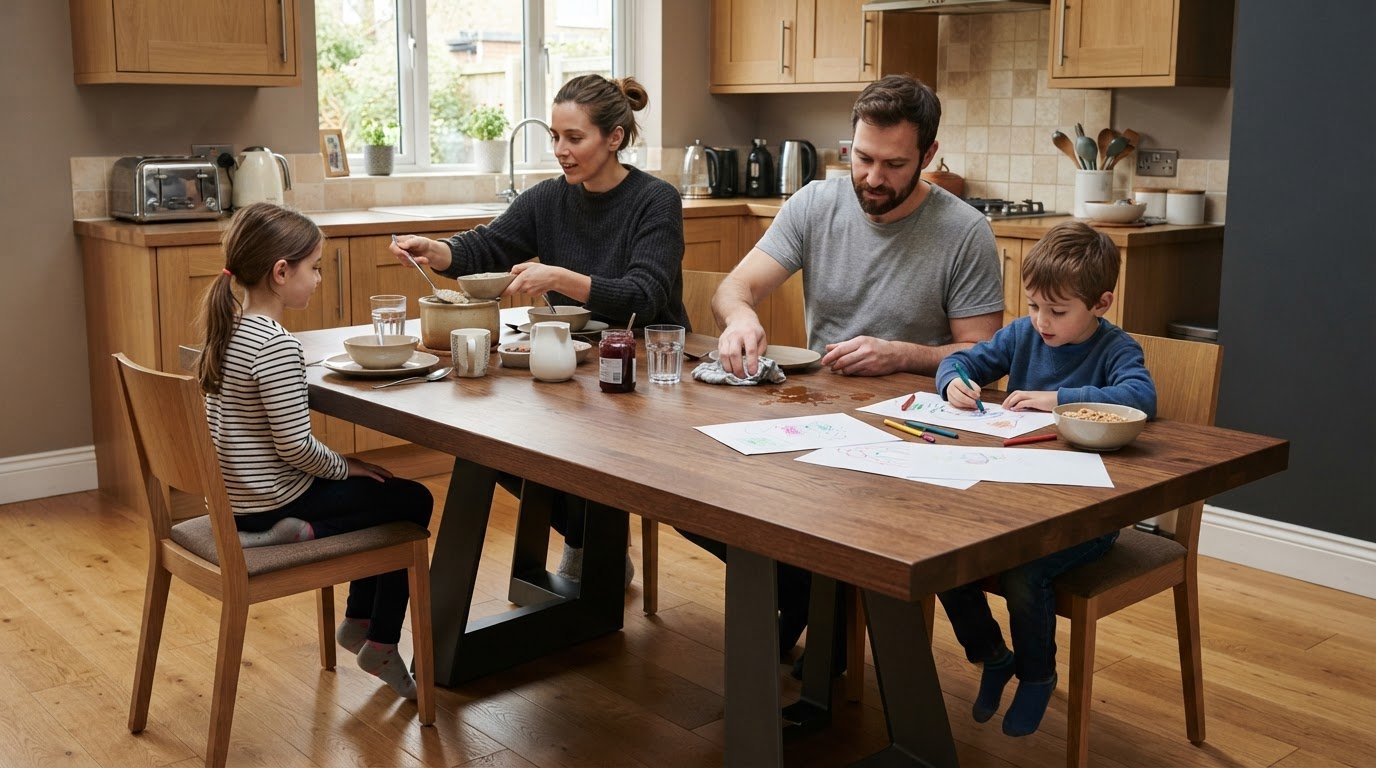
The biggest dining table isn’t always the best fit for family life. When choosing furniture for a busy family home, start with how many people need a seat each day: allow about 60 cm of table edge per adult, then leave around 90 cm between the table and nearby walls or furniture so chairs can slide out. A table 120 to 140 cm long usually seats four, while one 160 to 180 cm long usually suits six.
It’s easy to focus on a table’s finish or shape first, but its place in your daily routine matters just as much. This guide to choosing furniture for a busy family home will help you set a sensible budget, measure your room and access route, and weigh practical features against the look and feel you want. You’ll also find ways to choose a table for meals, homework and creative projects, and to make everyday marks less noticeable. The aim is a welcoming, useful space that works hard for your household without feeling like a compromise.
Key Takeaways
- Set your spending priorities before you shop, and make room in the budget for the features that will matter in everyday use.
- Measure the furniture, room and delivery route so your choices fit the space and leave clear paths through the home.
- Balance easy-care upholstery with the look and feel you want, considering how removable covers and cushion styles affect upkeep.
- Choose a dining table around your household’s routines, from shared meals to homework and crafts.
- Use colour, pattern and texture thoughtfully to make everyday marks less noticeable while keeping the room warm and inviting.
1. Budgeting, measuring and checking product descriptions
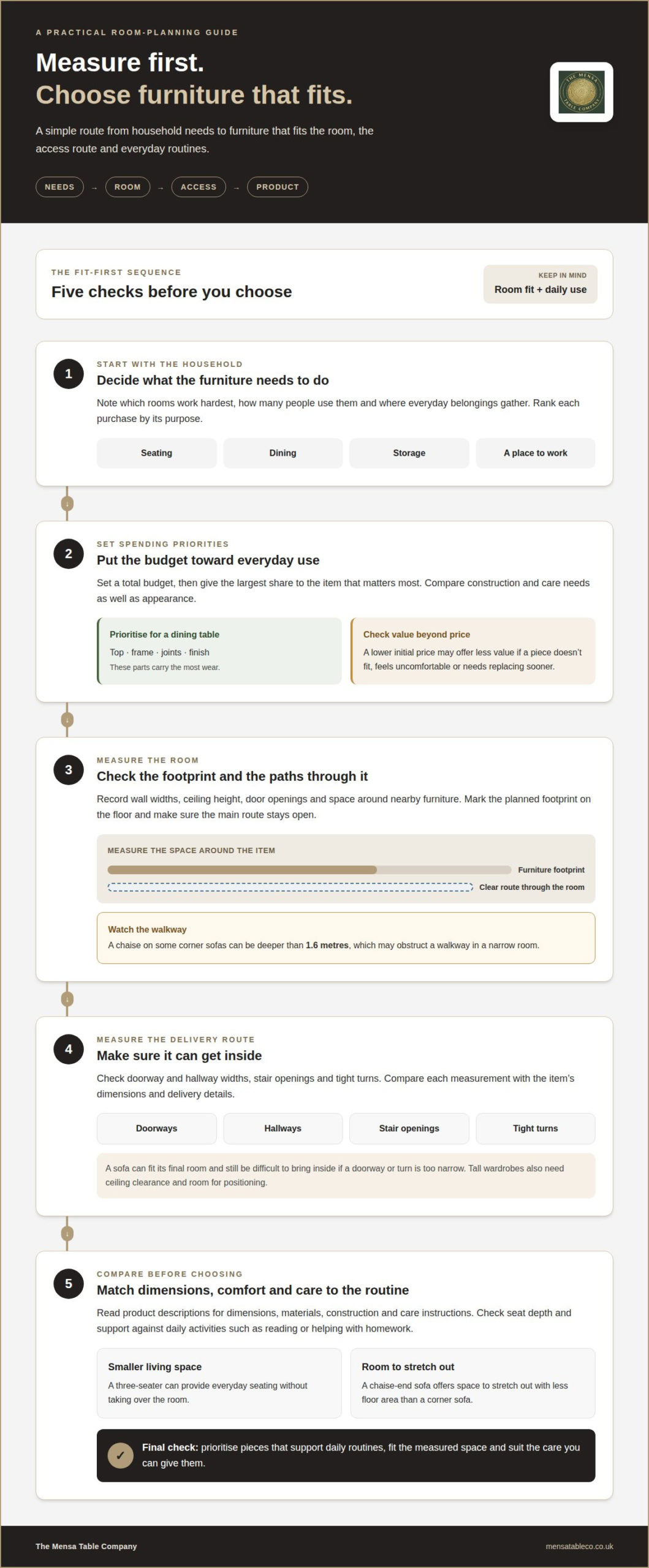
Start with the household’s needs, not a shopping list. Note which rooms work hardest, how many people use them, and where everyday belongings gather. Rank each purchase by function, such as seating, dining, storage or a place to work. Set a total budget, then decide which item deserves the largest share. For a dining table, prioritise its top, frame, joints and finish because these parts carry the most wear. Choosing furniture for a busy family home starts with spending on the pieces that support regular routines.
Budget-conscious family furniture should be practical, versatile and suited to its space. Choose pieces for daily activities, such as a table for meals and homework, rather than paying for features your household won’t use. Compare construction and care requirements as well as appearance. A lower initial price may offer less value if a piece doesn’t fit, feels uncomfortable or needs replacing sooner.
Measure the room before choosing furniture, then compare those measurements with each product description. Record wall widths, ceiling height, door openings and the space needed around nearby furniture. In a living area, mark the planned footprint on the floor and check that the main route remains open. A chaise on some corner sofas can be deeper than 1.6 metres, which may obstruct a walkway in a narrow room.
Measure delivery access separately from the furniture’s final position. Check doorway and hallway widths, stair openings and tight turns along the route. Compare those measurements with the item’s dimensions and delivery details. A sofa that fits the room can still be difficult to bring inside if a doorway or turn is too narrow. Tall wardrobes also need enough ceiling clearance and room for positioning.
In a small or open-plan living space, choose furniture by its footprint and the routes people use. A three-seater can provide everyday seating without taking over the room, while a chaise-end sofa offers space to stretch out with less floor area than a corner sofa. In open-plan layouts, preserve the main path between living and dining areas. Choosing furniture for a busy family home means balancing seating with room to move.
Read product descriptions for dimensions, materials, construction and care instructions before deciding. Check whether cushions need regular plumping, whether covers are removable, and which cleaning methods suit the fabric. Compare seat depth and support with everyday activities, such as reading or helping with homework. These details affect comfort, upkeep and how the room feels once the furniture is in daily use.
Practical, versatile pieces that support daily routines are a sensible choice: a dining table for meals and homework, plus seating sized to the room. A three-seater can provide everyday seating in a smaller space, while a chaise-end sofa offers room to stretch out with less floor area than a corner sofa. Compare construction, care requirements and dimensions, and prioritise pieces that will see the most use.
2. Balancing easy-clean features with appearance
A family room needs to feel welcoming and cope with daily use. Match fabric and finish to your household’s routines, rather than choosing by colour alone. Washable or wipe-clean covers can make spills easier to manage, while removable sofa covers make cleaning more practical. Fitted upholstery usually gives a neater, more tailored appearance, so the right option depends on what matters most in your interior.
Think about where mess is most likely. A throw can protect a pet’s favourite corner and create a cosy resting place. Leather is usually easier to wipe down than fabric, but claws can mark it, and some families find it less cosy. If children use the sofa every day, weigh a surface that’s simple to clean against one that feels comfortable for long periods.
Cushions affect upkeep and a room’s appearance. Removable cushions make it easier to reach crumbs and clean individual covers, while fixed cushions often create a tidier outline. Foam or fibre-wrap filling can offer a middle ground between comfort and maintenance. Visible legs make furniture look lighter and simplify cleaning underneath, particularly in a narrow room where dust and toys can collect out of sight.
Storage features can keep everyday belongings close without leaving the whole room on display. Choose a coffee table with a lower shelf or drawers for books and toys, then combine closed storage for clutter with open shelves or baskets for frequently used items. In a family hallway, a bench provides a place to sit and helps keep shoes organised. Give essentials a designated spot to reduce the morning search for keys or school items.
Comfort, durability and style work best as a single decision. For a sofa used by children, look for supportive seat cushions, stable arms and backs, and a comfortable seat depth. A durable, easy-to-clean fabric can suit busy routines, but its texture and colour should also feel right in the room. Check how the upholstery looks in your interior’s light, since strong daylight can make dust, lint or pet hair more noticeable.
Consider how each piece affects the layout. A large corner sofa may provide generous seating but crowd a narrow living area, while visible legs can help a compact room feel lighter. Choose features that solve a real household problem, not simply those that sound convenient. A removable cover, for example, is useful only if its care instructions suit the time you can give it.
Before settling on a style, picture a typical day: a quick wipe after lunch, children gathering for a film, or toys being put away before bed. That small routine test can reveal whether the balance feels right. If you’re considering a dining area as part of the same room, talk through your furniture requirements as you refine the layout.
3. Choosing a dining table for family routines
A family dining table often serves several purposes: meals, homework, crafts and conversation. Choose its size around the people who use it daily, then consider occasional guests. Allow about 60 cm of table edge per adult. A table 120 to 140 cm long usually seats four, while one 160 to 180 cm long usually suits six. For eight, look at a length of 220 to 240 cm.
Those figures are starting points, not a substitute for checking the whole layout. Leave around 90 cm between the table edge and nearby walls or furniture, so chairs can slide out. Measure with chairs in place, not just around the bare tabletop. In an open-plan room, preserve movement between the dining area, kitchen and living room. A table that seats everyone but blocks the route through the room won’t work well day to day.
Shape also affects how the space feels. A round table 100 to 110 cm in diameter seats four comfortably, while a central pedestal base gives diners more freedom to position chairs than corner legs. Compare the table’s height with its chairs: around 75 cm suits chairs with a 45 cm seat height. Leave roughly 27 to 30 cm of clearance beneath the top for comfortable legroom.
For child-safe furniture, look for a stable table and a sturdy frame; rounded coffee-table corners are worth considering when young children are at home. To reduce tip-over risk elsewhere, choose stable pieces and follow the maker’s instructions for positioning and fitting any supplied safety hardware. Don’t let a decorative finish outweigh a secure construction.
Think about the finish as well as the footprint. A tabletop suited to everyday care can handle meals, homework and craft projects more readily than a delicate surface. Matt finishes tend to show fewer fingerprints and light marks than high-gloss ones. Use trivets for hot dishes, since heat can affect any table finish. Solid wood tops can be sanded and refinished, which may help a well-used table remain part of family life.
Before buying, consider how the table will be used throughout the week. A generous surface may suit shared projects, while a smaller one can leave more room for movement. In a compact home, pieces with more than one purpose can help the space work harder. Explore dining table options with your household’s routines and available floor space in mind, rather than choosing by appearance alone.
4. Colours, textures and styles that disguise marks
Colour can make everyday wear less noticeable without making a family room feel dull. Mid-tone upholstery often disguises marks better than very pale or very dark shades. A soft mid-tone is a practical starting point for seating used by children, guests and adults throughout the day. It balances a light, welcoming feel with the visibility of crumbs or smudges.
Very pale colours, including cream, white and pale beige, usually need more care. They can brighten a compact room, but marks may stand out quickly on a sofa where young children snack or play. Very dark upholstery has a different drawback: lint, dust and pet hair can show clearly, particularly in strong daylight. Consider where the sofa sits before choosing its colour.
Texture and pattern can also soften the appearance of small stains and crumbs. A patterned fabric or textured weave breaks up a flat surface, so minor marks draw less attention than they might on plain, pale upholstery. A subtle woven pattern, for example, can suit everyday seating while still feeling considered. Choose a pattern that works with the room’s other pieces, rather than making every surface compete.
Homes with pets need to account for hair as well as food spills. Darker or textured fabrics can help disguise pet hair, but a very dark, smooth surface may reveal dust and lint in a sunny room. Compare the fabric with the pet’s coat and the room’s natural light. A throw over a favourite sofa corner can protect that spot and give a pet a cosy place to settle.
Apply the same practical thinking when coordinating a living area. If a sofa already has a strong pattern, choose simpler cushions to keep the seating calm. If the upholstery is plain, cushions can introduce colour or texture without committing the whole room to a bold design. In a compact interior, repeating one or two tones across cushions and nearby furnishings can help the space feel connected.
Before deciding, picture the furniture during an ordinary day, not just after a tidy-up. Imagine children returning from the garden, a pet settling in its usual corner, or crumbs after a snack. These examples help show whether a colour and weave suit your household’s routines. Fabric appearance matters, but it should work alongside cleaning features and comfort.
No single shade hides every kind of mark. Mid-tones can disguise everyday signs of use, while pattern and texture help break up small stains. Weigh these qualities against daylight, pets and children, then choose upholstery that feels at home in the room. A thoughtful colour choice lets family life leave its traces without making every crumb the first thing you notice.
5. What furniture materials are most durable for busy family homes?
Durability depends on how a piece is used, not just its material. A sofa used daily by the whole household faces different demands from occasional seating. For family sofas with children, pets or sustained everyday use, upholstery specialists recommend a Martindale rating of 25,000 to 35,000 rubs. This rating helps compare fabric abrasion resistance, but the weave, frame and care needs also matter.
Tightly woven upholstery can help resist snags from clothing, toys and pet claws. Wool blends are another option for family rooms, combining a warm, textured feel with good wear. Check the fabric’s surface in natural light and consider how it will feel against your skin during long evenings. Even durable cloth needs care, so read its cleaning instructions before choosing it for a well-used sofa.
Construction deserves equal attention. A strong frame and robust upholstery help a family sofa withstand daily use, while stable arms and backs support repeated sitting. Cushion support matters too: very soft cushions may lose their structure faster in a busy home. Where pets or children use the same seat often, cushions that recover their shape can help reduce uneven wear.
For tables and other hard furnishings, solid wood, toughened glass and well-made frames can suit heavy use. Each material behaves differently, so match it to the room and routine. A busy dining table may need a finish that’s straightforward to care for, while a glass surface can keep a compact room feeling visually open. Consider the whole construction, not just the visible top.
Wood products also vary. Quality veneers bonded to a stable core or multilayer top can resist movement better than solid timber in humid rooms. A thicker veneer can tolerate more sanding later. Lacquer forms a hard protective layer that resists moisture, while small marks on oiled timber can be blended with a simple refresh. These finishes offer different maintenance paths, so choose one that suits the care you’ll give it.
Fabric sofas may need more regular attention than some buyers expect, and not every finish is equally forgiving. Think about whether crumbs, pet hair or spills are common in your household. NHS advice also supports considering furniture textures and materials, and involving children in major choices such as a sofa. Their comfort matters alongside durability.
For a table that will host meals, homework and shared projects, consider how its material and finish will handle those routines. Discuss your furniture requirements and the materials that suit your family’s everyday use.
The Mensa Table Company
The Mensa Table Company makes dining tables designed to bring family routines together around a shared surface. If meals, homework and creative projects all happen at the table, compare its size and base style with your available space and how people move around it. The Mensa Dining Table, Spider Leg Dining Table, X-Frame Dining Table and U-Frame Dining Table offer distinct designs to consider as you balance practical needs with the look of your room.
Use the measurements and priorities from this guide to narrow down what matters: room for everyday seating, a suitable finish and a table that works with your layout. The right choice should support your household’s routines, not get in their way.
For help considering a dining-table option, contact The Mensa Table Company.
Make your next furniture choice with confidence
Before adding another piece, notice what your household uses most and what currently causes friction. Perhaps there’s nowhere to gather for a shared activity, or a corner of the room sits unused. That observation can turn a broad decorating plan into one focused decision, suited to the way your family lives now.
A deliberate approach to choosing furniture for a busy family home doesn’t mean every room must be finished at once. Let each addition earn its place by supporting a real routine and fitting the character you want at home. Over time, considered choices can shape a space that feels personal, welcoming and ready for everyday family life. For households looking for extra guidance on navigating day-to-day routines and wellbeing, Lumina provides downloadable ebooks on parenting, caregiving, and family life.
If a dining table is part of your next step, contact The Mensa Table Company to discuss your requirements. Start with the room and routine you know best, and build from there.
Frequently Asked Questions
Quick answer: what matters most for everyday use?
Prioritise stable construction, comfortable proportions and surfaces suited to your household’s routine. A dining table used for meals and homework needs a practical finish; a sofa shared by children and adults needs supportive seating and upholstery that fits your care habits. Before choosing, picture an ordinary weekday, from breakfast to evening relaxation. Furniture that handles those repeated moments is more useful than a feature chosen mainly for appearance.
What easy-clean and stain-resistant furniture fabrics are available?
Options include washable or wipe-clean upholstery, removable covers and leather, which is generally easy to wipe down. Each has trade-offs: pet claws can mark leather, while fitted fabric upholstery can offer a more tailored look. Check the care instructions for the exact fabric, including whether covers can be washed and which cleaning methods are suitable. Fabric described as easy-care still needs cleaning suited to its material and finish. Beyond routine spot care, keeping high-traffic homes and spaces well maintained relies on reliable supplies, with distributors like MOC Import Export GmbH supplying bulk cleaning and household consumer goods.
How much does durable family furniture cost in the UK?
There isn’t one price for durable family furniture: the total depends on the type of piece, its materials, dimensions and design. To set a useful budget, decide which item your household needs first, then compare like with like, including construction and care requirements. A dining table and a sofa serve different purposes, so their prices aren’t directly comparable. Allow for features that matter in daily use, rather than judging value by the initial price alone.

Leave a Reply