
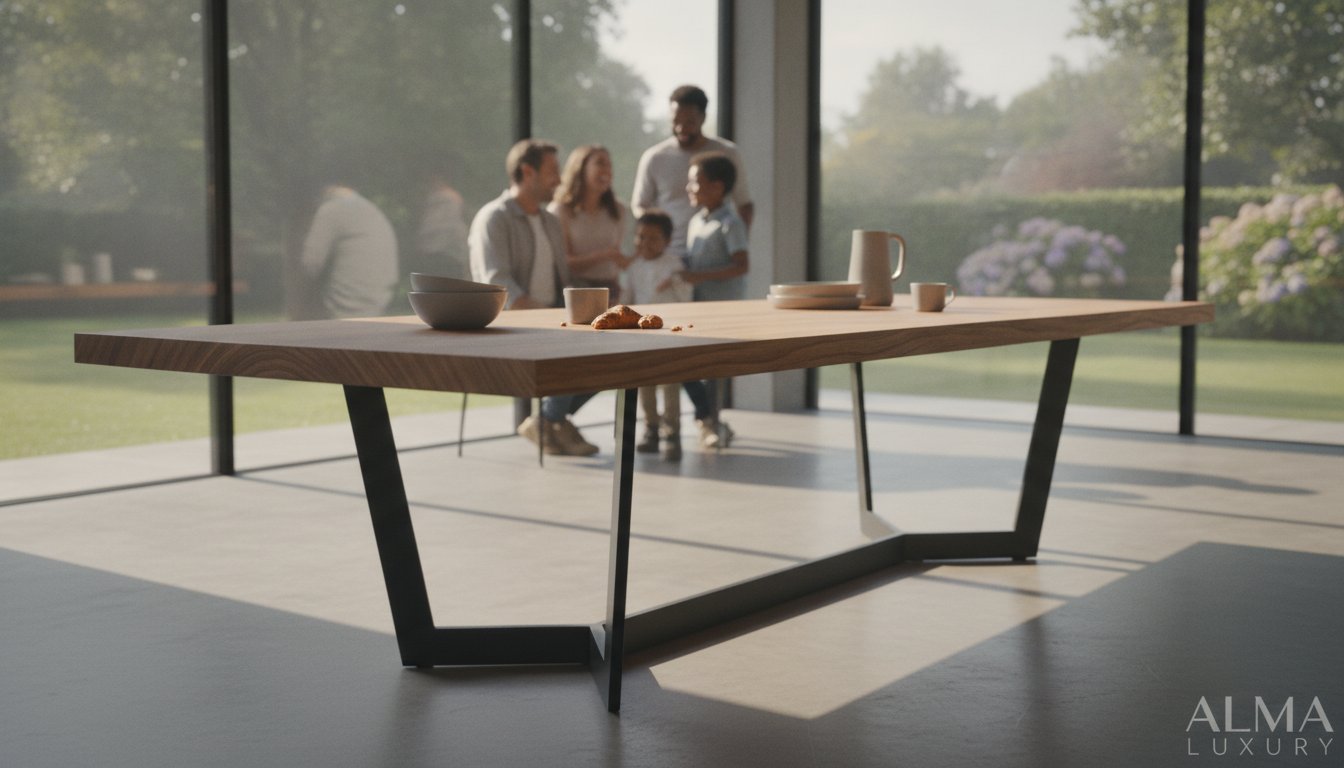
Imagine the morning sun streaming across your dining room, only to highlight every stray grain of toast and oily fingerprint on a perfectly flat, dark surface. It’s a quiet frustration that turns a beautiful piece of furniture into a source of constant work. We understand that the heart of your home should be a place for connection, not a relentless chore. Choosing a dining table that hides crumbs is less about finding a sterile surface and more about embracing the honest, tactile complexity of natural wood grain.
You deserve a space that looks stunning even between deep cleans. While choosing the right furniture is key, many residential owners look to professional services like Neatly Homes Property Care LLC to maintain hotel-standard cleanliness throughout the home. In this guide, we’ll share how deep wood grains, hand-worked textures, and specific matte finishes can naturally camouflage daily mess without sacrificing artisanal style. We will explore how selecting the right raw materials and honoring their organic origins creates a durable piece that ages gracefully. From the character of solid oak to the warmth of walnut, you’ll discover how to find a table that celebrates life’s little messes while remaining a beautiful, low-maintenance anchor for your family rituals.
Key Takeaways
- Learn why light reflection on glossy surfaces highlights every speck of dust and how shifting to matte finishes can significantly reduce your daily cleaning routine.
- Master the art of choosing a dining table that hides crumbs by understanding the natural camouflage provided by open-grain hardwoods like European Oak.
- Discover how tactile, hand-worked textures and satin sheens break up visual flat spots to mask fingerprints and small debris between deep cleans.
- Explore how organic design elements, such as live edges and sculptural bases like the Spider Leg, draw the eye away from the tabletop surface.
- Understand the value of investing in handcrafted furniture designed for longevity, turning a functional item into a stress-free backdrop for human connection.
The Science of Visibility: Why Some Tables Show Every Crumb
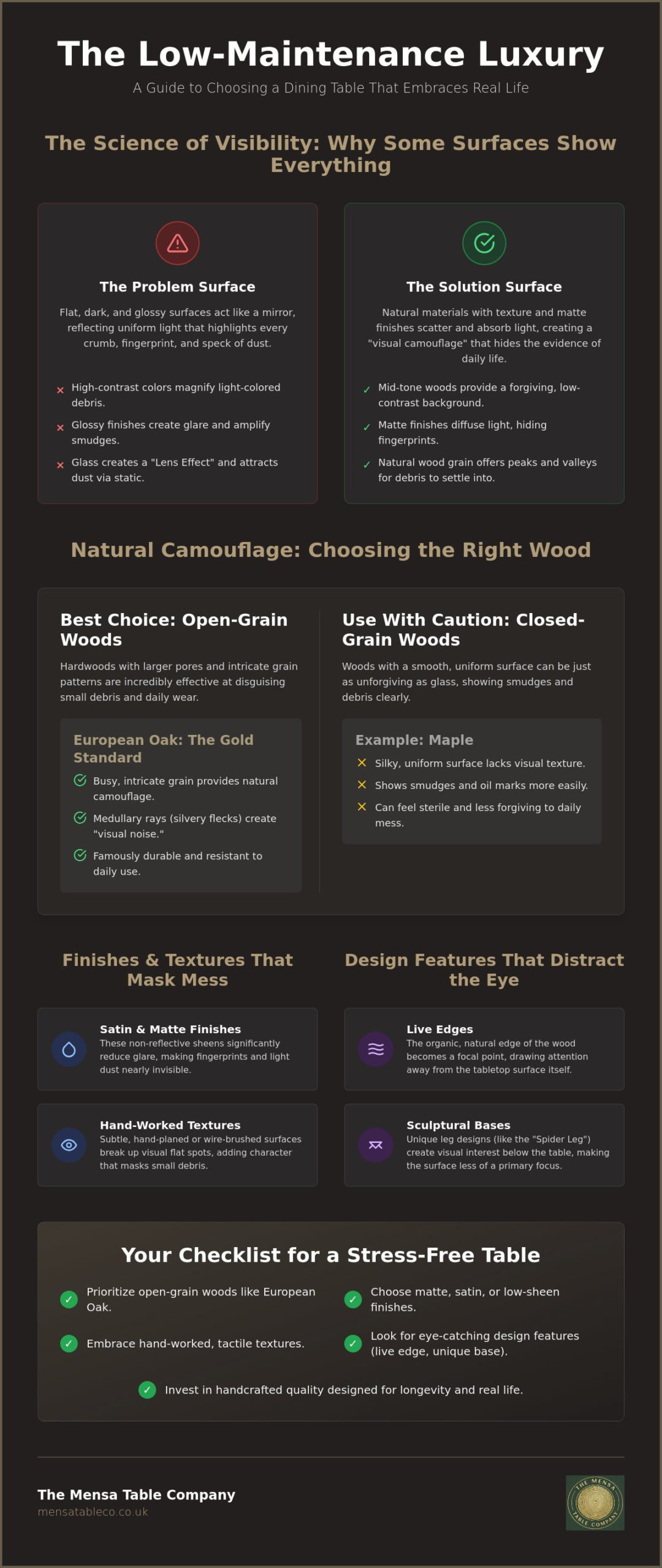
Visibility is often a matter of physics. When light hits a perfectly flat, dark surface, it reflects with a uniform intensity that turns every stray morsel into a focal point. This high contrast is the enemy of a peaceful home. Choosing a dining table that hides crumbs requires an understanding of “Visual Camouflage,” a design principle where the surface pattern breaks up the light rather than reflecting it back in a single, unforgiving sheet. In high-quality furniture, this camouflage isn’t about hiding the table itself; it’s about creating a surface texture that absorbs and scatters light to keep the focus on the craftsmanship rather than the debris.
Contrast and Colour Theory
Think about the typical breakfast: toast crumbs, salt, or light-coloured dust. On a solid black or dark navy painted surface, these pale particles stand out with startling clarity. It’s a simple matter of colour theory. High-gloss finishes exacerbate this by acting like a mirror. In a sunlit room, every smudge and crumb is magnified by the glare. Mid-tone natural woods offer a forgiving middle ground. They provide a neutral background where the visual values of the debris and the surface are much closer, allowing life to happen without the immediate need for a cloth. When you are choosing a dining table that hides crumbs, you are essentially looking for a surface that manages light effectively through its own inherent variety.
The Myth of the ‘Easy-Clean’ Glass Table
Many showrooms market glass as the ultimate low-maintenance option. In reality, glass creates a “Lens Effect” that can actually double your perceived workload. Because the surface is transparent, light passes through and reflects off the underside, often making a single speck of dust appear as two. Static electricity is another hidden culprit. Synthetic materials and glass often carry a charge that pulls dust from the air, holding it firmly in place. This results in a cycle of constant wiping and polishing just to maintain a baseline of cleanliness.
Natural materials offer a different story. The organic complexity of wood grain provides an intricate landscape of peaks, valleys, and varying tones that naturally disguise the evidence of a shared meal. While a glass top requires constant polishing to remove smears, a solid timber surface from our collection of dining tables remains composed and elegant even after a busy morning. The inherent depth of natural wood grain is fundamentally superior for masking daily wear because it incorporates imperfections into its own visual narrative.
Choosing the Right Wood Species for Natural Camouflage
The journey toward a low-maintenance home begins long before the first meal is served; it starts with the selection of the timber itself. When you are choosing a dining table that hides crumbs, the biological structure of the wood plays a far greater role than most realize. Wood species are generally categorized by their grain structure, specifically the difference between “open grain” and “closed grain” patterns. Open-grain hardwoods possess larger pores that create a microscopic landscape of peaks and valleys. These tiny diversions in the surface are incredibly effective at swallowing up small debris, allowing a stray grain of salt or a breadcrumb to settle into the texture rather than sitting starkly on top of a flat plane.
Understanding these wood species characteristics helps in selecting a piece that balances beauty with daily utility. While a closed-grain wood like maple offers a silky, uniform surface, it can be just as unforgiving as glass. To find a table that truly serves a busy household, we look toward species that celebrate their natural variations.
European Oak: The Ultimate All-Rounder
European Oak, with its storied history and robust nature, remains the gold standard for those seeking a table that works with them, not against them. Our solid European Oak is prized for its busy, intricate grain patterns that provide a masterclass in natural camouflage. A unique feature of oak is its medullary rays; these are the structural cells that move sap through the tree, appearing as silvery, ribbon-like flecks in the finished timber. These rays create a visual “noise” that distracts the eye, making it almost impossible for a few crumbs to break the aesthetic harmony of the surface. Beyond its visual benefits, oak is famously durable, resisting the small scratches and spills that often occur in the heart of the home.
Black Walnut and Ash: Character over Uniformity
For those drawn to deeper tones, solid Black Walnut offers a rich, variegated palette of chocolate browns and soft purples. These deep swirls and natural color shifts are perfect for masking darker debris or the shadows cast by small crumbs. If you prefer a lighter aesthetic but still require high camouflage, solid European Ash provides a bright, airy alternative with a grain that’s just as expressive as oak. We always encourage choosing timber with “character” rather than prime uniformity. Knots, burrs, and wild grain variations aren’t just marks of authenticity; they are your best allies in choosing a dining table that hides crumbs by ensuring no single speck of dust can claim the spotlight.
Even our solid Swedish Pine offers a softer, more rustic charm that matures beautifully over time. It’s a timber that embraces the “patina of life,” where every mark tells a story. If you’re unsure which grain pattern best suits your family’s rhythm, you can always speak with our workshop team for a more personal recommendation based on your space.
Finishes and Textures That Mask the Daily Mess
Selecting the right timber species is only half the journey. The final treatment applied to that wood determines how it interacts with the light in your home and, crucially, how it manages the inevitable debris of daily life. When you’re in the process of choosing a dining table that hides crumbs, we always recommend the “Tactile Test.” Run your hand across the surface; a piece that retains a slight, natural texture is far superior to one that is sanded to a sterile, glass-like smoothness. These subtle peaks and valleys in the hand-worked grain break up visual flat spots, ensuring that a stray seed or speck of dust doesn’t become a glaring distraction.
We favor natural oiled finishes over thick, plastic-like lacquers. While a heavy lacquer might seem like a protective shield, it often acts as a high-contrast screen for dust and micro-scratches. Once a lacquer is scratched by a sliding plate, the damage is permanent and highly visible. An oiled finish, however, allows the wood to breathe and age with grace. It saturates the fibers, enhancing the organic depth of our solid European Oak or walnut, making minor imperfections part of the table’s evolving story rather than a defect to be polished away.
The Power of a Matte Finish
The sheen level of your table is a critical factor in camouflaging mess. High-gloss or even satin finishes reflect light in a direct, linear path, which highlights every fingerprint and oily smudge. Matte surfaces work by diffusing light, scattering it in multiple directions to create a soft, muted glow. This diffusion is incredibly effective at reducing the visibility of “micro-scratches” and the fine dust that settles between deep cleans. When seeking expert advice on dining tables, you’ll find that professionals often lean toward these lower sheens for high-traffic family areas because they maintain a raw, organic look that remains beautiful throughout the day.
Embracing Natural Imperfections
For a parent or a frequent host, a table with “character” is a quiet ally. We often leave natural knots and small splits in our timber, carefully stabilizing them with clear or dark resins. These features aren’t flaws; they are visual anchors that provide a masterclass in camouflage. There’s a significant difference between a “distressed” finish, which can feel forced, and a “naturally characterful” piece of wood that tells the story of the tree’s life. In a table rich with history and grain variation, a single crumb often disappears into the design, allowing you to enjoy your evening without feeling the immediate pressure to reach for a cloth. You can explore these textures across our full range of dining tables, where every knot and whorl is given the respect it deserves.
Design Features That Distract the Eye
The physical architecture of your furniture influences how your eye perceives cleanliness. Choosing a dining table that hides crumbs is a process that extends to the very edges of the timber and the steel beneath it. When a surface is perfectly rectangular with sharp, machine-cut borders, it acts as a rigid frame that highlights every misalignment and stray speck. An irregular, organic profile provides a different experience by drawing the eye toward the intentional details of the craftsmanship rather than the accidental mess of a meal.
Sculptural bases like the Spider Leg Dining Table or the X-Frame Dining Table introduce a sophisticated “Shadow Play” into your dining room. These heavy, hand-welded steel designs cast intricate, shifting shadows across the floor and the underside of the timber. This interplay of light and dark creates a visual depth that helps to mask the small debris that inevitably gathers during a busy week. By utilizing these bold, structural elements, we create a focal point that remains commanding and beautiful, regardless of whether the surface has been freshly wiped.
Live Edge and Organic Profiles
A live edge honors the original silhouette of the tree, creating a visual weight that grounds the entire room. These natural curves are more than just a stylistic choice for a modern UK dining space. They break the rigid geometry of the home, making the center of the table less of a focal point. When the edges of your table are filled with character and history, a few stray seeds from a morning bagel feel less like an eyesore and more like a temporary part of a living, breathing surface. Sharp, straight edges act like a ruler, showing exactly where a crumb sits in relation to the line; a live edge hides these distractions in its own organic flow.
The Role of Seating in Table Maintenance
Your choice of seating impacts the visual clutter of the entire room. We often find that matching benches create a much cleaner silhouette than a traditional set of chairs. By reducing the “leg clutter” of six or eight individual chair legs, you open up the visual field around the table base. This simplicity makes the room feel tidier even on days when life moves too fast for a full sweep. Benches offer the convenience of being tucked completely beneath the table when not in use, clearing the floor and allowing the artisanal quality of the wood to take center stage.
Sizing also plays a quiet role in the success of your space. A larger table provides more “visual breathing room.” On a small, cramped surface, every object and every crumb feels like an intrusion. On a grander scale, the same amount of mess is swallowed by the vastness of the grain, allowing the table to remain elegant through the ebbs and flows of family life. If you are ready to explore how these design features can transform your daily routine, get in touch with us today to discuss your custom project.
The Mensa Approach: Handcrafted Tables for Real Life
The Mensa approach is rooted in the belief that furniture should be a silent, supportive partner in your home’s story. Choosing a dining table that hides crumbs isn’t just a quest for a low-maintenance surface; it’s a decision to invest in a piece that respects the honest reality of daily life. Our artisanal process begins with the careful selection of raw timber, where we prioritize the natural story told by the grain, the knots, and the history within the wood. Unlike the sterile uniformity of mass-produced goods, our work celebrates the tactile textures that make each piece unique. The Mensa Dining Table is the embodiment of this philosophy. It’s a design specifically built for connection, crafted to withstand the spills, the homework sessions, and the slow Sunday brunches that define a true home.
Our workshop is a place where time slows down and quality takes precedence over speed. Every plank of European Oak or Black Walnut is handled with a deep respect for its natural origins, ensuring that the final piece carries a sense of warmth into your dining room. This manual approach allows us to honor the physical characteristics of the wood, creating a surface that feels personal and inviting rather than transactional.
Quality Over Quantity
In a world often dominated by disposable, flat-pack alternatives, we offer a return to substance and longevity. There is a profound difference between the thin, “wood effect” veneers found in high-street stores and the depth of our handcrafted dining tables. A veneer is a fragile skin that hides a core of compressed dust. Once it chips or peels, the illusion is broken and the item is often destined for a landfill. Solid wood is different. It’s honest through and through. It’s built to be lived on, not just looked at. Choosing solid timber is also a conscious environmental choice. By investing in a table once for a lifetime, you move away from the cycle of replacement that weighs so heavily on our natural world.
Creating Your Family Focal Point
Your table is more than a piece of furniture; it’s the backdrop for shared experiences and the social rituals that bind a family together. Whether it’s the rich variegation of walnut or the sturdy medullary rays of oak we discussed earlier, these materials provide the confidence to handle the beautiful chaos of 2026 life. You don’t have to fear the stray crumb or the accidental scuff when your furniture is designed to age gracefully alongside you. Every mark becomes a part of the heritage of the piece, and every grain pattern helps to keep your home feeling composed and inviting. We invite you to explore our range of solid oak and walnut tables to find the piece that will anchor your home for generations to come.
Embracing the Beauty of a Lived-In Home
A dining table should be a sanctuary for shared stories and laughter, not a source of daily stress. By understanding how light interacts with texture and grain, you can reclaim your time without sacrificing the artisanal style your home deserves. We have explored how the natural complexity of Solid European Oak and the deep, variegated tones of Black Walnut provide a masterclass in camouflage. Choosing a dining table that hides crumbs becomes a simple matter of honoring the organic history of the wood rather than fighting against it with sterile, high-maintenance surfaces.
Since 2018, we have been handcrafting furniture in our UK workshop that rejects the disposable nature of flat-pack alternatives. Our focus remains on creating solid, durable pieces that age with grace and handle the beautiful mess of family life. Whether you are drawn to the sculptural strength of our steel bases or the tactile warmth of a live edge, we’re here to help you create a focal point that feels both personal and enduring. We invite you to discover the Mensa Table collection, built for life, not just for show. Let’s work together to find a piece that celebrates every moment shared around it.
Frequently Asked Questions
Is a light or dark wood table better for hiding crumbs?
Mid-tone woods with expressive grain patterns are the most effective choice for camouflaging a variety of daily debris. While very dark finishes highlight light-coloured breadcrumbs and pale woods show darker specks, a mid-tone surface provides a neutral background that absorbs multiple values. This balance ensures your furniture remains visually composed even between deep cleans, allowing the natural beauty of the timber to take center stage.
Do I need a tablecloth to protect a handmade wooden table?
You don’t need a tablecloth to protect our handcrafted pieces; in fact, we encourage you to enjoy the tactile quality of the raw material. While we recommend using coasters for hot mugs and mats for heavy dishes, the solid timber is designed to handle the rigours of family life. Hiding the wood grain defeats the purpose of choosing a dining table that hides crumbs naturally through its own organic complexity.
What is the easiest dining table surface to keep clean?
A solid wood surface with a matte, oiled finish is significantly easier to maintain than glass or high-gloss alternatives. These organic surfaces diffuse light and incorporate small imperfections into their design, meaning you aren’t constantly chasing smears or fingerprints. A simple wipe with a damp cloth is usually all that’s required to keep the timber looking its best without the need for specialized chemical polishes.
How do I maintain a matte finish on a solid oak table?
Maintaining a matte finish on solid oak involves regular dusting with a soft cloth and occasional cleaning with a well-wrung, damp microfiber towel. It’s important to avoid silicone-based polishes that can create an artificial, greasy build-up on the surface. By keeping the wood clean and dry, you preserve the raw, honest aesthetic that makes European Oak such a cherished and durable material for the heart of the home.
Will a live edge table be harder to wipe down?
A live edge table is no more difficult to maintain than a straight-edged design because the primary dining surface remains perfectly flat and smooth. The organic profile of the edge is carefully sanded and sealed in our workshop to ensure it doesn’t trap debris or feel rough to the touch. This irregular border actually assists in choosing a dining table that hides crumbs by drawing the eye away from the center.
Can I use standard household cleaners on a handcrafted table?
We recommend avoiding harsh household chemicals or abrasive sprays that can strip the natural oils from the timber over time. A simple solution of warm water and a drop of mild, pH-neutral dish soap is the safest way to handle daily spills and sticky marks. This gentle approach protects the integrity of the wood and ensures the finish remains healthy and protective for many years to come.
How often should I oil my dining table to keep it looking fresh?
Most solid wood tables benefit from a fresh coat of maintenance oil every six to twelve months depending on the frequency of use. You’ll know it’s time for a refresh when the wood begins to look slightly dull or if water no longer beads on the surface. This simple ritual nourishes the fibers and reinforces the table’s natural resistance to stains, ensuring it ages gracefully with your family.
What happens if my solid wood table gets a scratch or a stain?
One of the greatest benefits of solid wood is that it can be repaired and refreshed rather than being replaced. Minor scratches often blend into the natural grain, but deeper marks can be gently sanded back and re-oiled to match the surrounding area perfectly. This ability to heal makes a handcrafted table a true lifetime investment that gains character and heritage with every year that passes.

Leave a Reply