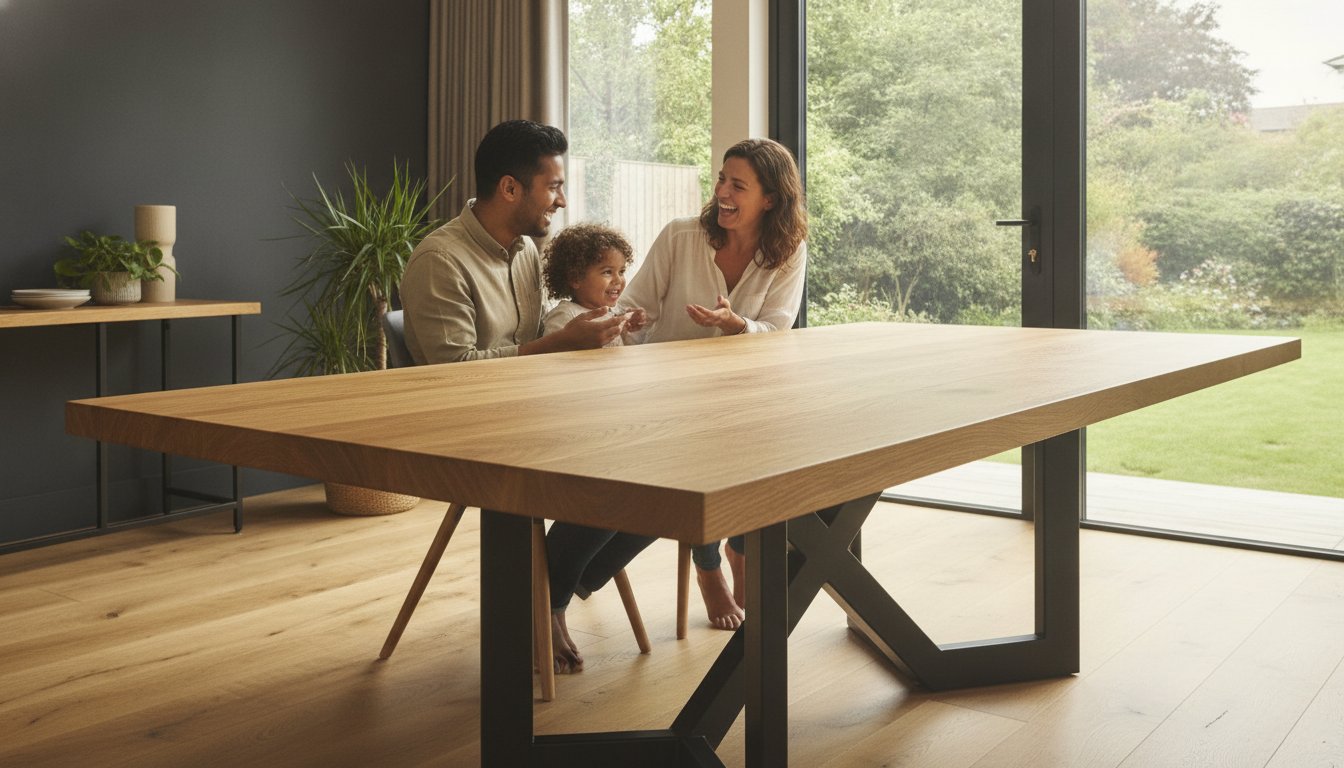
Could the very center of your home be a hidden source of worry for your family? We often think of the dining area as a sanctuary for connection, yet many modern pieces trade structural integrity for convenience. You’ve likely felt that frustrating sway of a lightweight frame or worried about the harsh chemicals used in mass-produced finishes. It’s a common concern, especially when your home’s focal point should be a place of absolute security. In this guide, we’ll help you identify the best safest dining table by evaluating the raw materials and the manual techniques that ensure lasting stability.
You deserve peace of mind every time your family gathers. We’ll show you how to choose furniture that prioritises non-toxic finishes and heavy, solid timber over flimsy, mass-produced alternatives. You’ll learn why the physical mass of the wood matters for safety, how to spot artisanal craftsmanship that protects little ones from sharp edges, and why investing in a handcrafted piece creates a stable foundation for your home’s most precious rituals. From structural mass to ethical sourcing, we’ll guide you through every detail that makes a table truly secure and enduring.
Key Takeaways
- Learn why choosing solid timbers like European Oak or Ash is essential to avoid the hidden VOCs and formaldehyde often found in cheap MDF furniture.
- Discover why physical mass and a wide base are the primary factors when identifying the best safest dining table for a high-traffic family home.
- Understand how specialised leg designs, such as the Spider Leg, provide central stability while ensuring the furniture remains resistant to tipping.
- Find out how to select the right corner profiles and room clearances to prevent accidental injuries and ensure a comfortable, safe flow in your dining space.
- Explore why permanent, handcrafted joints offer far superior structural integrity compared to the flimsy connections found in mass-produced alternatives.
What Defines the Safest Dining Table for a Modern Home?
When you sit down for a meal, you shouldn’t have to think about the furniture beneath you. True safety in a home’s focal point is a quiet, invisible quality. It’s a combination of physical stability, meticulous edge finishing, and the health of the materials used in the workshop. While many mass-produced options focus on aesthetic trends, the best safest dining table is one that prioritises the physical well-being of those gathered around it. This involves looking past the grain pattern to understand how the piece is anchored and finished.
Throughout the history of Table design and function, the most reliable pieces have always shared a common trait: substantial mass. In a busy household where children play and guests lean, a table must be more than a surface; it must be a secure anchor. We view safety as a lifecycle that begins the moment a heavy, solid piece is set in place, continuing through decades of shared meals and social rituals without ever losing its structural integrity.
The Three Pillars of Table Safety
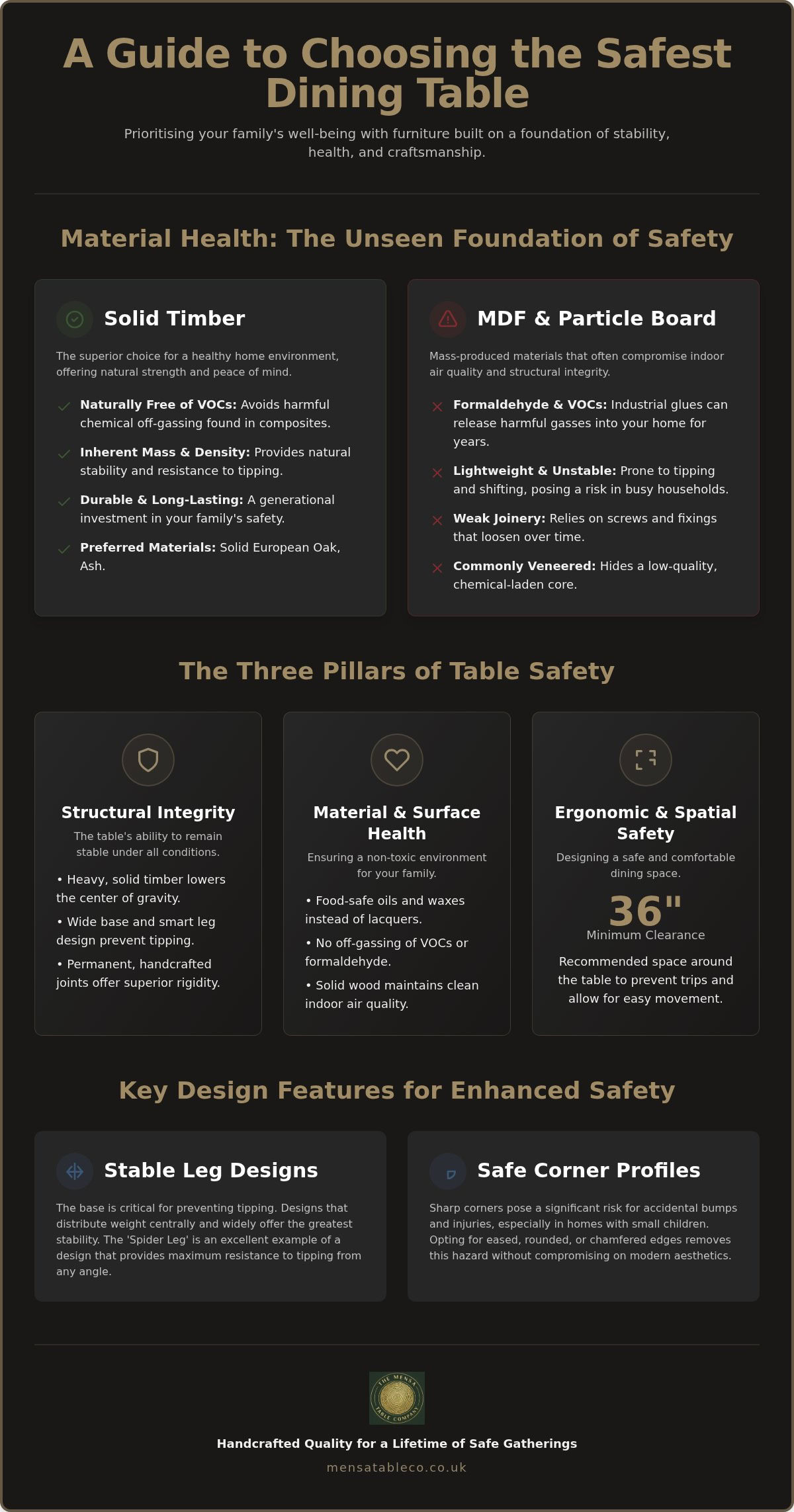
We define safety through three essential lenses. First is structural integrity, where the frame and legs are engineered to support far more than just the weight of the timber. Second is surface safety, which relies on the use of non-toxic oils and waxes to create a food-safe environment free from harsh chemical off-gassing. Finally, ergonomic safety ensures the piece respects the human body. Following guidelines from the National Kitchen and Bath Association, we recommend at least 36 inches of clearance around your dining tables to prevent trips and allow for comfortable, unhindered movement.
Why Weight Matters for Stability
Lightweight, flat-pack furniture often presents a significant tipping risk, especially when weight is applied to an edge or a corner. Solid wood furniture offers a natural solution through its sheer density. When we work with solid European oak or ash, we aren’t just choosing a beautiful material; we’re selecting a ballast that keeps the home safe. Structural ballast in the context of solid wood furniture is the inherent mass of the timber that lowers the piece’s center of gravity, providing a natural resistance to tipping or sliding during daily use. This weight ensures that even a heavy knock from a child or a leaning adult won’t cause the table to shift or collapse, providing a level of security that lighter materials simply cannot match.
The safety of a table also depends on what you can’t see. Unlike temporary fixings that loosen over time, permanent, handcrafted joints ensure the piece remains rigid for generations. By rejecting flimsy screws in favour of traditional joinery, we ensure that the table’s safety lasts as long as the timber itself, turning a simple piece of furniture into a reliable legacy for your family.
Material Health: Why Solid Wood is the Safest Choice
While structural weight provides physical security, the materials within the grain determine the long-term health of your home environment. Choosing the best safest dining table means looking beyond the surface to ensure the timber isn’t harbouring hidden chemicals. Many mass-market options use veneers over medium-density fibreboard (MDF) or particle board. These composites rely on industrial glues that can release formaldehyde and volatile organic compounds (VOCs) into your dining room for years. Through the use of natural, sustainably sourced timber, we ensure your living space remains free from these irritants.
Indoor air quality is a silent pillar of safety. VOCs are chemicals that evaporate at room temperature, often originating from the synthetic resins used in mass-produced furniture. Solid timber avoids this risk entirely. We favour hand-applied oils and waxes over heavy industrial lacquers. These finishes are not only safer for food contact but also allow the wood to breathe, maintaining its natural character without compromising your family’s health. If you’re curious about which timber best suits your family’s lifestyle, feel free to reach out to our workshop team for a personal recommendation.
The Truth About Off-Gassing in Cheap Furniture
Off-gassing describes the slow release of trapped gasses from manufactured materials. In the dining room, where heat and moisture are common, this process can accelerate. Solid wood furniture acts as a natural alternative, improving indoor air quality by replacing chemical-heavy composites with pure, organic material. Identifying safe finishes is equally vital; we look for artisanal oils and water-based lacquers that provide a protective barrier without the toxic footprint of traditional solvent-based products.
Hardwood vs. Softwood: A Safety Comparison
The choice of species also plays a role in the daily safety of your household. Different timbers offer unique physical benefits that contribute to a secure dining environment. Beyond the health of the air, the density of these timbers also contributes to the overall stability of the piece. This mass is a critical deterrent against furniture tip-over incidents, as solid wood provides the necessary weight to keep the table grounded.
- Solid European Oak remains the gold standard for many families due to its incredible density and dent resistance. It handles the rigours of a busy kitchen without splintering or degrading over time.
- For those seeking an exceptionally smooth surface, Solid Black Walnut offers a tight grain that feels soft to the touch and remains splinter-free over decades of use.
- If you prefer a lighter feel, Solid Swedish Pine provides a structurally sound alternative that is slightly softer, making it a gentle choice for homes where a more tactile, warm atmosphere is desired.
Real wood also possesses natural anti-bacterial properties. Studies have shown that certain hardwoods can neutralise bacteria more effectively than plastic or laminate surfaces. This makes solid timber a naturally hygienic choice for food preparation and communal dining, ensuring your table remains a clean and safe sanctuary for generations.
Stability and Support: Evaluating Leg Designs for Safety
The structural foundation of your furniture dictates how it responds to the unpredictable energy of a busy home. While we’ve discussed the importance of timber mass, that weight must be balanced by a support system that resists tipping and swaying. To find the best safest dining table, you must look at the footprint of the legs. A table’s resistance to lateral force depends entirely on how the frame distributes the weight of the solid timber top across the floor. In our workshop, we ensure every metal and wood frame is finished without sharp burrs or edges, protecting hands and knees from industrial hazards.
Design and safety aren’t mutually exclusive. The Spider Leg Dining Table is a perfect example of this balance. While the central support offers ample legroom, the legs splay outward to create a wide, secure base that prevents the table from becoming top-heavy. This design ensures that even if a guest leans heavily on one corner, the centre of gravity remains firmly within the support zone, providing a level of security that lightweight, four-legged alternatives often lack.
Comparing Frame Styles for Tipping Resistance
Different frame styles offer unique advantages for home safety. The X-Frame Dining Table is a traditional choice for longer pieces, as the wide-set support at either end provides maximum weight distribution for heavy family gatherings. For those who prefer modern architectural lines, the U-Frame and Trapezium models offer a broad, safe base that sits flush against the floor, significantly reducing the risk of the table sliding or shifting. Similarly, the A-Frame and V-Frame designs balance striking visual appeal with structural security, ensuring the table remains a steady anchor for your daily rituals.
The Physics of a Safe Dining Table
The relationship between the tabletop and its support system is governed by physics. As the thickness and weight of the wood increase, the leg system must become more robust to maintain a low centre of gravity. This is a critical factor highlighted in the CPSC Furniture Stability Guidelines, which emphasise how weight distribution prevents accidental tip-overs. We rely on high-quality mechanical fixings rather than glue-only construction, ensuring the bond between the legs and the top never falters under pressure.
Safety also extends to how you sit. We’ve found that pairing your table with handcrafted benches often provides a more stable seating environment than lightweight chairs. Benches offer a lower centre of gravity and a much wider footprint, making them far less likely to tip over when children are climbing on or off. This holistic approach to stability ensures every element of your dining set works together to protect your family.
Practical Selection: Choosing Your Table Based on Safety Needs
Selecting the best safest dining table requires a thoughtful look at the environment where it will reside. A piece of furniture doesn’t exist in a vacuum; it interacts with your family, your pets, and the very architecture of your room. While a large, grand surface is often desirable, an oversized table can become a safety hazard if it restricts movement. We recommend following the National Kitchen & Bath Association (NKBA) guideline of maintaining at least 36 inches of clearance between the table edge and the nearest wall. This space allows chairs to be pulled back freely and ensures that people can move through the room without risk of tripping or bumping into corners.
The profile of the table’s edge is another vital consideration. While square edges provide a clean, contemporary aesthetic, they can be unforgiving in a home with active children. Chamfered edges offer a sophisticated middle ground, while fully rounded profiles provide the highest level of impact safety. To ensure your table remains perfectly level and secure on any surface, we use high-quality floor protectors that prevent the piece from sliding on polished stone or damaging delicate hardwood floors, maintaining the stability of our dining tables throughout their life.
Matching the Table to Your Household
In homes with toddlers, the combination of a heavy base and rounded edges is the gold standard for safety. For multigenerational households, accessibility is key. We ensure our furniture meets standard heights between 28 and 34 inches to provide comfortable support and easy access for everyone. You can also perform a simple “Reach Test” in your space; if a person has to overextend to pass a dish or lean too far forward, the table might be too wide for safe, comfortable use. If you have questions about the right dimensions for your home, you can talk to our team about custom sizing to ensure a perfect fit.
Maintenance as a Safety Practice
Safety is an ongoing commitment that continues long after the table arrives in your home. Maintaining proper timber hydration through regular oiling ensures the wood grain remains supple and sealed, effectively preventing the formation of sharp splinters or structural cracks. We also suggest a quick annual check of the mechanical fixings. Even the most robust best safest dining table can experience slight movement due to seasonal changes in humidity, and ensuring every bolt remains tight keeps the structure as stable as the day it left our workshop.
The Mensa Approach: Handcrafted Quality as the Ultimate Safety
Our workshop operates on a simple, unwavering belief: a table should be as permanent as the memories made around it. We’ve purposefully rejected the modern “flat-pack” philosophy, where convenience often comes at the cost of structural integrity. Instead, we embrace the slow, deliberate work of creating permanent, solid joints that won’t loosen or fail over time. When we select our timbers, we look for more than just a beautiful grain. We evaluate every board for structural reliability and grain health, ensuring that the best safest dining table for your home starts with the raw integrity of the wood itself.
From the first cut of the timber to the final hand-applied finish, our commitment to safety is personal. We view the artisanal process as the only way to ensure every edge is finished with care and every fixing is placed with precision. This manual approach allows us to create durable, safe furniture that mass-produced factories simply can’t replicate. By choosing substance over flashy marketing, we provide a thoughtful, intentional alternative that values the connection between the creator and the families who will use our work for generations.
The Signature Mensa Dining Table
The Mensa Dining Table stands as the cornerstone of our collection, embodying our commitment to timeless style and uncompromising stability. Every piece is handcrafted in the UK, where our team manages every detail of production to ensure a secure, grounded presence in your home. Unlike mass-market pieces that rely on chemical-heavy veneers, our flagship design uses the natural mass of solid timber to create a stable focal point that resists tipping and swaying.
Bespoke Solutions for Unique Spaces
Safety shouldn’t be limited to the dining room, which is why we apply the same rigorous standards to our breakfast bars and kitchen islands. Choosing coffee tables that match these standards creates a cohesive, secure environment throughout your living space. Since every home is unique, we offer personalised safety through custom sizing, allowing you to tailor the dimensions of your furniture to fit your room perfectly. This ensures you maintain proper clearance and stability, regardless of your floor plan’s specific challenges.
Building a Secure Foundation for Your Home
Choosing a dining table is a commitment to your family’s daily well-being. Throughout this guide, we’ve explored how the best safest dining table is defined by its physical mass, the health of its raw materials, and the precision of its joinery. By moving away from flimsy, chemical-heavy composites and embracing solid timber construction, you’re investing in a piece that offers ultimate stability and multi-generational durability. Every table we create is handcrafted in the UK using non-toxic finishes, ensuring that your home remains a sanctuary for connection and growth.
Your dining space should be a site of absolute peace of mind. Whether you’re identifying the needs of a home with toddlers or seeking a stable focal point for shared social rituals, the right choice combines structural mass with intentional design. We invite you to move beyond the transactional nature of modern furniture and discover the value of true craftsmanship. Explore our range of handcrafted, solid wood dining tables and find a secure anchor that will serve your household for decades to come.
Frequently Asked Questions
Are round dining tables safer than rectangular ones?
Round tables are often considered safer in households with young children because they lack sharp corners. However, safety also depends on the base. A round table with a narrow pedestal can be less stable than a rectangular table with a wide-set frame. If you choose a rectangular style, opting for rounded or chamfered corners provides a similar level of protection while maintaining the superior stability of a four-legged or X-frame base.
What is the most stable leg design for a large dining table?
For larger surfaces, the X-Frame and Spider Leg designs offer the highest levels of stability. The X-Frame distributes weight across a broad footprint at either end, while the Spider Leg uses a central splayed structure to prevent tipping. These designs ensure the best safest dining table remains grounded even when weight is applied to the edges, providing a secure foundation that lightweight, mass-produced legs cannot match.
Is solid wood better than glass for a family dining table?
Solid wood is generally the safer choice for families due to its durability and lack of shatter risk. While tempered glass is strong, it can still break under extreme impact or thermal stress, creating hazardous shards. Solid timber like European Oak or Ash provides a tactile, warm surface that is naturally anti-bacterial. It also has the physical mass required to prevent the table from shifting or sliding during active daily use.
How do I know if my dining table finish is non-toxic?
You should look for finishes described as food-safe, such as natural oils, waxes, or water-based lacquers. These products don’t release harmful volatile organic compounds (VOCs) into your home. At our workshop, we prioritise artisanal finishes that protect the wood grain without the use of harsh industrial chemicals. If you’re unsure about a specific piece, ask the maker for a safety data sheet or confirmation that the finish meets toy-safe standards.
What is the safest way to clean a solid wood dining table?
The safest approach is to use a soft, damp cloth with a mild, pH-neutral soap. Avoid harsh chemical cleaners or abrasive sprays, as these can strip the natural oils and damage the protective finish. Keeping the timber clean and dry prevents the buildup of bacteria and ensures the surface remains smooth and splinter-free. Regular maintenance with a high-quality wood oil will also help preserve the wood’s structural integrity and health.
How can I prevent a dining table from tipping over?
Prevention starts with choosing a piece with significant physical mass and a wide leg footprint. A heavy, solid wood top acts as a natural ballast, lowering the centre of gravity and making the piece harder to tip. You should also ensure the table is placed on a level surface and equipped with high-quality floor protectors. Avoiding lightweight, top-heavy designs is the most effective way to ensure you have the best safest dining table for your home.
Are metal table legs safer than wooden ones?
Both materials are safe if they are engineered correctly, but they offer different benefits. Metal legs, like our Trapezium or U-Frame designs, provide incredible rigidity and are often bolted directly into the timber for a permanent connection. Wooden legs offer a traditional aesthetic and integrated joinery. The key to safety isn’t the material itself, but the quality of the fixings and the absence of sharp edges or burrs in the final finish.
Does a heavier table top make the table more or less stable?
A heavier top increases stability, provided it is supported by a robust leg system. The mass of solid timber creates a downward force that keeps the table firmly planted on the floor. However, if a heavy top is placed on a flimsy or narrow base, it can become top-heavy and prone to tipping. We balance our thick oak and walnut tops with heavy-duty frames to ensure the entire structure remains secure and grounded.

Leave a Reply