

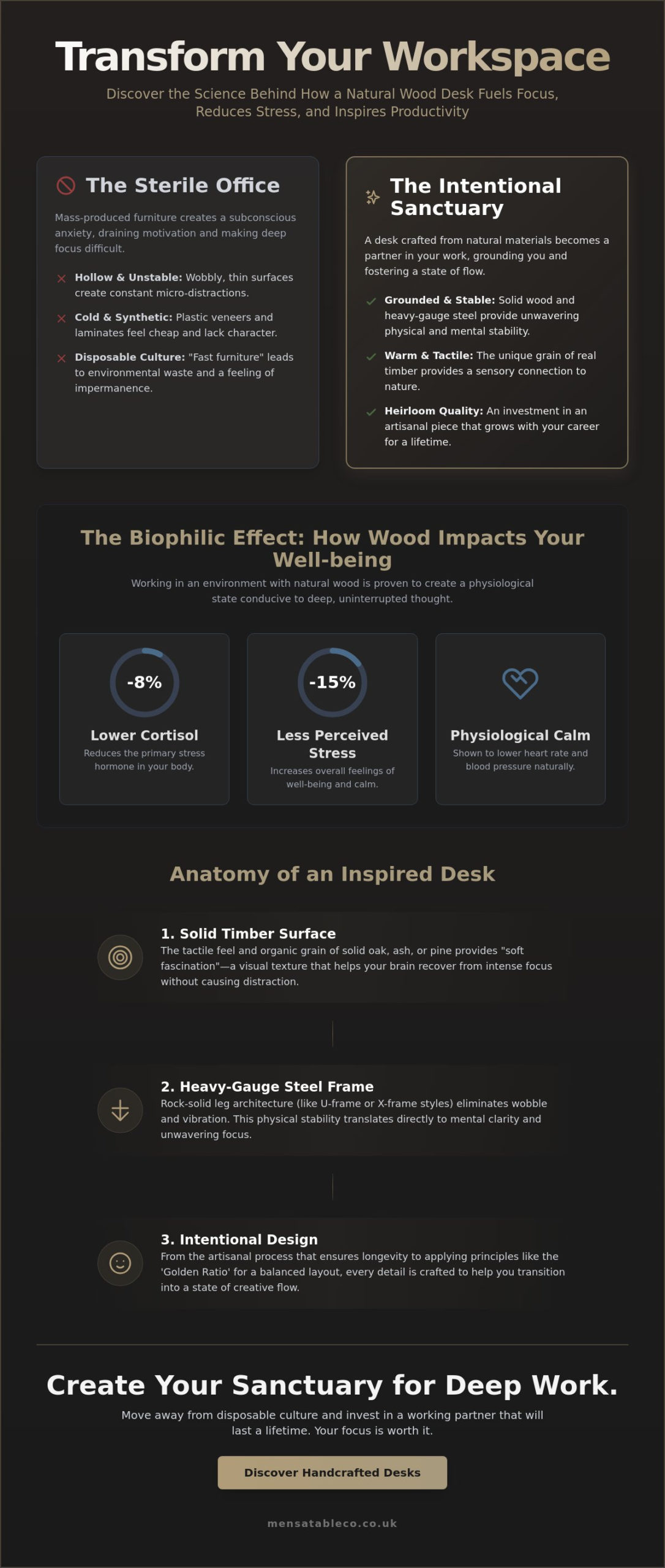
Did you know that working in an environment with natural wooden elements can lower your cortisol levels by 8% and reduce perceived stress by as much as 15%? Most of us have spent far too many hours hunched over a wobbly, thin laminate surface that feels more like a temporary pitstop than a place of purpose. You’ve likely felt that creeping mental fatigue that comes from a sterile, soul-less environment where the only character is the cold glow of a monitor. It’s an exhausting way to work, and it’s a feeling we understand deeply.
Finding a desk that inspires productivity isn’t about adding more gadgets or complex cable management trays. It’s about returning to the grounding, tactile reality of natural materials like solid ash or slow-grown Swedish pine. We believe that a workspace should be a sanctuary, crafted with the same intention and manual care you bring to your own best work. This guide will show you how choosing furniture built for longevity and human connection can sharpen your focus, reduce cognitive overload, and transform your daily performance from a transactional chore into a meaningful ritual.
Key Takeaways
- Understand how the sensory experience of real timber creates a natural calm that synthetic, mass-produced materials simply can’t replicate.
- Discover the essential features of a desk that inspires productivity and how intentional design helps you transition into a state of creative flow.
- Learn to select the right leg architecture for your workflow, whether you need the grounded stability of a U-frame or the airy openness of an X-frame.
- Apply the ‘Golden Ratio’ to your desktop layout to ensure you have the perfect balance of space for both digital tools and tactile deep work.
- Gain insight into the artisanal process that separates heirloom-quality furniture from disposable office gear, ensuring your investment lasts a lifetime.
Beyond the Screen: Why Your Workspace Needs a Desk That Inspires Productivity
We often think of our computers as the primary tools of our trade, yet the foundation beneath them dictates the quality of our focus. Choosing a desk that inspires productivity is about more than just finding a flat surface; it’s about creating a dedicated site for deep work. Many modern offices have become sterile environments filled with cold plastics and thin veneers that lack soul. These materials don’t just feel cheap; they drain our motivation by signaling that our workspace is temporary and disposable. When we treat our furniture as a mere transaction, we overlook the emotional weight of the place where we spend most of our waking lives.
Our philosophy at The Mensa Table Company is that a desk should be a working partner. It’s an anchor for your daily ambitions and a physical witness to your professional growth. Moving away from the “sterile office” means choosing materials that have lived a life before they reached your room. This transition from mass-produced gear to intentional, artisanal pieces changes the way you approach your morning ritual. It transforms the desk from a piece of equipment into a sanctuary for high-level thinking.
The Silent Impact of Surface Quality on Focus
Physical stability translates directly into mental clarity. When you rest your arms on a surface that doesn’t yield or vibrate, your brain stops processing the micro-distractions of a shaky environment. This stability aligns with the fundamental principles of ergonomics, where the physical setup must support the body’s natural state to prevent fatigue and strain. There’s a quiet sense of “desk pride” that comes from working on a substantial piece of furniture. It reinforces your professional identity. A wobbly or “thin” desk creates a subtle, subconscious anxiety, making it harder to commit to hours of intense concentration. Consider the difference in character between these two environments:
- The Disposable Workspace: Hollow-core tops, plastic edge banding, and lightweight legs that shimmy when you type.
- The Intentional Workspace: Hand-finished timber, heavy-gauge steel frames, and a surface that feels permanent and grounded.
Moving Away from the Disposable Office Culture
We’ve grown accustomed to a “fast furniture” culture where desks are replaced every few seasons. This cycle carries a heavy environmental and mental cost. Flat-pack items lack the unique grain and history found in solid European oak or slow-grown pine. When you work on a surface with visible growth rings and a tactile history, you feel connected to something larger than the task at hand. It’s a shift from a transactional purchase to an investment that lasts a lifetime. Our team believes that a desk that inspires productivity should be a companion that grows with your career rather than a commodity destined for a landfill. The psychological benefit of working on real timber is profound; it provides a sensory grounding that synthetic materials simply cannot replicate.
The Psychology of Natural Materials: How Solid Wood Fuels Creative Flow
Biophilic design is often reduced to a few potted plants on a shelf, yet its true power lies in the primary surfaces we touch. This isn’t merely a romantic notion; it’s grounded in how our biology responds to the natural world. Research suggests that workspaces incorporating wooden elements can lead to an 8% reduction in cortisol levels and a 15% increase in perceived well-being. When you sit at a desk that inspires productivity, you’re tapping into a deep-seated human need for connection with organic materials. The presence of wood in an indoor environment has been shown to lower heart rates and blood pressure, creating a physiological state conducive to deep, uninterrupted thought.
The visual landscape of your workspace matters just as much as the physical one. Unlike the repetitive, high-contrast patterns of synthetic veneers, the organic grain of solid European oak or walnut provides what psychologists call “soft fascination.” These natural patterns hold our attention without draining our cognitive energy, allowing the brain to recover from the intense focus required by digital screens. Scientific reviews on The Psychology of Natural Materials highlight how these biophilic elements reduce activity in the brain’s prefrontal cortex, effectively shielding us from the emotional and cognitive overload common in modern office life.
Biophilia and the Mental Clarity of Timber
Choosing a solid timber surface is a deliberate act of choosing mental clarity. In a 2025 study, participants working in wooden environments completed tasks up to 16 seconds faster and with greater accuracy than those in concrete or plastic spaces. This performance boost comes from the calming effect of the material. Whether it’s the honeyed warmth of ash or the deep, reliable weight of oak, the material itself acts as a buffer against the frantic pace of digital notifications. If you’re looking for a way to anchor your home office, you might reach out to our craftsmen to discuss which wood species best suits your creative temperament.
The Importance of Tactile Feedback in Deep Work
The “feel” of a desk is a silent communicator to your nervous system. Synthetic materials like metal or glass are often cold to the touch, which can cause a subtle, unconscious tensing of the muscles. Timber, however, is a natural insulator that feels warm and inviting. This tactile feedback serves as a sensory anchor. When your forearms rest on a hand-sanded surface, it signals to your brain that you’ve entered a zone of focus. This physical connection helps transition your mind from the distractions of the household into a state of creative flow. By investing in a desk that inspires productivity, you’re creating a ritualized space where the very texture of the wood invites you to do your best work.
Form Meets Function: Comparing Desk Styles for Different Workflows
Bespoke sizing is perhaps the most overlooked productivity hack in modern office design. Most mass-produced desks come in a handful of rigid sizes that rarely account for the specific constraints of a home office or the reach of your arms. By tailoring the dimensions of the timber top to your exact space, you eliminate the clutter of “dead zones” and ensure every inch of the surface serves a purpose. This intentionality creates a seamless transition between your physical environment and your creative output.
The Spider Leg and X-Frame: Stability for Heavy Thinkers
For those whose work involves intensive typing, detailed drawing, or the use of multiple heavy monitors, stability is the primary requirement. The Spider Leg design is a favorite for creative professionals who need a central anchor that won’t shimmy or vibrate. Its complex, interlocking geometry distributes weight evenly, providing a rock-solid foundation that feels immovable. Similarly, the X-Frame Dining Table, when used as a desk, brings a sense of rustic authority and permanence to a study. These designs are for “heavy thinkers” who want their furniture to feel like a permanent part of the room’s heritage rather than a temporary fixture.
Minimalist U-Frame and Trapezium Designs for Digital Nomads
Creating Your Productivity Haven: A Guide to Desk Selection and Setup
Designing a sanctuary for your work requires a shift in perspective from mere utility to spatial harmony. To create a desk that inspires productivity, you must consider the “Golden Ratio” of your desktop. This isn’t just about fitting a laptop; it’s about the range of motion your body requires for different types of thinking. We recommend a layout where your monitor occupies the central third, leaving the flanking sides open for tactile tools like a leather-bound journal or a sketchpad. When your elbows have room to breathe, your mind follows suit. Positioning your desk near a natural light source allows the sun to catch the unique character of the wood grain, providing a visual rhythm that keeps you alert without the harsh glare of overhead fluorescent bulbs.
Sizing Your Desk for Physical and Mental Space
Most mass-produced desks are surprisingly shallow, often measuring only 60cm in depth. This setup forces your monitor too close to your eyes and leaves zero room for your forearms to rest comfortably. For true deep work, a depth of 80cm or more is often necessary to maintain proper eye health and provide the physical support needed for long hours of concentration. Choosing a bespoke desk allows you to tailor these dimensions to your specific reach and the constraints of your room. It ensures that your furniture fits your body’s natural proportions rather than forcing you to adapt to a standard factory size. This intentional sizing eliminates the cluttered “dead zones” that often accumulate on surfaces that are either too small or awkwardly shaped.
Balancing Tech with Natural Elements
Integrating technology shouldn’t mean sacrificing the organic warmth of your workspace. We prefer managing cables through discreet, hand-carved channels or under-desk timber trays rather than relying on plastic-heavy “organisers” that disrupt the aesthetic. When selecting accessories, choose materials like brass, felt, or stone that complement the rich, dark tones of solid black walnut. These materials age beautifully alongside the wood, creating a cohesive look that feels timeless. It’s also vital to designate an “analog zone” on your surface. This is a dedicated space where no electronics are allowed, reserved exclusively for brainstorming and handwritten notes. This simple boundary helps your brain switch between the frantic pace of digital tasks and the slow, deliberate focus of creative problem-solving. If you’re ready to design a workspace tailored to your unique workflow, start a conversation with our workshop to explore the possibilities of a custom build.
Handcrafted for the Long Haul: The Mensa Table Company Philosophy
At the heart of our workshop is a belief that the things we surround ourselves with should possess a soul. When you sit down at a desk that inspires productivity, you aren’t just engaging with a piece of furniture; you’re connecting with the hands that shaped it. Most office gear today is the result of a faceless assembly line, where speed is prioritized over substance. We choose a different path. Our process is steady, calm, and deliberate, ensuring that every knot and grain pattern is given the respect it deserves. This manual approach creates a bond between the creator and the user, elevating the desk from a mere commodity to a meaningful life investment.
There’s a quiet confidence that comes from working on a surface built with such intention. Unlike wood-effect veneers that chip and peel at the first sign of wear, solid timber possesses an inherent resilience. Our desks are built to survive house moves, career changes, and the passage of time across multiple generations. They don’t just last; they evolve. Knowing exactly where your wood came from and the tight-knit team that brought it to life adds an emotional value that mass-produced items can’t replicate. It transforms your office into a space of authenticity and warmth.
From Raw Timber to Your Home Office
Our commitment to high-quality craftsmanship begins with the selection of the raw materials. We don’t deal in flimsy flat-pack solutions or furniture restoration. Instead, we focus on creating new, durable pieces that serve as the focal point of a home. The journey of a Mensa Table Company piece starts with ethical sourcing and ends with a hand-finished surface that feels personal and inviting. Every stage of the production is dictated by the time required for high-quality output. We take pride in the history of our components, ensuring that the finished product reflects the natural heritage of the timber itself.
Investing in a Legacy Piece for Your Career
It’s helpful to reframe the cost of a handcrafted desk as a “per-day” investment in your mental clarity. When you consider the thousands of hours you’ll spend at your workspace over the next decade, the value of a supportive, beautiful surface becomes clear. Over time, your desk will develop a unique patina. The subtle changes in the wood’s character become a tactile map of your professional journey. This is the true power of a desk that inspires productivity; it’s a surface that gains character as it ages. Your work is important. It deserves a foundation that reflects that value and provides a sanctuary for your best ideas to flourish.
Elevate Your Daily Work with Intentional Design
Your workspace is the silent partner in every creative breakthrough and professional milestone you achieve. By moving away from the sterile, disposable culture of mass-produced furniture and embracing the grounding presence of solid timber, you create a dedicated site for mental clarity. We’ve explored how the tactile warmth of real wood and the structural integrity of hand-forged frames work together to shield you from cognitive overload. Investing in a desk that inspires productivity isn’t just about aesthetics; it’s about honoring the importance of your daily labor with a surface that reflects its value.
Our tight-knit team in the UK takes immense pride in every piece we build, using only durable, solid timber like Solid European Oak, Ash, and Walnut. We don’t believe in the fragility of flat-pack gear. Instead, we focus on heirloom quality that grows with you through every career change and house move. If you’re ready to transform your home office into a sanctuary of focus, we invite you to explore our range of handcrafted desks and find your focus. Your best work is waiting for a surface that’s as committed to excellence as you are.
Frequently Asked Questions
What is the best desk material for productivity?
Solid timber is the superior choice because it offers biophilic benefits that synthetic materials cannot replicate. Materials like oak, ash, and walnut provide a tactile grounding that lowers stress levels and improves focus. This sensory connection helps create a desk that inspires productivity by reducing mental fatigue during long hours of deep work.
How do I choose a desk size that inspires focus without cluttering my room?
You should measure your available space and account for the Golden Ratio of your workflow, which usually requires a depth of at least 80cm for modern monitor setups. A bespoke desk allows you to maximize your floor plan while ensuring you have enough elbow room for both digital and analog tasks. This custom approach prevents the clutter of dead zones found in standard factory sizes.
Are handcrafted desks better for ergonomics than standing desks?
Handcrafted desks focus on mental ergonomics and structural stability, which are just as vital as the height adjustability of a standing desk. While standing desks address physical movement, a solid timber desk provides a vibration-free surface that reduces micro-distractions. The warmth of the wood also prevents the muscle tension often caused by resting your arms on cold metal or glass.
What is the difference between solid wood and wood veneer for a home office?
Solid wood is a permanent, living material that gains character over time, whereas wood veneer is a thin layer prone to peeling and chipping. Veneers are often applied to hollow-core boards that lack the weight and density needed for a stable workspace. Choosing solid timber ensures your investment survives house moves and career changes without losing its structural integrity or soul.
How does desk leg design affect my work experience?
Leg architecture dictates the stability and weight of your room, with designs like the Spider Leg or X-Frame providing maximum vibration resistance for intensive typing. A U-Frame or Trapezium design offers a cleaner, more minimalist silhouette for smaller spaces. These structural choices affect how grounded you feel, ensuring the desk remains a steady partner in your creative process.
Can a desk really improve my mental health and work performance?
Working on a natural wood surface can lower cortisol readings by 8% and reduce perceived stress by 15%. These physiological changes lead to better accuracy and faster task completion. By surrounding yourself with organic materials, you create a sanctuary that protects your mental clarity from the sterile, draining effects of a typical tech-heavy office.
How do I care for a solid wood desk used for daily work?
Caring for a solid wood desk involves little more than regular dusting and the occasional application of natural oils to maintain the timber’s luster. You should avoid harsh chemical cleaners that can strip the finish or damage the grain. Because these pieces are built from high-quality European oak and walnut, they’re designed to handle the rigors of daily professional use with minimal maintenance.
Why should I choose a bespoke desk over a standard high-street model?
A bespoke desk offers a level of intentionality and personal connection that standard high-street models simply can’t provide. You gain a piece tailored to your specific body proportions and room constraints, built by craftsmen who value quality over assembly-line speed. It’s a shift from buying a disposable commodity to investing in a legacy item that reflects the importance of your work.

Leave a Reply