

Feeling secure in a high-value purchase starts with two practical checks: understand how your payment method may protect you, and assess whether the online shop and its reviews appear genuine. According to the UK legislation register, the Consumer Credit Act provides a source of protection for many online purchases made by credit card. Debit cards offer less protection, although a refund claim may be possible through the voluntary chargeback scheme.
This guide covers both, from payment choices and checkout precautions to practical ways to assess a furniture shop and its customer feedback. These checks can help you make a considered decision without relying on polished photos or persuasive wording alone.
Key Takeaways
- Compare payment methods before checkout and avoid paying for an online purchase by direct bank transfer.
- Look for consistent shop details and reviews that describe specific, believable customer experiences.
- Keep a clear record of the furniture ordered, agreed terms, payment and delivery details.
- Read the returns policy, warranty wording and after-sales information so you understand what each covers.
- Use these checks to approach a substantial furniture purchase with greater confidence and clarity.
1. Using credit cards and checking payment protections
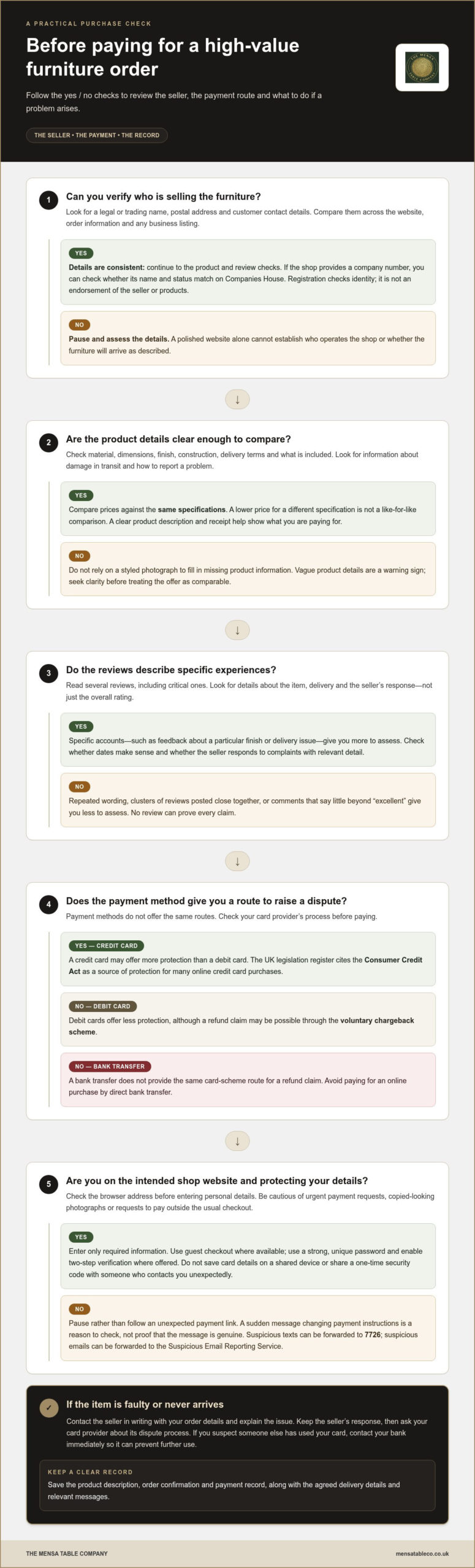
A credit card may offer more protection than a debit card for an online furniture purchase. The UK legislation register cites the Consumer Credit Act as a source of protection for many online credit card purchases. Debit cards offer less protection, though a refund claim may be possible through the voluntary chargeback scheme. Check your card provider’s process before paying, and keep your order confirmation and payment record.
Choose a payment method that gives you a route to raise a dispute. A bank transfer does not provide the same card-scheme route for a refund claim. If an item is faulty or never arrives, contact the seller in writing with your order details and explain the issue. Keep the response, then ask your card provider about its dispute process. If you suspect someone else has used your card, contact your bank immediately so it can prevent further use.
Compare prices by matching the specifications, not just the headline figure. Check the material, dimensions, finish, construction, delivery terms and what is included. A lower price for a different specification is not a like-for-like comparison. A clear product description and receipt help you understand what you are paying for.
Protect your payment details at checkout. Enter only required information, use guest checkout where available and confirm that you are on the correct shop website before submitting your details. Use a strong, unique password for important accounts and enable two-step verification where offered. Don’t save card details on a shared device or share a one-time security code with someone who contacts you unexpectedly.
- On moving day: Keep the removal van in sight and avoid leaving furniture or boxes on the street. Check doors and windows before leaving the old home.
- Against burglary: Store valuables out of view, lock doors even while at home, and use suitable security measures. Motion sensors can alert you to unexpected movement.
- Against fire and water: Keep furniture away from obvious water sources and heat, and follow care instructions for the materials. Consider how your home insurance treats damage to valuable belongings.
Payment protection can offer a route to seek recourse, while good account security helps reduce the risk of your details being misused. Set a furniture budget that includes delivery and any protection you choose, so you can make practical security choices without stretching your budget. Store receipts and order emails in an account protected by a unique password, making them easier to find if a delivery or payment problem arises.
2. Checking online shops and reviews for legitimacy
Warning signs include pressure to pay immediately, vague product details, photographs that appear copied and requests to pay outside the shop’s usual checkout. Treat a sudden message changing payment instructions as a reason to pause, not as proof that the message is genuine. A polished website alone cannot establish who operates the shop or whether the furniture will arrive as described.
Start by checking the shop’s identity. Find its legal or trading name, postal address and customer contact details, then compare them across the website, order information and any business listing. If the shop provides a company number, search it on Companies House and check that the name and status match. Registration is an identity check, not an endorsement of the seller or its products.
Read the product page as carefully as you would inspect a piece in person. Check the material, dimensions, finish, construction, delivery terms and what’s included. Look for clear information about damage in transit and how to report a problem. Whether examining a dining table or exploring living room pieces from retailers like RitzHouzz, a transparent description should clearly explain construction and everyday durability rather than relying on a styled photograph alone.
Patterns across reviews are more useful than a single glowing comment. Read several, including critical ones, and look for details about the item, delivery and the seller’s response. Repeated wording, clusters of reviews posted close together or feedback that says little beyond “excellent” gives you less to assess. A detailed account of a particular finish or delivery issue is more informative, though no review can prove every claim.
Check that review dates make sense alongside the shop’s product range and responses. Notice whether the seller addresses specific complaints properly, explains what action followed and avoids sharing private customer details. Reviews on the shop’s own site can provide context, but compare them with feedback on independent platforms when available. Consider the amount and quality of detail, not simply the overall rating.
Before entering personal details, inspect the browser address and make sure you’re on the intended shop domain. Don’t follow payment links from unexpected emails or texts. Suspicious texts can be forwarded to 7726, and suspicious emails can be forwarded to the Suspicious Email Reporting Service. These steps help protect your account, but don’t replace checking the seller and the order terms.
Furniture insurance is a separate factor from seller legitimacy. Check your policy’s contents cover and how it treats accidental damage, rather than assuming a new purchase or jewellery is covered in the same way. For greater peace of mind, save the product description, order confirmation and relevant review details together. If a furniture detail needs clarification before you decide, send a question about your purchase.
3. What UK consumer rights apply to high-value purchases?
A high price alone does not tell you which protections apply. Separate the furniture purchase from the payment method: product concerns relate to the item and agreement, while card protections relate to the payment. The UK legislation register cites the Consumer Credit Act as a source of protection for many online purchases made by credit card. Keep that distinction in mind when deciding whom to contact.
Start by saving the evidence: the product description, order confirmation, receipt, delivery information and any messages about materials, dimensions or finish. If a dining table arrives with a different finish from the one described, these records help you explain the mismatch precisely. Photograph the item and its packaging before moving or assembling it, especially if you notice damage on delivery.
Next, report the specific problem to the seller in writing. Include the order reference, the date you received the item, a concise description and relevant photographs. State what resolution you are seeking, such as an explanation, repair or replacement, without assuming that every remedy suits every situation. Keep a copy of your message and note when the seller replies. A clear chronology can prevent disagreement about what was said.
Check what the seller promised before purchase. Compare the listing with the furniture received, including the named material, dimensions, finish and stated delivery arrangements. Natural variation in wood grain may look different from a missing component or a material that conflicts with the description. Explain the difference using the seller’s wording, not just impressions such as “not as expected”.
- Keep the record: Store receipts and emails together, and retain screenshots of product details that could change after the sale.
- Be specific: Identify the part, finish or delivery issue, and attach photographs that show the concern clearly.
- Escalate methodically: Keep the seller’s response and payment records. If the payment was by card, ask your provider about its dispute process.
For a custom or made-to-order piece, read the written agreement closely before paying. Check that it records the agreed materials, dimensions, finish and delivery terms. If any detail differs from your understanding, ask for the wording to be corrected before placing the order. This gives both sides a shared reference if questions arise later.
Don’t treat a shop’s returns policy as a complete statement of your legal rights. It describes the seller’s process, while your position can depend on the circumstances of the purchase and the issue. Read the policy alongside the order terms, and keep both. If a seller rejects a complaint, ask for the reason and relevant term in writing. Clear records help you assess the next step without confusing a payment dispute with a product complaint.
4. What should a high-value purchase contract or receipt include?
A useful contract or receipt clearly records what you agreed to buy. Check that it identifies the seller and buyer, gives the order date and reference, and describes the furniture precisely. For a table, that means recording its material, dimensions, finish, quantity and any agreed design details. “Wooden table” leaves more room for misunderstanding than a specific description.
Before paying, compare the written specification with the product page and your messages. If you agreed a different finish by email, save that exchange with the order confirmation. For made-to-order furniture, ask for the agreed measurements and material to appear in the order record. This gives both sides a shared reference if the delivered piece differs from the agreement.
Check that the financial record separates the furniture price from delivery and other charges. It should show the total payable in pounds, the payment method and whether payment is complete or outstanding. Keep the payment confirmation as well as the receipt: the receipt records the sale, while the payment record shows how the money was sent.
- Seller and buyer: Names and the contact or billing details used for the order.
- Furniture description: Material, dimensions, finish, quantity and agreed options.
- Payment record: Itemised charges, total in GBP, payment method and payment status.
- Delivery terms: Delivery address, stated timing and any agreed access arrangements.
- Relevant terms: References to returns, warranty wording and how to report an issue.
Delivery information should match the arrangement you accepted. Check the address, delivery details and any timing stated in the order. If an estimate changes, keep the updated message alongside the original record. For a large piece going into a particular room, make sure any agreed access or placement details are written down rather than relying on a conversation that may later be remembered differently.
Read any terms linked from the receipt or contract before completing the order. Note where the seller explains returns, manufacturer’s guarantee coverage and the process for reporting damage. A receipt may link to separate terms instead of repeating them, so save a copy or screenshot of the version shown at purchase. Don’t assume that a general statement such as “covered” explains which situations or components are included.
Finally, check the document for contradictions before accepting it. Compare the finish and dimensions with your saved specification, then confirm the total and delivery address. If a detail is wrong, request a corrected record before the order proceeds. Store the final receipt, product description, payment confirmation and seller correspondence together so the complete purchase trail is easy to retrieve.
5. How can you check warranties, returns policies and after-sales support?
Read the warranty before ordering, not after a fault appears. Check who provides it, which parts it covers, and how long the stated cover lasts. Look for exclusions involving finishes, everyday wear, accidental damage or changes made after delivery. For example, a promise covering the frame may not cover a surface mark. Keep the exact warranty wording with your order record.
Separate the warranty from the returns policy. A warranty explains the stated cover for particular faults or components. A returns policy describes the seller’s process for requests to return an item. Check how to start a claim, what evidence to provide, and whether collection or return arrangements are explained. Note any conditions about packaging, assembly or the item’s condition.
For made-to-order furniture, read the policy alongside the agreed specification. Check how it treats a piece made to your measurements or finish, and what happens if the delivered item differs from the order. Don’t assume a general returns statement answers every situation. Save the version displayed when you buy, since website wording may later change.
- Coverage: Identify the parts, faults and situations included or excluded.
- Duration: Note the start point and stated length of any warranty.
- Claims: Find the correct contact route and the information the seller asks you to provide.
- Resolution: Check what the policy describes, such as inspection, repair, replacement or another outcome.
- Returns: Read the process, condition requirements and any stated return arrangements.
After-sales support is easier to assess when the process is clear. Look for a named contact method, instructions for reporting a fault and an explanation of what happens next. Check whether you need to provide an order reference, photographs or a description of the issue. A useful support response should address your actual question, rather than send only a generic policy statement.
Before completing an order, write down any unresolved detail. Ask how to report a fault, whether the warranty covers the component you’re concerned about, and which policy applies to your purchase. Keep the reply with the product description, receipt and delivery messages. If you’re considering furniture from The Mensa Table Company, contact the team with a question about your purchase. Clear written terms make it easier to understand the support process if you need it later.
The Mensa Table Company: The Mensa Dining Table
The Mensa Table Company makes dining tables for people choosing a lasting focal point for everyday meals and shared occasions. Its range includes The Mensa Dining Table, The Spider Leg Dining Table, The X-Frame Dining Table and The U-Frame Dining Table, with distinct designs to consider alongside your room and how you use it.
Once you’ve reviewed payment protections, shop details and purchase terms, compare the table specifications with your needs. Consider the available space, the shape that suits your room and the details you want recorded clearly before ordering. This practical comparison can make choosing a dining table feel more considered.
Explore The Mensa Dining Table and the other table options at mensatableco.co.uk, or contact The Mensa Table Company to discuss your choice.
Make your next choice with confidence
Feeling secure in a high-value purchase comes from having enough clarity to choose at your own pace. Before deciding, picture how the table will serve your home: everyday meals, long conversations and gatherings with family and friends. Then choose a design that suits your room and the people who will share it.
The Mensa Table Company offers The Mensa Dining Table, The Spider Leg Dining Table and The X-Frame Dining Table. Take time to consider which design suits your space and the atmosphere you want to create. A well-chosen table can become part of the rhythm of home life, not simply another purchase.
If you’re ready to discuss your choice or have a question before taking the next step, contact The Mensa Table Company. Move forward with care, and look forward to the moments your new table may bring together.
Frequently Asked Questions
What makes a high-value purchase feel secure?
Feeling secure in a high-value purchase means knowing what you’re agreeing to and having a sensible plan if something goes wrong. Before committing, make sure the item suits its intended use, the written order reflects your choices and you know how to raise a concern. If a table will host family meals, for example, consider its size and care needs alongside its appearance. Confidence comes from matching expectations with clear records.
How can you verify a seller and product before making an expensive purchase?
Compare the seller’s identity, product description and order paperwork for consistency, then consider whether product-specific feedback supports the claims. Check that the material and finish named in a review match the item you’re considering, rather than relying on general praise. The Mensa Table Company allows logged-in customers who purchased a product to leave a review. Keep the product details you relied on with your order confirmation.
What payment methods offer the most protection for large purchases in the UK?
Credit cards may offer stronger protection than debit cards for many online purchases, and the UK legislation register cites the Consumer Credit Act as a source of protection. Debit card refunds may be possible through the voluntary chargeback scheme. Protections depend on the transaction and provider’s process, so keep your order and payment records. The Mensa Table Company accepts Apple Pay and Google Pay, but don’t assume these change the protections attached to the underlying card.
Should you buy insurance for an expensive purchase, and what does it cover?
Before buying separate insurance, consider whether your home contents policy covers the item’s full value and the risks that concern you. Policies differ in how they treat accidental damage, theft and damage during delivery, so read the wording and exclusions. Check whether a single-item limit applies or the furniture must be listed separately. For a solid-wood table, also distinguish sudden damage from gradual wear, which insurers may treat differently.

Leave a Reply